AI and Global Governance
 Michael Willson
What Is AI Global Governance?
AI global governance is the system of rules, standards, and collaborations that countries and organizations are creating to manage artificial intelligence across borders. The goal is simple: keep AI safe, fair, and useful for everyone while reducing risks that no single country can handle alone. Whether it is misinformation, autonomous weapons, or economic disruption, these issues do not stop at national borders. That is why international cooperation on AI is becoming urgent today.
Right after understanding the concept, many professionals look for the right way to prepare themselves for this new landscape. One practical step is pursuing an AI certification, which helps learners build expertise and credibility in a world where global governance and technical knowledge are increasingly connected.

AI and Global Governance
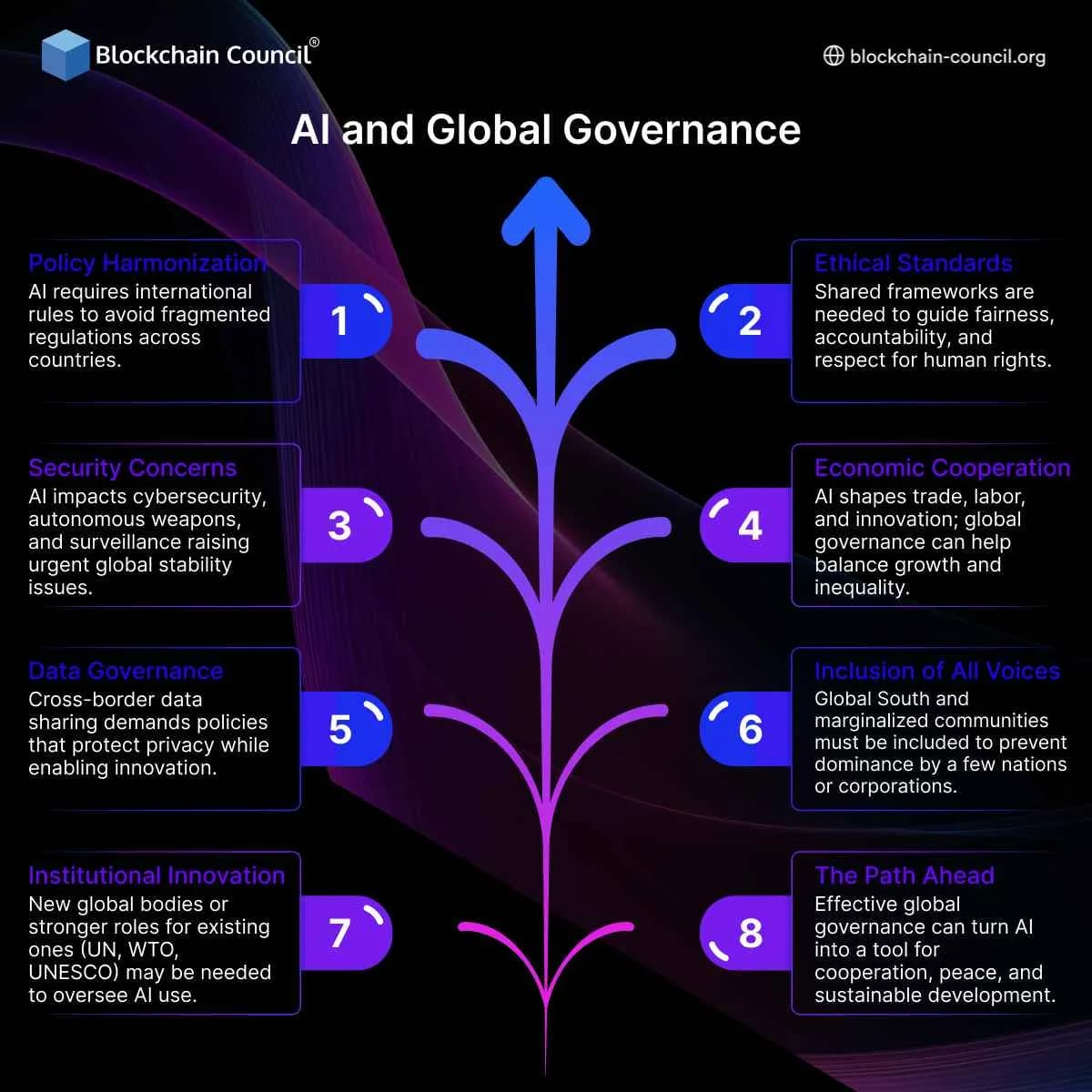
- Policy Harmonization
AI requires international rules to avoid fragmented regulations across countries. - Ethical Standards
Shared frameworks are needed to guide fairness, accountability, and respect for human rights. - Security Concerns
AI impacts cybersecurity, autonomous weapons, and surveillance — raising urgent global stability issues. - Economic Cooperation
AI shapes trade, labor, and innovation; global governance can help balance growth and inequality. - Data Governance
Cross-border data sharing demands policies that protect privacy while enabling innovation. - Inclusion of All Voices
Global South and marginalized communities must be included to prevent dominance by a few nations or corporations. - Institutional Innovation
New global bodies or stronger roles for existing ones (UN, WTO, UNESCO) may be needed to oversee AI use. - The Path Ahead
Effective global governance can turn AI into a tool for cooperation, peace, and sustainable development.
Why Do We Need AI Governance at a Global Level?
The first and most direct reason is risk. AI has the power to influence politics, finance, health, and even conflict. Without shared guardrails, systems developed in one country can quickly affect the rest of the world. A malicious model trained to generate disinformation, for example, can destabilize elections in many nations at once.
Another reason is fairness. Wealthy countries and tech giants often have more resources to train massive models. Without international oversight, this can widen inequality and limit access to AI benefits for low and middle-income countries. Global governance helps ensure that everyone has a voice and that opportunities are shared more equally.
Finally, there is the matter of trust. People will not use AI fully if they cannot trust how it is built and managed. Clear global standards make AI more reliable, encouraging adoption across industries.
Recent Developments at the United Nations
The United Nations has taken the lead in AI governance over the past year. In September 2025, it launched the Global Dialogue on AI Governance in New York. This initiative is designed as a meeting place where governments, civil society, and the private sector can work together on safe and trustworthy AI. Discussions focus on ethics, interoperability, human rights, and capacity building.
At the same time, the UN created an Independent International Scientific Panel on AI, made up of about 40 experts. Their role is to provide evidence-based advice to policymakers so decisions are not only political but also grounded in technical knowledge. This helps bridge the gap between science and policy, which has been a major problem in past governance efforts.
The Paris AI Action Summit 2025
One of the most visible global events was the Paris AI Action Summit in February 2025. It brought together around 60 countries and produced a declaration supporting “Inclusive and Sustainable Artificial intelligence for People and the Planet.” The focus was on fairness, transparency, and sustainability.
However, it also revealed divisions. Both the United States and the United Kingdom declined to sign the declaration. This showed the difficulty of achieving global consensus, especially when different countries have conflicting priorities about security, innovation, and sovereignty.
Measuring Governance: The AGILE Index
In 2025, researchers introduced the AGILE Index to evaluate how prepared countries are for AI governance. It looks at 40 countries and scores them across four pillars, 17 dimensions, and 43 indicators. This kind of measurement helps identify which nations are leading, which are lagging, and what gaps need to be filled.
Indices like AGILE also allow governments to track progress over time and compare themselves to peers. They create accountability and highlight where international support is most needed.
Frameworks for Global AI Governance
Scholars have recently proposed a Five-Layer Governance Framework. This model integrates regulation, standards, assessment, certification, and implementation. The idea is to make sure that high-level rules do not just stay on paper but are translated into practice at every level.
This kind of layered system could be what global governance needs: flexible enough to adapt to fast-moving AI but structured enough to ensure consistent accountability.
National and Regional Initiatives
Even as global forums move forward, individual countries are pushing their own strategies.
- In mid-2025, China’s Premier Li Qiang proposed a global AI cooperation organization, aiming to centralize efforts under one umbrella.
- At the BRICS Summit 2025, member countries adopted a declaration calling for the UN to take the lead in governance.
- Germany is developing its own sovereign version of AI systems to preserve data sovereignty, showing a preference for regional control rather than global dependence.
These moves highlight both the progress and the challenges. While many nations agree that cooperation is necessary, they also want to maintain their own independence and security. This tension between sovereignty and global standards is at the heart of today’s governance debate.
Key Risks Driving the Push for Governance
In January 2025, the First Independent International AI Safety Report identified a range of potential dangers: misuse of personal data, autonomous weapons, bioweapon development, disinformation campaigns, and large-scale system failures. These are the types of threats that no country can tackle alone.
Beyond official reports, more than 200 scientists have signed open letters urging binding international rules. They stress “red lines” around issues like self-replicating AI and military uses that could destabilize peace. Even the UN Security Council has debated AI’s role in conflict escalation and global security.
These warnings are pushing global leaders to act faster and more decisively. Policymakers are beginning to value the insights gained from a Prompt Engineering Course as they shape AI governance frameworks.
Challenges in Building a Global System
The challenges are many. First, there is fragmentation: different countries have different values and approaches. Second, there is weak coordination across disciplines. AI governance touches on law, ethics, cybersecurity, economics, and human rights all at once, making cooperation complex.
Another challenge is the gap between policy and implementation. Declarations and frameworks often sound good on paper but fail in practice without proper enforcement and resources. Bridging this gap requires more practical mechanisms like audits, certifications, and technical standards.
This is where professionals trained in agentic AI certification can play a role. They learn to design, audit, and deploy AI in a way that aligns with evolving governance needs, bridging the space between theory and practice.
Innovation vs. Safety
Another major theme is balance. On one side, governments want to encourage innovation and economic growth. On the other, they must reduce risks and protect citizens. Too much regulation could slow down progress. Too little could lead to harm.
Countries and organizations are trying to find a middle path. Some propose flexible treaties, while others suggest global agencies that can update rules as AI evolves. Industry leaders often argue for tech certifications to ensure professionals follow responsible standards while still innovating.
How Does Inequality Affect Global AI Governance?
One of the biggest challenges in creating global rules for AI is inequality. Not all countries have the same resources or technical skills. While some nations can build large models and enforce detailed safety rules, others are still working to set up basic digital systems.
This imbalance creates a risk: if only wealthy countries design the rules, the rest of the world may have to follow standards that do not reflect their needs. For example, rules focused only on advanced robotics or self-driving cars may not help a country where AI is used more for agriculture or healthcare.
To close this gap, capacity-building is a key part of UN discussions. Support programs, training, and accessible education are being encouraged. For individuals, one way to stay ahead is by pursuing a Data Science Certification, which helps build the skills needed to take part in both national and global AI projects.
What Role Do Scientific Panels Play in Governance?
Another issue is how to keep AI rules informed by evidence rather than just politics. This is where scientific panels come in. The UN’s new Independent International Scientific Panel on AI is meant to provide unbiased, expert advice. With about 40 specialists from different fields, it brings technical understanding into governance debates.
Such panels ensure that rules are realistic. If policymakers propose something too broad or too narrow, the panel can highlight risks and suggest practical changes. This connection between science and policy is essential, as AI systems evolve much faster than traditional regulation.
How Can Future Scenarios Shape Global Governance?
Looking ahead, there are several possible paths for AI governance. Some experts suggest a global AI agency, similar to how the International Atomic Energy Agency monitors nuclear issues. This would give the world a central body with authority to set standards and respond to risks.
Others prefer a layered approach, where regional and national rules are linked but not controlled by one global authority. This could reduce concerns about sovereignty but still encourage shared practices.
Flexible treaties are another idea. Instead of one fixed agreement, treaties could be updated regularly as new AI risks appear. This would allow governance to keep pace with innovation.
For professionals interested in shaping these futures, business-focused programs like the Marketing and Business Certification offer insights into how AI governance connects with industry growth and global markets.
How Do We Measure Progress in Governance?
It is one thing to make declarations, but another to track if they work. This is why tools like the AGILE Index are so important. By evaluating countries across multiple pillars, it shows who is improving and who is falling behind.
Indices also create pressure. Governments do not like to rank poorly compared to others. Public scoring can encourage more investment in AI safety, fairness, and inclusion.
Beyond global indices, certifications and training are another way to measure progress at the individual level. When more people earn AI certs, it signals that the workforce is adapting to global standards.
What Are the Technical Levers of Governance?
Technical Levers of Governance
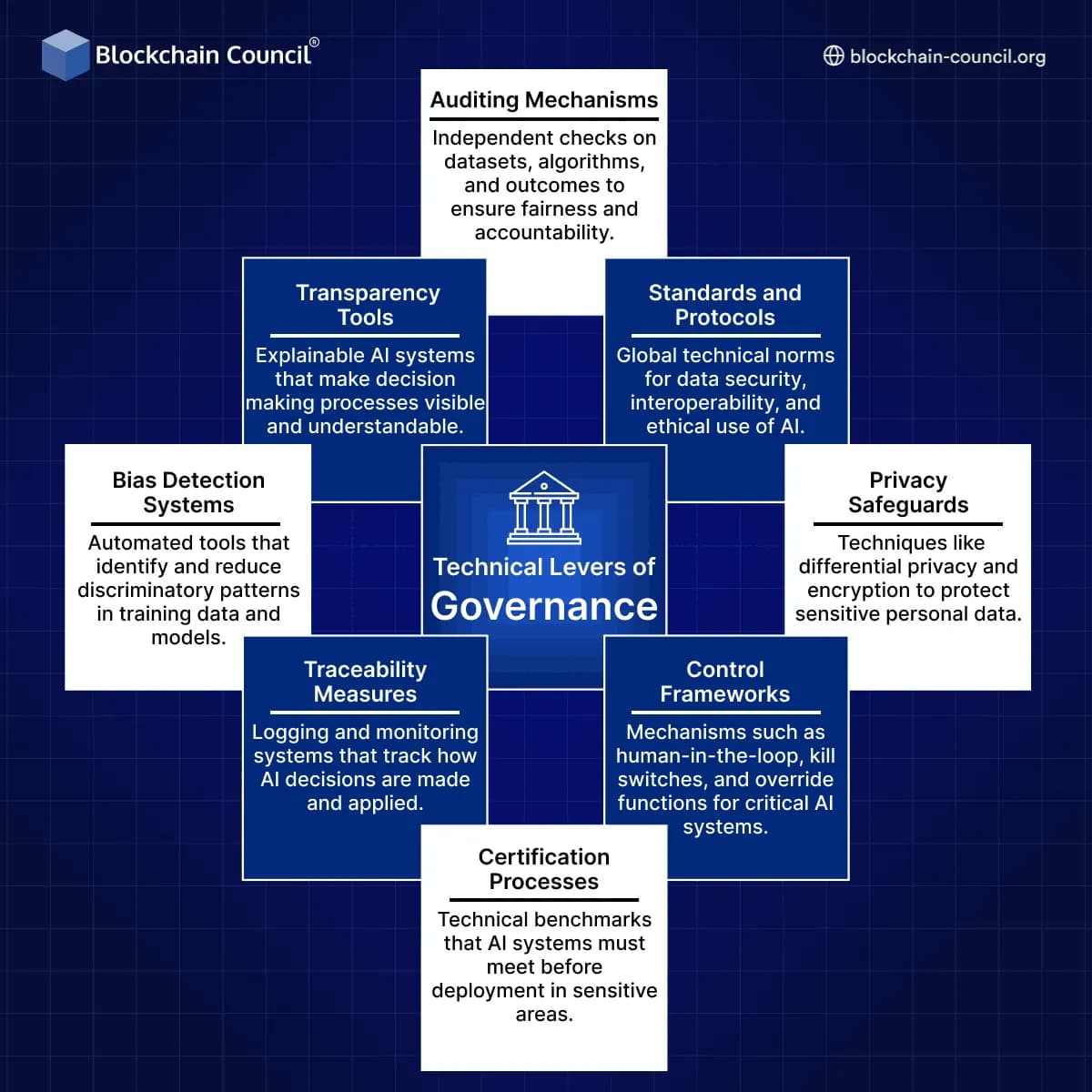
- Auditing Mechanisms
Independent checks on datasets, algorithms, and outcomes to ensure fairness and accountability. - Transparency Tools
Explainable AI systems that make decision-making processes visible and understandable. - Standards and Protocols
Global technical norms for data security, interoperability, and ethical use of AI. - Bias Detection Systems
Automated tools that identify and reduce discriminatory patterns in training data and models. - Privacy Safeguards
Techniques like differential privacy and encryption to protect sensitive personal data. - Traceability Measures
Logging and monitoring systems that track how AI decisions are made and applied. - Control Frameworks
Mechanisms such as human-in-the-loop, kill switches, and override functions for critical AI systems. - Certification Processes
Technical benchmarks that AI systems must meet before deployment in sensitive areas.
AI governance is not just about ethics or politics. It also requires concrete technical tools. Some of the most important levers include:
- Standards: agreed rules for data privacy, security, and interoperability.
- Audits: checks on how models are trained, tested, and used.
- Certification: formal approval processes to ensure compliance with safety rules.
- Incident reporting: systems for documenting and sharing AI failures or abuses.
These technical levers make governance more than words. They give it teeth. Professionals who understand these processes are more valuable in global discussions. Many gain this expertise through targeted programs in technology and advanced governance studies.
Can Blockchain Help in AI Governance?
Interestingly, blockchain is being explored as a support tool for AI governance. Because blockchain systems are transparent and tamper-proof, they can be used to track data use, model changes, or compliance audits.
For example, a global registry of AI models built on blockchain could make it easier to see how models are trained and deployed. This would increase transparency and reduce the risk of hidden manipulations.
If you want to build expertise in this area, blockchain technology courses offer the foundations needed to connect blockchain with AI governance.
Why Is Balance Between Innovation and Control So Difficult?
One of the hardest questions in governance is how to encourage innovation while keeping risks low. If rules are too strict, start-ups and smaller players might be locked out of the market. If rules are too loose, powerful companies might create systems that cause harm.
Global governance discussions often come back to this trade-off. The answer may lie in adaptive systems that change over time, rather than one set of fixed rules. For now, countries are experimenting with their own methods, while forums like the UN try to bring them together.
What Are the Objections to Global AI Governance?
Not everyone agrees that global governance is the best path forward. Some countries argue that it risks reducing national sovereignty. They fear that a central body could impose standards that do not fit local laws or cultures. For example, a privacy standard designed in Europe might not work in regions with different data practices.
Another objection is enforcement. Even if nations agree on rules, who ensures they are followed? Unlike trade or nuclear agreements, AI is hard to monitor because models can be trained privately and deployed across borders instantly. Without strong verification systems, governance can become symbolic rather than practical.
Finally, there are concerns about power. If governance is dominated by wealthy nations or big tech firms, smaller players may be sidelined. This could widen global inequalities rather than close them.
How Can Transparency and Accountability Be Ensured?
For AI governance to work, transparency must be a core principle. This means open reporting about how models are trained, what data they use, and how they perform in real-world settings.
Accountability also matters. If an AI system causes harm, there should be clear rules on who is responsible — whether it is the developer, the company deploying it, or both. Shared accountability frameworks are being discussed at the UN and other forums, but they are still in early stages.
Practical steps like open audits, shared testing standards, and public registries of AI systems are being explored. These measures would make it harder for companies or governments to hide irresponsible practices.
Why Do Cultural and Regional Perspectives Matter?
Global governance cannot be one-size-fits-all. Culture shapes how people view risk, privacy, and fairness. In some regions, people value collective security more than individual privacy. In others, freedom of expression is the top priority.
This diversity means governance frameworks must allow flexibility. Regional or national variations can exist within a broader global system. The key is making sure these variations do not lead to conflicts or gaps in safety.
For professionals, understanding cultural differences is part of building global readiness. That is why training programs across multiple fields — from business to technology — emphasize context-specific governance approaches.
What Is the Future Outlook for Global Cooperation?
The future of AI governance may involve hybrid systems. One possibility is a global coordinating body that sets broad principles, while regions adapt them into their own legal systems. This would mirror how climate agreements work: shared goals, but national flexibility in execution.
Another future scenario is dynamic treaties that evolve over time. As AI risks change, the treaties can be updated, ensuring that governance stays relevant. This would be very different from older forms of global agreements that stay fixed for decades.
The most ambitious outlook is a global AI agency, with authority similar to the International Atomic Energy Agency. It could monitor risks, enforce standards, and coordinate emergency responses if AI is misused. Whether countries would agree to such a powerful body, however, remains uncertain.
How Can Individuals Prepare for This Future?
While governments debate, individuals can take steps to prepare themselves for a more regulated AI world. Professionals in every field — from policy to engineering — will need to understand governance principles.
Learning through AI certs is one way to stay ahead. Certifications signal expertise and readiness to work in global environments where rules and standards are becoming part of daily practice. They also help bridge the gap between technical work and the larger governance frameworks shaping the future.
Conclusion: Why AI Governance Matters for Everyone
Global AI governance is no longer a distant idea. It is happening right now, with the UN launching dialogues, summits drafting declarations, and nations creating their own strategies. The urgency comes from shared risks: disinformation, misuse, inequality, and potential threats to peace.
At the same time, challenges remain. Enforcement is weak, cultural differences are wide, and the balance between innovation and safety is delicate. The future will likely require flexible systems that evolve as AI grows.
The rise of global governance marks a turning point: AI is no longer just a tool of innovation but a shared responsibility. The decisions made today will shape whether AI becomes a source of security and opportunity, or of conflict and division.