
How Does Agentic AI Enhance Python Development?

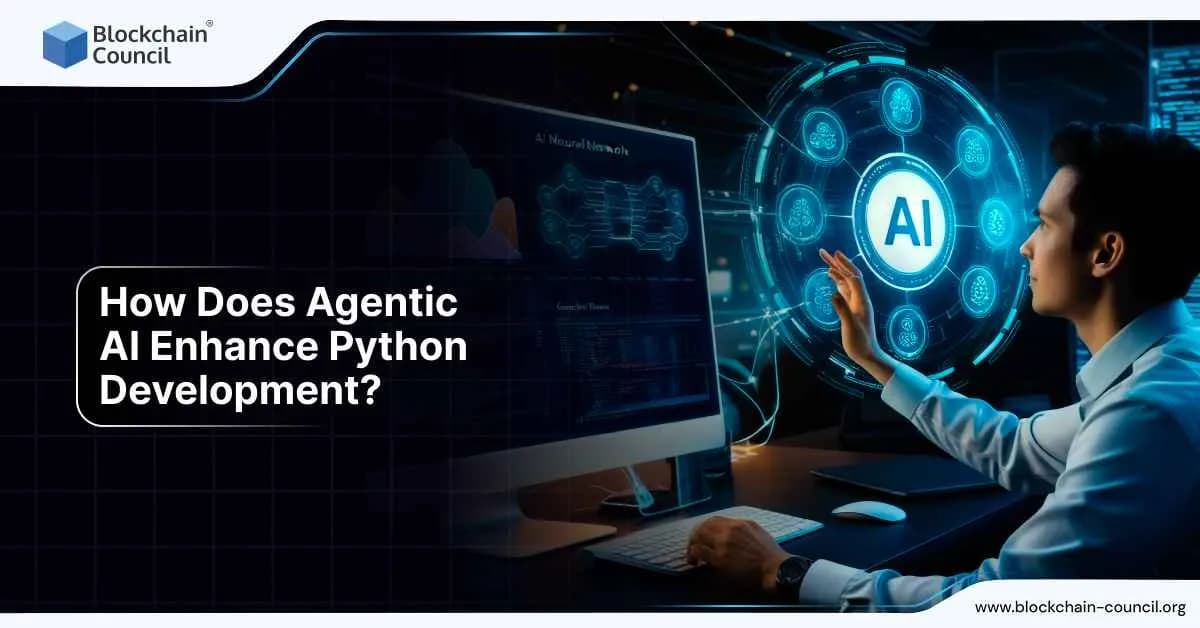
Python developers are finding that agentic AI is more than just a productivity boost—it’s changing the way code is written, tested, and deployed. By turning prompts into structured plans, connecting repositories as active agents, and automating tasks across the pipeline, agentic AI makes Python workflows faster, safer, and easier to scale. For professionals who want to stay ahead of these shifts, an AI certification provides a practical entry point into understanding and applying these new methods.
Smarter Frameworks for Agents
Several Python libraries have emerged to support agentic AI development. LangChain, AutoGen, CrewAI, and LangGraph give developers tools to handle memory, state, API integration, and multi-step workflows. Newer options such as Dialz offer lighter frameworks that make it simpler to embed agents in diverse environments. For those aiming to explore applied AI more broadly, structured AI certs guide learners through real-world implementations across industries.

Automating the Development Pipeline
Agentic AI doesn’t stop at code generation. AWS and Google Cloud have introduced agents that write, test, deploy, and monitor applications directly from Python. This means less manual intervention and fewer errors creeping into production. Developers interested in working directly with autonomy at this level can build deeper knowledge through the agentic AI certification, which focuses on secure and efficient autonomous workflows.
IDEs That Think Ahead
One of the most exciting innovations is the rise of agentic IDEs. AWS’s Kiro, for example, breaks down prompts into blueprints, validates consistency, and reduces the guesswork known as “vibe coding.” OpenAI’s web-based coding tool extends this further by allowing agents to navigate directories, test code, and manage dependencies. These tools make Python programming more structured and reliable. Developers who want to link such innovations with secure back-end systems can explore blockchain technology courses, which pair automation with robust data management.
How Agentic AI Enhances Python Development
| Area | Enhancement |
| Frameworks | LangChain, AutoGen, CrewAI, and new lightweight libraries streamline workflows |
| Automation | Agents write, test, deploy, and monitor applications across the pipeline |
| IDEs | Tools like AWS Kiro and OpenAI’s Codex-based IDEs reduce coding errors |
| Visual Reasoning | Python agents generate new tools in response to image or task inputs |
| Repo Integration | EnvX turns repositories into active agents for dependency checks |
| Protocols | MCP improves interoperability across agentic systems |
| Efficiency | Agents reduce context switching and speed up deployments |
| Scientific Use | Automates transformation of equations into JAX functions for modeling |
| Decision Support | Agents provide structured plans instead of raw snippets |
| Scalability | Handles complex multi-agent workflows across services and APIs |
Building Smarter Tools with Python
Researchers are now exploring how agentic AI can invent tools in real time. PyVision, for instance, uses visual reasoning with Python to create and refine tools as tasks demand. At the same time, frameworks like EnvX allow repositories to act as agents themselves, validating dependencies and simplifying collaboration across projects. For managers aiming to connect these innovations with business growth strategies, the Marketing and Business Certification offers valuable guidance.
Protocols and Standards for Agents
The Model Context Protocol (MCP) is becoming a key standard for making Python-based agentic systems more modular. By enabling agents to communicate with tools and applications through an open protocol, MCP keeps projects flexible and scalable. For data professionals who want to drive these improvements with strong analytics, the Data Science Certification provides advanced training in the pipelines that agentic AI depends on.
Scientific and Mathematical Workflows
Agentic AI is also transforming Python’s role in research. One study demonstrated how agents can take differential equations, validate them, and convert them into JAX functions for parallel execution. This reduces boilerplate, speeds up calibration, and lowers barriers for scientific computing. For those who want to broaden their expertise beyond coding into new technical domains, the Global Tech Council provides training across technology areas that prepare professionals for multidisciplinary innovation.
Conclusion
Agentic AI enhances Python development by turning code into coordinated, autonomous processes. It powers frameworks, automates pipelines, invents tools, integrates repositories, and standardizes protocols. From scientific computing to enterprise applications, the gains are clear: fewer errors, faster workflows, and more scalable systems. Developers and leaders who build skills now through targeted certifications will be best placed to shape the future of Python development in an era of intelligent agents.
Related Articles
View All
AI & ML
Free Vibe Coding: Exploring Google Antigravity and Agent-First Development
Free Vibe Coding is reshaping developer workflows. Learn how Google Antigravity enables agent-first building, validation, and traceable outputs in a free preview tier.

AI & ML
Gemini for Coding: How Gemini Code Assist Changes Modern Development
Learn how Gemini for Coding and Gemini Code Assist support code generation, refactoring, tests, agentic workflows, and Vibe Coding in modern IDEs.
AI & ML
Gemma 4 vs Gemini: Rise of Local AI for Privacy-First, Offline Deployment
Gemma 4 vs Gemini compares local open-weight AI with cloud-only Gemini. Learn the differences in privacy, cost, performance, and how to run Gemma 4 locally in 2026.
Trending Articles
The Role of Blockchain in Ethical AI Development
How blockchain technology is being used to promote transparency and accountability in artificial intelligence systems.

AWS Career Roadmap
A step-by-step guide to building a successful career in Amazon Web Services cloud computing.
Top 5 DeFi Platforms
Explore the leading decentralized finance platforms and what makes each one unique in the evolving DeFi landscape.