

Stablecoin Wallet Security for Businesses

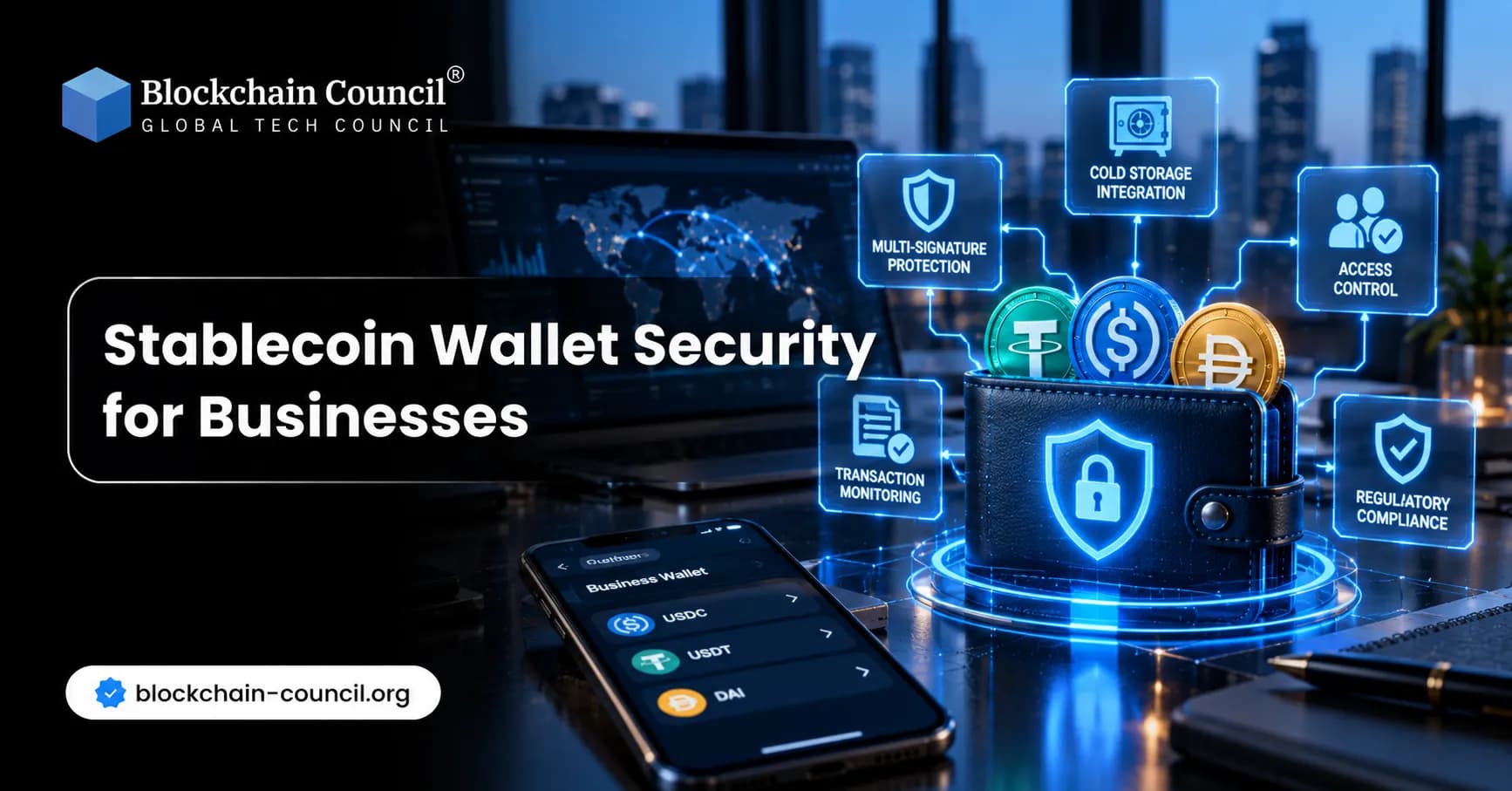
A single stolen key can empty a company treasury in minutes. That is why Stablecoin Wallet Security for Businesses has become a board-level topic. Chainalysis reported that about $3.4 billion in cryptocurrency was stolen in 2025, including the $1.5 billion Bybit theft in February of that year. Attackers now target people, devices, and software vendors as often as they target code. Finance teams, IT leaders, and founders who hold or move stablecoins need clear rules, strong tools, and tested habits. Professionals who want to build this knowledge can study for a Certified Stablecoin Payments Professional credential. This guide explains the main controls in plain language, from key storage to incident response. It is general information, not legal or financial advice.
Custodial and Non-Custodial Wallet Models
The first decision is who holds the keys. A key is a secret code that proves you control funds on a blockchain. Whoever holds the key controls the money.

Feature | Custodial wallet | Non-custodial wallet |
|---|---|---|
Who holds the keys | A provider, such as an exchange or custodian | Your business |
Setup effort | Low | Higher |
Main risk | Provider failure, hack, or freeze | Your own mistakes or theft |
Recovery help | Often available | Usually none if keys are lost |
Control | Shared with the provider | Full |
Best for | Smaller teams that want simplicity | Teams with strong security skills |
Hybrid Models Are Common
Many businesses split their funds. They keep a small working balance with a regulated custodian for daily payments, and they hold larger reserves in wallets they control. This spreads risk across two systems.
Stablecoin-Specific Considerations
Stablecoins add one more factor. Issuers can often freeze tokens at an address when they receive a lawful order, and the U.S. GENIUS Act expects issuers to be able to comply with such orders. A freeze can help in a theft, but speed matters, and recovery rates remain low. So prevention is far better than hoping for recovery.
Private Keys, Seed Phrases, and Signing
Understanding three terms makes everything else easier. Learners who pursue a Certified Cryptocurrency Expert credential study these basics in depth.
Private key: The secret that authorizes spending from a wallet.
Seed phrase: A list of words that can recreate a wallet's keys. Anyone who has it can take everything.
Signing: The act of approving a transaction with a private key.
Where Keys Should Live
Never store keys in email, chat apps, shared drives, or plain text files. Safer options include:
Hardware wallets: Small devices that keep keys offline and sign inside the device.
Hardware security modules (HSMs): Certified machines built to protect keys in data centers.
Multi-party computation (MPC): A method that splits a key into shares so no single machine ever holds the whole key.
Qualified custodians: Regulated providers that manage keys on your behalf.
The Danger of Blind Signing
Blind signing means approving a transaction without seeing its real details. This habit caused one of the largest thefts on record. In the Bybit case, reports say attackers compromised a developer machine at the wallet software provider and tampered with the signing screen. Signers saw a normal transfer on the screen, while the underlying transaction was different.
The lesson is clear. A group of signers protects you from a stolen key, but not from a corrupted display. Always verify the destination address, amount, and network on the signing device itself, and compare them with the approved request through a separate channel.
Watch Your Supply Chain
Hardware wallets and wallet software come from vendors, and vendors can be attacked. Decrypt reported this week that hardware wallet maker Keystone disclosed the theft of a factory device-verification key. The company said seed phrases and private keys were not exposed, but the incident shows why teams should buy devices from official sources and track vendor security notices.
Role-Based Access and Separation of Duties
Most thefts involve a person's access being abused or stolen. Good design makes sure no single person can move large sums alone.
Define Clear Roles
Initiator: Creates a payment request.
Approver: Reviews and approves the request.
Signer: Holds a key share or device that authorizes the transfer.
Administrator: Manages users and policies but cannot move funds.
Auditor: Views records but cannot change anything.
The same person should never create, approve, and sign the same payment.
Apply Least Privilege
Give each person only the access needed for their job. Review permissions every quarter. When someone changes roles or leaves, remove their access the same day, including devices and shared accounts.
Protect the People
Attackers often start with phishing and fake support messages. Train staff to spot them. Require hardware-based multi-factor authentication for every account connected to treasury tools. Keep personal details of signers private, because criminals have used leaked names and addresses to pressure victims.
Multisignature and Approval Policies
A multisignature wallet, or multisig, requires several approvals before funds move. A common format is "m of n." For example, a 3-of-5 wallet has five signers and needs any three to approve.
Choosing a Quorum
A good quorum balances safety and convenience. Too few signers raise theft risk. Too many slow down payments and increase the chance of lost keys. Many businesses choose 2-of-3 for smaller treasuries and 3-of-5 or higher for larger ones.
Spread Signers Out
Place signers on different devices, in different locations, and under different administrators. Do not let all keys sit on one network or in one office.
Multisig vs MPC
Feature | Multisig | MPC |
|---|---|---|
How it works | Several separate keys approve on the blockchain | One key is split into shares |
Visibility | Rules appear on the blockchain | Rules are enforced off-chain |
Chain support | Varies by blockchain | Often works across many chains |
Common risk | Weak signer devices and tampered interfaces | Weak vendor security and policy errors |
Neither choice solves everything. Both still need strong device security and good process.
Build Tiered Approval Policies
Set different rules for different amounts. For example:
Small payments may need one approver.
Medium payments need two approvers.
Large payments need three approvers plus a time delay.
Changes to policies, signers, or limits need the highest level of approval.
Add Time Delays and Out-of-Band Checks
A delay of a few hours for large transfers gives the team time to spot trouble. Before approving, confirm unusual requests through a separate channel, such as a call to a known number. Do not rely on the same chat thread that made the request.
Designing these controls touches software, security, finance, and operations. A broad Tech Certification path can help team members build the technical base needed to design, test, and audit such systems.
Address Allowlisting and Transaction Limits
Allowlisting means that the wallet only sends funds to pre-approved addresses. It blocks many mistakes and attacks.
How to Run an Allowlist
Collect the address from the recipient through a trusted channel.
Verify it by a second method, such as a call.
Add it to the list after approval from two people.
Wait through a cooling-off period before first use.
Send a small test payment before the first large transfer.
Review the list every quarter and remove old entries.
Beware of Address Poisoning
In address poisoning, a criminal sends a tiny transaction from an address that looks almost the same as one you use. They hope you will copy it from your history later by mistake. Never copy addresses from transaction history. Always use the verified allowlist and compare the full address, not only the first and last characters.
Set Limits That Fit Your Business
Per-transaction limits: A ceiling on each transfer.
Daily or weekly limits: A cap on total outflows.
Per-recipient limits: Lower caps for new addresses.
Network limits: Only allow chains you actually use.
Time limits: Restrict large transfers to business hours with staff on duty.
Limits reduce the damage if something goes wrong. Tune them with the finance team so they do not block normal operations.
Cold Storage and Operational Wallets
Think of wallets as tiers, much like cash in a shop. You keep a little in the till, more in a safe, and the rest in a vault.
Tier | Purpose | Connection | Typical share of funds |
|---|---|---|---|
Hot or operational wallet | Daily payments and refunds | Online | Small |
Warm wallet | Refills the hot wallet | Limited online access | Medium |
Cold wallet | Long-term reserves | Offline | Majority |
The shares above are examples, not rules. Set your own based on payment volume and risk.
Sweep and Refill Rules
Set a maximum balance for the hot wallet. When it grows past that level, move the excess to cold storage. When it falls low, refill it through an approved process. This keeps the amount exposed online small.
Plan for Network Fees
Many blockchains need a small fee in the network's native token. Keep a separate, small fee wallet and protect it too. Running out of fee tokens during an incident can delay an urgent transfer.
Keep Cold Storage Truly Cold
Store cold keys on devices that stay offline. Use sealed, labeled storage in secure locations. Log every access. Test that you can still recover and use the funds.
Backup, Recovery, and Incident Response
Security includes planning for loss and attack, not only prevention.
Backups and Recovery
Back up seed phrases or key shares on durable, offline media, such as metal plates, and store copies in separate secure places.
Split backups so no single person can rebuild the wallet alone.
Document the recovery steps in plain language and keep them updated.
Run recovery drills at least once a year using test funds.
Plan for key person risk. If a signer leaves, becomes unavailable, or loses a device, you must be able to replace them safely.
Incident Response Plan
A good plan names who does what, in order.
Detect: Use alerts for unusual transfers, new devices, and policy changes.
Contain: Pause outgoing transfers, disable suspicious accounts, and revoke access.
Escalate: Notify the incident lead, finance, legal, and executives.
Freeze and trace: Contact the stablecoin issuer, exchanges, and your custodian quickly to request freezes and flag addresses.
Report: Contact law enforcement and meet any legal notice duties.
Recover and rotate: Move remaining funds to new wallets, rotate keys, and rebuild trust in devices.
Review: Hold a no-blame review and fix the root cause.
Practice the plan with tabletop drills. The first time you read it should not be during a real attack.
Business Wallet Security Checklist
Use this list to check your program.
Decide which wallets are custodial and which are non-custodial.
Keep keys in hardware wallets, HSMs, MPC, or qualified custody.
Never store seed phrases digitally or in shared documents.
Verify transactions on the signing device before approval.
Define roles for initiator, approver, signer, administrator, and auditor.
Prevent any one person from controlling a full payment.
Use hardware-based multi-factor authentication everywhere.
Use multisig or MPC with a sensible quorum.
Spread signers across devices, places, and teams.
Set tiered approval rules by amount.
Add time delays for large transfers.
Maintain an address allowlist with a cooling-off period.
Send test transactions before first use.
Set per-transaction, daily, and per-recipient limits.
Separate hot, warm, and cold wallets.
Cap the hot wallet balance and automate sweeps.
Keep a protected fee wallet.
Back up keys offline and test recovery yearly.
Track vendor security notices and update software.
Write and rehearse an incident response plan.
Review access, limits, and logs every quarter.
Why Skills and Smart Hiring Matter in Stablecoin Security
Stablecoin infrastructure connects digital assets with payment systems, financial services, and blockchain networks. Organisations working in this space need talent with the right mix of technical, financial, and operational knowledge. HireValid's candidate assessment platform is worth exploring for teams looking to evaluate role-specific skills during recruitment.
Conclusion
Strong Stablecoin Wallet Security for Businesses rests on a few clear ideas. Protect the keys with the right tools. Separate duties so no one person can move large sums. Use multisig or MPC with sensible quorums. Limit where money can go and how much can leave. Keep most funds in cold storage. Plan for backup, recovery, and incident response before you need them.
Recent theft cases show that attackers target people, devices, and vendors, not just code. So verify what you sign, train your staff, and review your controls often.
Marketing and communications teams also have a role. When an incident happens, clear and honest messages to customers protect trust. A recognised Marketing Certification can help professionals prepare crisis communication plans and explain security measures in simple language. Strong controls and clear communication together give your business the best chance to keep digital dollars safe.
FAQs
1. What Is Stablecoin Wallet Security for Businesses?
Stablecoin wallet security refers to the policies, technologies, and controls businesses use to protect stablecoins and the private keys that authorize transactions. It helps prevent unauthorized transfers, wallet theft, operational mistakes, and loss of access to digital assets.
2. Why Is Stablecoin Wallet Security Important for Businesses?
Businesses may use stablecoins for supplier payments, customer transactions, payroll, and international settlements. Weak wallet security can expose funds to theft, fraud, or irreversible transfer errors. Strong security controls help protect assets, maintain financial continuity, and support compliance obligations.
3. What Are the Main Types of Stablecoin Wallets?
The main types include hot wallets, cold wallets, custodial wallets, and non-custodial wallets. Hot wallets connect to online services and support convenient transactions, while cold wallets keep keys offline. Custodial wallets rely on a provider to manage keys, whereas non-custodial wallets give the business direct control.
4. How Can Businesses Protect Stablecoin Wallet Private Keys?
Businesses should store private keys in secure key-management systems or hardware security modules, restrict access to authorized personnel, and maintain protected recovery procedures. Private keys and recovery phrases should never be shared publicly, stored in unsecured documents, or transmitted through unprotected communication channels.
5. What Is Multi-Signature Security for Stablecoin Wallets?
Multi-signature security requires multiple authorized keys to approve a transaction. For example, a business might require two approvals from three designated signers before funds can be transferred. This reduces dependence on a single individual or compromised credential and supports stronger financial controls.
6. Should Businesses Use Hot Wallets or Cold Wallets for Stablecoins?
The choice depends on transaction frequency and security requirements. Hot wallets are useful for routine payments because they are accessible online, while cold wallets can provide stronger protection for funds that do not need frequent movement. Many businesses use a combination of both.
7. How Can Businesses Prevent Unauthorized Stablecoin Transfers?
Businesses can implement role-based access controls, multi-factor authentication, transaction approval thresholds, allowlisted recipient addresses, and multi-signature authorization. They should also review access permissions regularly and independently verify requests to change wallet addresses or payment instructions.
8. What Are the Common Security Risks Associated With Stablecoin Wallets?
Common risks include phishing attacks, stolen private keys, compromised devices, malicious smart contracts, insider threats, fake payment requests, and incorrect wallet addresses. Businesses may also face risks from compromised custodians, blockchain infrastructure failures, and stablecoins losing their intended peg.
9. How Does Multi-Factor Authentication Improve Wallet Security?
Multi-factor authentication requires users to verify their identity using more than one authentication method. It can reduce the risk of account compromise when a password is stolen. Businesses should use phishing-resistant authentication where available and avoid relying solely on SMS for high-risk administrative accounts.
10. How Can Businesses Protect Stablecoin Wallets From Phishing Attacks?
Employees should verify website domains, avoid unexpected wallet links, inspect transaction details before signing, and never disclose private keys or recovery phrases. Businesses should also provide security training, use approved wallet applications, and establish procedures for reporting suspicious messages and payment requests.
11. What Is the Role of Hardware Security Modules in Stablecoin Wallet Security?
A hardware security module (HSM) is a specialized device that securely generates, stores, and uses cryptographic keys. Businesses can use HSMs to reduce exposure of private keys and enforce controlled signing operations. The effectiveness of an HSM depends on proper configuration, access management, and operational procedures.
12. How Can Businesses Secure Stablecoin Wallets Used by Multiple Employees?
Businesses should assign individual accounts and permissions, separate transaction creation from approval, and require additional authorization for large transfers. They should maintain audit logs, remove access promptly when employees leave, and conduct regular reviews of wallet permissions and signing policies.
13. What Is Wallet Address Allowlisting?
Wallet address allowlisting restricts transfers to previously approved destination addresses. It can help reduce accidental payments and certain types of fraud. Businesses should use a controlled process for adding or changing addresses, including independent verification through a trusted communication channel.
14. How Should Businesses Back Up and Recover Stablecoin Wallets?
Businesses should establish secure backup procedures for recovery phrases, key material, and wallet configurations. Backups should be protected against unauthorized access, physical damage, and single points of failure. Recovery procedures should be documented and tested without exposing sensitive credentials to unauthorized personnel.
15. How Can Businesses Monitor Stablecoin Wallet Activity?
Businesses can use wallet monitoring tools, blockchain explorers, transaction alerts, and compliance analytics to track transfers and identify unusual activity. Monitoring should cover large transactions, unexpected destinations, repeated failed attempts, and transfers that differ from normal business patterns.
16. What Should a Business Do If Its Stablecoin Wallet Is Compromised?
The business should activate its incident-response plan immediately. Depending on the situation, this may involve disabling compromised credentials, revoking access where possible, contacting the wallet or custody provider, notifying relevant internal teams, and preserving transaction records. If funds have been transferred, recovery may be difficult because confirmed blockchain transactions are generally irreversible.
17. How Does Custodial Wallet Security Differ From Non-Custodial Wallet Security?
With a custodial wallet, a third-party provider manages or controls the private keys, so the business must evaluate the provider's security, governance, and recovery procedures. With a non-custodial wallet, the business controls its own keys and bears greater responsibility for secure storage, access management, and recovery.
18. Do Businesses Need Compliance Controls for Stablecoin Wallets?
Depending on the jurisdiction and business model, businesses may need identity verification, sanctions screening, transaction monitoring, recordkeeping, and other compliance controls. They should evaluate applicable legal requirements and choose wallet and custody services that support their operational and regulatory needs.
19. How Can Businesses Choose a Secure Stablecoin Wallet Provider?
Businesses should evaluate key-management practices, security audits, access controls, recovery procedures, incident response, insurance terms where applicable, supported stablecoins and networks, and regulatory status. They should also review service availability, transaction limits, reporting capabilities, and the provider's history of security incidents.
20. What Are the Best Practices for Stablecoin Wallet Security?
Best practices include securing private keys, using multi-factor authentication, applying multi-signature approvals, separating duties, allowlisting verified addresses, monitoring transactions, testing recovery plans, and training employees. Businesses should regularly review security controls and maintain a documented incident-response process.
Related Articles
View All
Stablecoin
Stablecoin Smart Contract Security
Smart contracts can control important stablecoin functions, but an audit alone cannot eliminate every risk. Learn which contract components to review, what common vulnerabilities mean, and how ongoing monitoring supports security.

Stablecoin
Stablecoin Reconciliation for Businesses
Stablecoin reconciliation connects on-chain transactions with invoices, orders, bank movements, and accounting records. Explore the data businesses need, common mismatches, and controls that improve financial reporting.

Stablecoin
Stablecoin Payment Risk Management Framework
Stablecoin payment risk spans the issuer, reserve assets, blockchain network, wallets, service providers, compliance obligations, and business operations. Learn how organisations can identify exposures, assign controls, and prepare for incidents.
Trending Articles

Top 5 DeFi Platforms
Explore the leading decentralized finance platforms and what makes each one unique in the evolving DeFi landscape.
How to Install Claude Code
Learn how to install Claude Code on macOS, Linux, and Windows using the native installer, plus verification, authentication, and troubleshooting tips.
How to Create Claude Skills?
Claude Skills are one of the most important features Anthropic has introduced for users who want automation that is structured, consistent and reusable. Instead of giving Claude long instructions ever