

Solidity vs Rust for Smart Contracts: Choosing Between Ethereum and Solana Development

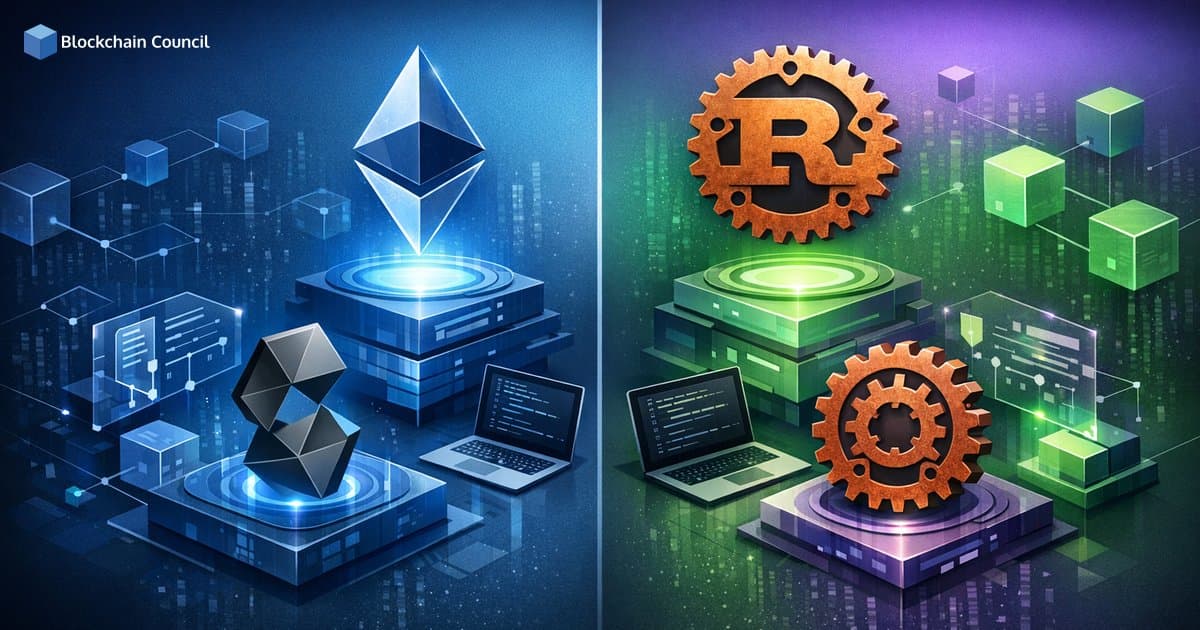
Solidity vs Rust for smart contracts is one of the most practical decisions developers and engineering leaders face in Web3. The choice is rarely about syntax preference. It is about where you plan to deploy, what performance your application requires, how much tooling maturity you need, and which security guarantees matter most for your use case.
Solidity is the dominant language for Ethereum and the broader EVM ecosystem, including major Layer-2s and EVM-compatible chains. Rust is the default for Solana programs and is also central to Rust-first and WASM-based ecosystems such as NEAR and Polkadot (ink!). Understanding these trade-offs helps teams invest in the right skills, hiring plans, and architecture decisions.

Ecosystem Context: Ethereum and EVM (Solidity) vs Solana and Rust-First Chains
The biggest driver in the Solidity vs Rust conversation is ecosystem fit.
Ethereum and EVM Networks: Why Solidity Remains the Default
Ethereum continues to lead in DeFi adoption and network effects. Across Ethereum L1 and major EVM Layer-2s such as Arbitrum, Optimism, Base, and Scroll, the EVM stack accounts for a substantial share of global DeFi TVL according to industry data from providers including Alchemy and market research outlets.
Solidity also benefits from multichain reach. The same mental model and similar tooling apply across:
Ethereum mainnet
Layer-2 rollups (optimistic and zk-based EVM environments)
EVM sidechains and alt L1s such as Polygon PoS, BNB Chain, Avalanche C-Chain, and Gnosis Chain
This portability is valuable for teams that want to launch on an L2 for cost and scale, then expand to other EVM networks with minimal rewrites.
Solana and Rust-First Ecosystems: Why Rust Matters Beyond One Chain
Solana is designed for high throughput and low latency, with block times often cited in the hundreds of milliseconds and a protocol-level design targeting very high transactions per second. This architecture is commonly chosen for use cases such as order-book DEXs, high-frequency trading workflows, and consumer applications that require low fees and fast interactions.
Rust also transfers well across multiple non-EVM ecosystems:
NEAR: Rust smart contracts compiled to WASM
Polkadot/Substrate: Rust for runtimes and ink! for WASM contracts
WASM-oriented platforms: increasingly standard Rust toolchains for contract compilation and testing
Even outside on-chain code, Rust is widely used for infrastructure including clients, indexers, and cryptographic tooling.
Language Design: Domain-Specific Solidity vs Systems-Level Rust
Solidity and Rust were created for different purposes, and that distinction shows up directly in how you build smart contracts.
Solidity: EVM-Native Smart Contract Language
Solidity is a domain-specific language designed around Ethereum concepts and the EVM execution model. It includes built-in primitives for common contract needs such as addresses, events, and transaction context variables.
Strengths of Solidity for smart contracts:
Fast onboarding for developers coming from JavaScript or TypeScript, due to familiar syntax and patterns.
Battle-tested standards such as ERC-20, ERC-721, and governance modules that are widely reused.
Large reference base of audited contracts and established DeFi and DAO architectures.
Limitations to manage:
Historical exploit patterns including reentrancy, access control misconfiguration, and risky low-level calls like delegatecall.
Gas and storage constraints that shape design choices, especially on Ethereum L1.
Complexity from inheritance and upgradeability that can introduce subtle bugs.
For optimization, many teams combine Solidity with lower-level techniques such as Yul or inline assembly. Practitioner reports consistently cite meaningful gas savings in performance-critical paths when careful low-level optimization is applied.
Rust: Memory-Safe Systems Programming Adapted to Smart Contracts
Rust is a general-purpose systems language that gained prominence in blockchain development due to its performance and safety guarantees. Rust's ownership and borrowing model eliminates entire classes of memory bugs without relying on garbage collection, and its type system catches many errors at compile time. Teams working on high-throughput chains and infrastructure often choose Rust for predictable performance and safer low-level control.
Strengths of Rust for smart contracts and programs:
Memory safety by design, reducing risks like use-after-free and null dereference.
High performance suited to compute-heavy, low-latency environments.
Strong toolchain (cargo, clippy, rust-analyzer) that supports large codebases.
WASM compatibility, which matters for NEAR and Polkadot-style smart contracts.
Limitations to plan for:
Steeper learning curve, especially around lifetimes and the borrow checker.
More fragmented smart contract tooling compared to Solidity, depending on the chain.
Logic bugs still occur in account validation, authorization checks, and state transitions even when the language prevents memory corruption.
Tooling and Developer Experience: Mature EVM Stacks vs Evolving Rust Program Stacks
For many teams, the productivity difference comes down to the surrounding ecosystem rather than the language itself.
Solidity Tooling: Fast Iteration and Strong Security Workflows
Solidity development benefits from a mature set of frameworks and security tools. Common workflows include local nodes, forked mainnet testing, fuzzing, gas reporting, and well-established CI pipelines.
Frameworks: Hardhat, Foundry, Truffle, Brownie
IDE: Remix for browser-based compilation, deployment, and debugging
Security: Slither, Mythril, Echidna, and formal verification options such as Certora-style workflows
Libraries: OpenZeppelin contracts for access control, tokens, and governance patterns
This maturity also extends to the auditing market. Many top audit firms have deep EVM specialization, which reduces external risk for teams building high-value contracts.
Rust Tooling on Solana and WASM Chains: Improving Frameworks, More Moving Parts
Solana program development is Rust-first, with frameworks such as Anchor providing patterns for account validation, IDL generation, and client bindings. Testing setups like local validators are useful, but the overall experience can feel less standardized than EVM workflows, particularly for teams accustomed to Hardhat or Foundry.
On WASM-based platforms, Rust SDKs and local sandboxes have matured significantly, but the developer experience varies by chain and framework.
Security and Reliability: What Each Language Helps With, and What It Cannot
Security is not guaranteed by language choice alone. That said, Solidity and Rust differ in their baseline guarantees.
Solidity Security: Well-Known Risks and Well-Known Mitigations
Solidity's history includes major exploit categories such as reentrancy and unsafe call patterns. Modern best practices reduce risk substantially, especially when teams adopt:
Battle-tested libraries for token logic and access control
Defensive patterns such as checks-effects-interactions and pull-based payments
Rigorous testing with fuzzing and invariant checks
Operational controls such as multisigs and timelocks for admin functions
Because gas costs and execution limits can create unexpected denial-of-service risk, Solidity teams also need to design carefully around storage access patterns and loop bounds, particularly on L1.
Rust Security: Stronger Language-Level Guarantees, but Program Logic Remains Critical
Rust reduces entire classes of memory safety issues that are common in lower-level languages. This matters for protocol and infrastructure code, and it benefits on-chain programs as well. However, smart contracts and programs fail most often due to logic errors: missing signer checks, incorrect account ownership validation, unsafe serialization assumptions, or flawed economic design.
Frameworks like Anchor help by standardizing constraints and account checks, but they do not eliminate the need for threat modeling, code reviews, and professional audits.
Performance and Scalability: When Rust Matters More, and When the Chain Matters More
Performance is frequently cited in Solidity vs Rust discussions, but language performance and platform scalability are distinct considerations.
EVM Reality: Execution Costs Are Driven by Gas and Throughput Limits
On Ethereum L1, throughput and gas costs constrain complex execution. For many applications, scaling is achieved through Layer-2 rollups rather than micro-optimizing Solidity code. Careful design and selective low-level optimization can still reduce costs in high-frequency execution paths.
Solana Reality: Low Latency and High Throughput Enable New Product Types
Solana's architecture targets high throughput and low latency, making certain on-chain patterns viable that would be impractical elsewhere, including order-book matching and frequent state updates. Rust aligns well with these constraints because it compiles to efficient native code and supports fine-grained control.
Real-World Use Cases: Where Each Stack Is Most Common
Solidity and EVM Use Cases
DeFi: AMMs, lending markets, stablecoin systems, liquid staking, derivatives
NFTs and gaming: ERC-721 and ERC-1155 contracts, marketplaces, on-chain assets
DAOs: governor modules, treasury systems, voting and delegation
Enterprise EVM: permissioned deployments that reuse EVM semantics and tooling
Rust and Solana (Plus WASM Chains) Use Cases
Low-latency trading: order-book DEXs and high-frequency strategies
Consumer apps: microtransactions, social experiences, high interaction volume
Protocol and infrastructure engineering: clients, validators, indexing, performance tooling
WASM contracts: portable smart contracts on NEAR and Polkadot-style environments
Practical Decision Guide: How to Choose Solidity vs Rust for Smart Contracts
The following criteria help align language choice with product and team constraints.
Choose Solidity if You Prioritize Ecosystem Reach and Mature Tooling
You want access to the broadest DeFi, NFT, and DAO ecosystem.
You plan to deploy on Ethereum mainnet, major L2s, or EVM-compatible chains.
You value mature developer tooling and a deep auditing market.
Your team needs fast time-to-market and already has JavaScript or TypeScript experience.
Choose Rust if You Need Performance, Low Latency, or Rust-First Chain Access
You are building high-throughput applications where low latency and frequent state updates matter.
You are targeting Solana programs or WASM-based smart contract ecosystems.
You expect to invest in protocol-level engineering or infrastructure tooling.
You can support a longer ramp-up for developers new to ownership and lifetimes.
For Long-Term Careers: Learn Both, With an Intentional Sequence
Many educators and practitioners advise a Solidity-first path even for developers aiming at Solana, because EVM-based resources dominate DeFi primitives, common attack patterns, and smart contract design discussions. Adding Rust subsequently expands access to Solana and multiple Rust-first ecosystems.
For internal training and upskilling, structured learning tracks in Solidity development, Rust programming, Solana program development, and smart contract security provide a strong foundation for both application and infrastructure roles.
Conclusion: Pick the Ecosystem First, Then the Language
Solidity vs Rust for smart contracts is ultimately an ecosystem and product decision. If you want maximum composability with today's DeFi and EVM Layer-2 landscape, Solidity remains the most direct route, supported by mature tooling and a large security and auditing industry. If your application demands low latency, high throughput, and Rust-first deployment targets such as Solana or WASM platforms, Rust offers a strong engineering fit with better baseline memory safety and efficient performance.
For many professionals and teams, the highest-leverage approach is to build Solidity fluency for EVM literacy and security patterns, then add Rust to unlock Solana and broader systems-level Web3 engineering. That combination aligns with how the ecosystem continues to develop across both applications and infrastructure.
Related Articles
View All
Smart Contracts
From Idea to Deployment: Building, Testing, and Deploying Smart Contracts with Hardhat and Foundry
Learn a practical, end-to-end workflow for building, testing, and deploying smart contracts with Hardhat and Foundry, including speed, testing depth, and deployment tradeoffs.

Smart Contracts
Smart Contracts for Real-World Assets (RWA): Tokenization, Compliance, and On-Chain Settlement
Learn how smart contracts for real-world assets (RWA) enable tokenization, compliance-by-design, and on-chain settlement for Treasuries, credit, funds, and real estate.

Smart Contracts
Cross-Chain Smart Contracts: Designing Interoperable dApps with Bridges, Oracles, and Messaging Protocols
Learn how cross-chain smart contracts enable interoperable dApps using bridges, oracle networks, and messaging protocols, plus key security patterns and design best practices.
Trending Articles

The Role of Blockchain in Ethical AI Development
How blockchain technology is being used to promote transparency and accountability in artificial intelligence systems.

Top 5 DeFi Platforms
Explore the leading decentralized finance platforms and what makes each one unique in the evolving DeFi landscape.

How Blockchain Secures AI Data
Understand how blockchain technology is being applied to protect the integrity and security of AI training data.