

What Is Quantum Error Correction? Meaning, Methods, and Challenges

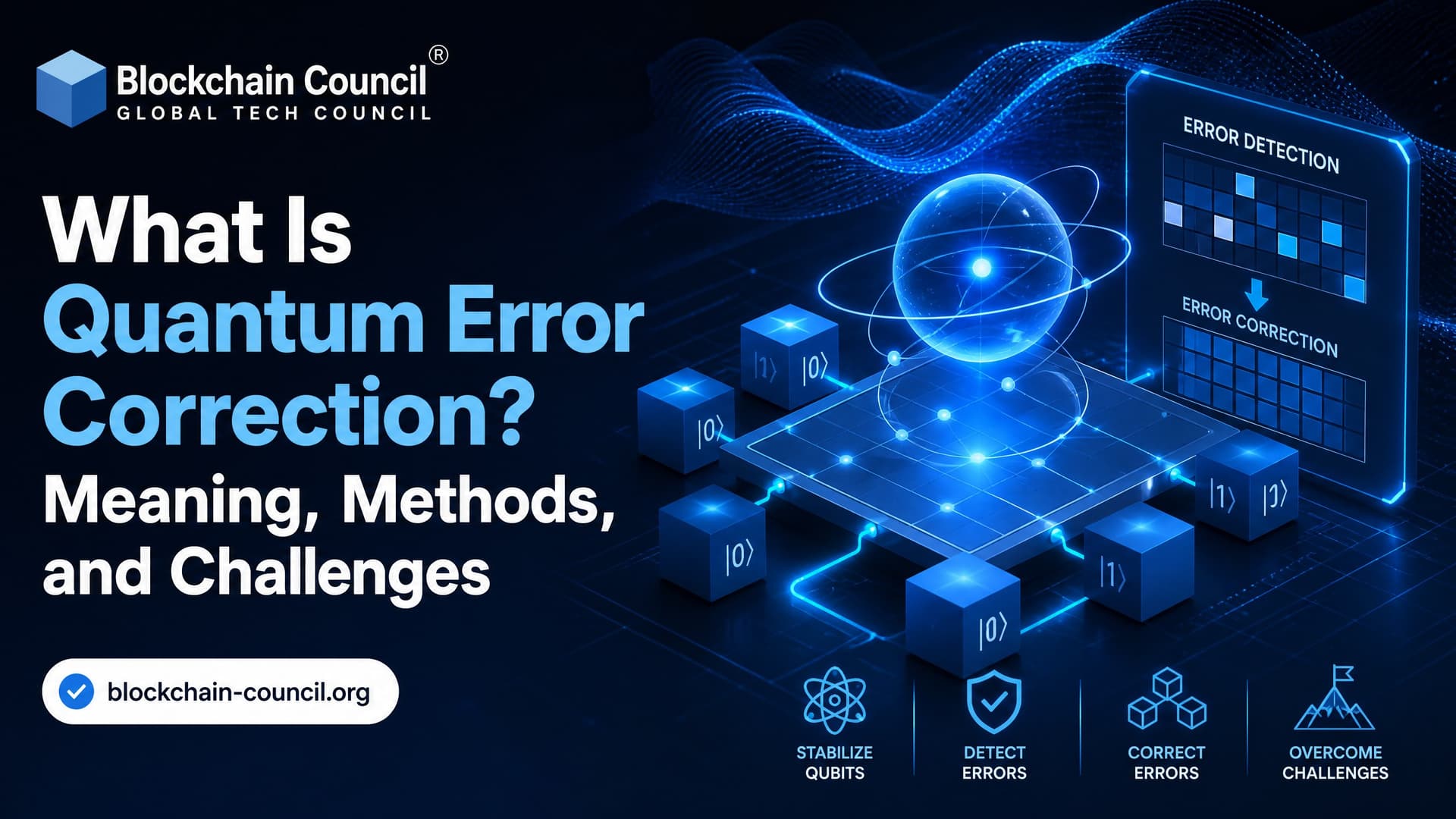
Quantum error correction is the set of methods used to protect fragile quantum information from noise, decoherence, faulty gates, and imperfect measurement. Without it, useful large-scale quantum computing does not happen. Current physical qubits lose coherence too quickly, and even a small gate error can spread through a circuit before the algorithm reaches its answer.
The idea is simple to state but hard to build: encode one logical qubit across many physical qubits, measure only the error information, then correct or track the error without learning the quantum state itself. That last part matters. If you measure the encoded state directly, you destroy the superposition you were trying to protect.

What Does Quantum Error Correction Mean?
Quantum error correction, often shortened to QEC, extends classical error-correcting code theory into quantum systems. Classical computers copy bits freely. Quantum computers cannot do that because of the no-cloning theorem. So QEC creates redundancy through entanglement, not copying.
A typical QEC cycle has three stages:
- Encoding: Map one or more logical qubits into a larger group of physical qubits.
- Syndrome extraction: Measure stabilizers or parity checks that reveal which error likely occurred.
- Recovery or tracking: Apply a correction or update a classical Pauli frame so later operations interpret the logical state correctly.
In practice, many systems do not physically apply every correction gate. They track corrections in software because extra gates introduce extra error. This detail trips up beginners. They expect QEC to act like a repair tool that constantly flips qubits back. Real hardware often says, in effect, we know an X correction is pending, so account for it later.
Why Quantum Computers Need Error Correction
Quantum errors come from several sources: energy relaxation, phase drift, crosstalk, leakage outside the computational states, and measurement mistakes. A qubit can suffer a bit flip, represented by the Pauli X operator. It can also suffer a phase flip, represented by Z. Both can happen together as Y.
That is already harder than classical error correction. A quantum state can be in superposition, so QEC must protect amplitudes and phases. It must also avoid revealing whether the logical state is 0, 1, or a superposition. Stabilizer measurements solve this by asking indirect questions such as: are these qubits in even or odd parity?
Fault-tolerant quantum computing depends on this. The threshold theorem says that if physical error rates stay below a certain threshold, and the noise has suitable locality and independence properties, longer quantum computations can be made reliable with manageable overhead. The exact threshold depends on the code, hardware, decoder, and noise model.
Main Methods of Quantum Error Correction
Stabilizer Codes
Most practical QEC schemes are stabilizer codes. A stabilizer code defines the valid code space as the simultaneous +1 eigenspace of selected Pauli operators. If a measured stabilizer returns -1, something has changed. The pattern of these measurement outcomes is the syndrome.
For an n-qubit stabilizer code with m independent stabilizer generators, the number of encoded logical qubits is k = n - m. The code distance d describes the smallest undetectable logical error. A larger distance usually means stronger protection, but also more qubits and more measurement circuits.
Classic examples include the Shor nine-qubit code and the Steane seven-qubit code. They are still useful for learning because they show how bit-flip and phase-flip errors can be corrected together. If you are studying QEC for a technical role, do not skip these. Surface codes make more sense after you have seen these smaller constructions.
Surface Codes
The surface code is the leading candidate for many superconducting and trapped-ion roadmaps because it uses local operations on a two-dimensional layout. Data qubits sit on a lattice. Ancilla qubits measure local X-type and Z-type stabilizers. The result is a stream of syndrome data that a classical decoder processes in real time.
Under common circuit-level depolarizing noise assumptions, rotated planar surface codes are often quoted with thresholds around 0.7 percent to about 1 percent, depending on the model and decoder. That number is not magic. If correlated noise or leakage dominates, the effective threshold can be lower.
Google Quantum AI reported a major surface-code result in Nature using its Willow processor. The team implemented distance-5 and distance-7 quantum memories with real-time decoding, and reported that increasing the code distance suppressed the logical error rate. The 101-qubit distance-7 memory reached an error per QEC cycle of about 0.143 percent. That is a serious milestone because it shows larger codes helping on real hardware, not only in simulation.
Color Codes, qLDPC Codes, and GKP Codes
Surface codes are not the only option. Color codes use lattice geometry too, but they can support a wider set of transversal logical gates in some designs. That can reduce overhead for certain operations, although the engineering trade-offs are not trivial.
Quantum low-density parity-check codes, or qLDPC codes, are drawing heavy research interest because they aim for high distance with lower overhead. The catch is decoding. Sparse checks are attractive on paper, but the full hardware story depends on connectivity, measurement speed, and whether the decoder can keep up.
Gottesman-Kitaev-Preskill codes, known as GKP codes, encode information in oscillator states. They matter most in photonic and bosonic architectures because they can correct small shift errors in phase space. Xanadu has discussed roadmaps that combine GKP codes with qLDPC codes for very low target logical error rates later in the decade.
Fault Tolerance: More Than Storing a Qubit
Correcting idle memory is only part of the job. A fault-tolerant computer must run gates, measurements, state preparation, and error correction cycles without letting one physical fault cascade into many logical faults.
This is where techniques such as lattice surgery, code switching, and magic state distillation enter the picture. To be blunt, magic state distillation is one reason estimates for useful fault-tolerant machines can look enormous. Non-Clifford gates are expensive to protect. You cannot judge a serious quantum roadmap by logical qubit count alone. Ask what logical gate rates, error rates, and distillation resources are assumed.
Real-time decoding is another hard requirement. Surface codes generate syndrome data every cycle. In superconducting systems, the classical side often needs to respond on microsecond-scale timing. Riverlane demonstrated FPGA-based real-time decoding integrated with Rigetti superconducting hardware in 2024, which points to how tightly quantum processors and classical control stacks must be co-designed.
Key Challenges in Quantum Error Correction
Noise Is Not Always Friendly
Textbook QEC often starts with independent Pauli errors. Hardware does not always behave that politely. Crosstalk can correlate errors across qubits. Leakage can move a qubit outside the expected |0> and |1> states. Calibration drift can change error rates during an experiment.
A decoder trained or tuned for the wrong noise model can make poor corrections. I have seen simulated surface-code results look excellent until the measurement-round indexing was checked. One swapped X-syndrome and Z-syndrome stream can flatten the logical error curve and make a good code look broken. On hardware, the same kind of bookkeeping error is expensive.
Overhead Is Large
QEC trades many physical qubits for one logical qubit. A distance-d rotated surface code uses roughly d x d data qubits, plus measurement qubits and control infrastructure. Reaching very low logical error rates can require hundreds or thousands of physical qubits per logical qubit, depending on physical error rates and algorithm length.
Measurement Must Be Fast and Accurate
Syndrome measurement is not optional background work. If parity checks are noisy, the decoder may identify the wrong error. If measurement is too slow, the system accumulates more error before the next correction cycle. This is why quantum engineering teams care about readout fidelity, reset time, wiring density, and cryogenic control electronics as much as they care about qubit count.
Where QEC Is Used Today
Quantum error correction is already being used in experimental quantum memories and small logical-qubit demonstrations. Google, Quantinuum, Microsoft, Riverlane, Rigetti, and several academic groups have reported progress in protected operations, real-time decoding, and logical error suppression.
Photonic systems use QEC ideas to fight photon loss in computation and networking. KIST researchers have reported photonic QEC work with a photon-loss threshold up to 14 percent. Trapped-ion systems have demonstrated very low two-qubit gate errors, often below 0.001 in leading experiments, which is promising for future fault-tolerant designs if speed, scaling, and decoding keep pace.
QEC concepts also influence quantum sensing and metrology. Decoherence-free subspaces and noiseless subsystems can protect encoded information from specific environmental noise patterns. These are not always full fault-tolerant QEC systems, but they use the same central idea: encode information where the environment has less power to destroy it.
What Professionals Should Learn Next
If you work in software, start with stabilizer formalism, Pauli operators, syndrome extraction circuits, and basic decoders such as minimum-weight perfect matching. Then simulate a repetition code and a small surface code. Tools such as Stim and PyMatching are practical choices for this. If you work closer to hardware, focus on readout fidelity, leakage, reset, timing, and correlated noise characterization.
For structured learning, consider Blockchain Council's quantum computing training as an internal learning path, especially if you want to connect QEC with quantum algorithms, cryptography, and emerging enterprise use cases. If your work overlaps with blockchain security or post-quantum planning, pair that with Blockchain Council resources in blockchain and cybersecurity so you understand both the quantum stack and the systems it may affect.
The best next step is concrete: build a three-qubit bit-flip code, then a phase-flip version, then inspect a surface-code syndrome graph. Do not just read the equations. Run the cycles, break the decoder, and watch how logical errors appear. That is when quantum error correction stops being an abstract promise and becomes an engineering discipline.
Related Articles
View All
Quantum Computing
Why Quantum Error Correction Is Important for Scalable Quantum Computers
Quantum error correction turns noisy physical qubits into reliable logical qubits, making scalable quantum computers and long algorithms possible.

Quantum Computing
Quantum Error Correction Demystified: Why Noise Matters and How Fault-Tolerant Quantum Computers Work
Quantum error correction explains why qubits fail and how logical qubits, thresholds, decoding, and fault tolerance make scalable quantum computers possible.

Quantum Computing
Quantum Computing in Healthcare: Use Cases, Benefits, and Challenges
Quantum computing in healthcare could support drug discovery, imaging, genomics, and security, but clinical proof remains limited and early stage.
Trending Articles
AWS Career Roadmap
A step-by-step guide to building a successful career in Amazon Web Services cloud computing.
What is AWS? A Beginner's Guide to Cloud Computing
Everything you need to know about Amazon Web Services, cloud computing fundamentals, and career opportunities.
Claude Code Vs Cursor
Claude Code vs Cursor compares two AI coding tools based on features, automation, and developer workflows.