

AI-Made Midterm Ads Top $137M, and 70% Carry No AI Label

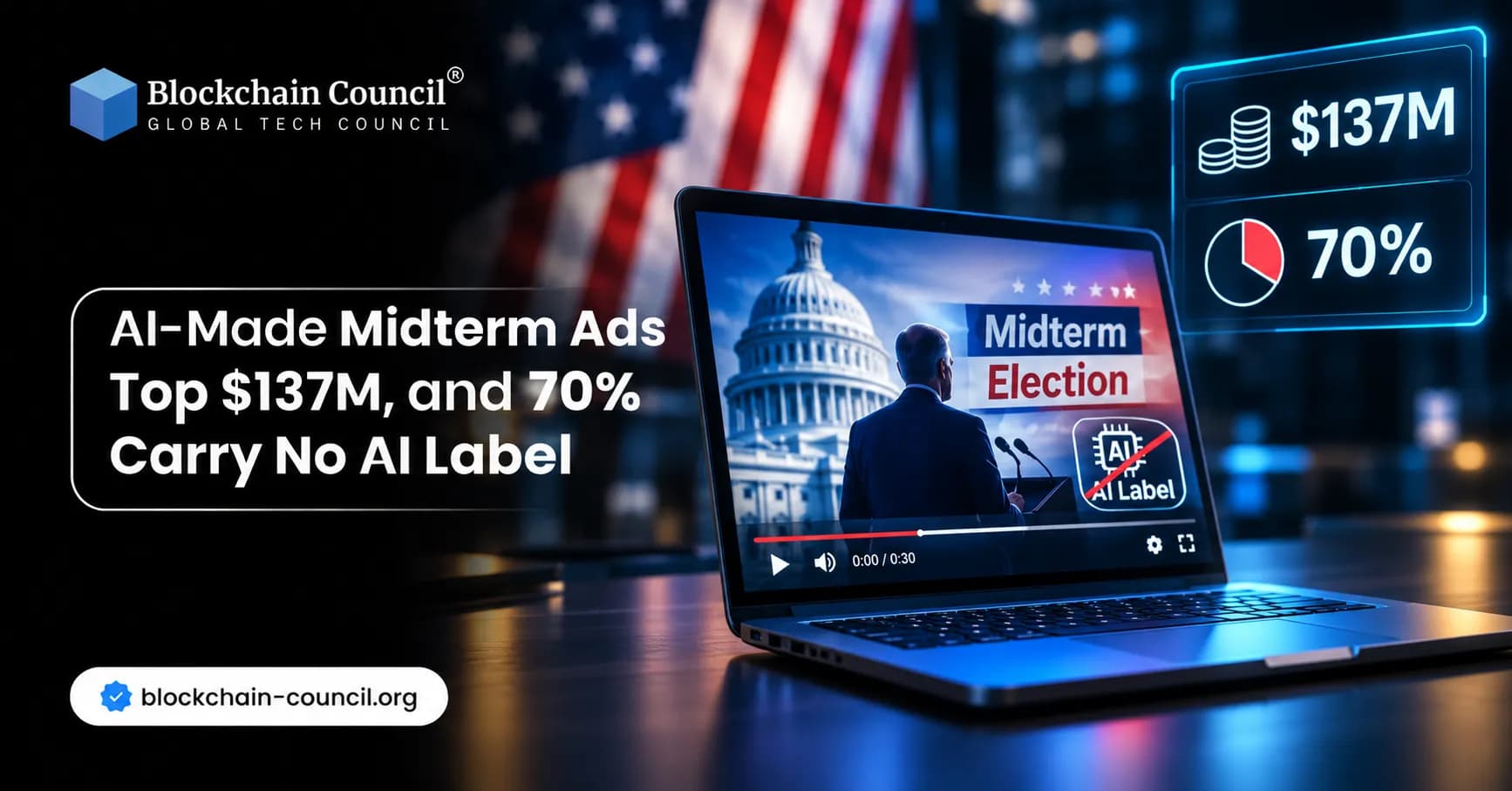
Americans vote today in the 2026 midterm elections, and many have already seen something that never happened. A Senate candidate laughing at hateful slogans on cards. A governor appearing to speak about a scandal in the first person. A rival rewriting a holy book at a desk. These scenes come from AI-made midterm ads, and researchers say they are now a nine-figure part of campaign spending. The Wesleyan Media Project, which tracks political advertising, counts more than $137 million spent on ads made or enhanced with artificial intelligence this cycle, and about 70% of those ads carried no AI label. That makes today's vote the first big test of how voters, platforms, courts, and lawmakers handle synthetic political media.
To follow stories like this one, it helps to understand how the technology works. Learners who want a solid base in how AI systems generate text, images, and video can start with the Certified Artificial Intelligence (AI) Expert program. This guide explains the numbers, the rules, the legal fight, and what voters can do, in plain language for beginners and professionals alike.

What the $137 Million Figure Really Means
The headline number comes from the Wesleyan Media Project, working with AdImpact data, and was reported widely in mid-October. It covers 220 ads in 34 states that were generated or enhanced with AI, tracked through 11 October. An earlier count, published on 4 September, found 164 ads and just under $80 million. The total rose by roughly $57 million in about six weeks.
How to Read the Numbers
Several figures circulate, and they measure different things:
$137 million: airtime bought for ads that used AI somewhere in them, not only fully synthetic ads.
About 70% with no label: the share of reviewed ads that did not tell viewers AI was used. Wesleyan's own count of the 220 ads found that only 27% carried a disclaimer, which is consistent with a figure of roughly 70% or more going unlabeled.
Just over $13 million: AdImpact's narrower count, limited to ads with an identifiable disclosure.
At least $38 million: CNN's analysis of ad spending that appears to use AI imagery without disclosure.
Researchers say the true total is probably higher, because AI use is hard to detect. In the 2024 cycle, the Wesleyan team found less than $50,000 in AI ad spending.
Who Is Spending
Wesleyan found that about 81% of the identified AI ads came from Republican campaigns or Republican-aligned groups, and about 12% from Democrats, with the rest from independents. Researchers noted that Democratic campaigns may face more reputational risk from using AI, since Democratic voters generally favor stronger AI rules. That is an interpretation, not proof that Democrats avoid the tools. Some Democratic campaigns have gone the other way and added on-screen tags such as "Made by humans, not A.I."
Why AI Ads Exploded in One Election Cycle
Three forces explain the jump. First, cost. Generative tools can produce polished video, voice, and images in hours instead of weeks, so small campaigns and outside groups can make content that once needed a studio. Second, speed. A campaign can react to the news cycle within a day. Third, attention. Strange or shocking visuals spread quickly on social media, and strategists have borrowed the logic of internet memes.
People who build or manage such tools need to know what they can and cannot do. Those who want hands-on skills in creating AI applications can explore the Certified Artificial Intelligence (AI) Developer certification, which focuses on the development side.
Not All AI Use Is Deceptive
AI appears in ads in many ways. Some uses are mundane, such as generating background footage, editing audio, or creating stylized graphics. Others are more serious, such as a deepfake, which is a realistic fake of a real person's face or voice. Wesleyan reported that nearly half of the AI ads it identified featured deepfake-style depictions of real politicians. Satire and parody also appear, and several state laws exempt them. The line between obvious satire and misleading content is at the center of the debate.
The Label Gap: Why Most Ads Carry No Disclosure
A label is a short notice, such as "AI-generated," shown on screen or spoken in the ad. Labels matter because viewers cannot reliably spot synthetic media by eye. Erika Franklin Fowler, a co-director of the Wesleyan Media Project, has said some AI uses are hard to detect without a disclosure.
Why So Many Ads Skip the Label
No national rule: there is no federal requirement to label AI in political ads, so the duty depends on the state, if any.
Gaps in coverage: roughly 19 states have no election AI law at all, according to one tracker.
Narrow definitions: some laws apply only to deceptive deepfakes, not every use of AI.
Exemptions: satire, parody, and some federal races may fall outside certain state laws.
Small labels: where labels exist, they can be faint. One widely reported 85-second ad in March carried only a small corner tag.
Enforcement is slow: complaints take time, and ads can finish their run before a decision arrives.
A poll by Talker Research for Scripps News found that 43% of surveyed registered voters believed something in a political ad was real before learning it was AI-generated.
Examples From the Campaign Trail
Reporting this fall has highlighted several cases:
In New York, Republican gubernatorial candidate Bruce Blakeman posted AI-generated videos, including ones showing Gov. Kathy Hochul and New York City Mayor Zohran Mamdani. The state Democratic Party filed a complaint with the Board of Elections, saying the ads lacked a label required by state law. Blakeman's team defended the videos as satire.
In Pennsylvania, a Republican campaign released an ad with a deepfake of Gov. Josh Shapiro speaking in the first person about a past harassment settlement, with no on-screen label and a disclosure only after about 45 seconds, according to New Jersey coverage.
In Texas, Ken Paxton's campaign ran AI-generated videos attacking Democrat James Talarico, who has said he refuses to use AI in his own ads.
These cases span several states, though the data show far more spending on the Republican side.
Federal Rules: Why No National Standard Exists
There is still no federal law that specifically governs AI in political ads. A few federal tools touch the topic, but none fills the gap.
What Federal Agencies Have Done
FEC: the Federal Election Commission considered AI deepfakes in 2023 and 2024 but did not adopt a rule, and the commissioners disagreed over whether existing fraud rules already cover them.
FCC: in February 2024 it ruled that AI-generated voices in robocalls count as artificial under federal robocall law. In 2024 it also proposed disclosure rules for broadcast political ads, but those were never finalized, and questions about its authority remain.
Congress: several bills would require disclaimers or ban deceptive AI content in federal campaigns, but none has become law.
The Preemption Fight
A separate argument is whether Washington should override state AI laws. A December 2025 executive order pushed for a single federal approach and aimed to limit state regulation. Supporters argue that fifty different rulebooks make compliance hard and slow innovation. Critics, including many state lawmakers and some Republicans, argue that states are the only ones acting and that federal inaction should not erase their rules. Legal experts have questioned how far an executive order can go, and bills to either lock in or cancel preemption remain stalled.
Understanding how AI models are built and deployed, including how fake media is made and detected, requires strong technical knowledge. A broader Tech Certification path can help learners connect AI, security, and digital infrastructure.
State Laws: A Patchwork
States have moved much faster than Washington. The National Conference of State Legislatures counted 31 states with election deepfake laws in June 2026, while other trackers show about 30 enforceable laws as of early October, depending on how they treat laws blocked in court. Of the 31, 28 required disclosures, and Maryland, Minnesota, and Texas prohibited certain deepfakes even with a warning.
Approach | What It Does | Examples |
|---|---|---|
Disclosure | Requires a clear AI label on covered ads | Michigan, Louisiana, Tennessee, Nevada |
Prohibition | Bans certain deceptive AI media of candidates | Maryland, Minnesota, Texas |
No law | No election AI rule on the books | About 19 states, per one tracker |
Even where laws exist, details differ. Michigan requires a short spoken acknowledgment and a written notice. Louisiana's 2026 law requires disclosure on certain ads that falsely portray candidates. Some laws apply only within a set window before an election, and many exempt satire. The result is that the same ad can need a label in one state and none in the next.
The Free Speech Debate: Both Sides
Political speech receives the strongest protection under the First Amendment, so AI rules face serious legal tests.
The Case for Disclosure and Limits
Supporters, including consumer groups such as Public Citizen, argue that voters have an interest in knowing when a video of a candidate is fabricated. They say labels add information without banning speech, and they point to polls showing broad public support. One survey cited in New Jersey coverage found that 73% of respondents wanted platforms to label AI images and videos, and majorities of both Democrats and Republicans favored strict AI regulation.
The Case for Caution
Opponents and civil liberties advocates argue that broad rules can chill satire, parody, and legitimate criticism, and that government should not decide what counts as deceptive political speech. Courts have sided with some of these arguments. A federal court in Hawaii struck down that state's election deepfake law in a case brought by the satire site Babylon Bee. Federal judges in California found parts of its law unconstitutional. In September 2026, a federal judge temporarily blocked Montana from enforcing its law, citing likely harm to a conservative PAC's free speech rights. Researchers have also noted that labels can sometimes backfire on the candidate who uses them.
Both camps agree on one point: most laws that survive court challenge require a label instead of banning the ad.
How Platforms and Broadcasters Respond
Big platforms have their own rules. Google and Meta began requiring disclosure of realistic AI-altered imagery or voices in political ads ahead of 2024, and Meta's rules rely on advertiser self-declaration plus platform detection. These rules apply only to paid ads on those services, not to organic posts, and they cannot see every edit. The London-based Institute for Strategic Dialogue has called 2026 the first US election where AI is built into every major social platform.
Broadcasters face a legal bind. Under federal law, stations generally must run ads from legally qualified candidates without rejecting them for content, so a station cannot simply pull a misleading candidate ad. Outside groups face different rules, and that can leave stations and viewers uncertain.
How Voters Can Spot AI-Made Ads
Voters can protect themselves with simple habits:
Look for labels on screen, in the caption, or in the ad's description.
Check the source. Is the sponsor named, and does the sponsor have a record of accuracy?
Ask whether the scene could have happened. Dramatic events with no news coverage are suspect.
Watch for glitches such as odd hands, blurry text, or mismatched lip movement, while remembering that good fakes may have none.
Search the claim through trusted news and fact-checking sources.
Pause before sharing, since a quick share can spread a fake.
What Comes Next
Expect the debate to continue after the votes are counted. Courts will keep testing state laws, Congress may revisit disclosure bills, and the preemption fight will shape who sets the rules. Researchers will also study whether AI ads changed any outcomes, which is still unknown. Campaigns, agencies, and brands that communicate with the public will need clear ethics policies, honest labeling, and plain-language explanations of how they use AI. Professionals in communication roles can build those skills with a Marketing Certification, which supports clear and responsible messaging.
Conclusion
AI-made midterm ads have grown from a rounding error in 2024 to more than $137 million this cycle, and most still reach voters with no label. The facts are clear on spending and on the missing national rule. The remaining questions are contested: how much to regulate, who should do it, and where free speech begins and ends. Today's vote will not settle those questions, but it gives the clearest real-world test so far of AI in politics.
Sources and Official Links
The study behind the headline figures comes from the Wesleyan Media Project, which publishes its AI-in-ads tracking and releases on its official site. The reports below were used for this article.
Al Jazeera: AI deepfake ads grow more popular in US midterm campaigns
Gizmodo: $137 million spent on AI-generated ads, only 27% included a disclaimer
The Conversation: As AI political deepfakes go viral, lawmakers struggle to keep up
FAQs
1. How much money have US political campaigns spent on AI-generated advertisements in 2026?
US political campaigns and political action committees (PACs) have spent more than $137 million on advertisements created or enhanced using artificial intelligence during the 2026 midterm election cycle. The Wesleyan Media Project identified 220 such advertisements through October 11, 2026.
2. Why are AI-generated political advertisements becoming popular?
AI allows political campaigns to create videos, images, voiceovers, and campaign messages more quickly and often at lower production costs. It also enables campaigns to generate realistic scenes, customise advertisements, and experiment with different messaging strategies.
3. What percentage of AI-generated political ads do not disclose AI usage?
Approximately 73% of identified AI-generated or AI-enhanced political advertisements did not contain an AI disclosure label. Only 27% included a disclaimer, raising concerns about transparency and voters' ability to recognise synthetic content.
4. What is an AI-generated political advertisement?
An AI-generated political advertisement is a campaign message created partly or entirely using artificial intelligence. It may include synthetic images, fabricated videos, digitally generated voices, AI-written scripts, or manipulated footage featuring political candidates.
5. How are AI-generated advertisements being used in the 2026 US midterm elections?
Campaigns are using AI to create attack advertisements, political satire, candidate impersonations, and fictional scenarios. Some advertisements depict candidates saying things they never said or participating in events that never happened.
6. Which political groups are spending the most on AI-generated advertisements?
The Wesleyan Media Project's dataset found that Republican candidates and pro-Republican groups sponsored approximately 81% of identified AI advertisements and accounted for 88% of the spending. Democratic sponsors accounted for a smaller share of the tracked advertisements.
7. What is the Wesleyan Media Project?
The Wesleyan Media Project is a political advertising research initiative based at Wesleyan University. It monitors election advertisements, analyses campaign spending, and studies how political campaigns communicate with voters through television and digital platforms.
8. How much has AI political advertising grown compared with the 2024 elections?
The contrast is substantial. The Wesleyan Media Project identified less than $50,000 in spending on AI-generated political advertisements during the 2024 election cycle, compared with more than $137 million identified during the 2026 midterm cycle.
9. What are deepfake political advertisements?
Deepfake political advertisements use artificial intelligence to create or manipulate realistic images, videos, or audio recordings. They can make candidates appear to deliver fabricated speeches, participate in fictional events, or express opinions they never communicated.
10. Can AI-generated political advertisements spread misinformation?
Yes. AI-generated advertisements can spread misleading information when synthetic content is presented as authentic footage or genuine statements. Fabricated candidate appearances and manipulated audio can make it harder for voters to distinguish real political events from digitally created material.
11. Why are AI disclosure labels important in political advertising?
Disclosure labels inform viewers when artificial intelligence has been used to generate or significantly manipulate advertising content. They help audiences evaluate the authenticity of campaign material and make more informed decisions about the information being presented.
12. Are AI-generated political advertisements regulated in the United States?
Regulation varies across the United States. Several states have laws addressing certain AI-generated political deepfakes or requiring disclosure, but there is no comprehensive federal law specifically governing all AI-generated political advertisements.
13. Do AI disclosure laws guarantee that political advertisements will be labelled?
No. Research from the Wesleyan Media Project found that approximately 29% of identified AI advertisements carried labels in states with disclosure requirements, compared with 32% in states without such requirements. This suggests that disclosure laws alone may not ensure consistent labelling.
14. How can voters identify AI-generated political advertisements?
Voters can look for unusual facial movements, inconsistent lip synchronisation, artificial voices, unrealistic backgrounds, and suspiciously edited scenes. However, modern AI-generated content can appear highly realistic, so visual inspection alone is not a reliable verification method.
15. Can AI make political advertisements more affordable for smaller campaigns?
Yes. AI tools can reduce the need for expensive filming, actors, locations, and traditional video production. Smaller campaigns may use these tools to create promotional content with fewer resources, although effective distribution and advertising still require funding.
16. How can AI-generated advertisements influence voter behaviour?
AI advertisements can influence how voters perceive candidates, political issues, and campaign messages. Fabricated videos may create false impressions, while repeated exposure to misleading content can affect public trust even when viewers later discover that the material was synthetic.
17. What are the biggest risks of using AI in political campaigns?
Major risks include:
Fabricated candidate statements and appearances.
Misleading political narratives.
Unlabelled synthetic videos and images.
Impersonation and voice cloning.
Reduced public trust in authentic media.
Difficulty identifying the original source of campaign content.
18. How are social media platforms responding to AI-generated political content?
Social media platforms have introduced different disclosure and content policies for AI-generated material. However, requirements vary between platforms, and enforcement can be challenging when advertisements are distributed across multiple digital channels.
19. Could AI-generated political advertisements affect future elections?
AI-generated advertisements could become a more significant part of future election campaigns as video-generation and voice-cloning technologies improve. Their influence will depend on disclosure requirements, platform policies, campaign practices, and voters' ability to verify political information.
20. What does the $137 million AI advertising trend mean for the future of political communication?
The spending surge demonstrates how quickly artificial intelligence is becoming part of political campaigning. While AI can make advertising production more accessible and efficient, the limited use of disclosure labels highlights the need for stronger transparency practices, responsible content creation, and better media verification.
Related Articles
View All
News
Bitcoin Enters Midterm Election Day Near $78K
Bitcoin enters U.S. Midterm Election Day near $77,000 as investors watch crypto regulation, ETF outflows, Federal Reserve policy, tech stocks, and Binance's recovery. Explore how election uncertainty could influence the cryptocurrency market.
News
Google Cloud Doubles, but AI Mode Dents Search Ads
Google Cloud revenue grew 103% to $30.7 billion and the Gemini app passed one billion users, yet Alphabet shares fell about 13%, erasing roughly $500 billion, as AI Mode’s lower ad earnings and heavy spending worried investors.

News
Ethereum's Devcon 8 Starts Today in Mumbai (Nov 3-6)
Ethereum’s Devcon 8 starts today in Mumbai, with four days of talks on scaling, privacy and the app layer. Here is what to expect, and what the postponed Glamsterdam testnet launch means.
Trending Articles

Top 5 DeFi Platforms
Explore the leading decentralized finance platforms and what makes each one unique in the evolving DeFi landscape.
How Blockchain Secures AI Data
Understand how blockchain technology is being applied to protect the integrity and security of AI training data.
What is AWS? A Beginner's Guide to Cloud Computing
Everything you need to know about Amazon Web Services, cloud computing fundamentals, and career opportunities.