

Layoff Narratives in 2026: Are Tech Companies Really Cutting Jobs Due to AI?
 Suyash Raizada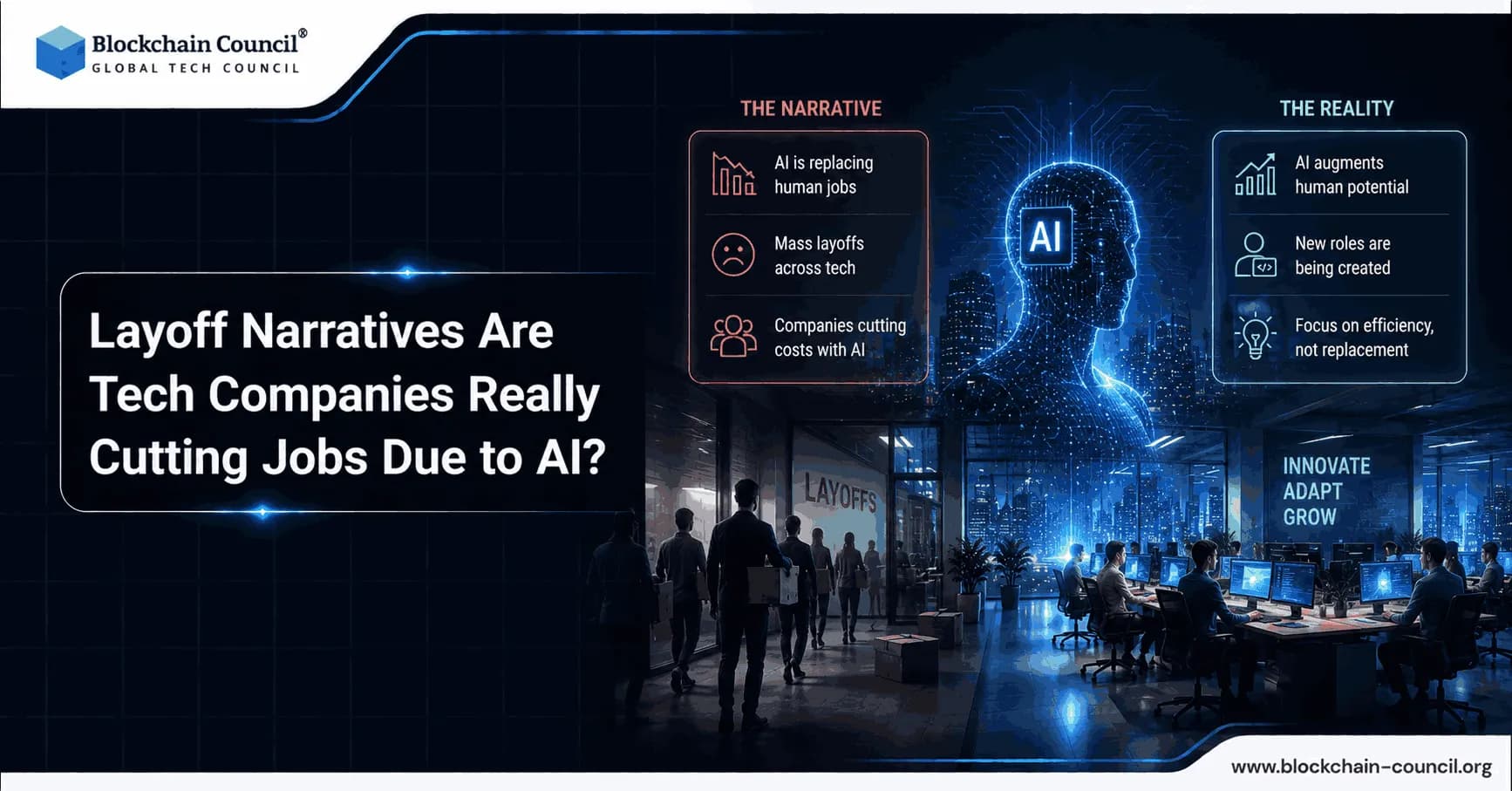
Layoff announcements across big tech in 2026 have arrived with a new explanation: AI-driven efficiency. From executive memos to earnings calls, companies are increasingly framing workforce reductions as the natural outcome of automation, AI-generated code, and smaller teams doing more. But many experts argue this storyline is often AI-washing - a convenient narrative that masks a more complex mix of cost-cutting, post-pandemic restructuring, and the need to fund massive AI infrastructure investments.
Layoffs in 2026 are increasingly tied to automation, cost optimization, and AI-driven productivity shifts-build relevant, future-proof skills with an AI certification, strengthen implementation capability using a Python Course, and understand how AI is reshaping business functions through an AI powered marketing course.

This article breaks down what is really happening behind the wave of 2026 layoffs, why "layoff due to AI" claims are rising, and what professionals can do to respond.
What Changed in 2026: The Rise of AI-Enabled Layoff Messaging
In early 2026, major firms including Meta, Google, Amazon, Block, Atlassian, Pinterest, and Salesforce announced significant layoffs while explicitly linking cuts to productivity gains from AI tools. The messaging follows a consistent theme: AI increases output per employee, so companies need fewer people to maintain or grow results.
Some of the most cited examples include:
Block cutting close to 40% of its workforce (more than 4,000 roles), with leadership arguing that AI tools and flatter organizational structures are changing how companies are built and run.
Atlassian reducing headcount by about 10% (around 1,600 roles) while citing the need to fund AI initiatives and enterprise sales investment.
Meta laying off hundreds of employees - including roughly 700 in a single week - as it plans to dramatically increase AI spending.
On the surface, the "AI made us do it" explanation seems plausible. AI copilots, coding assistants, automated support, and content generation tools can increase throughput. But the broader economic and strategic context tells a more complicated story.
The Deeper Drivers Behind the Layoff Wave
Many analysts view 2026 layoffs as the result of several overlapping forces, with AI acting as both a real productivity lever and a convenient public rationale. Here are the major drivers.
1. Cost-Cutting and Margin Protection, Even During Profitable Periods
A point that confuses many employees and observers is that layoffs continue even when companies report strong profits. That does not contradict the layoffs, because public companies typically prioritize operating margin expansion and meeting investor expectations.
When AI is positioned as an efficiency multiplier, leadership can justify reductions as disciplined execution - even if the cuts are primarily about lowering ongoing expenses.
2. Post-Pandemic Restructuring and Role Realignment
The tech layoff cycle that began in 2022 followed aggressive pandemic-era hiring. By 2026, many organizations are still right-sizing to match slower growth, shifting product strategies, and maturing business lines.
Economists and labor experts frequently note that company maturation changes hiring needs. Teams built for rapid expansion may later shift toward optimization, consolidation, and platform reuse. AI can accelerate that shift, but it is rarely the original cause.
3. Funding Enormous AI Capital Expenditure
One of the most direct explanations behind 2026 layoffs is the sheer cost of AI infrastructure. Amazon, Meta, Google, and Microsoft are expected to invest a combined $650 billion in AI within a single year, much of it directed toward data centers, chips, networking, and energy.
That scale of investment creates pressure to find savings elsewhere. Payroll is one of the largest controllable costs, so layoffs can function as a mechanism to self-fund AI infrastructure without damaging near-term financial results.
Is It Really a Layoff Due to AI, or AI-Washing?
The term AI-washing has emerged to describe situations where companies over-attribute layoffs to AI. The argument is not that AI is irrelevant - it is that AI is sometimes used as a simplified narrative that reduces public backlash, signals modernization, and reassures investors that leadership is acting decisively.
Several expert perspectives underscore this nuance:
Some consultants argue AI tools are now capable enough that the same volume of work can be completed with fewer people in certain functions.
Workplace and labor market analysts note that restructuring, budget shifts, and organizational flattening are also significant drivers.
Career data researchers point out that persistent cuts over multiple years are reshaping the perceived stability of tech employment.
A "layoff due to AI" can be partly accurate and still incomplete. The motivating factor may be cost and strategy, while AI provides the justification and the operational means to run leaner.
Where AI Is Actually Reducing Headcount Pressure
Even where AI is overused in messaging, it is also true that AI is changing the labor equation in measurable ways.
Software Development and Engineering
Some tech firms now report that 25% to 75% of code in certain contexts is AI-generated. That does not automatically mean 25% to 75% fewer developers, but it does change staffing models in three ways:
Fewer entry-level tasks such as boilerplate generation and repetitive refactoring.
Higher output expectations per engineer, raising the performance bar across teams.
Shifting skill demand toward system design, code review, security, and AI-assisted testing.
Sales, Marketing, and Customer Support
Salesforce has stated that AI handles roughly 30% to 50% of work in some functional areas, which helps companies maintain service levels with fewer employees. This becomes a compelling argument for leadership teams trying to increase profitability with a smaller workforce.
Operations and Back-Office Functions
AI-driven automation is also affecting roles in analytics, finance operations, HR operations, and IT service management - areas where workflows can be standardized and augmented by agents and copilots.
Case Snapshots: Meta, Block, Atlassian, and Salesforce
Meta: AI Transformation and Investment Pressure
Meta leadership has described 2026 as a pivotal year for AI transforming work. Layoffs have occurred alongside efforts to ramp up AI spending and monitor internal AI usage. This combination reflects a dual logic: drive productivity per employee and redirect savings toward AI capabilities.
Block: A Dramatic Bet on Lean AI Teams
Block's reduction of nearly 40% of its workforce stands out for both scale and messaging. Leadership framed AI tools and flatter teams as a fundamental shift in how companies operate and predicted the broader industry would adopt lean, AI-enabled team structures quickly. This points to a strategic identity shift, not only a tactical cost reduction.
Atlassian: Cutting to Fund AI and Enterprise Focus
Atlassian's layoffs were explicitly positioned as a way to fund AI and enterprise sales investments. This is one of the clearest examples of layoffs functioning as budget reallocation - moving resources from general headcount into AI product development and go-to-market priorities.
Salesforce: Delivering More Work with Fewer People
With public statements that AI performs 30% to 50% of certain work, Salesforce illustrates how automation narratives can align with profit goals. Reports of cultural change toward efficiency reflect a broader shift across tech: employee output is increasingly measured against cost per unit of work, with AI setting a new baseline for productivity expectations.
What This Means for Professionals: How to Stay Resilient After a Layoff
If you are affected by a layoff or concerned about job security, the most practical approach is to treat AI as a permanent layer in modern work rather than a temporary trend.
Key Steps to Take Now
Map your tasks to AI-augmentable workflows: Identify what can be automated and what requires judgment, domain expertise, security awareness, and stakeholder alignment.
Build demonstrable AI fluency: Hiring managers increasingly want proof - portfolio projects, automation scripts, prompt workflows, AI evaluation approaches, or AI governance knowledge all carry weight.
Strengthen adjacent durable skills: Security, data privacy, architecture, product thinking, and compliance are less likely to be fully automated and often become more valuable when AI is introduced.
Workforce changes now favor professionals who can work with AI systems, not compete against them-develop that edge with an Agentic AI Course, deepen ML understanding via a machine learning course, and align skills with evolving industry demand through a Digital marketing course.
Future Outlook: Fewer Specialized Roles, More Hybrid Expectations
Layoffs may continue as companies mature, prioritize efficiency, and channel billions into AI infrastructure. Predictions from executives and analysts suggest that leaner teams supported by AI tools could become a standard operating model faster than many workers anticipate.
The broader shift is not only about the number of layoffs - it is about the changing definition of a valuable tech role: fewer pure execution positions and more hybrid roles that combine domain expertise with AI tooling, evaluation, governance, and system design.
Conclusion: The Layoff Story Is Bigger Than AI
AI is influencing the labor market, and in some functions it can meaningfully reduce the number of people needed for the same output. But many 2026 layoff announcements also reflect cost-cutting, restructuring after pandemic-era over-hiring, and the urgent need to fund expensive AI infrastructure.
When you hear "layoff due to AI," treat it as a signal to look deeper. The real story is usually a combination of strategy, economics, and technology. For professionals, the best response is to adapt: build AI fluency, develop durable complementary skills, and prepare to operate in leaner organizations where output expectations are higher and AI is embedded in daily workflows.
FAQs
1. Are tech companies really cutting jobs due to AI in 2026?
Tech companies are not cutting jobs solely due to AI in 2026. Layoffs are influenced by multiple factors such as cost optimization, market conditions, and restructuring. AI plays a role, but it is not the only reason.
2. What are layoff narratives in 2026 related to AI?
Layoff narratives in 2026 often link job cuts to AI adoption. However, many companies use AI to improve efficiency rather than replace entire roles. The narrative is sometimes oversimplified.
3. Is AI replacing jobs completely in 2026?
AI is not completely replacing jobs but transforming them. Many roles are evolving rather than disappearing. New opportunities are also being created alongside automation.
4. Which industries are most affected by AI layoffs in 2026?
Industries like tech, customer support, and content operations are more affected. These sectors involve repetitive tasks that AI can automate. However, new roles are also emerging in these areas.
5. Are layoffs due to AI permanent?
Most layoffs linked to AI are part of transition phases. Companies are restructuring to adapt to new technologies. Over time, new roles and opportunities are expected to grow.
6. How does AI impact hiring trends in 2026?
AI is shifting hiring toward skills like data analysis, AI engineering, and automation management. Companies prefer candidates who can work alongside AI systems. Upskilling is becoming essential.
7. What is the role of automation in tech layoffs?
Automation reduces the need for repetitive tasks, which can lead to job reductions. However, it also increases productivity and creates new technical roles. The impact is both positive and negative.
8. Are layoffs more about cost-cutting than AI?
Yes, many layoffs are driven by cost-cutting and economic factors. AI is often one of several contributing elements. Companies aim to improve efficiency and profitability.
9. How can professionals adapt to AI-driven changes?
Professionals can adapt by learning new skills related to AI, data, and automation. Continuous learning and flexibility are key. Upskilling helps maintain career relevance.
10. What skills are in demand due to AI in 2026?
Skills like machine learning, data science, prompt engineering, and AI integration are in demand. Soft skills like critical thinking and problem-solving are also important. Hybrid skill sets are highly valued.
11. Are entry-level jobs affected by AI layoffs?
Entry-level roles are more vulnerable as AI can automate basic tasks. However, new entry-level opportunities are emerging in AI-related fields. Training and adaptation are important.
12. Do companies publicly link layoffs to AI?
Some companies mention AI as a factor, but most cite broader reasons like restructuring or efficiency. AI is often part of a larger strategy. Public messaging may not tell the full story.
13. Is AI creating new job opportunities in 2026?
Yes, AI is creating roles in development, maintenance, and oversight of systems. It also opens opportunities in new industries. The job market is evolving rather than shrinking.
14. How does AI affect job security?
AI can reduce job security in roles involving repetitive tasks. However, it increases demand for skilled professionals. Adapting to change improves long-term stability.
15. Are layoffs in 2026 higher than previous years?
Layoffs vary by region and industry. While some sectors see increases, others experience growth. AI is one factor among many influencing trends.
16. What is the future of work with AI?
The future of work involves collaboration between humans and AI. Jobs will focus more on creativity, strategy, and problem-solving. Automation will handle routine tasks.
17. Can AI fully replace human workers?
AI cannot fully replace human workers in most roles. Human judgment, creativity, and emotional intelligence remain essential. AI works best as a support tool.
18. How should companies handle AI-driven layoffs?
Companies should focus on reskilling and supporting employees during transitions. Ethical implementation of AI is important. Transparent communication builds trust.
19. What is the biggest misconception about AI layoffs?
The biggest misconception is that AI alone is responsible for layoffs. In reality, economic and strategic factors also play a major role. AI is part of a broader transformation.
20. Should professionals worry about AI layoffs in 2026?
Professionals should stay aware but not overly worried. Learning new skills and adapting to change can create new opportunities. AI can be an advantage if used effectively.
Related Articles
View All
Layoffs
Oracle Layoffs 2026: What 6 AM Job Cut Emails Mean for Cloud and AI Tech Workers
Oracle layoffs 2026 show how AI data center spending, automation, and centralized HR processes are changing risk for cloud and AI tech workers.

Layoffs
Oracle Job Cuts: Key Lessons for Tech Professionals in the AI Era
Oracle job cuts reveal how AI spending can reshape tech careers. Learn which roles are exposed, which skills matter, and how to reduce layoff risk.

Layoffs
From Social Platforms to Smart Platforms: How AI Automation Is Reshaping Hiring, Marketing, and Trust
AI is turning social platforms into smart platforms, automating hiring and marketing while straining online trust. Learn how Web3 skills add verification and career resilience.
Trending Articles

Top 5 DeFi Platforms
Explore the leading decentralized finance platforms and what makes each one unique in the evolving DeFi landscape.
How Blockchain Secures AI Data
Understand how blockchain technology is being applied to protect the integrity and security of AI training data.

Can DeFi 2.0 Bridge the Gap Between Traditional and Decentralized Finance?
The next generation of DeFi protocols aims to connect traditional banking with decentralized finance ecosystems.