

cahatgpt

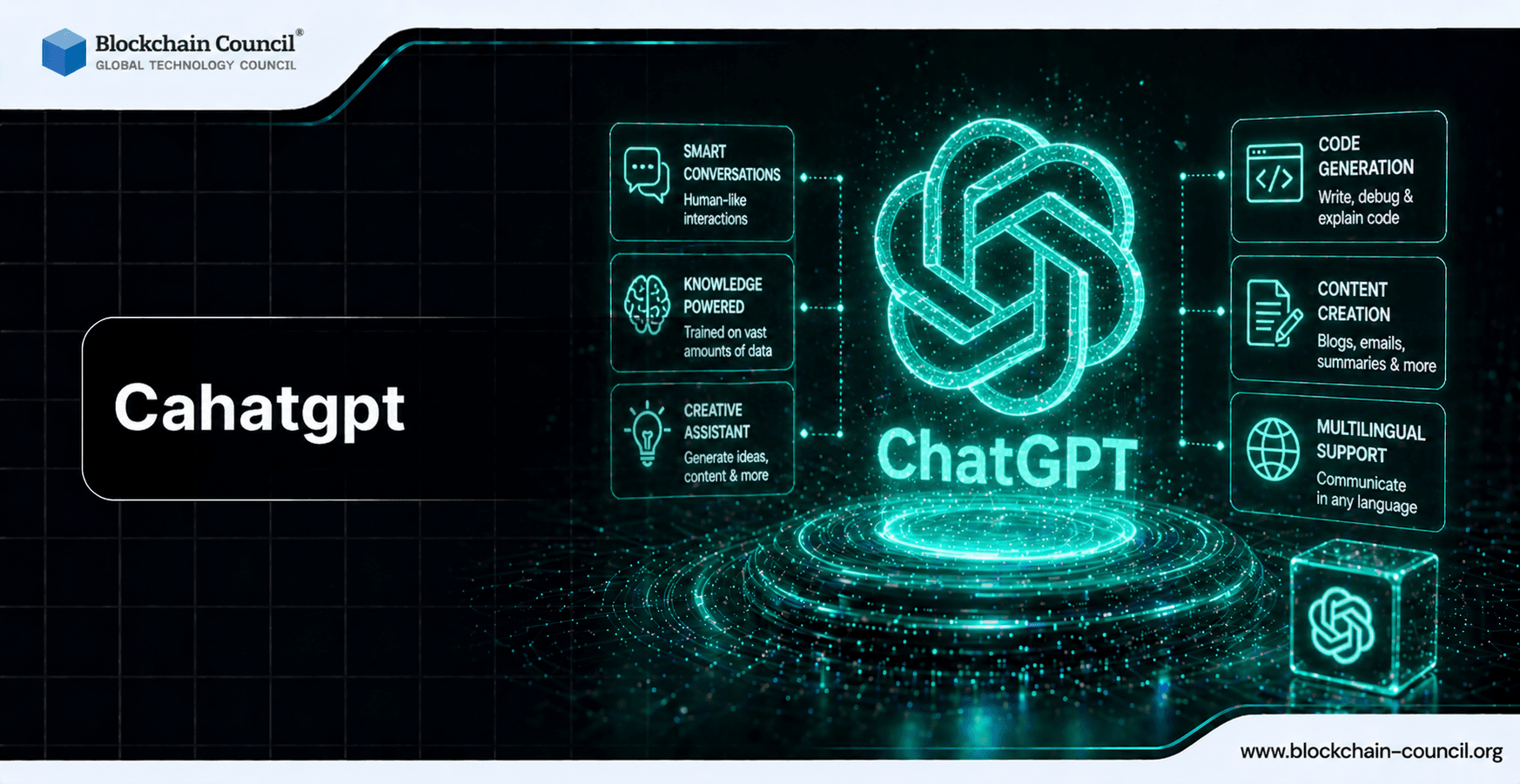
Artificial intelligence has transformed the way humans interact with technology, and ChatGPT stands as one of the most influential tools in this evolution. Designed to understand and generate human-like text, ChatGPT is widely used across industries for communication, automation, and problem solving.
This article explores ChatGPT in detail, including its technology, applications, recent developments, and future potential. It also examines how professionals can leverage AI tools effectively in their work.

For individuals seeking to build expertise in artificial intelligence, certifications such as the Claude Code Certification and the AI expert certification provide structured learning opportunities.
What is ChatGPT
ChatGPT is an advanced AI language model designed to generate human like responses based on user input. It uses natural language processing and machine learning techniques to understand context, answer questions, and assist with a wide range of tasks.
Key Features
Conversational interaction
Context awareness
Content generation
Problem solving capabilities
These features make ChatGPT a versatile tool for both personal and professional use.
How ChatGPT Works
ChatGPT is built on transformer architecture, which enables it to process and generate text efficiently. The model is trained on large datasets to understand patterns in language and respond appropriately.
Process Overview
User inputs a query
The model analyzes context and intent
It generates a response based on learned patterns
The output is refined for coherence and relevance
This process allows ChatGPT to provide meaningful and contextually accurate responses.
Real World Example
A customer support team uses ChatGPT to handle common inquiries such as order tracking and product information. This reduces response time and allows human agents to focus on complex issues, improving overall efficiency and customer satisfaction.
Applications of ChatGPT
Customer Support
ChatGPT automates responses to frequently asked questions, reducing workload and improving response times while maintaining consistency in communication.
Content Creation
Writers and marketers use ChatGPT to generate articles, social media posts, and marketing copy efficiently, enabling faster content production and idea generation.
Education
Students and educators use ChatGPT for tutoring, research assistance, and content explanation, making learning more accessible and interactive.
Software Development
Developers use ChatGPT for code generation, debugging, and documentation, streamlining development processes and improving productivity.
Professionals interested in advanced coding applications can explore the AI Powered coding expert Course.
ChatGPT in Marketing
AI powered tools like ChatGPT enable businesses to create personalized marketing campaigns, analyze customer behavior, and optimize engagement strategies. This leads to more targeted communication and improved conversion rates.
For deeper insights, the AI powered marketing course provides valuable knowledge.
Recent Developments in ChatGPT
Improved Context Understanding
Modern versions of ChatGPT can handle longer conversations and maintain context more effectively, allowing for more natural and meaningful interactions.
Multimodal Capabilities
ChatGPT is evolving to process not only text but also images and other forms of data, expanding its range of applications.
Integration with Tools
ChatGPT is increasingly integrated with productivity tools, enhancing workflows and enabling seamless collaboration across platforms.
Enhanced Safety Measures
Developers are implementing safeguards to reduce harmful outputs and ensure responsible use, addressing concerns related to misuse and bias.
Benefits of ChatGPT
Efficiency
ChatGPT automates repetitive tasks and provides quick responses, saving time and improving productivity in various applications.
Accessibility
The tool is accessible to users with different levels of technical expertise, making it widely usable across industries.
Scalability
ChatGPT can handle large volumes of interactions simultaneously, supporting business growth and operational efficiency.
Versatility
Its ability to adapt to different tasks and industries makes it a valuable tool for a wide range of use cases.
Challenges and Limitations
Accuracy Issues
ChatGPT may occasionally produce incorrect or outdated information, requiring users to verify critical details before relying on its responses.
Dependence on Data
The quality of ChatGPT’s output depends heavily on the data it was trained on, which can affect accuracy and relevance.
Ethical Concerns
Issues such as bias, misinformation, and misuse must be carefully managed to ensure responsible use of the technology.
Overreliance
Users may become overly dependent on AI, potentially reducing critical thinking and independent problem solving skills.
Ethical Considerations
Bias
AI systems may reflect biases present in their training data, which can lead to unfair or inaccurate outputs if not properly addressed.
Privacy
Ensuring the secure handling of user data is essential to maintain trust and comply with regulations.
Transparency
Users should have a clear understanding of how AI systems operate and make decisions, promoting accountability and trust.
Future of ChatGPT
Enhanced Capabilities
Future versions of ChatGPT are expected to offer improved reasoning, creativity, and adaptability, making them even more useful in complex scenarios.
Wider Adoption
ChatGPT will become more integrated into everyday life and business operations, expanding its influence across industries.
Better Regulation
Governments and organizations will introduce frameworks to ensure responsible and ethical use of AI technologies.
Preparing for AI Tools
Learn Fundamentals
Understanding the basics of AI helps users make better use of tools like ChatGPT and adapt to technological changes.
Practice Usage
Regular interaction with AI tools improves efficiency and familiarity, enabling users to leverage their full potential.
Stay Updated
Keeping up with advancements ensures that users can effectively utilize new features and capabilities.
Conclusion
ChatGPT represents a major advancement in artificial intelligence, transforming how people communicate, work, and solve problems. Its versatility and efficiency make it a powerful tool across industries.
As AI continues to evolve, ChatGPT will play an increasingly important role in shaping the future of technology and innovation.
FAQs
1. What is ChatGPT?
ChatGPT is an advanced artificial intelligence language model designed to understand and generate human-like text based on user input. It operates using sophisticated natural language processing techniques that allow it to interpret questions, provide detailed answers, and assist with a wide variety of tasks. Its ability to simulate human conversation makes it highly useful in areas such as customer support, education, and content creation. Over time, it has evolved into a versatile tool that can adapt to different contexts and provide meaningful, context aware responses.
2. How does ChatGPT work?
ChatGPT works using a transformer based neural network architecture that processes input text and generates responses by predicting the most relevant sequence of words. It analyzes the context, intent, and structure of the input, then produces an output based on patterns learned during training. This process involves complex mathematical computations and large datasets, allowing the model to deliver coherent and contextually appropriate responses in real time.
3. What are the main uses of ChatGPT?
ChatGPT is used across various domains, including customer support, content creation, education, and software development. It can answer questions, generate written content, assist with coding tasks, and provide explanations for complex topics. Its adaptability makes it a valuable tool for both individuals and organizations looking to improve efficiency and productivity.
4. Is ChatGPT accurate?
ChatGPT is generally accurate but not infallible. It may produce incorrect or outdated information, especially when dealing with complex or rapidly changing topics. Users should verify important information from reliable sources before making decisions based on AI generated responses.
5. Can ChatGPT replace humans?
ChatGPT cannot fully replace humans because it lacks genuine understanding, emotional intelligence, and real world experience. While it can automate certain tasks and provide valuable assistance, human judgment and creativity remain essential in many areas.
6. How is ChatGPT used in business?
Businesses use ChatGPT to automate customer interactions, generate content, and analyze data. This helps improve efficiency, reduce operational costs, and enhance customer experiences by providing quick and consistent responses.
7. What are the benefits of ChatGPT?
The benefits include increased efficiency, accessibility, scalability, and versatility. It allows users to perform tasks more quickly and effectively, making it a valuable tool in modern workflows.
8. What are the risks of ChatGPT?
Risks include inaccuracies, bias, misuse, and overreliance. Proper usage and verification are necessary to minimize these risks and ensure responsible use.
9. How does ChatGPT help in education?
ChatGPT supports education by providing explanations, tutoring assistance, and research support. It helps students understand complex topics and enhances learning experiences.
10. Can ChatGPT generate code?
Yes, ChatGPT can assist with code generation, debugging, and documentation, making it useful for developers and learners.
11. What is natural language processing?
Natural language processing is a field of AI that focuses on enabling machines to understand, interpret, and generate human language in a meaningful way.
12. How does ChatGPT handle context?
ChatGPT analyzes previous inputs in a conversation to maintain context and provide relevant responses, improving the quality of interactions.
13. Is ChatGPT secure?
Security depends on implementation and usage. Proper safeguards and best practices are necessary to protect user data and ensure safe interactions.
14. What industries use ChatGPT?
Industries such as healthcare, finance, education, and marketing use ChatGPT for various applications, including automation and decision support.
15. What is the future of ChatGPT?
The future includes improved capabilities, broader adoption, and deeper integration with other technologies, making it even more impactful.
16. How can professionals learn ChatGPT?
Professionals can learn through courses, certifications, and hands on practice, gaining skills to effectively use AI tools in their work.
17. What is responsible AI?
Responsible AI involves developing and using AI systems ethically, ensuring fairness, transparency, and accountability in their operations.
18. How does ChatGPT improve productivity?
ChatGPT automates repetitive tasks and provides quick responses, allowing users to focus on more complex and creative work.
19. Can ChatGPT understand emotions?
ChatGPT can recognize emotional cues in text but does not truly understand emotions, as it lacks human consciousness.
20. Why is ChatGPT important?
ChatGPT is important because it enhances communication, improves efficiency, and supports innovation across various industries, making it a key tool in the modern digital landscape.
Related Articles
View All
Info
VeChain Price Prediction: Supply Chain Adoption and What It Means for VET
VeChain's future price potential depends on enterprise adoption, supply chain activity, and developments in its dual-token ecosystem. Explore VET's tokenomics, StarGate staking, Galactica upgrades, technical price levels, and the key factors that could influence its long-term outlook.

Info
Most Accessible Crypto Exchange VIP Programs for Derivatives Traders in 2026
Compare the most accessible crypto exchange VIP programs for derivatives traders, including VIP qualification requirements, maker and taker fees, asset thresholds, leverage, and trading cost advantages across leading exchanges.

Info
How Spinbet NZ Is Bringing Blockchain into Faster and More Transparent Casino Play
One platform that shows how those benefits can work for casino payments is Spinbet NZ. Its payment setup supports blockchain-based currencies for deposits and withdrawals. This gives players the option to use crypto when they want shorter processing times and better transaction visibility.
Trending Articles
The Role of Blockchain in Ethical AI Development
How blockchain technology is being used to promote transparency and accountability in artificial intelligence systems.
AWS Career Roadmap
A step-by-step guide to building a successful career in Amazon Web Services cloud computing.

Top 5 DeFi Platforms
Explore the leading decentralized finance platforms and what makes each one unique in the evolving DeFi landscape.