

Building a Cockroach Janta Party MemeDAO: Step-by-Step Token, NFT, and Governance Guide

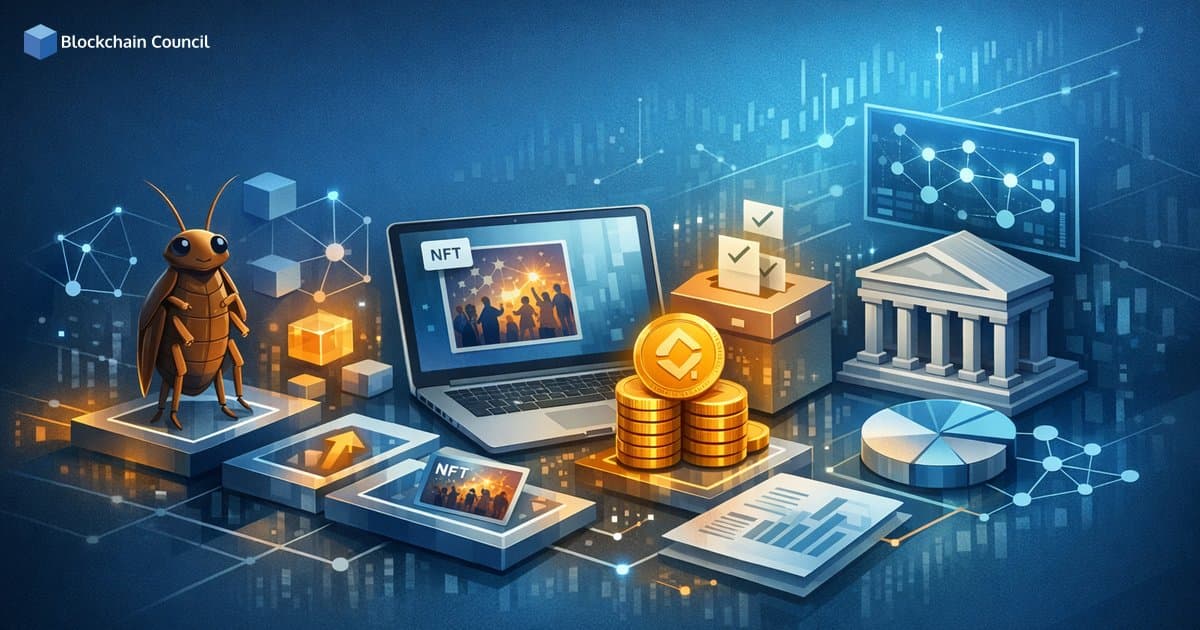
Building a Cockroach Janta Party MemeDAO is a practical way to convert viral, meme-native energy into transparent coordination: a community token for membership and voting, NFTs for contribution and identity, and governance that can fund real initiatives without relying on centralized gatekeepers. This guide presents a risk-aware, industry-aligned blueprint for launching a CJP-themed MemeDAO with a focus on sustainability, safety, and compliance.
What is the Cockroach Janta Party (CJP) and why it fits a MemeDAO model?
Cockroach Janta Party (CJP) emerged in May 2026 as an internet-first satirical political movement, widely reported as a response to controversial remarks attributed to Chief Justice of India Surya Kant about unemployed youth and online activists. The movement is associated with founder Abhijeet Dipke, a digital media strategist and former AAP social media volunteer.

CJP's identity is explicitly meme-native: a digital-forward symbol (often a smartphone with a cockroach), a satirical but policy-flavored manifesto covering transparency in funding, anti-defection penalties, student support, and institutional accountability, along with rapid online traction including tens of thousands of sign-ups within days and large social media followings.
This combination matters because MemeDAOs work best when there is:
- A strong narrative that people want to remix through memes, slogans, and symbols.
- A shared asset that coordinates participation, such as tokens and NFTs.
- A decision system for collective action through governance and treasury management.
Real-world precedents demonstrate the pattern: ConstitutionDAO coordinated roughly 17,000 contributors and raised over USD 40 million in ETH in under a week, while other cause-based DAOs have used governance tokens to organize funding, messaging, and community decision-making. The lesson is not to copy the hype, but to copy the coordination mechanisms.
Before you build: risks and design constraints you must address
A CJP-style MemeDAO sits at the intersection of crypto regulation, political finance sensitivity, and content moderation. Build your foundation before you mint anything.
- Crypto and securities risk: Governance tokens can attract regulatory scrutiny if marketed with profit expectations or if a small team appears to drive price outcomes. The U.S. SEC has repeatedly emphasized investment-contract analysis, while the EU's MiCA framework applies consumer protection and categorization rules to token offerings.
- India-specific considerations: India taxes virtual digital assets at 30% on gains and applies 1% TDS on transfers under the 2022 regime. RBI communications have consistently flagged crypto risks, and exchanges face strict KYC and AML requirements.
- Political finance and election law: Tokenized funding that touches candidates or campaigns can raise questions about anonymous or foreign contributions, reporting obligations, and spending caps under Indian election rules. Compliance obligations tend to intensify if a movement that begins as satire and advocacy starts funding electoral outcomes.
- Content, defamation, and AI safety: Incentivized meme production can drift into harassment, defamation, or deceptive AI-generated content. India has issued advisories on AI-generated deepfakes and misleading content, and platforms increasingly enforce moderation policies.
Practical takeaway: Design the CJP MemeDAO token as a coordination and governance utility. Avoid financial promises, build in transparency, and separate public goods and advocacy activities from direct electoral spending.
Step-by-step: how to launch a Cockroach Janta Party MemeDAO
Step 1: Define mission, scope, and red lines
Start with a written constitution that answers two questions:
- What is the DAO for? Examples include civic education, student support initiatives, RTI filing funds, open data, community events, research, and content creation.
- What is the DAO not for? Establish clear prohibitions on hate, harassment, violence, paid disinformation, and any spending that violates local election laws.
Publish this prominently on the website, forum, and governance documentation. Hash the constitution text on-chain for integrity by storing a content hash, while keeping the full document human-readable and accessible.
For teams formalizing rules and audits, Blockchain Council training such as Certified Blockchain Expert and Certified Smart Contract Developer provides relevant foundational knowledge.
Step 2: Choose a chain and governance stack that matches your community
For mass participation, transaction costs and user experience matter more than maximal decentralization in the early stages.
- Ethereum mainnet: Best-in-class security and composability, but high fees for frequent community actions.
- Ethereum L2s (Arbitrum, Optimism, Base, Polygon): Lower fees, strong DAO tooling, and widely used for governance and grants programs.
- Solana: Very low fees and high throughput, popular for viral meme tokens and NFTs across recent market cycles.
A battle-tested governance stack:
- Snapshot for off-chain voting linked to on-chain token balances, offering low cost and broad accessibility.
- Safe (formerly Gnosis Safe) for multi-sig treasury control.
- Optional on-chain governance using OpenZeppelin Governor, Aragon, Tally, or Zodiac modules once governance processes mature.
Step 3: Design tokenomics that prioritize governance, not speculation
Your community token, for example CJP or ROACH, should have clear utility:
- Voting and delegation
- Access gating for workstreams such as research, moderation, and treasury proposals
- Participation signaling, combined with contribution NFTs
Tokenomics checklist:
- No profit promises: Avoid language like "investment," "returns," or "guaranteed appreciation." Avoid buyback commitments.
- Simple supply model: A fixed cap, for example 1 billion tokens, is straightforward to communicate.
- Merit-based distribution: Use airdrops tied to verifiable contribution rather than large insider allocations.
- Vesting for core contributors: Multi-year vesting reduces sell pressure and aligns incentives with long-term goals.
Example allocation (illustrative):
- 50% community airdrops and retroactive rewards
- 20% treasury for DAO programs
- 15% core contributors with multi-year vesting
- 10% partners and grants
- 5% liquidity provisioning
Anti-whale and anti-Sybil controls to consider:
- Per-wallet caps during claims
- Reputation-weighted voting using NFT-based contribution records
- Quadratic voting for specific decisions where appropriate
Step 4: Build the NFT layer as identity, contribution, and reputation
NFTs work best for a movement DAO when they function as credentials rather than collectibles. Market trends since 2024 have shifted toward utility and membership NFTs rather than pure art speculation.
Recommended NFT types:
- Attendance NFTs: townhalls, campus meetups, civic workshops
- Contribution NFTs: RTI drafting, research, translations, moderation, event organizing
- Role NFTs: workstream leads, elected delegates, treasury signers
Implementation choices:
- Use ERC-721 or ERC-1155 on a low-fee network
- Prefer non-transferable (soulbound-style) contribution badges to prevent buying influence, consistent with the "Decentralized Society: Finding Web3's Soul" framework outlined by Vitalik Buterin, Glen Weyl, and Puja Ohlhaver
Governance integration: Combine token voting with contribution NFTs so influence reflects work, not just wallet size. A simple model:
voting weight = tokens (capped) + contribution badges
Step 5: Set up governance and treasury with progressive decentralization
Many successful DAOs use a phased approach similar to practices seen in long-running governance systems like MakerDAO and major token-governance protocols such as Uniswap and Compound.
Proposal lifecycle:
- Discussion on a forum using a standard template covering problem, plan, budget, and success metrics.
- Temperature check vote via Snapshot to filter low-signal proposals.
- Formal vote with defined quorum and threshold rules.
- Execution via Safe multi-sig, transitioning to on-chain execution as governance maturity increases.
Treasury setup:
- Use a 5-to-9-signer Safe with diverse representation across the community
- Define signer rotation schedules, term limits, and conflict-of-interest rules
- Use streaming payment tools such as Sablier for grants and contributor compensation to reduce misuse risk
Safety mechanisms:
- Emergency pause policy for credible security incidents or legal risk
- An elected safety or ethics committee to review content and high-risk proposals
Step 6: Plan compliance, transparency, and KYC triggers
For a political-satire movement with real-world effects, formalizing when identity checks are required is a sound risk-management practice.
- Separate funding lanes: Keep meme and advocacy funding separate from any direct electoral funding. Focus treasury spending on public goods such as research, civic education, legal aid, documentation, and community events.
- KYC as a conditional control: For general participation, full KYC can remain optional. For large donations, grants, or any activity touching election-sensitive spending, KYC on donors and recipients becomes a practical risk-reduction measure.
- Radical transparency: Publish treasury addresses, on-chain dashboards, and quarterly reports summarizing spend categories and outcomes.
Step 7: Launch plan that favors durability over hype
A sustainable launch sequence:
- Soft launch: Mint a non-transferable "Genesis Roach" badge to early volunteers and contributors. Use it as eligibility criteria for future merit-based rewards.
- Education-first: Publish tutorials on wallets, basic security, and DAO participation with plain-language risk disclosures. Consider regional language guides for broader inclusivity.
- Token distribution: Start with contribution-based claims and capped airdrops. Avoid early exchange-driven narratives and concentrate on governance utility.
- First proposals: Fund tangible initiatives aligned with the manifesto themes, such as RTI filing support, exam irregularity documentation, student legal aid, and open data explainers.
For teams building secure contracts and governance infrastructure, Blockchain Council programs such as Certified Web3 Community Expert, Certified Cryptocurrency Expert, and Certified Cybersecurity Expert cover relevant operational security and risk management topics.
Common failure modes and how to mitigate them
- Pump-and-dump dynamics: Use slow, merit-based token emissions, multi-year vesting, and avoid private sales that resemble capital raising.
- Governance capture: Combine token voting with contribution credentials, enable delegation, and consider quadratic mechanisms for decisions where concentration of holdings is a concern.
- Toxic content incentives: Establish clear community rules, active moderation, and penalties for harassment or deceptive AI-generated content. Require provenance labeling for AI-generated media.
- Exclusion and digital divide: Support hybrid participation through campus events, offline meetups, and onboarding sessions that reduce wallet and security friction for new participants.
Conclusion: turning a meme into accountable coordination
Building a Cockroach Janta Party MemeDAO can be more than a viral token launch if it is structured as a governance and public-goods system: a token designed for coordination, NFTs designed for contribution and reputation, and a treasury governed by transparent rules. The most durable movement DAOs do not chase speculation. They build legitimacy through clear safeguards, measurable impact, and repeatable governance processes.
If CJP-style communities can convert attention into credible structures, including proposal discipline, transparent funding, safer content norms, and inclusive onboarding, they can serve as a blueprint for how digitally native movements coordinate in the next era of civic technology.
Related Articles
View All
Info
Cockroach Janta Party Governance Model: Satire as a Blueprint for Resilient DAO Governance
Explore the Cockroach Janta Party governance model: a satire-inspired, multi-layer DAO framework designed to improve resilience, accountability, and inclusive participation.

Info
Cockroach Janta Party and Web3 Security: Persistence, Attack Surface, Defense-in-Depth
Learn how the Cockroach Janta Party meme movement maps to Web3 security threats, highlighting persistence, attack surfaces, and defense-in-depth best practices.

Info
Cockroach Janta Party Tokenomics: Designing Incentives That Survive Market Crashes and Rug-Pull Risks
Cockroach Janta Party tokenomics explained with a resilient blueprint: anti-rug distribution, LP locks, DAO treasury, governance utility, and crash-survival incentives.
Trending Articles
The Role of Blockchain in Ethical AI Development
How blockchain technology is being used to promote transparency and accountability in artificial intelligence systems.

Top 5 DeFi Platforms
Explore the leading decentralized finance platforms and what makes each one unique in the evolving DeFi landscape.
Blockchain in Supply Chain Provenance Tracking
Supply chains are under pressure to prove not just efficiency, but also authenticity, sustainability, and fairness. Customers want to know if their coffee really is fair trade, if the diamonds are con