

Blockchain Jobs in California
 Toshendra Kumar Sharma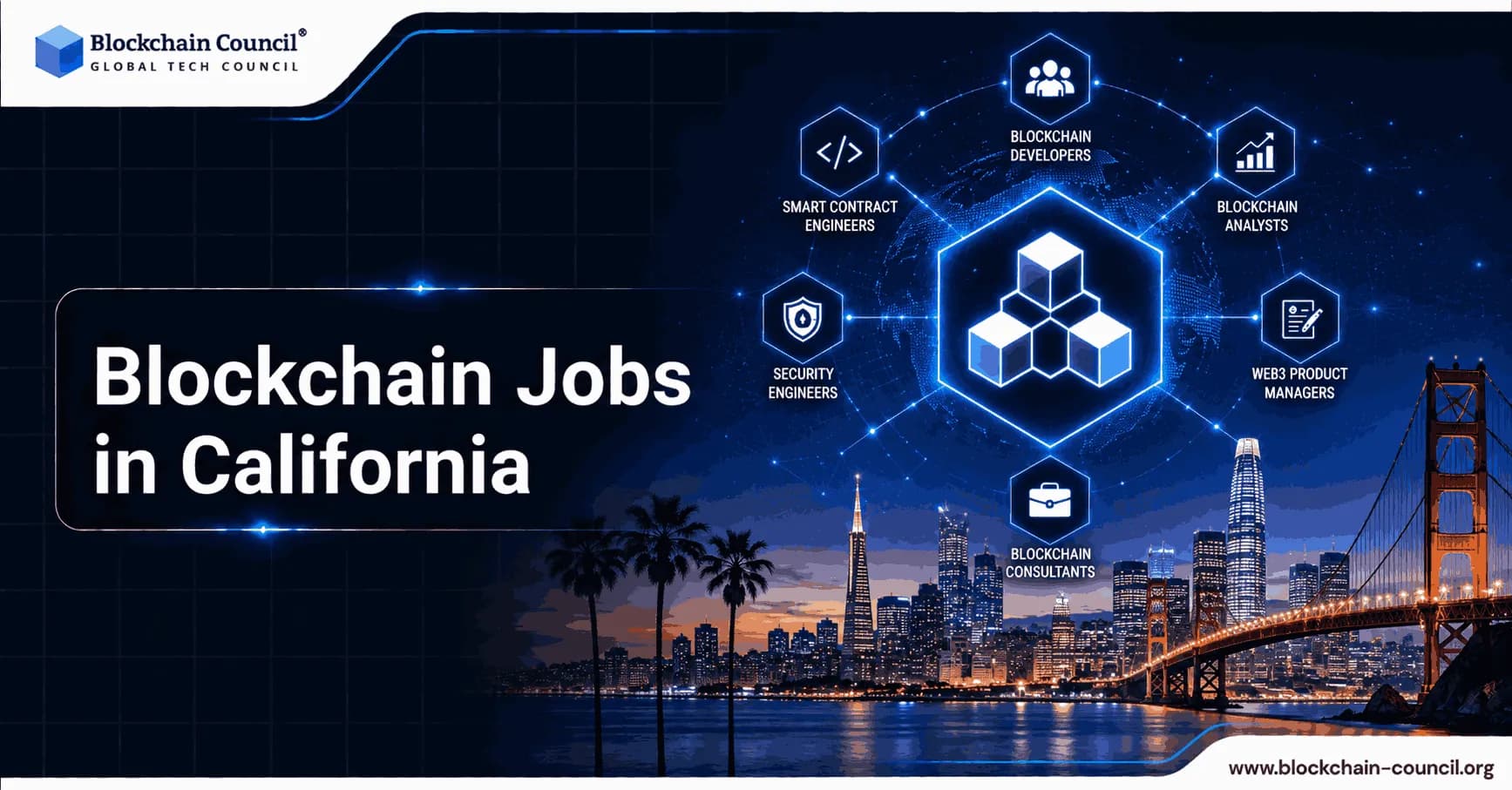
California remains the undisputed center of gravity for blockchain innovation in the United States, home to a dense concentration of venture backed Web3 startups, established crypto exchanges, and major technology companies experimenting with decentralized systems. From San Francisco's startup ecosystem to Los Angeles's growing NFT and creator economy scene, the state offers one of the widest ranges of blockchain career paths anywhere in the country. For professionals hoping to compete in this market, earning a Certified Blockchain Expert credential offers a recognized way to demonstrate broad, verifiable blockchain knowledge in a state where competition for strong roles remains intense.
The Roles Driving California's Blockchain Job Market
California's blockchain job market spans a genuinely wide range of positions. Smart contract developers remain in high demand at DeFi protocols and Web3 startups throughout the Bay Area, while blockchain security researchers and auditors are increasingly sought after as more projects handle significant financial value. Product managers with technical blockchain literacy help startups translate protocol level decisions into usable products, and growth focused roles at crypto exchanges and trading platforms continue to expand as the industry matures. Many of these positions specifically look for candidates holding a Certified Blockchain Developer credential, since California employers, particularly at well funded startups, consistently prioritize candidates who can show structured, verifiable proof of hands on development skills.

The Skills That Actually Matter to California Employers
Employers across California's blockchain sector tend to value practical, demonstrable experience over theoretical knowledge alone. Candidates who can point to deployed smart contracts, meaningful open source contributions, or a clear understanding of security auditing practices consistently perform well in interviews at venture backed startups. California companies also increasingly build products where blockchain integrates directly with cloud infrastructure, mobile applications, and traditional backend systems, which is why a broader Tech Certification has become a valuable addition to strong applications, signaling competence across the full technology stack that most production blockchain products actually depend on.
Future-Ready Skills
As technology becomes increasingly important across industries, students need opportunities to develop future-ready skills early in their education. A Tech Olympiad can introduce students to areas such as artificial intelligence, coding, cybersecurity, robotics, and computational thinking while encouraging curiosity and continuous learning. California's deep culture of early technical education and entrepreneurship reflects exactly the kind of foundation that this sort of structured exposure to technology can help build in students pursuing careers in fields like blockchain.
Building a Long Term Career in California's Blockchain Industry
Technical skill alone rarely guarantees the strongest opportunities in a state with as much competition for blockchain talent as California. Many professionals here work at startups where personal branding, networking, and the ability to pitch ideas clearly carry real weight alongside pure technical ability, particularly for those hoping to move into leadership or founder roles down the line. A Marketing Certification supports this directly, helping professionals present their expertise persuasively, build visibility in a market driven heavily by reputation and networking, and communicate the value of their work clearly to investors, teams, and clients. As California's blockchain industry continues to evolve alongside the broader tech sector, professionals who combine strong technical expertise with clear communication and continuous certification are best positioned to build lasting careers throughout the state.
FAQs
1. What are blockchain jobs in California?
Blockchain jobs in California include opportunities in blockchain development, Web3 engineering, smart contracts, digital assets, DeFi, stablecoins, blockchain infrastructure, cybersecurity, tokenization, compliance, and product management. Current job listings cover both technical and business roles.
2. Is California a good market for blockchain jobs?
Yes. California is one of the major U.S. markets for blockchain and Web3 employment, particularly around San Francisco, Silicon Valley, San Jose, Los Angeles, and other technology hubs. Current listings include more than 100 blockchain positions across the state on some job indexes.
3. Which cities in California have the most blockchain jobs?
San Francisco and the broader Bay Area are particularly important blockchain employment centers, with additional opportunities in San Jose, Los Angeles, Irvine, San Mateo, and other California cities. Current listings show blockchain and Web3 positions across these locations.
4. What blockchain job roles are available in California?
Common roles include Blockchain Developer, Blockchain Engineer, Solidity Developer, Smart Contract Engineer, Web3 Engineer, Blockchain Architect, Blockchain Security Engineer, Digital Asset Analyst, Blockchain Product Manager, and Web3 Business Development Specialist.
5. What skills are required for blockchain jobs in California?
Technical roles commonly require Solidity, Ethereum, EVM, JavaScript, TypeScript, Python, Go, Rust, smart-contract development, APIs, cloud infrastructure, cybersecurity, and distributed systems. Requirements vary by company and specialization.
6. Is Solidity in demand for blockchain jobs in California?
Yes. Solidity remains an important skill for Ethereum and EVM-based smart-contract development. Candidates who combine Solidity with testing, security, DeFi, and Web3 infrastructure skills can target specialized engineering positions.
7. What is the salary for blockchain jobs in California?
Blockchain compensation can be relatively high but varies substantially by role and experience. Current listings include a Senior Blockchain Developer role in the Bay Area at $102,500-$213,400 annually, while some senior blockchain/Web3 engineering positions advertise compensation above $200,000.
8. Are there entry-level blockchain jobs in California?
Yes. Opportunities can include internships, junior software engineering, research, operations, marketing, and early-career Web3 positions. Building a portfolio of blockchain projects can help candidates demonstrate practical skills when professional experience is limited. Current blockchain job boards also list internship opportunities in the California market.
9. Are blockchain jobs in California only for developers?
No. California's blockchain ecosystem also needs professionals in finance, legal, compliance, marketing, sales, operations, consulting, research, product management, and business development. Current listings include blockchain-related legal, strategy, sales, and business-development roles.
10. Are banks and financial companies hiring blockchain professionals in California?
Yes. Financial institutions and fintech companies are hiring for blockchain-related payments, stablecoins, digital assets, financial infrastructure, and Web3 roles. Current California listings include positions involving blockchain payments and stablecoin technology.
11. Are there RWA tokenization jobs in California?
Yes. California's blockchain market increasingly overlaps with real-world asset tokenization, digital securities, stablecoins, financial infrastructure, and institutional digital assets. Professionals with blockchain and traditional-finance knowledge can target this growing area.
12. What skills are useful for RWA tokenization jobs in California?
Useful skills include Solidity, smart contracts, token standards, Ethereum/EVM networks, digital securities, custody, KYC/AML, financial regulations, asset management, stablecoins, oracles, and blockchain interoperability.
13. Are there DeFi and stablecoin jobs in California?
Yes. Current California listings include positions connected to DeFi, stablecoins, payments, digital assets, and financial infrastructure. San Francisco is particularly active in these areas.
14. Is blockchain security important for careers in California?
Absolutely. Blockchain companies need professionals who understand smart-contract security, cryptography, wallet security, cybersecurity, vulnerability analysis, and secure infrastructure. Current San Francisco listings include dedicated blockchain and security engineering positions.
15. Can finance professionals find blockchain jobs in California?
Yes. Finance professionals can pursue careers involving digital assets, payments, stablecoins, tokenized assets, custody, trading, investment operations, compliance, and financial technology. California's fintech ecosystem creates opportunities at the intersection of blockchain and traditional finance.
16. Can international candidates apply for blockchain jobs in California?
Yes, depending on the employer and position. Some companies may offer visa sponsorship or relocation support, while others require existing U.S. work authorization. Candidates should verify the requirements of each individual vacancy.
17. How can I get a blockchain job in California without experience?
Start with blockchain fundamentals, Ethereum, Solidity, smart contracts, and Web3 development. Build projects such as an ERC-20 token, NFT marketplace, DeFi application, wallet integration, or RWA tokenization prototype. Publish the projects on GitHub and document your testing and security practices.
18. Where can I find blockchain jobs in California?
You can search LinkedIn, Indeed, Wellfound, Built In, Web3 job boards, specialist blockchain recruitment platforms, and company career pages. Current listings show opportunities across San Francisco, San Jose, Los Angeles, San Mateo, Irvine, and other California locations.
19. What should I include on my resume for a blockchain job in California?
Highlight Solidity projects, Ethereum/EVM experience, smart-contract deployments, GitHub repositories, Web3 tools, blockchain security, DeFi or RWA projects, cloud infrastructure, and relevant certifications. For non-technical roles, emphasize digital assets, fintech, compliance, finance, or product experience.
20. What is the future of blockchain jobs in California?
California's blockchain employment market is increasingly expanding beyond cryptocurrency into stablecoins, payments, RWA tokenization, institutional digital assets, DeFi, cybersecurity, blockchain infrastructure, and AI-powered financial technology. Current hiring already reflects this broader transition, particularly in the Bay Area.
Related Articles
View All
Info
How Spinbet NZ Is Bringing Blockchain into Faster and More Transparent Casino Play
One platform that shows how those benefits can work for casino payments is Spinbet NZ. Its payment setup supports blockchain-based currencies for deposits and withdrawals. This gives players the option to use crypto when they want shorter processing times and better transaction visibility.
Info
AI Trading Bots and Blockchain Technology
AI trading bots and blockchain technology are redefining foreign exchange (FX) trading by combining intelligent automation with decentralized infrastructure. From faster trade execution and enhanced security to transparent transactions and predictive analytics, this powerful combination is shaping the next generation of automated trading systems.

Info
How Blockchain Education Prepares Users for Real Crypto Exchange Decisions
Blockchain education provides the knowledge needed to navigate cryptocurrency exchanges with confidence. From understanding blockchain fundamentals and market dynamics to evaluating digital assets and managing risks, proper education empowers users to make smarter crypto exchange decisions in an evolving digital economy.
Trending Articles
The Role of Blockchain in Ethical AI Development
How blockchain technology is being used to promote transparency and accountability in artificial intelligence systems.

Top 5 DeFi Platforms
Explore the leading decentralized finance platforms and what makes each one unique in the evolving DeFi landscape.
How to Install Claude Code
Learn how to install Claude Code on macOS, Linux, and Windows using the native installer, plus verification, authentication, and troubleshooting tips.