

Blockchain Jobs in Europe
 Toshendra Kumar Sharma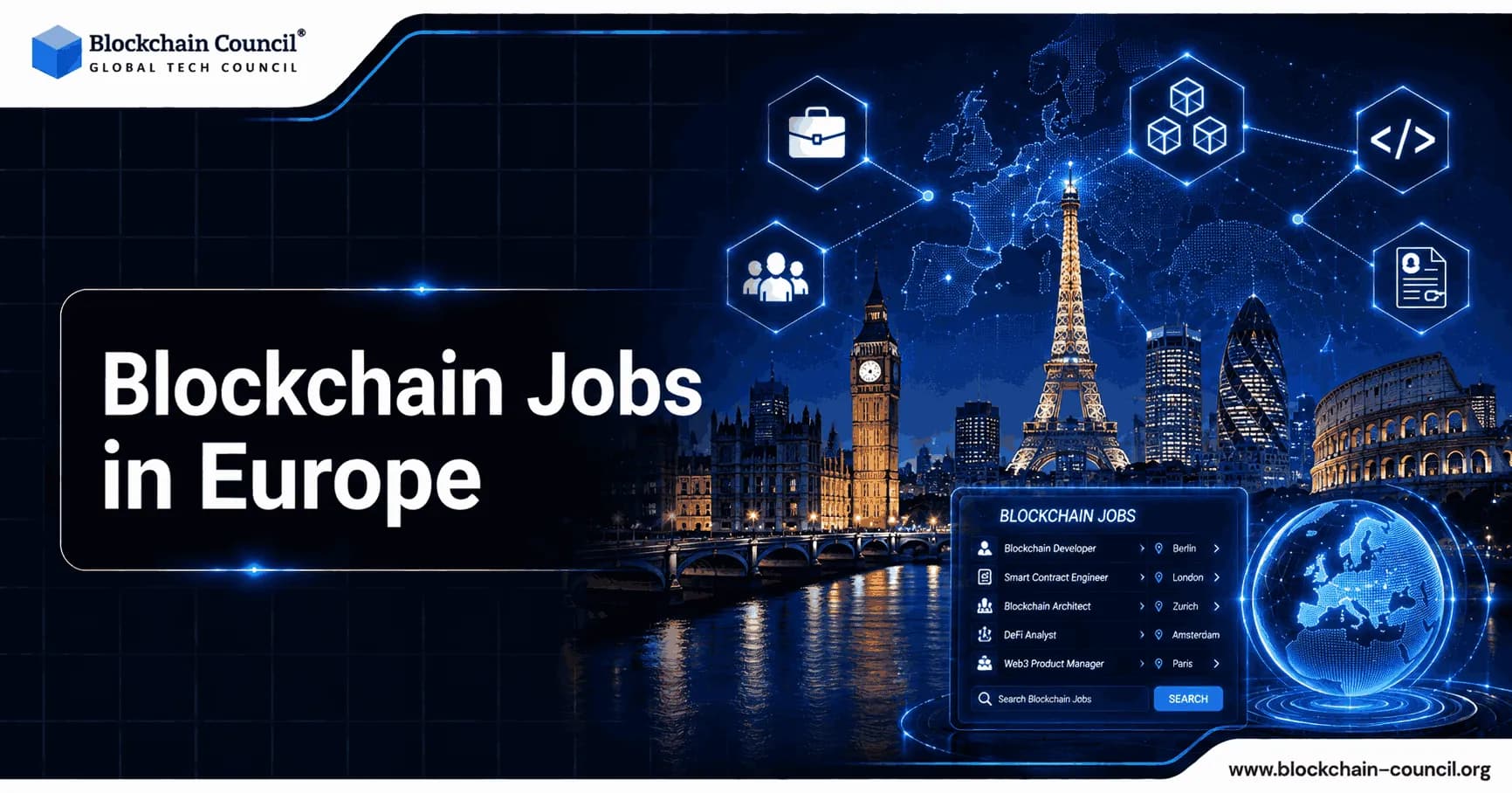
Europe has built one of the most balanced and regulated blockchain job markets in the world, supported by the European Union's Markets in Crypto Assets regulation, which gave companies a clear legal framework to operate under across member states. That structure has encouraged blockchain adoption well beyond crypto native startups, drawing banks, manufacturers, logistics companies, and public institutions into genuine blockchain experimentation across the continent. For professionals hoping to compete in this diverse market, earning a Certified Blockchain Expert credential offers a recognized way to demonstrate broad, verifiable blockchain knowledge to employers operating across dozens of countries and industries.
The Roles Shaping Europe's Blockchain Job Market
Blockchain hiring across Europe spans a genuinely wide range of sectors. Financial institutions in hubs like Frankfurt and London hire blockchain engineers to work on tokenized assets and digital settlement systems, while Germany's strong manufacturing base has created demand for blockchain professionals working on supply chain traceability and industrial IoT integration. Switzerland's Crypto Valley continues to host blockchain foundations and infrastructure companies, and public sector initiatives across several EU countries are exploring blockchain for digital identity and public records. Consulting firms with a European wide presence also hire blockchain specialists to advise clients navigating MiCA compliance. Many of these positions specifically look for candidates holding a Certified Blockchain Developer credential, since European employers consistently prioritize candidates who can demonstrate structured, verifiable technical training.

The Skills That Matter Across Europe's Blockchain Sector
With MiCA now shaping compliance requirements across the European Union, employers increasingly expect candidates to combine technical development skills with a working understanding of regulatory considerations that affect how blockchain products can legally operate. Deployed projects, security auditing experience, and clear technical documentation all help candidates stand out in a market that draws applicants from across the continent. Because many European blockchain projects integrate closely with existing financial, industrial, or government systems, candidates who hold a broader Tech Certification often stand out further, since it signals competence across cloud infrastructure, backend systems, and data security that these varied applications depend on.
Future-Ready Skills
As technology becomes increasingly important across industries, students need opportunities to develop future-ready skills early in their education. A Tech Olympiad can introduce students to areas such as artificial intelligence, coding, cybersecurity, robotics, and computational thinking while encouraging curiosity and continuous learning. Europe's many strong national education systems reflect the same value that this kind of early, structured exposure to technology brings to students building careers in specialized fields like blockchain.
Building a Career Across a Diverse, Multi-Market Region
Technical skill matters throughout Europe's blockchain job market, but competing across a continent with dozens of languages, cultures, and regulatory nuances rewards candidates who communicate clearly and adapt easily to different professional environments. Many blockchain professionals in Europe work as consultants or freelancers serving clients across multiple countries, which makes the ability to present work persuasively and build visibility genuinely valuable alongside technical ability. A Marketing Certification supports this directly, helping professionals communicate their expertise clearly across different markets, build a strong professional presence that attracts opportunities from multiple countries, and differentiate themselves in a region where technical talent is abundant and well distributed. As Europe's regulatory clarity continues to attract blockchain investment across industries, professionals who combine strong technical expertise with clear communication and continuous certification are best positioned to build lasting careers across the continent.
FAQs
1. What are blockchain jobs in Europe?
Blockchain jobs in Europe include opportunities in blockchain development, Web3, smart contracts, digital assets, DeFi, blockchain security, tokenization, compliance, custody, and blockchain infrastructure. Current listings span engineering, operations, legal, business development, product management, marketing, and finance.
2. Is Europe a good region for blockchain jobs?
Yes. Europe has a growing blockchain and digital-assets employment market, supported by technology companies, financial institutions, crypto businesses, startups, and blockchain protocols. Current job boards list hundreds of Web3 and crypto positions across the region.
3. What blockchain job roles are available in Europe?
Common roles include Blockchain Developer, Blockchain Engineer, Solidity Developer, Smart Contract Developer, Web3 Engineer, Blockchain Architect, Protocol Engineer, Blockchain Security Engineer, Digital Asset Analyst, Blockchain Consultant, Compliance Specialist, and Blockchain Product Manager. Current listings also include legal, operations, finance, and business-development roles.
4. What skills are required for blockchain jobs in Europe?
Technical employers commonly look for Solidity, Ethereum/EVM, Rust, Go, Python, JavaScript, TypeScript, smart contracts, distributed systems, cryptography, APIs, cloud technologies, and cybersecurity. Knowledge of blockchain regulation and financial markets can also be valuable for non-development roles.
5. Is Solidity in demand for blockchain jobs in Europe?
Yes. Solidity is an important skill for Ethereum and EVM-based smart-contract development, particularly in DeFi, tokenization, Web3 applications, and digital-asset infrastructure. Candidates can strengthen their profiles by combining Solidity with testing and smart-contract security.
6. What is the salary for blockchain jobs in Europe?
Blockchain compensation varies significantly by country, experience, specialization, company, and employment type. One 2026 European salary guide estimates mid-level blockchain developers at approximately €48,000-€95,000 annually, while current crypto listings show substantially higher compensation for some senior and specialized positions.
7. Are there entry-level blockchain jobs in Europe?
Yes. Entry-level opportunities exist, although junior blockchain-development positions can be competitive. Candidates can also enter the industry through software engineering, fintech, compliance, analytics, marketing, operations, or graduate roles and specialize in blockchain later. Current listings include junior and entry-level positions.
8. Are blockchain jobs in Europe only for developers?
No. The European blockchain ecosystem also needs professionals in compliance, AML, legal, risk, finance, product management, research, marketing, sales, business development, operations, and customer success. Current listings demonstrate demand across many of these categories.
9. Which European cities have the most blockchain jobs?
Major blockchain employment hubs include London, Berlin, Amsterdam, Paris, Zurich, Lisbon, Dublin, Vienna, and Stockholm, although opportunities vary by specialization. Current listings show particularly strong activity in London, Amsterdam, Berlin, Paris, Zurich, and other European technology and financial centers.
10. Are there blockchain jobs outside major European cities?
Yes. Blockchain companies increasingly support remote and hybrid employment, allowing professionals to work from locations outside major technology hubs. Current job boards list hundreds of remote-friendly crypto and Web3 opportunities accessible from Europe.
11. Are there RWA tokenization jobs in Europe?
Yes. Real-world asset (RWA) tokenization is becoming an important area within Europe's digital-asset and financial-technology ecosystem. Potential roles involve tokenized securities, smart contracts, custody, capital markets, compliance, digital assets, and blockchain infrastructure. European financial institutions are also exploring blockchain-based settlement infrastructure.
12. What skills are useful for RWA tokenization jobs in Europe?
Useful skills include Solidity, Ethereum/EVM, token standards, smart contracts, digital securities, asset tokenization, custody, KYC/AML, blockchain security, stablecoins, and capital-markets infrastructure. Understanding European digital-asset regulation can provide an additional advantage.
13. Are there Web3 jobs in Europe?
Yes. Europe currently has hundreds of Web3 and crypto vacancies across engineering, operations, legal, product management, business development, marketing, finance, and other functions. Current listings include opportunities at companies such as Kraken, Fireblocks, Coinbase, Chainalysis, Blockstream, and Bitpanda.
14. Is blockchain security important for careers in Europe?
Absolutely. Blockchain security is essential for protecting smart contracts, wallets, protocols, decentralized applications, and digital assets. Skills in smart-contract auditing, cryptography, secure coding, vulnerability analysis, and protocol security can make candidates more competitive.
15. Which blockchain development tools should job seekers in Europe learn?
Useful tools include Hardhat, Foundry, OpenZeppelin, Ethers.js, Web3.js, Git/GitHub, Docker, blockchain explorers, and smart-contract testing frameworks. Developers interested in protocol-level positions should also consider learning Rust or Go, depending on their target ecosystem.
16. Are there digital-asset and crypto jobs in Europe?
Yes. The European market includes positions in digital-asset engineering, custody, trading, compliance, risk, research, product development, institutional sales, and financial infrastructure. Current listings show particularly broad hiring across engineering, operations, legal, product, and business development.
17. Can freshers get blockchain jobs in Europe?
Yes, but competition for specialized roles can be high. Freshers can improve their chances by learning blockchain fundamentals, Solidity, Ethereum, smart contracts, Web3 development, Git, and cybersecurity, then building practical projects and publishing their work on GitHub.
18. Where can I find blockchain jobs in Europe?
You can search LinkedIn, Indeed, EURES, Web3.Career, Wellfound, specialist blockchain job boards, and company career pages. Current job platforms show opportunities across both local European offices and remote positions.
19. What should I include on my resume for a blockchain job in Europe?
Highlight Solidity or Rust projects, Ethereum/EVM experience, smart-contract deployments, GitHub repositories, Web3 applications, blockchain security, DeFi or RWA projects, APIs, distributed systems, cloud technologies, and relevant certifications.
For non-technical roles, emphasize blockchain knowledge alongside experience in finance, compliance, AML, risk, product management, research, marketing, operations, or business development.
20. What is the future of blockchain jobs in Europe?
The European blockchain employment market is moving beyond cryptocurrency-focused development toward digital assets, RWA tokenization, stablecoins, institutional blockchain, Web3 infrastructure, cybersecurity, compliance, and tokenized financial markets. The European Central Bank is also exploring blockchain-based financial-market infrastructure and tokenized money, signaling growing institutional interest in on-chain finance.
Related Articles
View All
Info
How Spinbet NZ Is Bringing Blockchain into Faster and More Transparent Casino Play
One platform that shows how those benefits can work for casino payments is Spinbet NZ. Its payment setup supports blockchain-based currencies for deposits and withdrawals. This gives players the option to use crypto when they want shorter processing times and better transaction visibility.
Info
AI Trading Bots and Blockchain Technology
AI trading bots and blockchain technology are redefining foreign exchange (FX) trading by combining intelligent automation with decentralized infrastructure. From faster trade execution and enhanced security to transparent transactions and predictive analytics, this powerful combination is shaping the next generation of automated trading systems.

Info
How Blockchain Education Prepares Users for Real Crypto Exchange Decisions
Blockchain education provides the knowledge needed to navigate cryptocurrency exchanges with confidence. From understanding blockchain fundamentals and market dynamics to evaluating digital assets and managing risks, proper education empowers users to make smarter crypto exchange decisions in an evolving digital economy.
Trending Articles
AWS Career Roadmap
A step-by-step guide to building a successful career in Amazon Web Services cloud computing.

Top 5 DeFi Platforms
Explore the leading decentralized finance platforms and what makes each one unique in the evolving DeFi landscape.

Can DeFi 2.0 Bridge the Gap Between Traditional and Decentralized Finance?
The next generation of DeFi protocols aims to connect traditional banking with decentralized finance ecosystems.