

Blockchain Developer Salary in India
 Toshendra Kumar Sharma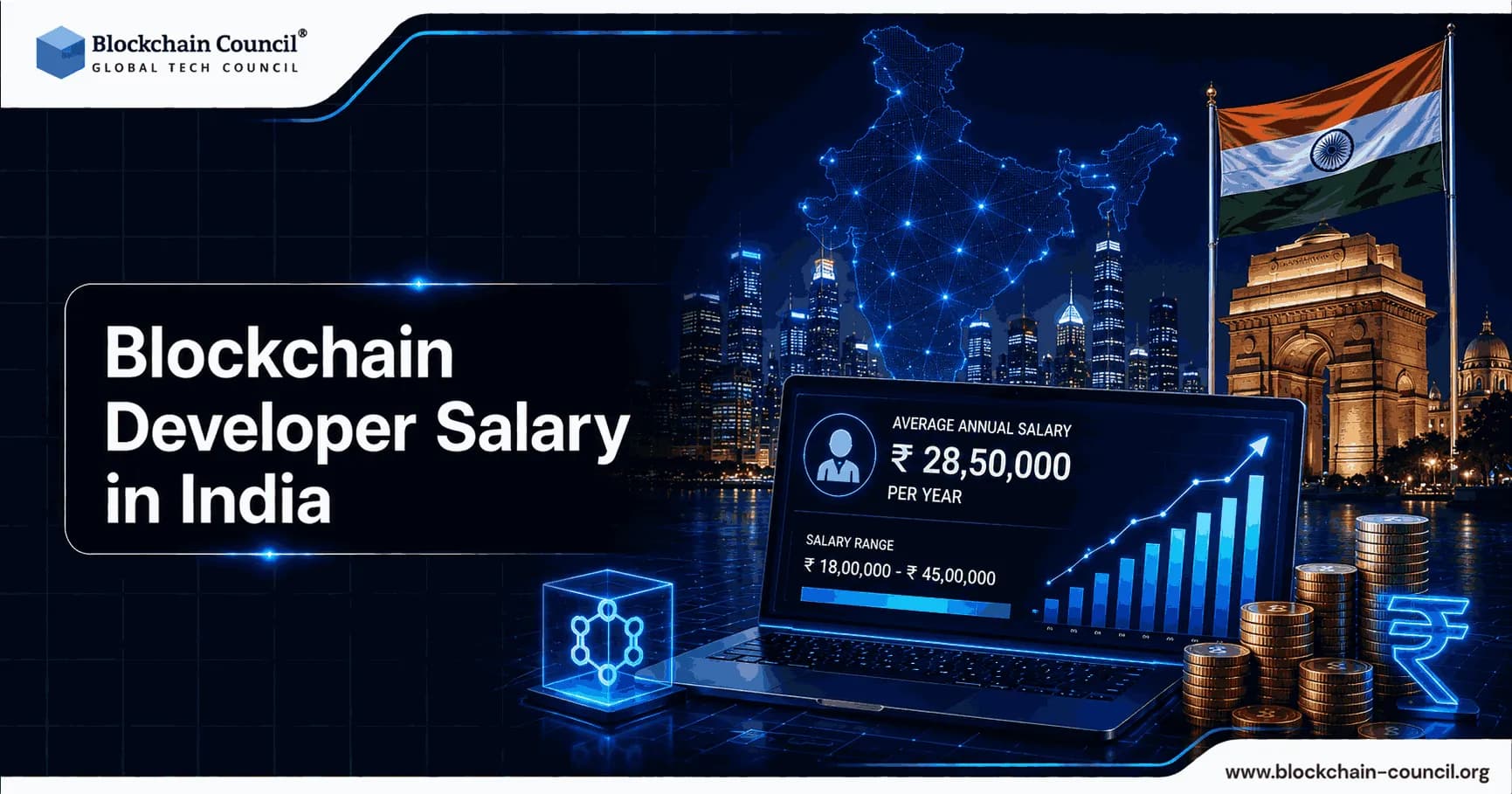
Blockchain developer pay in India covers a genuinely wide spread depending on which source you check. AmbitionBox reports a fairly modest average of ₹9.4 lakhs across all experience levels, with freshers earning around ₹7.4 lakhs and five-plus-year professionals reaching roughly ₹14 lakhs. A more recent 2026 compensation guide compiled from verified reported salaries paints a considerably stronger picture, placing the average for blockchain-skilled professionals at ₹32.6 lakhs annually, with the top 10 percent earning ₹62.8 lakhs or more and the top 1 percent crossing ₹106 lakhs. That gap is not a contradiction so much as a reflection of how differently "blockchain developer" gets defined and measured across different platforms, and understanding it is the first real step toward figuring out where your own skills and experience actually place you.
Closing the gap between the lower and upper ends of this range usually comes down to one thing: genuinely validated, job-ready skill. Blockchain Council's Certified Blockchain Developer certification has become one of the most recognized ways Indian developers build and demonstrate exactly that kind of credential to employers evaluating candidates across a genuinely crowded field.

What Blockchain Developers In India Actually Earn
Salary By Experience Level
Entry-level blockchain developers in India typically start somewhere between ₹5 and ₹9 lakhs annually, depending on the specific source and role definition, already positioning them above typical entry-level software engineering pay in most cases. Mid-career professionals with two to five years of experience generally land in the ₹13 to ₹14 lakh range according to more conservative industry benchmarks, while more recent, broader compensation data shows senior professionals reaching considerably higher, with India's senior blockchain salary range spanning roughly ₹17 to ₹40 lakhs or more depending on specialization and company type. Blockchain architects sit at the very top of this progression, averaging around ₹25 lakhs, typically two to three times what generalist blockchain developers earn in comparable roles.
Salary By City
Location remains one of the strongest factors shaping blockchain developer pay across India. Bengaluru consistently leads the country, with Glassdoor placing average city-specific pay around ₹8.6 lakhs, roughly 15 percent above the national average, and top earners in the city reaching as high as ₹23 lakhs. Other reports place Bengaluru's average closer to ₹10 lakhs, reinforcing its position as India's clear blockchain hiring hub. Hyderabad, Pune, Noida, and Mumbai also rank among the country's strongest blockchain job markets, generally offering competitive pay just behind Bengaluru, while location alone can shift compensation by up to 30 percent compared to smaller, tier-two cities.
Making sense of a market with this much variation by city and role definition takes more than surface-level research. Many developers pair their hands-on technical training with Blockchain Council's broader Certified Blockchain Expert program as well, building both the practical coding skill employers are actively hiring for and the wider strategic fluency that supports moving into architecture, consulting, or leadership roles as an Indian blockchain career develops.
The International Remote Premium Changes The Math Entirely
This is genuinely the most important factor shaping strong blockchain compensation in India right now. International companies are actively hiring India-based blockchain professionals for fully remote positions, and this route consistently pays global rates rather than domestic Indian salary bands. Tether has been actively hiring senior backend developers across Bengaluru, Mumbai, Hyderabad, Chennai, Pune, and Delhi for fully remote roles, while Coinbase maintains multiple India-based remote engineering positions as well. Industry analysis consistently describes this international remote premium as the single most impactful career strategy available to skilled Indian blockchain professionals, often paying meaningfully more than even the strongest domestic offers for comparable seniority and skill.
This dynamic means two developers with genuinely similar skill levels can see dramatically different total compensation depending entirely on whether they are competing in India's domestic job market or positioning themselves for this international remote track.
Specialization Still Matters Enormously
Within both the domestic and international tracks, specialization continues to separate strong earners from the rest of the market. Smart contract developers specifically start well above general blockchain developer pay, typically in the ₹8 to ₹11.4 lakh range even at entry level, while community managers and other non-technical blockchain roles command noticeably less. This pattern holds consistently across nearly every salary source: technical depth in smart contracts, Solidity, or enterprise frameworks like Hyperledger translates directly into stronger offers, regardless of which broader salary benchmark you compare against.
Competing successfully for the higher-paying international remote roles specifically requires genuinely comprehensive, portable technical training, not just familiarity with concepts. A Tech Certification in blockchain development gives Indian developers a practical, internationally recognized skill set that supports exactly this kind of competitive positioning against a genuinely global talent pool.
Building The Next Generation Of Indian Blockchain Talent
A genuinely strong blockchain career pipeline in India does not begin with a first job or certification. It begins with giving young students structured, hands-on exposure to technology early enough that fields like blockchain feel approachable well before they are choosing a career path. The World Tech Olympiad (WTO) is a global technology competition for students from Class 2 to Class 12. Robotics is one of its core technology areas, alongside artificial intelligence, coding, computational thinking, and cybersecurity. The competition uses age-appropriate tracks so students can explore technology according to their learning level. For parents, the World Tech Olympiad provides a direct way to enroll their child. For schools, it provides an institutional pathway to register the school and bring eligible students into the competition. Early, structured technical exposure like this is exactly what tends to produce the confident, capable professionals who go on to pursue advanced credentials and eventually compete successfully for India's strongest blockchain opportunities, domestic or international.
Turning Raw Salary Data Into A Real Career Strategy
Understanding where blockchain compensation actually sits across India's varied city and international remote markets is only useful if it becomes a concrete plan. Developers who successfully move toward the stronger end of this spread typically combine a recognized certification with a genuine, demonstrable portfolio, open-source contributions, deployed smart contracts, or real project work that gives international employers specifically a reason to trust a candidate they may never meet in person. For developers building a consulting practice or personal brand around their blockchain expertise, a Marketing Certification rounds out that strategy well, giving technically skilled professionals the communication and positioning skills needed to convert genuine expertise into visible, well-compensated opportunities across both domestic and international markets.
Final Thoughts
Blockchain developer salaries in India resist any single, simple number, and that is precisely why understanding the full spread, by experience level, by city, and critically, by domestic versus international remote positioning, matters so much more than relying on one averaged figure. Bengaluru leads domestically, specialization in smart contracts and architecture consistently commands a premium, and the international remote market offers a genuinely transformative path for developers who can build the validated, portable expertise global employers are looking for. Building that expertise through a recognized certification remains one of the clearest ways for Indian developers to move confidently toward the strongest end of this genuinely wide-ranging market.
FAQs
1. What Is the Average Blockchain Developer Salary in India?
As of 2026, the average blockchain developer salary in India is roughly ₹6 lakh to ₹7 lakh per year according to Glassdoor, with typical base salaries ranging from approximately ₹4 lakh to ₹10 lakh annually. Individual compensation varies considerably according to experience, city, employer, programming skills, and blockchain specialization.
2. How Much Does a Blockchain Developer Earn in India in 2026?
A practical 2026 salary range for blockchain developers in India is approximately ₹4 lakh to ₹15 lakh per year for many mainstream roles. Glassdoor reports an average base salary around ₹7 lakh, while recent individual salary submissions range from ₹3-₹4 lakh for some early-career positions to ₹13-₹16 lakh for an experienced developer in New Delhi.
3. What Is the Entry-Level Blockchain Developer Salary in India?
Entry-level blockchain developers in India can typically target around ₹3 lakh to ₹6 lakh per year, although candidates with strong software-development fundamentals and practical Web3 projects can earn more. Glassdoor currently shows fresher blockchain developer openings around ₹4-₹5 lakh annually, while recent salaries for professionals with one to three years of experience range considerably depending on location and employer.
4. What Is the Mid-Level Blockchain Developer Salary in India?
Mid-level blockchain developers with approximately three to five years of relevant experience can potentially earn around ₹6 lakh to ₹15 lakh per year. Compensation can rise when developers have production experience in Solidity, Ethereum, Rust, Go, smart contracts, distributed systems, or security. Recent Glassdoor submissions include ₹9 lakh for a developer with four to six years of experience, while individual employers and specialist roles can pay substantially more.
5. What Is the Senior Blockchain Developer Salary in India?
Senior blockchain developers can potentially earn approximately ₹12 lakh to ₹25 lakh+ annually, particularly when their roles involve architecture, smart-contract security, protocol engineering, or technical leadership. Current salary submissions show considerable variation, including ₹13-₹16 lakh for a professional with seven to nine years of experience and much higher outlier compensation in Bengaluru.
6. What Is the Blockchain Developer Salary in Bangalore?
Bangalore, or Bengaluru, is one of India's strongest markets for blockchain talent. Glassdoor's 2026 data estimates average blockchain developer compensation in Bangalore at approximately ₹8.6 lakh per year, with a typical range of roughly ₹5.06 lakh to ₹16.88 lakh. Reported top earners reach approximately ₹23 lakh annually.
7. Do Blockchain Developers Earn More in Bengaluru Than the India Average?
Current salary data suggests they can. Glassdoor estimates average blockchain developer compensation in Bangalore at approximately ₹8.6 lakh annually, compared with an India-wide average base salary around ₹6-₹7 lakh. Bengaluru's concentration of technology companies, startups, global capability centers, and engineering talent can support stronger opportunities for experienced blockchain professionals.
8. What Is the Salary of a Solidity Developer in India?
Solidity developers can command higher compensation when they have strong smart-contract and Web3 expertise. Flexiple's August 2026 dataset reports a ₹8.8 lakh median annual CTC for Solidity developers in India, with the middle 50% earning approximately ₹4.9 lakh to ₹17.6 lakh. The highest-paid 10% in its dataset earn more than ₹31 lakh annually.
9. What Is the Solidity Developer Salary in Bangalore?
Bengaluru appears particularly strong for Solidity development. Flexiple's August 2026 dataset places the all-level median Solidity developer compensation in Bengaluru at approximately ₹15.5 lakh per year, based on more than 500 compensation records. This is substantially above its all-India Solidity median of ₹8.8 lakh.
10. What Is the Full-Stack Blockchain Developer Salary in India?
Glassdoor estimates average full-stack blockchain developer compensation in India at approximately ₹7.65 lakh per year. Its typical 25th-to-75th-percentile range is around ₹5.7 lakh to ₹13 lakh, while reported 90th-percentile compensation reaches approximately ₹21 lakh. The dataset is small, however, so these figures should be treated as directional rather than sacred salary scripture.
11. Which Skills Can Increase a Blockchain Developer's Salary in India?
Higher-value skills include Solidity, Rust, Go, Ethereum, smart contracts, Web3 development, distributed systems, cryptography, backend engineering, cybersecurity, cloud infrastructure, and smart-contract auditing. Developers who combine blockchain expertise with strong conventional software engineering generally have better salary prospects because employers need engineers capable of building production systems, not merely explaining decentralization impressively.
12. Does Solidity Increase Blockchain Developer Salary in India?
Solidity can increase earning potential, particularly for developers targeting Ethereum, EVM networks, DeFi, tokenization, and smart-contract applications. Flexiple reports a ₹8.8 lakh median for Solidity developers nationally and approximately ₹15.5 lakh in Bengaluru. Developers who add smart-contract testing, security auditing, backend integration, and protocol knowledge can potentially target higher-value roles.
13. Is Rust a Valuable Skill for Blockchain Developers in India?
Yes. Rust is useful for protocol engineering, blockchain infrastructure, high-performance systems, and several Web3 ecosystems. Developers who combine Rust with distributed systems, networking, cryptography, security, and blockchain architecture can target more specialized engineering positions. Rust also transfers beyond blockchain, which is useful because constructing an entire career around whichever chain is fashionable this year would be unnecessarily adventurous.
14. Do Blockchain Developers Earn More Than Regular Software Developers in India?
Blockchain developers can earn a premium when they possess scarce expertise in smart contracts, distributed systems, cryptography, or security. However, blockchain is not automatically more lucrative than conventional software development. Experienced AI, cloud, cybersecurity, DevOps, backend, and data engineers can earn equally strong or higher compensation. Salary premiums usually come from specialization and engineering depth rather than the word “blockchain” itself.
15. Can Blockchain Developers in India Earn More Than ₹20 Lakh Per Year?
Yes. Experienced blockchain developers and specialists can earn ₹20 lakh or more annually, particularly in Bengaluru, international remote roles, Web3 startups, security, and protocol engineering. Glassdoor reports Bangalore blockchain developer top earners around ₹23 lakh, while its recent India submissions include a Bengaluru Rural developer with four to six years of experience reporting approximately ₹34-₹39 lakh annually. Such figures represent the upper market rather than typical compensation.
16. Can Blockchain Developers in India Earn ₹30 Lakh or More?
Yes, but salaries above ₹30 lakh generally belong to the upper end of the market. Flexiple reports that the highest-paid 10% of Solidity developers in its India dataset earn ₹31.1 lakh or more in all-in annual CTC. Reaching this level usually requires substantial engineering experience, specialized blockchain skills, strong security knowledge, or employment with a higher-paying domestic or international organization.
17. Do Blockchain Certifications Increase Developer Salaries in India?
Blockchain certifications can strengthen a candidate's professional profile, especially for students, beginners, and software developers transitioning into blockchain. However, certification alone does not guarantee a particular salary. The stronger combination is Blockchain Certification + Programming + Solidity/Rust + Smart Contracts + Security + Real Projects + Professional Experience. Credentials validate structured learning, while projects demonstrate that some of that learning survived contact with an actual codebase.
18. What Qualifications Are Needed to Become a Blockchain Developer in India?
A degree in computer science, information technology, software engineering, mathematics, or a related discipline can help, but practical development ability is equally important. Candidates should understand programming, data structures, algorithms, databases, APIs, Git, backend development, networking, blockchain fundamentals, smart contracts, testing, and security. Developers targeting specialized roles should add distributed systems, cryptography, cloud infrastructure, and system design.
19. How Can You Become a High-Paid Blockchain Developer in India?
A strong career path begins with conventional software engineering:
Programming → Data Structures → Algorithms → Git → Databases → APIs → Backend Development
Then build blockchain specialization:
Blockchain Fundamentals → Ethereum → Solidity/Rust/Go → Smart Contracts → dApps → Testing → Security
For advanced roles, progress into:
Distributed Systems → Cryptography → DeFi → Smart Contract Auditing → Protocol Engineering → Zero-Knowledge Technology → Blockchain Architecture
The highest-paying developers tend to combine deep engineering knowledge with scarce specialization rather than relying on one framework or certification.
20. What Is the Blockchain Developer Salary Outlook in India for 2026?
Current 2026 salary evidence shows a broad market. Glassdoor reports an average blockchain developer base salary of around ₹6-₹7 lakh per year, with a typical base-pay range of approximately ₹4 lakh to ₹10 lakh.
Bangalore offers stronger compensation, with Glassdoor estimating approximately ₹8.6 lakh average annual pay, a typical range around ₹5.06-₹16.88 lakh, and reported top earners around ₹23 lakh.
Solidity specialization can also command a premium. Flexiple's August 2026 data reports a ₹8.8 lakh national median for Solidity developers and approximately ₹15.5 lakh in Bengaluru.
A practical 2026 career-level estimate is therefore:
Junior Blockchain Developer → ₹3-₹6 lakh/year
Mid-Level Blockchain Developer → ₹6-₹15 lakh/year
Senior Blockchain Developer → ₹12-₹25 lakh+/year
Solidity/Protocol/Security Specialist → ₹15-₹35 lakh+ potential
International Remote or Highly Specialized Roles → ₹30 lakh+ potential
These are market-oriented estimates, not guaranteed salary bands. Employer, location, technical specialization, experience, and total compensation can shift the numbers substantially.
The strongest salary drivers are Software Engineering + Solidity/Rust/Go + Smart Contract Security + Distributed Systems + Protocol Engineering + Production Experience.
For developers aiming at the higher end of India's blockchain market, the progression is straightforward:
Software Developer → Blockchain Developer → Senior Blockchain Engineer → Smart Contract/Protocol Specialist → Blockchain Architect or Technical Lead
Blockchain knowledge can open the door, but engineering depth determines how far the salary goes.
Apparently decentralization has disrupted many things, but employers still remain annoyingly centralized around the idea of paying more for people who can solve harder problems.
Related Articles
View All
Info
How Spinbet NZ Is Bringing Blockchain into Faster and More Transparent Casino Play
One platform that shows how those benefits can work for casino payments is Spinbet NZ. Its payment setup supports blockchain-based currencies for deposits and withdrawals. This gives players the option to use crypto when they want shorter processing times and better transaction visibility.

Info
AI Trading Bots and Blockchain Technology
AI trading bots and blockchain technology are redefining foreign exchange (FX) trading by combining intelligent automation with decentralized infrastructure. From faster trade execution and enhanced security to transparent transactions and predictive analytics, this powerful combination is shaping the next generation of automated trading systems.

Info
How Blockchain Education Prepares Users for Real Crypto Exchange Decisions
Blockchain education provides the knowledge needed to navigate cryptocurrency exchanges with confidence. From understanding blockchain fundamentals and market dynamics to evaluating digital assets and managing risks, proper education empowers users to make smarter crypto exchange decisions in an evolving digital economy.
Trending Articles
What is AWS? A Beginner's Guide to Cloud Computing
Everything you need to know about Amazon Web Services, cloud computing fundamentals, and career opportunities.
Claude AI Tools for Productivity
Discover Claude AI tools for productivity to streamline tasks, manage workflows, and improve efficiency.
Blockchain in Supply Chain Provenance Tracking
Supply chains are under pressure to prove not just efficiency, but also authenticity, sustainability, and fairness. Customers want to know if their coffee really is fair trade, if the diamonds are con