

Building a Generative AI App End-to-End: From Dataset to Deployment (2025 Guide)

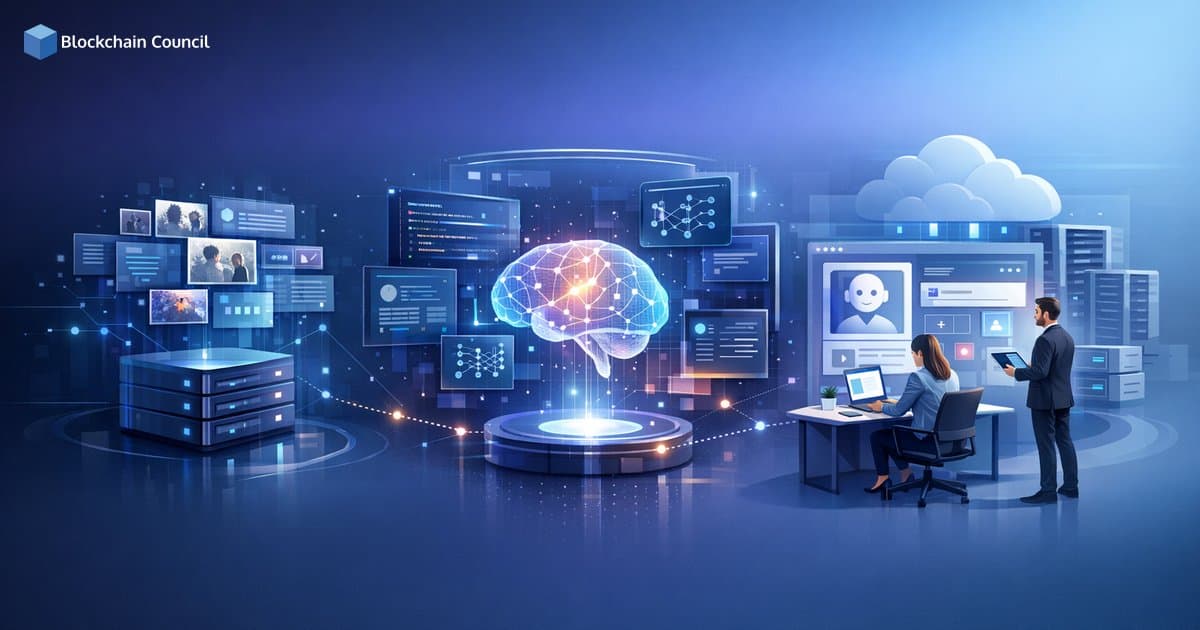
Building a Generative AI App End-to-End in 2026 looks less like a one-off chatbot demo and more like a production software system: scoped requirements, governed data pipelines, RAG-first grounding, robust orchestration, and MLOps-grade deployment with monitoring and evaluation. Guidance from cloud providers and enterprise implementation teams increasingly converges on a repeatable architecture where data quality, observability, and lifecycle management matter as much as model choice.
What an end-to-end generative AI application includes
A production-grade GenAI application typically includes six layers that work together:

Use case definition: what the app does and what "good" means (quality, latency, cost, compliance).
Data acquisition and preparation: ingest, clean, normalize, redact PII, and validate data.
Model strategy: API-first foundation models, self-hosted open-source models, or a hybrid approach.
Retrieval and orchestration: RAG, vector search, hybrid search, reranking, and agent tool use.
Application layer: backend APIs, UI, integrations (Slack, Teams, CRM, ERP).
Deployment and MLOps: CI/CD, environment separation, monitoring, evaluations, governance, and rollback plans.
Modern cloud architecture guidance recommends treating GenAI as DevOps plus MLOps: version artifacts (prompts, embeddings, indexes), maintain separate dev-staging-prod environments, and monitor both system metrics and LLM-specific quality indicators such as groundedness and safety.
Step 1: Problem framing and requirements
Before selecting datasets or models, define a single, testable job to be done. Common examples include:
Internal document Q&A with citations
Product description generation for an e-commerce catalog
Customer support draft replies grounded in policy documents
Summarization of meetings, tickets, or incident reports
Document non-functional requirements alongside the core use case:
Latency and throughput: target p95 response time, concurrent users, streaming needs.
Cost ceilings: per-request budget and monthly spend guardrails.
Accuracy vs. creativity: strict factuality for policy answers versus creative freedom for marketing copy.
Security and compliance: GDPR, data residency, retention policies, access controls, audit logging.
Enterprise implementation frameworks consistently show that choosing a concrete use case early prevents the common failure mode of building a generic chatbot that cannot be evaluated or governed.
Step 2: Data acquisition, transformation, and validation
In modern GenAI stacks, data quality is typically the primary bottleneck. High-performing models still fail when the underlying corpus is duplicated, outdated, noisy, or contains sensitive content that should never reach the model. A practical pipeline includes the following stages.
2.1 Data ingestion
Common sources include document repositories, databases, ticketing systems, CRM exports, codebases, wikis, and approved web sources. Most teams land raw data into a lake or warehouse (S3, GCS, Azure Data Lake, BigQuery, Snowflake) and then produce curated datasets for retrieval and evaluation.
A practical portfolio pattern is transcript ingestion - for example, from video platforms - into a relational database using a containerized stack. This illustrates a realistic workflow: source APIs, persistent storage, schema design, and reproducible pipelines.
2.2 Cleaning and normalization
Remove boilerplate, HTML noise, signatures, and repeated headers or footers
Normalize encodings and formats (dates, units, locale-specific symbols)
Deduplicate near-identical documents to prevent retrieval bias
Detect and redact PII (names, emails, phone numbers) where required
2.3 Chunking for RAG
Retrieval works best when content is chunked into semantically coherent pieces. A common starting point is 500 to 1,500 tokens with overlap, adjusted based on document structure. Chunking should preserve headings and section metadata to support better ranking and answer grounding.
2.4 Data validation
Treat data validation like software tests. The key checks include:
Schema checks: required fields, types, unique keys, foreign keys
Domain checks: allowed values, plausible ranges, language constraints
Safety checks: toxicity filters, sensitive-topic classification where needed
Relevance checks: confirm the dataset matches the intended use case
Step 3: Model strategy (API, self-hosted, or hybrid)
Most production teams default to orchestrating foundation models rather than training from scratch. The decision typically falls into three categories.
3.1 API-based foundation models
Pros: best-in-class quality, rapid iteration, minimal operational overhead
Cons: ongoing token costs, data residency constraints, limited control
3.2 Self-hosted open-source models
Models from the Llama family, Mistral, and Qwen variants are widely used, often with quantization to reduce cost. This option is common when data cannot leave a controlled environment or when predictable latency is required.
Pros: control, privacy, customizable performance-cost tradeoffs
Cons: higher engineering effort for serving, scaling, and patching
3.3 Hybrid setups
Hybrid architectures are increasingly standard. Smaller internal models handle routing, classification, and safe transformations, while larger external models handle complex reasoning. Sensitive tasks remain in-house while non-sensitive tasks call external APIs.
Step 4: RAG as the default enterprise pattern
Retrieval-augmented generation (RAG) is the dominant pattern for grounding answers in private data, reducing hallucinations, and minimizing the need for heavy finetuning. A production RAG pipeline typically follows these steps:
Embedding generation: convert each chunk into vectors using an embedding model (hosted or open-source).
Vector storage: store embeddings in a vector-capable database such as Postgres with pgvector, or a dedicated vector database.
Query-time retrieval: embed the user query and retrieve the top-k relevant chunks.
Hybrid search: combine keyword ranking (BM25) with vector similarity for robustness.
Reranking: apply cross-encoders or LLM-based rerankers for higher precision.
Grounded prompting: instruct the model to answer using only the provided context and to acknowledge when an answer is not available.
A key production principle: version and monitor RAG artifacts. Changes to chunking logic, embedding models, index parameters, or reranking configurations can materially change output behavior. Treat them as deployable components with regression tests.
Step 5: Orchestration, agents, and tool use
As GenAI applications mature, they move from single-shot prompting to multi-step orchestration. Frameworks such as LangChain, LlamaIndex, and Semantic Kernel are widely used, but many enterprises implement custom pipelines for reliability and governance reasons.
Common agentic patterns include:
Tool calling: query internal APIs, databases, ticket systems, or search endpoints
Verification steps: generate then validate against rules covering format, policy, and grounding
Routing: decide when to use RAG, when to invoke a summarizer, and when to escalate to a human
Structured outputs: JSON schemas for downstream automation
Step 6: Backend and application architecture
A reliable production architecture separates concerns clearly:
API service: FastAPI, Flask, Node/Express, or Java Spring for request handling
Retrieval service: vector database access, hybrid search, reranking
Model service: provider API wrapper or internal inference endpoint
Data and logging service: prompt logs, token usage, user feedback, analytics
Many production templates converge on a practical stack: Python with FastAPI, Postgres with pgvector, Docker for local environment parity, and deployment to a managed cloud platform. The goal is reproducibility - the same pipeline should run locally, in staging, and in production with configuration changes rather than code changes.
Step 7: Deployment, MLOps, and observability
GenAI projects frequently fail not because of model quality but due to gaps in operational readiness. Production systems require the following.
7.1 Containerization and environment separation
Docker images for each service
Dev-staging-prod environments with isolated data access
Kubernetes or serverless platforms for scaling and rollouts
7.2 CI/CD with safe releases
Automated tests for ingestion, chunking, retrieval, and prompt templates
Canary or blue-green deployments to reduce release risk
Infrastructure-as-code (Terraform, for example) for repeatability
7.3 Monitoring and evaluation
System metrics: latency, error rate, throughput, token counts, cost per request
Quality metrics: groundedness, citation coverage, refusal correctness, format validity
Safety metrics: toxicity, policy violations, sensitive-data leakage indicators
Feedback loops: thumbs up/down ratings, user comments, escalation tracking
Most teams maintain offline evaluation sets (golden questions with expected answers) and run periodic regression tests to detect retrieval drift, prompt regressions, or shifts in model behavior following updates.
Governance, privacy, and auditability
As GenAI integrates into core business workflows, governance must be part of the architecture from the start, not added later:
PII handling: redact or anonymize during ingestion; avoid sending sensitive content to external APIs when prohibited by policy
Access control: role-based permissions for data sources and actions
Policy enforcement: content filters, topic restrictions, brand voice constraints
Audit logs: store the prompt, retrieved context, model and prompt versions, and output for investigations and compliance reviews
If a GenAI application can trigger downstream actions - creating tickets, modifying records, or sending emails - treat it like any other API with strong authentication, authorization, and rate limits. Security-conscious teams frequently pair GenAI development with training in cybersecurity and governance to ensure that deployment practices meet organizational risk standards.
Real-world patterns you can implement today
Internal knowledge assistant with RAG
Ingest policies, manuals, and engineering documentation, build embeddings, and serve a chat interface integrated into Slack or Teams. Add citation support and enforce a rule: if the answer is not present in the retrieved context, the model should say so. This pattern is a common first production use case because the value is clear and evaluation is tractable.
E-commerce product description generation
Collect structured product metadata, apply style constraints, and generate descriptions at scale. Teams typically start with prompt engineering and later add lightweight finetuning or adapters when brand voice requirements exceed what prompt instructions can reliably deliver.
Transcript ingestion and summarization pipeline
Ingest video or audio transcripts into a relational database, create searchable embeddings, and provide summaries or Q&A over the content. This pattern covers the full workflow: data ingestion, schema design, RAG, API design, and deployment, making it a useful reference architecture for teams learning the stack.
Conclusion: End-to-end GenAI is a systems engineering discipline
Building a Generative AI App End-to-End in 2025 is best approached as building a governed, observable, and continuously improving software product. For most teams, success comes from a RAG-first design, strong data pipelines, and DevOps-grade deployment practices rather than training a custom model from scratch. Defining a narrow use case, curating reliable data, implementing retrieval and orchestration with clear service boundaries, and operating the system with monitoring and evaluation are the markers of production-standard work.
Professionals building these capabilities benefit from developing skills across data engineering, MLOps, prompt design, and secure deployment. Blockchain Council certifications and courses in Generative AI, Prompt Engineering, AI Developer tracks, and cybersecurity provide the end-to-end skill set needed to ship reliable, production-grade GenAI applications.
Related Articles
View All
Generative Ai
Career Guide: Generative AI Skills, Certifications, and Job Roles to Target
Explore in-demand generative AI skills, top job roles like LLM engineer and AI architect, and certifications to build a portfolio and advance your career.

Generative Ai
Top Generative AI Tools in 2026: A Practical Guide for Business and Developers
Explore the top generative AI tools in 2026 for business and developers, including LLMs, coding copilots, media tools, research apps, and automation platforms.

Generative Ai
Multimodal Generative AI: Text-to-Image, Text-to-Video, and Cross-Modal Reasoning Explained
Learn how multimodal generative AI powers text-to-image, text-to-video, and cross-modal reasoning, plus real enterprise use cases, risks, and skills to build safely.
Trending Articles

Top 5 DeFi Platforms
Explore the leading decentralized finance platforms and what makes each one unique in the evolving DeFi landscape.
What is AWS? A Beginner's Guide to Cloud Computing
Everything you need to know about Amazon Web Services, cloud computing fundamentals, and career opportunities.

Can DeFi 2.0 Bridge the Gap Between Traditional and Decentralized Finance?
The next generation of DeFi protocols aims to connect traditional banking with decentralized finance ecosystems.