

How Is CBDC Money Created? Issuance, Distribution, and Redemption Explained
 Suyash Raizada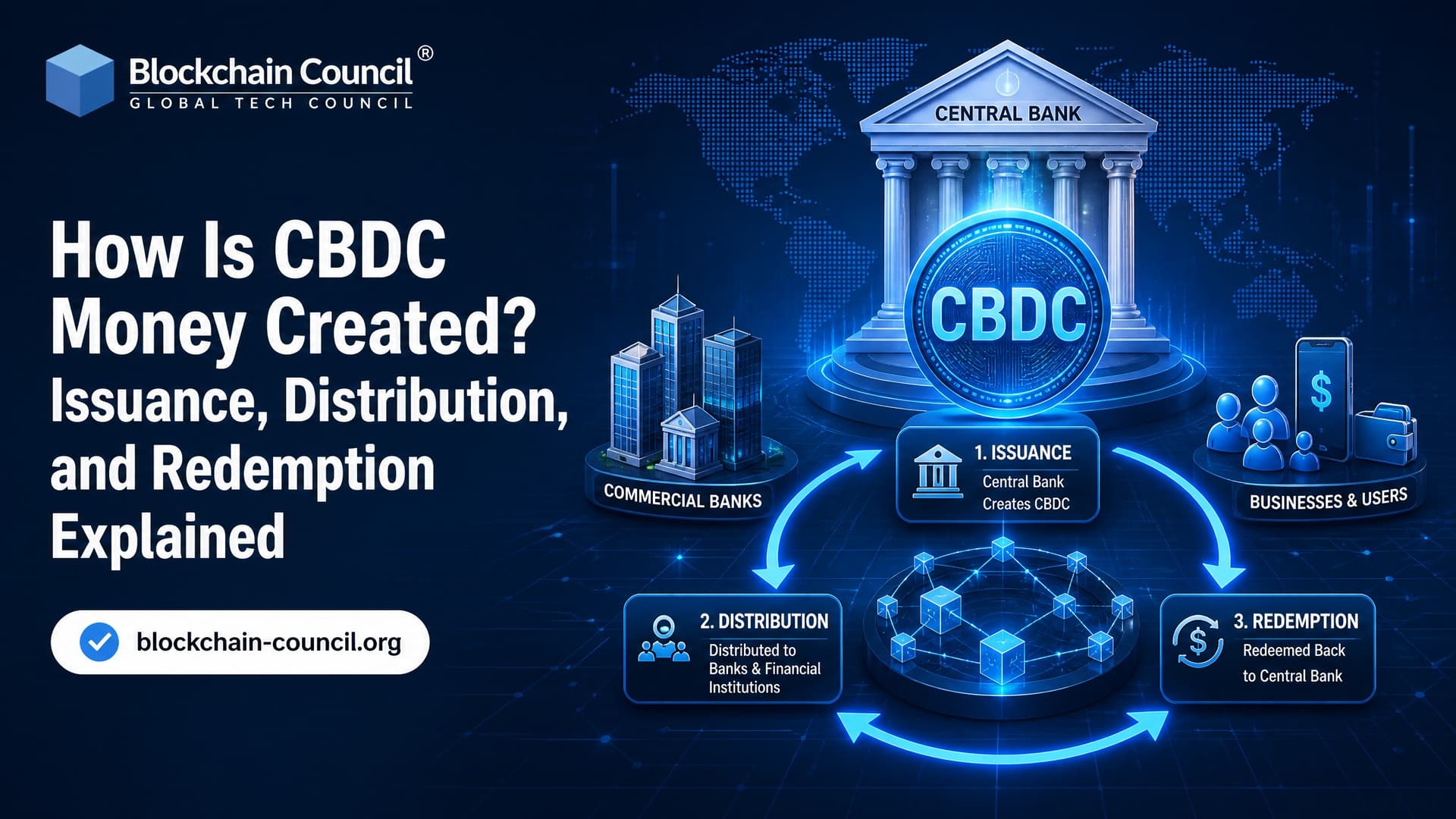
How is CBDC money created? A central bank creates CBDC money when it records new digital units of sovereign currency on a CBDC ledger and credits those units to an approved account, wallet, or intermediary. In most designs, that entry is matched by a reduction in cash, a reduction in commercial bank reserves, a conversion from bank deposits, or a central bank lending operation. The key point is simple: CBDC is central bank money in digital form, not a private token issued by a bank or fintech. Anyone trying to get a structured handle on this lifecycle often starts with a Certified Central Bank Digital Currency (CBDC) Expert credential, which frames issuance, distribution, and redemption within a formal CBDC context.
That sounds technical because it is. But the lifecycle is easy to follow once you split it into three stages: issuance, distribution, and redemption.

CBDC as Central Bank Money
A central bank digital currency is a liability of the central bank, just like banknotes and reserve balances. The Federal Reserve describes CBDC as a digital form of central bank money that would differ from commercial bank deposits and from reserves used only by banks. The World Bank frames CBDC as a new payment instrument denominated in the national unit of account and convertible at par with cash and regulated deposits.
That liability point matters. If you hold a bank deposit, your claim is on the commercial bank. If you hold cash, your claim is directly on the central bank. A retail CBDC would extend that direct central bank claim into a digital wallet or account used by households and businesses. Professionals comparing CBDC issuance mechanics against stablecoin issuance and other tokenized money models often pair this with a Certified Digital Assets Expert credential, since balance sheet mechanics like this rarely get evaluated in isolation from the broader digital asset landscape.
On a central bank balance sheet, CBDC would sit alongside banknotes and reserves. If people exchange banknotes for CBDC, the composition changes from paper cash to digital central bank money. If they move funds from bank deposits into CBDC, the banking system may see lower deposit funding while the central bank records more CBDC outstanding. This is why the European Central Bank has studied holding limits, tiered remuneration, and other controls for a possible digital euro.
The CBDC Lifecycle: Issuance, Distribution, Redemption
Most CBDC systems, whether account-based or token-based, follow the same economic cycle:
Issuance: The central bank creates digital units and credits them to an intermediary or user, with matching accounting entries.
Distribution: Banks, payment service providers, wallet operators, or the central bank itself move CBDC into user wallets and payment channels.
Redemption: CBDC is returned to the central bank or an authorized intermediary and converted back into cash or deposits, or removed from circulation.
The International Telecommunication Union makes a useful technical distinction here. It separates production, meaning creation and destruction of digital currency units, from issuance, meaning putting those units into or taking them out of circulation. In real systems, those may be handled by different components for security and audit reasons.
Issuance: How CBDC Money Is Created
Policy approval comes before minting
A CBDC does not begin with a developer pressing a mint button. It begins with legal authority, policy design, and operational rules. The IMF describes CBDC projects through a 5P path: preparations, proof of concepts, prototype, pilot, and production. Before production, a central bank must decide who can hold CBDC, whether balances earn interest, what wallet limits apply, and how anti-money laundering and data protection rules are handled.
Some jurisdictions may need changes to central bank law before CBDC issuance is permitted. That legal plumbing is not glamorous. It is often the slowest part.
Technical production on the ledger
At the technical layer, CBDC units are created through signed ledger entries. In an account-based model, the ledger records a credit to a CBDC account or wallet. In a token-based model, the system may create discrete digital tokens through a signed mint transaction.
The ITU reference architecture discusses both online and offline creation. A high-security design may use an air-gapped signing system, where mint or burn instructions are created in an isolated environment and later imported into the live platform. That separation reduces the chance that an attacker who compromises an operational server can create money.
In blockchain-style CBDC prototypes, the central bank usually acts as the root issuer. It signs special mint transactions and allocates CBDC to authorized banks. This can look familiar to developers who have worked with ERC-20 mint functions, but the governance is completely different. A CBDC mint is a monetary operation, not just a smart contract method call.
A practical warning from payment system builds: do not treat minting as a normal wallet top-up. If a mint request retries after a timeout and the platform has no idempotency key, you can credit a wallet twice while the reserve debit posts once. Your reconciliation file will catch it, usually with a variance that ruins someone's Friday evening. Production CBDC systems need atomic posting, strict authorization, and tamper-evident logs.
Balance sheet mechanics
When a central bank issues CBDC, it records a CBDC liability. The matching side depends on how the CBDC enters the system:
Cash conversion: A user exchanges banknotes for CBDC. Banknotes outstanding fall, CBDC outstanding rises.
Deposit conversion: A user moves funds from a commercial bank account into CBDC. The intermediary settles with the central bank, often through reserves.
Reserve-funded issuance: A commercial bank pays for CBDC using its reserve balance, then distributes CBDC to customers.
Central bank lending: CBDC may be created against a loan or claim on a borrower, then destroyed when the loan is repaid.
The ECB has modeled cases where CBDC is created through household conversions from cash or deposits, and cases where CBDC is linked to central bank credit. The outcome is the same at the core: central bank liabilities change form, and the outstanding CBDC stock must stay consistent with monetary policy objectives.
Account-Based vs Token-Based Issuance
The issuance flow depends heavily on design.
Account-based CBDC
In an account-based CBDC, the system tracks balances tied to verified identities or wallet records. Issuance happens when an approved account is credited. The user proves identity or authorization to spend, much like online banking or instant payment systems.
This model is easier for compliance and dispute handling. It is also more dependent on identity infrastructure. If privacy is a policy goal, the design must limit who can see transaction data and under what legal process.
Token-based CBDC
In a token-based CBDC, the system tracks digital objects or coins. Ownership may be proven by possession of cryptographic keys. Some research designs use blind signatures, where a user creates a blinded coin request, the bank debits the user's deposit, the central bank signs the blinded token, and the user later unblinds it in a wallet.
Token-based designs can support stronger cash-like properties, especially for low-value offline payments. They are harder to police after the fact. That is the trade-off.
Distribution: How CBDC Enters Circulation
The two-tier model
Most retail CBDC proposals use a two-tier model. The central bank issues CBDC to intermediaries, and intermediaries distribute it to users. China's e-CNY follows this broad structure: the People's Bank of China issues digital currency to operating institutions, and those institutions provide wallets and services to individuals and firms.
This model keeps the central bank focused on issuance, settlement, and oversight. Banks and payment providers handle customer onboarding, wallet apps, merchant integration, and support. For most countries, this is the sensible default. A central-bank-only retail model sounds clean on paper, but running customer service for millions of wallets is not a core central banking skill.
Distribution channels may include:
Bank and payment provider wallets
Mobile apps and web portals
Merchant QR payment systems
ATMs and branch-based cash conversion
Links to instant payment rails or card infrastructure
Direct and hybrid models
In a direct model, users hold CBDC accounts or wallets directly with the central bank. The IMF refers to this as a unilateral design, where the central bank handles issuance, distribution, and user interaction. It gives the public sector strong control but creates heavy operational and privacy burdens.
Hybrid models split the work. The central bank operates or supervises the core ledger, while private firms run front-end services. This is where many serious CBDC designs are heading, because it balances public trust with private sector delivery.
Redemption: How CBDC Is Retired
Redemption reverses issuance. A user sends CBDC back through a wallet provider, bank, ATM, or central bank channel and receives another form of money.
Common redemption paths include:
CBDC to bank deposit: The user cashes out to a commercial bank account. The CBDC balance falls, and the deposit balance rises.
CBDC to cash: The user withdraws banknotes through a branch or ATM. CBDC outstanding falls while physical cash increases.
CBDC destruction: The central bank debits the CBDC liability and burns or retires the corresponding ledger units.
The BIS has described prototype cash-in and cash-out flows where users convert bank account funds into CBDC and then back into deposits. The ITU architecture covers the secure destruction of digital currency units through signed transactions. In plain English, burning CBDC is the digital version of withdrawing worn banknotes and shredding them, except the action is a controlled ledger update.
Why Issuance and Redemption Design Matters
CBDC design is not just a wallet UX question. It affects bank funding, payment resilience, privacy, and monetary transmission.
Financial stability: If CBDC becomes too attractive during stress, deposits could move quickly out of banks. Caps or tiered interest rates may reduce that risk.
Cybersecurity: Mint and burn privileges are the crown jewels. They need hardware security modules, segregation of duties, and continuous audit trails.
Offline payments: Offline CBDC can improve access, but double-spend prevention is hard when devices cannot talk to the ledger.
Programmability: Conditional transfers can help with controlled disbursement, but putting too many rules into money itself can create legal and operational headaches.
To be blunt, programmable CBDC is often overhyped. The safer path is usually programmable payment instructions around CBDC, not deeply programmable money that changes its legal character or use rights in confusing ways. Engineers responsible for the security controls behind minting and redemption, such as hardware security modules and audit trails, often round out their skills with a general Tech Certification, since segregation of duties and tamper-evident logging draw as much on conventional systems and security engineering as on ledger design.
What Professionals Should Learn Next
If you work in banking, fintech, compliance, cybersecurity, or blockchain engineering, CBDC knowledge now sits at the intersection of payment architecture and digital asset infrastructure. Start by mapping a simple ledger with four accounts: central bank CBDC liability, commercial bank reserves, user wallet balance, and user bank deposit. Then test cash-in, payment, and cash-out flows. Reconciliation will teach you faster than a slide deck.
For structured learning, consider Blockchain Council programs such as Certified Blockchain Expert™, Certified Blockchain Developer™, and Certified Cryptocurrency Expert™. If your role includes smart contract or wallet architecture, Certified Smart Contract Developer™ is also relevant. Build the accounting model first, then study the cryptography and ledger design behind issuance and redemption. And since public understanding of how CBDC money is created and redeemed directly affects trust in the system, teams responsible for explaining these mechanics to the public often bring in a Marketing Certification to help turn balance sheet mechanics into a story people outside central banking can actually follow.
FAQs
1. How is CBDC money created?
A central bank digital currency (CBDC) is created when a central bank issues a new digital liability denominated in its national currency.
Conceptually, the central bank records CBDC on its balance sheet just as it records other forms of central bank money.
The key point is:
CBDC creation = creation or conversion of central bank money into digital CBDC form
That does not necessarily mean every CBDC issuance increases the total money supply. Often, one form of money is simply exchanged for another.
2. Who has the authority to issue CBDC?
The central bank or legally designated monetary authority would issue CBDC under the jurisdiction's applicable legal framework.
Commercial banks, fintech companies, and payment service providers might distribute CBDC, but they do not thereby become its issuer.
So:
Central bank → issuer
Banks/PSPs → possible distributors and service providers
A wallet company's logo on the screen does not confer monetary sovereignty. Convenient, really.
3. Is CBDC physically “minted” like cash?
No.
Physical currency requires banknotes to be printed or coins to be minted.
CBDC is created electronically through authorized changes to the central bank's monetary records.
Conceptually:
Physical cash → printing/minting
CBDC → authorized digital issuance
The exact technical mechanism depends on whether the system is account-based, token-based, centralized, distributed, or hybrid.
4. What happens on the central bank's balance sheet?
CBDC would generally appear as a liability of the central bank.
Suppose a commercial bank converts 1 million units of central bank reserves into CBDC for distribution.
A simplified liability-side change could look like:
Bank reserves: −1,000,000
CBDC outstanding: +1,000,000
Total central bank liabilities need not increase from that conversion alone. Their composition changes.
Actual central-bank accounting can, naturally, involve more detail than this mercifully short example.
5. Does issuing CBDC automatically create new money?
No.
This is one of the most important distinctions.
Suppose someone converts:
$500 bank deposit → $500 CBDC
The person has changed the form in which money is held, not necessarily received $500 of additional purchasing power.
Whether broader money or central bank balance-sheet totals change depends on how the conversion is settled and how banks and the central bank respond.
6. How is CBDC different from commercial bank deposit creation?
Commercial bank deposits are generally liabilities of commercial banks.
CBDC is a liability of the central bank.
Therefore:
Bank deposit → commercial bank money
CBDC → central bank money
Commercial banks can create deposit money through lending and other balance-sheet transactions. They cannot independently create official CBDC.
7. How could CBDC be distributed?
A CBDC could use several distribution models.
In a direct model:
Central Bank → User
In an intermediated or two-tier model:
Central Bank → Commercial Bank/PSP → User
Many proposed retail architectures preserve an intermediary role for banks and payment providers rather than requiring the central bank to service every customer directly.
8. How does two-tier CBDC issuance work?
In a simplified two-tier system:
Step 1: Central bank issues CBDC.
Step 2: An authorized bank or PSP obtains access to CBDC.
Step 3: Customers convert eligible funds into CBDC.
Step 4: CBDC appears in customer wallets.
The central bank maintains monetary control while private institutions handle much of the distribution and customer-service machinery.
9. How could a customer convert a bank deposit into CBDC?
Suppose Alice wants 200 CBDC units.
She requests a conversion through her bank or wallet provider:
Alice's bank deposit: −200
Alice's CBDC balance: +200
Behind the scenes, the bank and central bank infrastructure perform the corresponding settlement operations.
Alice has exchanged one form of money for another rather than magically becoming 200 units wealthier, which would admittedly be the more popular architecture.
10. What happens to the commercial bank when deposits become CBDC?
If customers convert commercial bank deposits into CBDC, the banking system may lose deposit funding.
At a simplified level, conversion can involve a bank using central bank reserves or obtaining liquidity needed to settle the CBDC conversion.
Large-scale migration could therefore affect:
Bank reserves
Deposit funding
Liquidity
Funding costs
Lending conditions
This is one reason CBDC design has implications for financial stability.
11. Could customers convert physical cash into CBDC?
Potentially, depending on the system.
A customer could surrender physical currency through an authorized channel and receive an equivalent CBDC amount.
Conceptually:
100 cash → 100 CBDC
The CBDC would replace the physical form of central bank money held by that user.
12. Could CBDC be converted back into cash?
Potentially, if the jurisdiction maintains cash and allows CBDC-cash conversion.
The process would be:
CBDC → cash
CBDC and physical currency could therefore coexist rather than one necessarily replacing the other.
The exact conversion channels would depend on the central bank's design.
13. What is CBDC redemption?
Redemption is the process of converting CBDC into another eligible form of money and removing or reducing the corresponding CBDC claim.
For example:
CBDC → commercial bank deposit
or:
CBDC → physical cash
From the system's perspective, the outstanding CBDC amount may be reduced as part of that process.
14. What happens when CBDC is redeemed into a bank deposit?
Suppose Alice redeems 300 CBDC units.
Conceptually:
Alice's CBDC: −300
Alice's bank deposit: +300
The CBDC infrastructure and banking system then settle the corresponding transfer.
The central bank may reduce CBDC outstanding while adjusting other central bank liabilities such as reserves.
15. Is redeemed CBDC “destroyed”?
In accounting terms, outstanding CBDC can be extinguished, cancelled, or retired when redeemed.
For example:
CBDC outstanding: −300
with another liability potentially increasing:
Bank reserves: +300
This is analogous to changing the composition of central bank liabilities rather than literally destroying digital objects with a tiny ceremonial shredder.
16. How does issuance work in a token-based CBDC?
In a token-oriented architecture, authorized infrastructure could create valid digital monetary units or token representations corresponding to CBDC issuance.
The system must ensure:
Authenticity
Unique validity
Spending authority
Prevention of duplication
Prevention of double spending
Correct redemption
Token issuance would still ultimately be controlled by the central bank.
17. How does issuance work in an account-based CBDC?
In an account-based system, issuance can be represented through changes to balances on an authoritative ledger.
For example:
CBDC system balance before issuance: 0
Authorized issuance: +1,000,000
The system then allocates or transfers CBDC balances according to its distribution model.
No blockchain or digital token is required.
18. Does blockchain create CBDC money?
No.
Blockchain can record or validate CBDC transactions, but it does not independently create sovereign money.
The monetary authority determines issuance.
A blockchain-based system might execute an authorized issuance instruction:
Central Bank Authorization → CBDC Token/Ledger Creation
The authority comes from the central bank, not from the blockchain.
Technology records the monetary decision. It does not acquire a central banking license by executing code.
19. Can CBDC earn interest?
Potentially.
A central bank could design a remunerated CBDC that pays interest, or a non-remunerated CBDC that does not.
Interest-bearing CBDC could strengthen certain monetary-policy transmission mechanisms, but it could also make CBDC more competitive with commercial bank deposits.
Designers therefore need to consider financial-stability effects.
20. Could CBDC holdings have limits?
Yes.
A central bank could potentially impose:
Maximum wallet balances
Conversion limits
Transaction limits
Tiered remuneration
Different rules for individuals and businesses
Holding limits could reduce the risk of large-scale migration from commercial bank deposits into CBDC.
21. What happens during a bank run?
CBDC could potentially make it easier for depositors to move money from commercial banks into central bank money digitally.
Instead of withdrawing physical cash, users might transfer:
Bank Deposit → CBDC
rapidly through an application.
This could accelerate deposit outflows during periods of financial stress.
Potential safeguards include holding limits, remuneration structures, liquidity facilities, and other design measures.
22. Does CBDC issuance affect the money supply?
It can, but the effect depends on how CBDC is issued.
If existing central bank money is converted into CBDC:
Reserves → CBDC
the composition of central bank liabilities changes.
If a bank deposit is converted into CBDC, the effects involve both commercial-bank and central-bank balance sheets.
If the central bank creates additional CBDC through an expansionary monetary operation, broader monetary conditions could change.
Therefore:
CBDC issuance mechanism ≠ automatically monetary expansion
23. Could governments simply create unlimited CBDC?
Technically, digital units can be created easily. Institutionally and economically, issuance remains constrained by the central bank's legal mandate, monetary-policy framework, governance, and the consequences of excessive money creation.
Creating excessive central bank money can contribute to:
Inflation
Currency depreciation
Financial instability
Loss of monetary credibility
CBDC changes the technology of money, not the basic economics of monetary discipline.
24. How does CBDC issuance differ from cryptocurrency mining?
The mechanisms are fundamentally different.
CBDC
Central bank authorization → digital central bank money issued
Bitcoin
Protocol + proof-of-work mining → BTC issued according to predetermined rules
CBDC supply is governed institutionally through the monetary system.
Cryptocurrency issuance follows the rules of the relevant network protocol.
25. How does CBDC issuance differ from stablecoin issuance?
A reserve-backed stablecoin issuer typically creates tokens when eligible reserve assets or funds are received.
Conceptually:
$1 received → 1 stablecoin issued
CBDC issuance instead creates or converts a central bank liability.
Therefore:
CBDC → central bank money
Stablecoin → privately issued digital instrument supported by its legal and reserve arrangement
26. What is the CBDC lifecycle?
A simplified CBDC lifecycle is:
1. Central bank authorizes issuance
↓
2. CBDC is created on the core system
↓
3. Banks/PSPs obtain or distribute CBDC
↓
4. Users convert deposits or cash into CBDC
↓
5. CBDC enters user wallets
↓
6. Users transfer CBDC among themselves
↓
7. Merchants and users receive CBDC
↓
8. CBDC may circulate repeatedly
↓
9. Users convert CBDC back into deposits or cash
↓
10. Corresponding CBDC is redeemed or retired
The same digital value may circulate through many transactions before redemption.
27. What happens during ordinary CBDC payments?
Ordinary payments generally do not require new CBDC to be created.
Suppose Alice pays Bob 50 CBDC:
Alice: −50
Bob: +50
Total CBDC outstanding remains unchanged.
The system simply transfers existing central bank money between holders.
28. Why is this distinction important?
Three processes are often confused:
Issuance → CBDC enters circulation
Transfer → existing CBDC changes holder
Redemption → CBDC leaves circulation or converts into another form
A payment does not necessarily create money, just as handing someone a $20 banknote does not force the central bank to print another one.
29. What would the complete issuance and redemption loop look like?
A simplified two-tier loop is:
Central Bank
↓ Issues CBDC
Bank/PSP
↓ Distributes CBDC
User Wallet
↓ Makes payments
Other Users/Merchants
↓ Redeem CBDC
Bank/PSP
↓ Returns/reconciles CBDC
Central Bank
↓ Retires CBDC or converts it into another central-bank liability
This creates a controlled monetary lifecycle from issuance through circulation to redemption.
30. What is the easiest way to understand CBDC money creation?
Think of CBDC as a digital form of central bank money whose quantity and circulation are controlled through the central bank's balance sheet and monetary framework.
The essential sequence is:
Issuance → Distribution → Circulation → Redemption
And the essential distinction is:
Issuance creates or converts central bank liabilities into CBDC
Distribution gets CBDC to users
Payments transfer existing CBDC
Redemption converts CBDC back into another eligible form of money
CBDC therefore does not give central banks an entirely new ability to “create money from a computer.” Central banks already create monetary liabilities electronically. CBDC primarily changes which digital central-bank liability the public can hold and how that money can be distributed and used.
That distinction is less dramatic than the phrase “digital money creation,” but considerably more useful for understanding how a real CBDC monetary system would work.
Related Articles
View All
Digital Assets
CBDC Governance Explained: Standards, Oversight, and Stakeholder Roles
CBDC governance defines how digital central bank money is issued, supervised, secured, and operated across central banks, banks, PSPs, regulators, and users.

Digital Assets
CBDC vs Commercial Bank Money: Legal Tender, Risk, and User Experience
Compare CBDC vs commercial bank money across legal tender status, credit risk, privacy, adoption data, and real user experience in live pilots.

Digital Assets
CBDC vs Mobile Payments: Understanding Wallets, Settlement, and Money Types
CBDC vs mobile payments explained through wallets, settlement, and money types, with real examples from India, China, Nigeria, and the Bahamas.
Trending Articles
AWS Career Roadmap
A step-by-step guide to building a successful career in Amazon Web Services cloud computing.

Top 5 DeFi Platforms
Explore the leading decentralized finance platforms and what makes each one unique in the evolving DeFi landscape.
Claude AI Tools for Productivity
Discover Claude AI tools for productivity to streamline tasks, manage workflows, and improve efficiency.