

CBDC vs Digital Payments: What Makes Central Bank Money Different?
 Suyash Raizada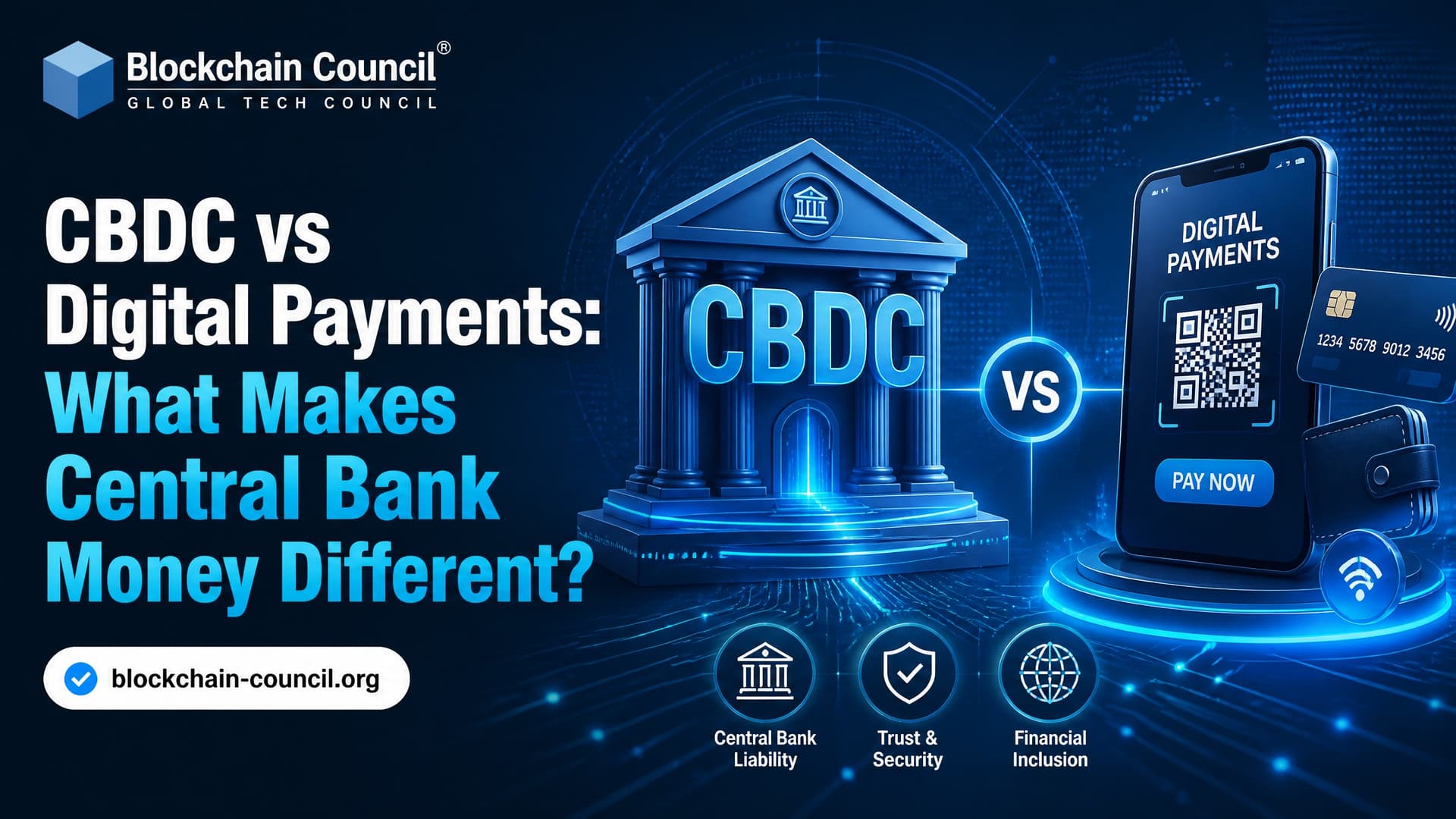
CBDC vs digital payments is not just a comparison of two payment apps. The real difference sits underneath: it is the money itself. A central bank digital currency is public money, issued as a direct liability of the central bank. Most digital payments today move private money, such as commercial bank deposits, e-money balances, or wallet balances backed by a private provider. For professionals who want to develop focused knowledge of this emerging financial infrastructure, a Certified Central Bank Digital Currency (CBDC) Expert pathway can provide a structured foundation for understanding CBDC concepts and applications.
That distinction affects credit risk, legal status, settlement finality, privacy design, and the role of banks. If you work in payments, fintech, blockchain, compliance, or digital assets, this is the part worth getting right.

What Is a CBDC?
A central bank digital currency, or CBDC, is a digital payment instrument denominated in a country's official unit of account and issued by the central bank. Think of it as digital central bank money. It is closer to cash than to a bank app balance, although the exact design can vary.
For professionals comparing CBDCs with other forms of digital assets, a Certified Digital Assets Expert pathway can complement this knowledge by providing broader exposure to digital asset concepts and their role in the evolving financial ecosystem.
Central banks and international bodies such as the Bank for International Settlements and the International Monetary Fund generally split CBDCs into two types:
Retail CBDC: Available to households and businesses for everyday payments, government transfers, or savings-like balances.
Wholesale CBDC: Restricted to banks and financial institutions for interbank settlement, securities settlement, or tokenized financial market infrastructure.
Retail CBDC can be account-based, where users are identified through accounts, or token-based, where the payment object functions more like digital cash. In practice, many designs are hybrid. Central banks usually do not want to run consumer support desks for millions of wallets, so intermediated models are common in pilots.
What Are Existing Digital Payments?
Cards, bank transfers, mobile wallets, and instant payment apps already feel digital. But they usually do not give you direct access to central bank money.
Most digital payments rely on one of the following:
Bank deposits: Your balance is a liability of a commercial bank. Card networks, online banking, and many fast payment systems move claims between bank accounts.
E-money: Your balance is a liability of a non-bank payment provider or mobile money operator, usually backed by bank deposits or safe assets.
Fast payment systems: These give near real-time confirmation, but users still hold private claims, not central bank liabilities.
This is where many discussions get muddy. A payment can be instant for the user and still not be central bank money. In payment integration work, the hard part is often reconciliation, not speed. For example, an ISO 20022 pacs.008 customer credit transfer can be accepted while the downstream ledger posting or a pacs.002 status message still needs careful matching. The user sees a successful payment. The institutions still need final settlement and clean books.
CBDC vs Digital Payments: The Core Differences
1. The Issuer and Liability Are Different
The biggest difference is simple: who owes you the money?
With a CBDC, the claim is on the central bank. With a bank deposit, the claim is on a commercial bank. With e-money, the claim is on a private provider. Regulation, capital rules, safeguarding requirements, and deposit insurance reduce risk in private money systems, but they do not remove it.
Central bank money is treated as the safest money in a jurisdiction because it is issued by the monetary authority. That is why settlement between banks ultimately relies on reserves at the central bank. A retail CBDC would extend a version of that safety to the public in digital form.
2. Legal Tender Status Changes the Legal Role
Cash is usually legal tender. Private digital payments are usually contractual. A merchant can refuse a card network, a wallet, or a specific payment app unless law or contract says otherwise.
A CBDC may be granted legal tender status by legislation, depending on the country and design. If that happens, it carries a public legal role closer to cash. It can become an official means of discharging monetary obligations, not just another payment option provided by a company.
That sounds technical. It is not. Legal tender affects acceptance, dispute handling, public trust, and the design of payment obligations in contracts.
3. Settlement Finality Is Not the Same as Instant Confirmation
Fast payment systems are impressive. Many countries now offer domestic transfers that complete in seconds. But instant user experience is different from settlement in central bank money.
In a CBDC transaction, the asset being transferred is a central bank liability. If designed for real-time settlement, the payment can settle directly in central bank money. That gives the transaction a finality profile closer to cash, in digital form.
In ordinary digital payments, the user may receive immediate confirmation while banks, clearing systems, and settlement accounts handle the final positions behind the scenes. The payment is still very useful. It just is not the same monetary instrument.
4. CBDC Changes Access to Central Bank Money
Today's monetary system is largely two-tiered. The public uses bank deposits and e-money. Banks and certain financial institutions use central bank reserves.
A retail CBDC would change that structure by giving households and businesses access to digital central bank money. Not necessarily through accounts held directly at the central bank, and not necessarily without private intermediaries. But the underlying money would be public money.
This is why CBDC is a policy decision, not only a software project.
Why Are Central Banks Studying CBDCs Now?
BIS surveys have reported that more than 90 percent of central banks are engaged in some form of CBDC work, from research to pilots. The reasons vary by country, but several themes repeat.
Declining cash use: In some economies, public money is becoming less visible in daily retail payments.
Payment sovereignty: Governments do not want critical payment infrastructure controlled entirely by foreign networks or private platforms.
Financial inclusion: Some jurisdictions see retail CBDC as a way to reach people underserved by banks.
Cross-border payments: CBDC experiments test whether international transfers can become cheaper, faster, and more transparent.
Competition: A neutral public payment rail can reduce dependence on a few dominant providers.
To be blunt, CBDC is not always the best answer. If a country already has cheap, universal instant payments, strong consumer protection, and high trust in banks, a retail CBDC has to solve a real problem. Otherwise, it risks becoming an expensive duplicate system.
CBDC Design Choices That Matter
The policy debate often focuses on whether a CBDC should exist. Practitioners ask a sharper question: how would it work?
Account Based or Token Based
Account based CBDC relies on identity and account records. Token based CBDC focuses on possession and transfer of a digital value object. The token model sounds like cash, but preventing double spending offline is difficult. Secure hardware, value limits, and delayed synchronization are common design tools.
Interest Bearing or Non-Interest Bearing
A CBDC could pay interest, although many retail designs avoid this at first. Interest bearing CBDC would affect demand for bank deposits and could change how monetary policy transmits. It may also raise political questions if the public sees CBDC as a government savings account.
Privacy Tiers
Central banks face a hard trade-off. Users want privacy. Regulators require anti-money laundering and counterterrorist financing controls. Many pilots explore tiered privacy, where small low-risk payments have lighter checks while larger transactions require stronger identification.
Offline Payments
Offline capability is one of the most practical CBDC features. It matters during network outages, disasters, and in areas with weak connectivity. But it is hard to build safely, because the system must control double spending when devices reconnect.
CBDC, Stablecoins, and Tokenized Deposits
CBDCs are often compared with stablecoins and tokenized deposits. The comparison is useful, but only if you separate the asset from the technology.
CBDC: Public money, direct central bank liability, potentially legal tender.
Stablecoin: Private token, usually backed by reserves or algorithms, not central bank money.
Tokenized deposit: Commercial bank deposit represented on a distributed ledger or token platform.
Stablecoins and tokenized deposits can support programmable payments and blockchain-based settlement workflows. They may be useful in capital markets, Web3 commerce, and treasury operations. But they remain private money unless the issuer is the central bank.
If you are building in this area, courses such as Blockchain Council's Certified Blockchain Expert, Certified Cryptocurrency Expert, and Certified Smart Contract Developer help you understand token standards, settlement models, and digital asset custody.
Regulatory and Operational Risks
CBDC systems would become critical public infrastructure. That raises the bar for security, uptime, governance, and accountability.
Key policy concerns include:
Bank disintermediation: If people move large balances from banks into CBDC, bank funding could weaken.
Digital bank runs: In stress events, users might shift deposits into CBDC quickly unless caps or tiered remuneration apply.
Cybersecurity: A CBDC platform would be a high-value target for fraud, disruption, and state-level attacks.
Data protection: Payment data can reveal sensitive personal and business activity.
Interoperability: CBDC must work with banks, wallets, merchants, payment processors, and possibly cross-border systems.
This is why many central banks favor staged pilots over instant national rollout. Sensible. Payments are boring only until they fail.
For professionals working with the technical infrastructure behind digital payments, blockchain systems, and emerging financial technologies, a Tech Certification pathway can provide complementary technology knowledge that supports a broader understanding of these systems.
Will CBDCs Replace Digital Payments?
No, not in most markets. The more likely future is coexistence.
CBDC can provide a public anchor for digital money. Banks, fintechs, card networks, mobile wallets, and blockchain-based systems can still compete on user experience, credit, loyalty, analytics, merchant tools, and specialized services. Fast payment systems will continue to matter too.
The key point in CBDC vs digital payments is not which one is faster. It is whether the payment moves public central bank money or private liabilities. That difference determines risk, finality, legal treatment, and the architecture of the financial system.
If your work touches payments or digital assets, start by mapping the money type in every transaction flow. Ask: who issued the asset, who settles it, what happens if the intermediary fails, and what legal status applies? Then build the technical model. To go deeper, pair CBDC policy study with blockchain, smart contract, and crypto asset training through Blockchain Council certification tracks.
For professionals who also need to understand how emerging financial technologies are positioned, communicated, and adopted, a Marketing Certification pathway can complement technical knowledge with broader marketing skills relevant to digital finance and evolving payment ecosystems.
Building Technology Skills Through Competitions
Technology learning can also begin at an early stage through structured academic competitions. The World Tech Olympiad (WTO) is a global technology competition for students from Class 2 to Class 12, offering age-appropriate tracks in areas such as Robotics, Artificial Intelligence, Coding, Computational Thinking, and Cybersecurity.
The Robotics track gives students an opportunity to explore how machines work, how programmed instructions control robotic systems, and how technology can be used to solve real-world problems. Through structured learning and competition, students can develop practical technology awareness along with problem-solving, logical-thinking, and computational skills.
The World Tech Olympiad provides both individual and institutional participation pathways. Parents can directly enroll their children, while schools can register their institution and bring eligible students into the competition. This makes the Robotics Olympiad a practical way for schools and families to introduce students to emerging technologies and encourage early interest in technology-driven learning.
FAQs
1. What is the difference between CBDC and digital payments?
A Central Bank Digital Currency (CBDC) is a form of digital central bank money, while digital payments are methods for electronically transferring money.
When you pay using a debit card, mobile wallet, banking app, or instant-payment service, you are usually moving commercial bank money. With a CBDC payment, the underlying monetary asset itself can be a direct liability of the central bank.
So the key distinction is:
CBDC = type of money
Digital payment = method of moving money
2. Aren’t most payments already digital?
Yes. A large share of modern payments already happens electronically through:
Debit and credit cards
Mobile banking
Instant-payment systems
Mobile wallets
Online banking
QR-code payments
But making a payment digitally does not mean the money being transferred is CBDC.
Most existing consumer digital payments involve commercial bank deposits or privately issued payment instruments. CBDC changes the underlying monetary claim, not merely the screen used to send it.
3. What makes CBDC central bank money?
CBDC is issued by a country's central bank or monetary authority and represents a liability of that institution.
Compare:
CBDC → central bank liability
Bank deposit → commercial bank liability
Stablecoin → private issuer or arrangement
The balances may all display “100” inside an app, because apparently identical-looking numbers weren't confusing enough, but their legal and financial structures can be fundamentally different.
4. How is CBDC different from a debit card payment?
A debit card normally provides access to money held in a commercial bank account.
When a customer pays:
Customer Bank Deposit → Payment Network → Merchant Bank Deposit
The card itself is not money. It is a payment instrument used to instruct banks to move money.
With CBDC:
Customer CBDC → CBDC Infrastructure → Merchant CBDC
The underlying asset being transferred can be central bank money.
5. How is CBDC different from a credit card?
A credit card usually involves credit provided by a financial institution, not immediate spending of central bank money held by the consumer.
The card issuer pays or facilitates payment to the merchant, and the customer later repays the credit-card balance.
CBDC is fundamentally different because it represents money already held by the user. It does not inherently provide borrowing or a credit facility.
6. How is CBDC different from a mobile wallet?
A mobile wallet is primarily an interface or payment application.
Depending on the service, a wallet may contain or provide access to:
Bank deposits
Card credentials
Stored value
Stablecoins
Cryptocurrencies
Potentially CBDC
CBDC describes the underlying form of money, while a wallet describes how users access and transfer it.
A CBDC could therefore appear inside a mobile wallet without the wallet itself becoming a central bank.
7. How is CBDC different from instant bank payments?
Instant-payment systems allow commercial bank deposits to move rapidly between bank accounts.
Conceptually:
Bank A Deposit → Instant Payment Infrastructure → Bank B Deposit
CBDC could instead transfer central bank money between users.
Both systems could provide payments within seconds. The important distinction is therefore not necessarily speed, but the type of money being transferred and how settlement occurs.
8. Is CBDC safer than existing digital payments?
From an issuer credit-risk perspective, CBDC has a distinctive advantage because it represents a central-bank liability.
Commercial bank deposits carry exposure to commercial banks, although banking regulation and deposit-insurance systems can provide substantial protection.
CBDC still faces digital risks including:
Cyberattacks
Wallet compromise
Fraud
Credential theft
Operational outages
Device security problems
Central bank money does not make poorly chosen passwords invincible.
9. Does CBDC eliminate payment intermediaries?
Not necessarily.
Many CBDC models retain banks and payment service providers (PSPs) to handle:
Digital wallets
Customer onboarding
Identity verification
Payment interfaces
Fraud controls
Customer support
A typical structure could be:
Central Bank → Banks/PSPs → Consumers and Businesses
CBDC can therefore change the settlement asset without eliminating the private payment industry.
10. Can CBDC payments be instant?
Potentially. CBDC infrastructure could be designed for near-real-time transfers and 24/7 availability.
However, existing instant-payment systems can also provide extremely fast payments.
The stronger CBDC distinction is that settlement could involve central bank money directly, rather than merely making commercial bank payments faster.
For consumers, the difference may be largely invisible unless it affects cost, reliability, acceptance, or other features.
11. Could CBDC make digital payments cheaper?
Potentially, but lower costs are not guaranteed.
CBDC infrastructure could increase payment competition and potentially reduce certain processing, settlement, or intermediary expenses.
Businesses might benefit from:
Lower payment costs
Faster settlement
Automated reconciliation
Greater payment-provider competition
However, CBDC systems still require cybersecurity, infrastructure, compliance, wallet services, customer support, and maintenance. Digital does not mean free. Servers remain stubbornly unwilling to work for exposure.
12. How does settlement differ between CBDC and digital bank payments?
In conventional digital payments, multiple institutions may participate in authorization, clearing, and settlement.
For example:
Consumer → Bank → Payment Network → Merchant Bank → Merchant
Final settlement between financial institutions may occur through central bank reserves or another settlement arrangement.
CBDC could potentially provide a more direct transfer of central bank money between CBDC holders, depending on the architecture.
13. Can CBDC work offline while other digital payments cannot?
Potentially.
CBDCs can be specifically designed to support limited offline payments using secure cards, devices, or hardware.
A transaction might occur as:
Payer Device → Recipient Device
followed later by:
Offline Records → CBDC System → Reconciliation
This could improve payment resilience during telecommunications or internet outages. Preventing offline double spending and fraud, however, is technically difficult.
14. Is CBDC more private than current digital payment systems?
Not automatically.
CBDC privacy depends on system architecture, applicable law, identity requirements, and data-access rules.
Possible privacy mechanisms include:
Data minimization
Pseudonymous identifiers
Tiered identification
Separation of identity and payment data
Privacy-enhancing cryptography
Existing digital payments also create records across banks, payment networks, merchants, and service providers. The useful question is therefore who can access which transaction data, rather than whether something happens digitally.
15. Would the central bank see every CBDC payment?
Not necessarily.
An intermediated CBDC could allow banks or PSPs to manage customer identities while limiting information available to the central bank.
For example:
Identity information → Bank/PSP
Settlement information → CBDC infrastructure
Actual arrangements would depend on the country's technical and legal framework. A CBDC can be designed with different levels of data visibility, so claims that every CBDC automatically means complete central-bank surveillance oversimplify the issue.
16. Can CBDC payments be programmable?
Potentially.
CBDC infrastructure could support programmable payments, where transactions execute when predefined conditions are satisfied.
Examples might include:
Automated settlement
Escrow
Recurring payments
Delivery versus payment
Conditional transfers
This should be distinguished from programmable money, where restrictions are imposed on how particular monetary units can be spent. That raises much broader questions about privacy, fungibility, autonomy, and public policy.
17. Could CBDC replace cards and mobile payment apps?
Technically, CBDC could compete with some existing payment methods, but complete replacement is unlikely to be necessary.
Consumers could continue using familiar interfaces while CBDC operates underneath them.
For example:
Mobile Wallet → CBDC
Bank App → CBDC
Payment Card → CBDC
The visible payment experience could remain familiar even though the settlement asset changes. Financial infrastructure loves changing everything underneath while leaving users with approximately the same button.
18. Why introduce CBDC if instant digital payments already exist?
This is one of the most important CBDC policy questions.
Where countries already have efficient instant-payment systems, a retail CBDC must offer additional value beyond speed.
Potential reasons include:
Public access to digital central bank money
Payment-system resilience
Greater competition
Financial inclusion
Offline payments
Reduced dependence on private payment infrastructure
Monetary sovereignty
Support for future tokenized financial systems
If existing payment infrastructure already solves these problems adequately, the case for retail CBDC may be less compelling.
19. How do CBDC and existing digital payments compare?
Feature | CBDC Payments | Conventional Digital Payments |
|---|---|---|
Underlying money | Central bank money | Usually commercial bank money |
Issuer of underlying balance | Central bank | Usually commercial bank |
Digital | Yes | Yes |
Payment speed | Potentially instant | Can already be instant |
Banks required | Not necessarily, but often involved | Usually involved |
Payment networks | Architecture-dependent | Common |
Offline capability | Can potentially be designed in | Usually limited |
Privacy | Design-dependent | Provider/system-dependent |
Credit exposure | Central bank liability | Usually commercial bank liability |
Programmability | Potentially | Already possible in many systems |
Consumer interface | Wallet/card/app | Wallet/card/app |
Financial inclusion | Potential policy objective | Varies by system |
The table highlights why CBDC should not simply be marketed as “faster digital payments.” Many countries already possess those.
20. What makes CBDC fundamentally different from other digital payments?
The fundamental difference is the money underneath the payment technology.
A conventional digital-payment journey might be:
Bank Deposit → Card/Wallet/Instant Payment System → Recipient's Bank Deposit
A CBDC payment could instead be:
CBDC → CBDC Payment Infrastructure → Recipient's CBDC
Both experiences might involve tapping a phone, scanning a QR code, or clicking a payment button. But one transfers a claim on a commercial bank, while the other transfers digital central bank money.
For consumers, CBDC could potentially provide direct access to sovereign digital money, offline capability, payment resilience, and new privacy arrangements. For businesses, it could potentially offer faster settlement, greater payment competition, lower processing costs, and easier integration with automated financial systems.
But CBDC must prove that these benefits are meaningful compared with increasingly sophisticated existing payment systems.
That is the central issue: CBDC is not important merely because it makes payments digital. Payments are already digital. CBDC is important because it could change what form of money is being transferred, who issues that money, how it settles, and how the public accesses central bank money in an increasingly digital economy.
Related Articles
View All
Digital Assets
CBDC vs Ethereum: Central Bank Money and Decentralized Platforms Compared
CBDC vs Ethereum explained through governance, programmability, privacy, performance, use cases, and the future of digital money infrastructure.

Digital Assets
CBDC vs Stablecoins: Which Digital Money Model Is Better for Payments?
CBDC vs Stablecoins for payments explained: compare speed, trust, regulation, Web3 use, cross border settlement, and where each model fits best.

Digital Assets
CBDC vs Commercial Bank Money: Legal Tender, Risk, and User Experience
Compare CBDC vs commercial bank money across legal tender status, credit risk, privacy, adoption data, and real user experience in live pilots.
Trending Articles
AWS Career Roadmap
A step-by-step guide to building a successful career in Amazon Web Services cloud computing.

Top 5 DeFi Platforms
Explore the leading decentralized finance platforms and what makes each one unique in the evolving DeFi landscape.
How Blockchain Secures AI Data
Understand how blockchain technology is being applied to protect the integrity and security of AI training data.