

CBDC vs Commercial Bank Deposits: Safety, Access, and Banking Impact
 Suyash Raizada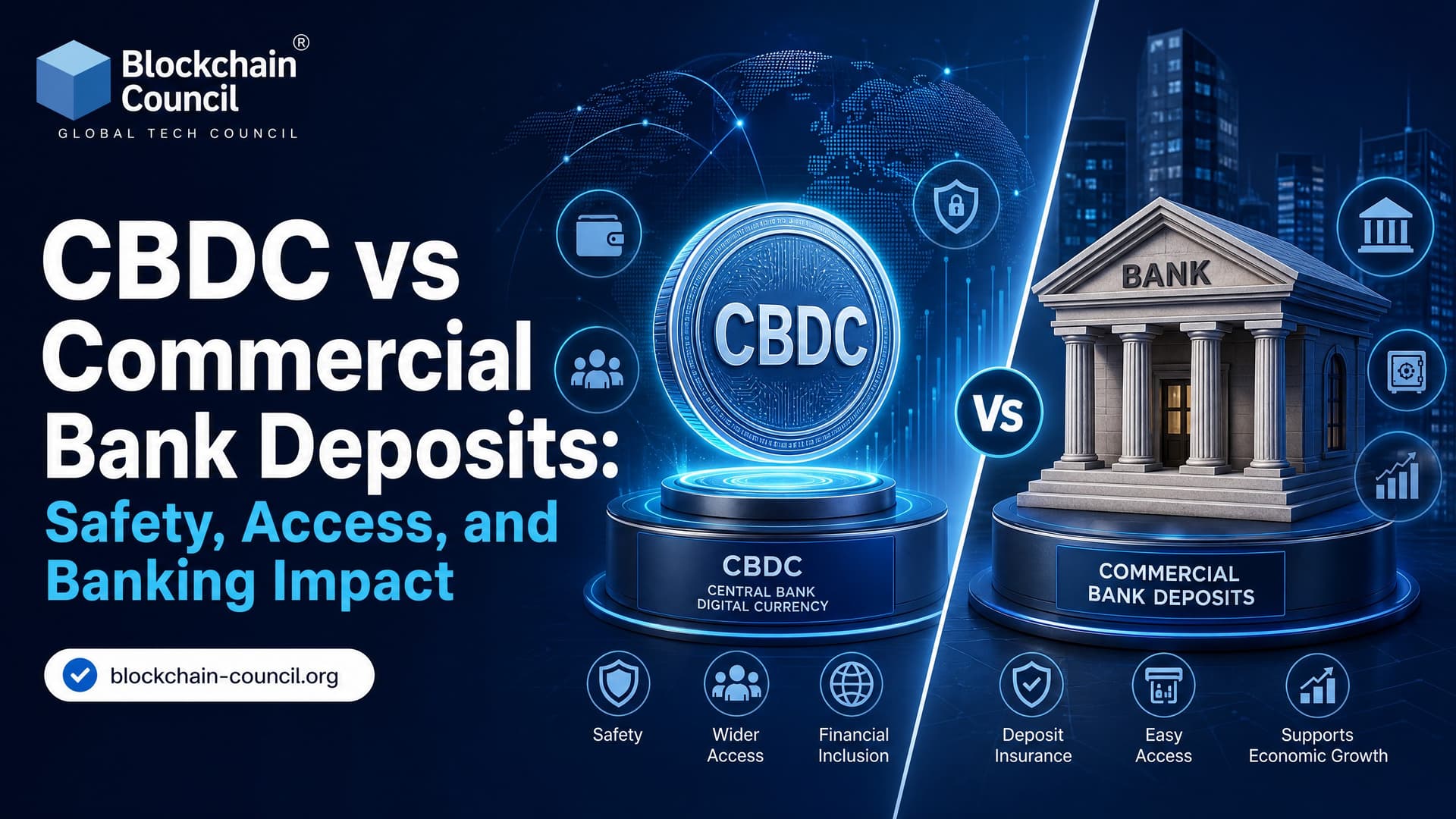
CBDC vs commercial bank deposits is not a simple winner-takes-all comparison. A central bank digital currency is safer at the instrument level because it is a direct liability of the central bank. Commercial bank deposits are private bank liabilities protected by deposit insurance, regulation, and central bank liquidity facilities. That difference sounds technical. It is not. It shapes how households store money, how banks fund lending, and how regulators think about bank runs. For professionals who want a structured understanding of this evolving financial system, a Certified Central Bank Digital Currency (CBDC) Expert pathway can help build focused knowledge around CBDC concepts, architecture, and applications.
Here is the practical answer. CBDC can make digital money safer for users, but a poorly designed CBDC can make the banking system less stable. The design choices matter more than the slogan.

What Is a CBDC?
A central bank digital currency, or CBDC, is digital central bank money available beyond the settlement systems used by banks. In a retail CBDC model, households and businesses could hold digital claims on the central bank in a wallet or account-like structure.
For professionals exploring the wider digital financial ecosystem, a Certified Digital Assets Expert pathway can complement CBDC knowledge by providing broader exposure to digital assets and the technologies and concepts surrounding modern financial infrastructure.
That makes CBDC closer to cash than to a bank deposit. The Federal Reserve has described a CBDC as a direct central bank liability that would not need deposit insurance to maintain confidence. The Bank for International Settlements, the IMF, and the ECB use similar framing: central bank money carries no ordinary credit risk and no liquidity risk for the public.
Commercial bank deposits work differently. Your bank account balance is a liability of the bank. In most advanced economies, that balance is protected by deposit insurance up to a defined limit, backed by bank regulation, and supported by access to central bank liquidity in stress. In daily life, deposits are usually safe and useful. Legally and economically, though, they are not the same as central bank money.
CBDC vs Commercial Bank Deposits: Basic Safety Comparison
At the instrument level, CBDC wins on safety.
CBDC: A digital liability of the central bank, similar in status to cash.
Commercial bank deposits: Liabilities of private banks, supported by deposit insurance and regulation.
Cash: Physical central bank money with storage, transport, and security limits.
That last point is easy to miss. Cash is risk-free in credit terms, but it is inconvenient at scale. You can withdraw some banknotes, but storing millions in physical cash is costly and risky. A CBDC could remove much of that friction. That is good for usability. It is also exactly why central banks worry about fast deposit flight.
Why CBDC Can Increase Bank Run Risk
Bank runs used to have friction. People queued at branches. ATMs had withdrawal limits. Moving large amounts took time. CBDC changes the mechanics.
If a retail CBDC allows large instant transfers from bank deposits into risk-free central bank money, depositors gain a new escape route during market stress. The BIS and ECB have both warned that this could raise latent systemic run risk. The World Bank has made a similar point: a CBDC might let customers run from banks more easily and more rapidly than they can with cash.
To be blunt, speed is the issue. In production payment systems, the operational detail that bites teams is not the wallet UI. It is the transfer limit, the queue behavior, and what happens when 50,000 users try to move funds at 9:01 a.m. after a bad headline. If the conversion rail from deposits to CBDC is always open, uncapped, and instant, the central bank has built a very efficient run channel.
When CBDC Risks Are Limited
CBDC does not automatically destabilize banks. IMF balance sheet analysis shows that financial stability concerns are smaller when CBDC mainly replaces physical cash and banks hold ample excess reserves. In that case, the banking system can absorb conversion into CBDC without a major increase in funding costs.
The risk grows when CBDC competes directly with deposits. If households move meaningful balances out of banks, banks must replace low-cost retail deposit funding with something pricier. That could mean wholesale borrowing, central bank borrowing, or higher deposit rates. None of those is free.
Recent empirical work found that a one dollar increase in CBDC holdings reduced bank deposits by about 81 cents on average. Bank lending fell by roughly 20 cents for each dollar increase in CBDC, because banks partly replaced deposits with wholesale funding. The lending effect may look modest at first glance. The funding mix is the bigger warning sign. More wholesale funding can raise interest rate risk and make banks less resilient when equity values fall.
Design Choices That Decide the Outcome
The debate around CBDC vs commercial bank deposits should focus on design, not ideology. The main safeguards are well understood.
1. Holding Limits
Central banks can cap how much CBDC an individual or firm may hold. A cap reduces the appeal of CBDC as a full substitute for a bank account. It also limits how much money can leave the banking system quickly.
2. Tiered Remuneration
If CBDC pays interest, it becomes a stronger competitor to deposits. If it pays no interest, or pays a lower rate above a threshold, it can serve as payment money rather than an investment asset. This is one reason the ECB and BIS often discuss tiered remuneration in retail CBDC design.
3. Intermediated Distribution
In a two-tier CBDC model, commercial banks and regulated payment service providers manage customer wallets, onboarding, compliance, and front-end services. The central bank operates the core ledger and carries the balance sheet liability.
This model keeps banks involved. It also avoids turning the central bank into a nationwide retail customer service operation. Anyone who has worked on financial onboarding knows the real workload: sanctions screening, account recovery, fraud disputes, KYC refresh cycles, and support tickets from users who changed phones without backing up their credentials.
4. Interoperability With Deposits
CBDC must convert smoothly with commercial bank money, but not in a way that causes uncontrolled liquidity swings. IMF work stresses interoperability because public confidence depends on convertibility. If users cannot move between deposits and CBDC, the system fragments. If they can move unlimited amounts instantly, banks face run risk. The balance is delicate.
Access and Financial Inclusion
CBDC could improve access to digital payments, especially where bank account penetration is low or payment infrastructure is fragmented. A well-designed wallet could let people receive wages, government transfers, or merchant payments without opening a traditional bank account.
McKinsey has noted that CBDC could give consumers and businesses access to central bank issued digital wallets. Academic research also finds that CBDCs can improve payment efficiency and financial accessibility, though outcomes depend heavily on local banking infrastructure and regulation.
There is a trade-off. If CBDC wallets are provided directly by the central bank or mainly by nonbank providers, commercial banks may lose retail balances and payment relationships. That can weaken their ability to offer lending and account services. Inclusion is valuable, but it should not be designed by pretending credit intermediation does not matter.
Impact on Commercial Banks
For banks, CBDC is both a funding challenge and a payments challenge.
Deposits are valuable because they are usually stable and relatively low cost. A widely available CBDC, especially an interest-bearing CBDC, would reduce the liquidity premium banks earn from deposits. Banks may respond by raising deposit rates, increasing loan rates, cutting lending, or relying more on wholesale funding.
Payments are also at stake. If households and firms prefer central bank money for daily transactions, banks could lose fee income and customer touchpoints. That said, banks are not locked out of the future. In intermediated CBDC models, they can provide wallets, compliance services, fraud monitoring, merchant tools, programmable payment features, and treasury integration for enterprises.
For professionals building skills in this area, this is where blockchain and digital asset knowledge becomes practical. CBDC is not the same as a public cryptocurrency, but many design questions overlap with tokenization, wallet architecture, identity, settlement finality, and smart contract controls. Blockchain Council's Certified Blockchain Expert™ and Certified Cryptocurrency Expert™ give readers a structured grounding in digital assets, distributed ledgers, and crypto market infrastructure.
Building Technology Skills Through Competitions
Technology learning can also begin at an early stage through structured academic competitions. The World Tech Olympiad (WTO) is a global technology competition for students from Class 2 to Class 12, offering age-appropriate tracks in areas such as Robotics, Artificial Intelligence, Coding, Computational Thinking, and Cybersecurity.
The Robotics track gives students an opportunity to explore how machines work, how programmed instructions control robotic systems, and how technology can be used to solve real-world problems. Through structured learning and competition, students can develop practical technology awareness along with problem-solving, logical-thinking, and computational skills.
The World Tech Olympiad provides both individual and institutional participation pathways. Parents can directly enroll their children, while schools can register their institution and bring eligible students into the competition. This makes the Robotics Olympiad a practical way for schools and families to introduce students to emerging technologies and encourage early interest in technology-driven learning.
CBDC Implementation Models
Most policy work points to four broad models:
Two-tier or intermediated retail CBDC: Banks and payment firms provide wallets and customer services, while the central bank runs the core infrastructure.
Direct CBDC: The central bank provides accounts or wallets to the public. This offers control but creates operational burden and higher disintermediation risk.
Account-based CBDC: Users are identified, and balances resemble bank accounts connected to payment systems.
Token-like or value-based CBDC: The design aims to mimic cash-like transfer features, sometimes with offline payment capability, while still using regulated onboarding.
My view: for large banking systems, a direct retail CBDC is the wrong default. It concentrates too much operational responsibility at the central bank and puts unnecessary pressure on deposits. A two-tier model with holding limits and tiered remuneration is more realistic.
What Professionals Should Watch Next
CBDC development is moving from papers to pilots in many jurisdictions. BIS and IMF surveys show that most central banks are researching, testing, or piloting CBDCs. The IMF's 2024 policy work highlights financial stability, monetary policy transmission, and cross-border spillovers as central design concerns.
For banks, watch deposit beta, wallet caps, transfer limits, and whether CBDC pays interest. For enterprises, watch integration standards, settlement finality rules, and whether CBDC can be used in programmable payments. For developers, pay attention to identity, privacy, offline transaction handling, and reconciliation. The boring ledger edge cases matter. Duplicate payment messages and failed reversals cause more trouble than the demo ever shows.
For professionals who want to understand the technology supporting these financial systems, a Tech Certification pathway can complement CBDC and digital asset knowledge with broader technology-focused learning.
Final Takeaway
CBDC is safer than commercial bank deposits if you look only at credit and liquidity risk. But money is a system, not just an instrument. Unrestricted CBDC could drain deposits, raise bank funding costs, and make digital bank runs faster.
The best path is not CBDC replacing banks. It is carefully calibrated CBDC coexisting with commercial bank deposits: capped, interoperable, mostly non interest bearing for large balances, and distributed through regulated intermediaries. If you work in banking, fintech, policy, or enterprise payments, start by mapping how CBDC would affect deposit flows and liquidity stress scenarios. Then build the skills to understand the infrastructure behind it.
As CBDCs and digital financial infrastructure continue developing, professionals also need to understand how these technologies are communicated and positioned for businesses and users. A Marketing Certification pathway can complement technical knowledge with broader marketing and business skills relevant to emerging financial technologies.
FAQs
1. What is the difference between a CBDC and a commercial bank deposit?
A Central Bank Digital Currency (CBDC) is digital money issued by a central bank, while a commercial bank deposit is money recorded in an account at a private commercial bank. The crucial difference is the issuer. CBDC is generally a direct liability of the central bank, whereas a bank deposit is a liability of the commercial bank. Both may look like ordinary digital balances to users, but their underlying credit risk, access arrangements, and role in the banking system are different.
2. Is a CBDC safer than money in a commercial bank account?
From an issuer credit-risk perspective, CBDC would generally be considered safer because it is a liability of the central bank rather than a private bank. Commercial bank deposits carry exposure to the bank, although deposit insurance and banking regulation can substantially protect eligible depositors. CBDCs would still face other risks, including cyberattacks, wallet compromise, fraud, operational outages, and loss of credentials. “Safe” therefore depends on which particular disaster humanity has managed to arrange that day.
3. Is CBDC central bank money or commercial bank money?
CBDC is central bank money. Commercial bank deposits are commercial bank money.
The distinction can be summarized as:
Cash → Central bank money
CBDC → Central bank money
Commercial bank deposit → Commercial bank money
This matters because CBDC gives eligible users direct exposure to a central-bank liability, whereas bank deposits are claims on private banking institutions.
4. Can consumers convert bank deposits into CBDC?
Potentially, yes. A retail CBDC could allow consumers to convert commercial bank deposits into an equivalent amount of CBDC.
For example:
$500 bank deposit → $500 CBDC
The consumer has changed the form and issuer of the monetary claim, rather than becoming $500 wealthier. Behind the scenes, the commercial bank and central bank would settle the conversion according to the CBDC architecture.
5. Can CBDC be converted back into a bank deposit?
A well-integrated CBDC system could allow conversion in both directions:
Bank Deposit ↔ CBDC
For example, a consumer receiving CBDC from a customer or employer might choose to transfer it into a conventional bank account. Businesses could potentially configure merchant systems to automatically convert incoming CBDC into deposits, reducing the need to manage separate CBDC balances.
6. Would consumers need a bank account to use CBDC?
Not necessarily. One potential advantage of retail CBDC is that users could potentially access digital central bank money without maintaining a conventional commercial bank deposit account. Access could be provided through banks, payment service providers, cards, smartphones, or other authorized mechanisms. Whether a bank account is required would depend on the distribution, identity, and wallet model selected by the central bank.
7. Would CBDC accounts be held directly at the central bank?
They could be, but many CBDC designs consider an intermediated or two-tier model.
A simplified architecture is:
Central Bank → Banks/PSPs → CBDC Users
The central bank issues the CBDC, while private intermediaries provide wallets, onboarding, customer service, compliance, and payment interfaces. This avoids turning the central bank into the retail bank for an entire population, complete with millions of password-reset requests.
8. How are commercial bank deposits protected?
Commercial bank deposits are generally protected through a combination of banking supervision, capital and liquidity requirements, risk management, resolution frameworks, and, in many jurisdictions, deposit insurance up to specified limits.
The exact protection depends on the country, institution, account type, and amount held. Depositors should therefore distinguish between insured and uninsured balances rather than assuming every deposit receives unlimited government protection.
9. Would CBDC need deposit insurance?
Generally, CBDC would not require conventional deposit insurance because it is itself a direct central bank liability, rather than a deposit owed by a commercial bank.
Deposit insurance exists primarily to protect eligible depositors against commercial-bank failure. With CBDC, the issuer-credit structure is different. However, consumer protections could still be needed for fraud, unauthorized transactions, wallet-provider failures, and operational problems.
10. Could CBDC pay interest like a bank deposit?
Technically, yes. A central bank could design either an interest-bearing CBDC or a non-interest-bearing CBDC.
Paying competitive interest on CBDC could make it more attractive than commercial bank deposits, potentially increasing deposit outflows from banks. For that reason, policymakers may consider non-interest-bearing CBDC, tiered remuneration, or other mechanisms intended to preserve CBDC's payment function without making it an overwhelmingly attractive savings instrument.
11. Why could CBDC reduce commercial bank deposits?
Consumers and businesses might decide to move some money from bank accounts into CBDC because CBDC represents central bank money.
The flow would be:
Commercial Bank Deposit → CBDC
If this occurs on a large scale, commercial banks could lose an important source of relatively stable funding. The effect would depend on CBDC adoption, holding limits, interest rates, deposit pricing, and how banks replace the lost funding.
12. How could CBDC affect bank lending?
Banks use deposits as one important source of funding for loans and other assets. If significant deposits migrate into CBDC, banks may need to replace them using wholesale funding, central bank borrowing, longer-term debt, or more competitive deposit rates.
Higher funding costs could potentially affect:
Loan interest rates
Credit availability
Bank profitability
Lending strategies
The magnitude of these effects would depend heavily on CBDC design and the banking system's response.
13. Could CBDC make bank runs faster?
Potentially. During financial stress, depositors might be able to move money electronically from a commercial bank into central bank money:
Bank Deposit → CBDC
This could be faster and easier than withdrawing large amounts of physical cash. Consequently, CBDC design discussions often consider holding limits, tiered interest rates, conversion restrictions, liquidity facilities, and other safeguards intended to reduce destabilizing flows during periods of panic.
14. What are CBDC holding limits and why might they be used?
A central bank could restrict the maximum amount of CBDC that an individual or business can hold.
For example, once a wallet reaches its permitted threshold, additional incoming CBDC could potentially be redirected automatically into a linked commercial bank account.
Holding limits could help CBDC function primarily as a payment instrument while reducing its attractiveness as a large-scale substitute for bank deposits.
15. How would CBDC affect banks' interest rates on deposits?
If CBDC becomes an attractive alternative to bank deposits, commercial banks may need to offer better terms to retain customers.
That could include:
Higher deposit interest rates
Lower account fees
Better payment services
Improved digital banking
Additional customer benefits
CBDC could therefore increase competition for deposits. That may benefit consumers, although it could also increase banks' funding costs and ultimately influence lending rates.
16. Is CBDC more accessible than a commercial bank deposit?
It could be, particularly if designed around financial inclusion. CBDC access could potentially be offered through low-cost wallets, smart cards, feature phones, payment providers, or simplified accounts.
However, accessibility is not automatic. Identity requirements, smartphone dependence, poor connectivity, disability access, digital literacy, and wallet fees could still create barriers. A CBDC becomes inclusive through deliberate design, not through the ceremonial inclusion of “financial inclusion” in a policy document.
17. Would CBDC provide the same banking services as a commercial bank account?
Usually not. A CBDC wallet would primarily provide access to money and payments, whereas commercial banks offer a much broader range of financial services.
Banks may provide:
Savings accounts
Loans
Mortgages
Credit cards
Overdrafts
Investments
Business financing
Wealth management
CBDC therefore does not inherently replace the economic functions performed by banks.
18. How would CBDC and commercial bank deposits coexist?
A future monetary system could allow users to hold and transfer among several forms of money:
Cash ↔ CBDC ↔ Commercial Bank Deposits
Consumers might keep CBDC for everyday payments while maintaining bank deposits for savings, interest, credit relationships, and other financial services.
Businesses might accept CBDC from customers and automatically sweep the funds into commercial bank accounts. Interoperability would therefore be critical to making coexistence convenient.
19. What are the biggest advantages and risks of CBDC compared with bank deposits?
Feature | CBDC | Commercial Bank Deposit |
|---|---|---|
Issuer | Central bank | Commercial bank |
Liability | Central bank | Commercial bank |
Issuer credit risk | Very low in domestic nominal terms | Depends on bank, regulation and insurance |
Deposit insurance | Generally unnecessary for issuer risk | Often available within limits |
Interest | Design-dependent | Common on some accounts |
Loans and credit | Generally not core function | Major function |
Public access | Design-dependent | Requires banking relationship |
Holding limits | Possible | Usually product-dependent |
Payment functionality | Core objective | Core banking service |
Bank-run implications | Could receive deposit flight | Source of potential outflows |
Cyber/operational risk | Yes | Yes |
Financial inclusion | Potential design objective | Varies by banking system |
The important trade-off is that CBDC could provide consumers with digital access to central bank money, while commercial bank deposits connect payments with a much broader system of savings, lending, credit creation, and financial services.
20. Will CBDCs replace commercial bank deposits and traditional banking?
Complete replacement is unlikely to be the objective of most CBDC designs. Central banks have strong reasons to preserve the role of commercial banks in credit creation, lending, customer relationships, financial intermediation, and economic financing.
A more plausible structure is:
Central Bank
↓ issues
CBDC
↕ interoperates with
Commercial Bank Deposits
↓
Loans + Savings + Credit + Business Finance + Other Banking Services
CBDC could therefore become an additional layer of the monetary system rather than a substitute for commercial banking.
For consumers, the key change would be the ability to hold digital central bank money alongside commercial bank deposits. For banks, the challenge would be maintaining attractive deposits and stable funding when customers have another digital monetary option.
The ultimate impact depends less on the mere existence of CBDC and more on its holding limits, remuneration, distribution model, privacy rules, interoperability, and ease of conversion. Those design choices determine whether CBDC becomes a modest payment alternative or a much more significant force reshaping bank funding and competition.
Related Articles
View All
Digital Assets
CBDC vs Commercial Bank Money: Legal Tender, Risk, and User Experience
Compare CBDC vs commercial bank money across legal tender status, credit risk, privacy, adoption data, and real user experience in live pilots.

Digital Assets
CBDC vs Ethereum: Central Bank Money and Decentralized Platforms Compared
CBDC vs Ethereum explained through governance, programmability, privacy, performance, use cases, and the future of digital money infrastructure.

Digital Assets
CBDC Interview Questions and Answers for Banking, Fintech, and Blockchain Roles
Prepare for CBDC interviews with practical answers on retail and wholesale CBDCs, regulation, bank impact, pilots, and fintech strategy.
Trending Articles
What is AWS? A Beginner's Guide to Cloud Computing
Everything you need to know about Amazon Web Services, cloud computing fundamentals, and career opportunities.
Claude AI Tools for Productivity
Discover Claude AI tools for productivity to streamline tasks, manage workflows, and improve efficiency.
Blockchain in Supply Chain Provenance Tracking
Supply chains are under pressure to prove not just efficiency, but also authenticity, sustainability, and fairness. Customers want to know if their coffee really is fair trade, if the diamonds are con