

CBDC and Banking Disintermediation: Risks for Lenders and Financial Markets
 Suyash Raizada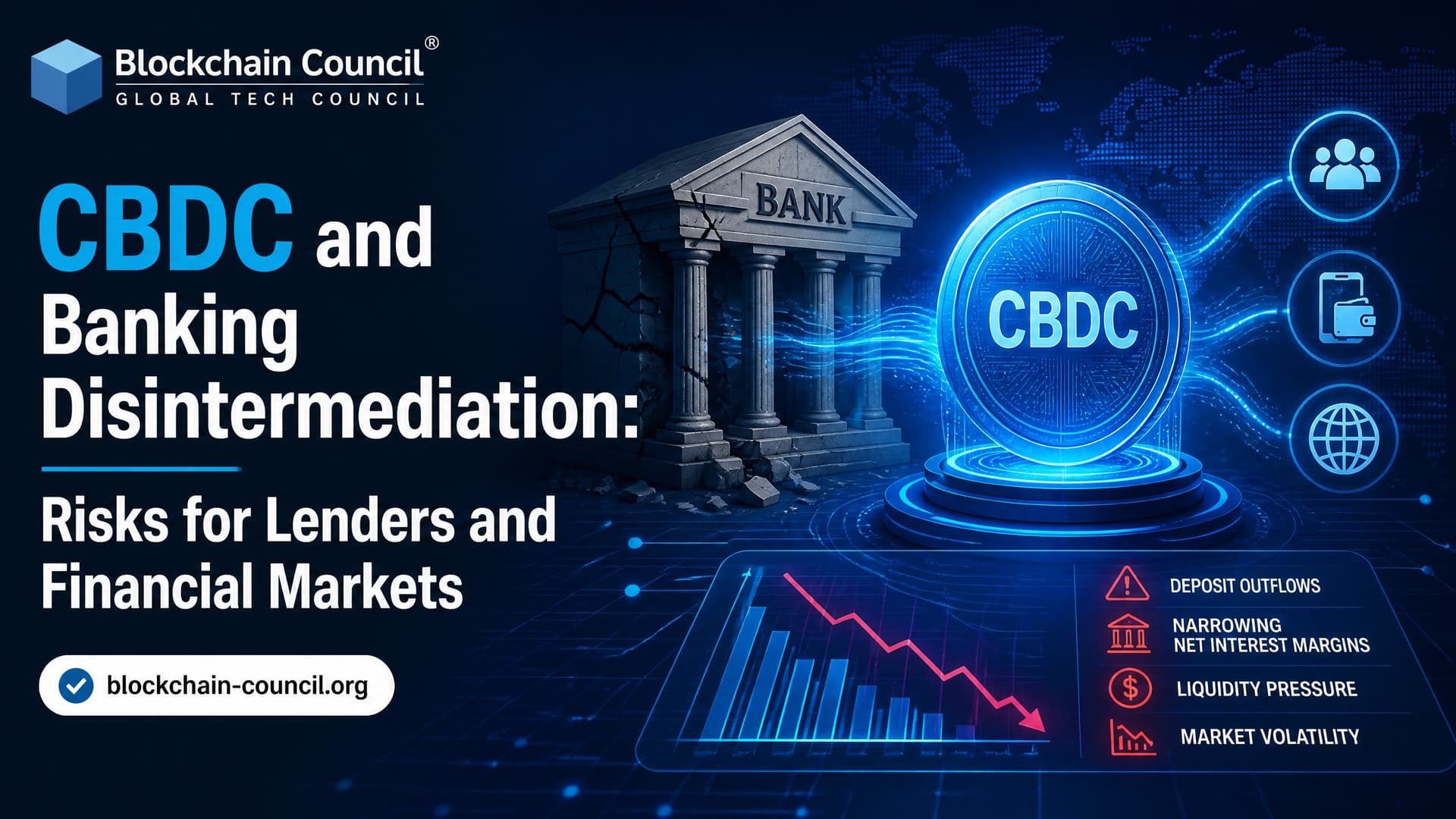
CBDC and banking disintermediation is not a theoretical side issue. If households and firms can hold central bank digital money directly, some bank deposits may move out of commercial banks. For lenders that fund loans with retail deposits, that shift changes funding costs, liquidity planning, and the speed at which a bank run can unfold. If you want the broader design and policy background behind this risk, the Certified Central Bank Digital Currency (CBDC) Expert program is a reasonable place to start.
The evidence so far is measured, not dramatic. Nigeria's eNaira and the Bahamas' Sand Dollar have not caused major deposit losses, largely because adoption stays low and both designs include safeguards. Still, research from the IMF, BIS, ECB, and Federal Reserve points to the same risk: the larger and more deposit-like a retail CBDC becomes, the more pressure it puts on bank balance sheets.

What Banking Disintermediation Means in a CBDC System
Banking disintermediation means customers bypass commercial banks as deposit holders and move money into another asset. In a CBDC context, that asset is a direct claim on the central bank.
Retail CBDC carries the highest risk because it is available to households and businesses. Wholesale CBDC is different. It is restricted to banks and financial institutions and mainly improves settlement between regulated entities. It does not usually compete with retail deposits.
There are two practical channels you need to understand:
Slow disintermediation: customers gradually move part of their savings from bank deposits into CBDC during normal periods.
Fast disintermediation: customers move funds quickly into CBDC during stress, treating it as safer than a commercial bank deposit.
That second channel worries risk teams most. A depositor does not need to stand in a branch queue. A mobile wallet can move funds in seconds. Under stress, this behaves less like old cash withdrawal patterns and more like an instant payment rail pointed at a risk-free destination.
Why Deposits Still Matter So Much to Banks
Since this deposit-substitution story increasingly overlaps with tokenized deposits and stablecoins doing similar work, it is worth pairing this reading with a Certified Digital Assets Expert credential to cover that adjacent ground.
CBDC design debates sometimes understate a basic banking fact: deposits remain the cheapest and most stable funding source for many lenders.
ECB data show that deposits fund about 70 percent of euro area bank liabilities. Household deposits account for a large share, and stable retail deposits make up more than 40 percent of total deposits. EU banks also carried a loan-to-deposit ratio of about 109.2 percent in mid-2023, which shows how tightly lending capacity is linked to deposit availability.
If a CBDC pulls a meaningful slice of these balances away, banks have to replace them. The replacement is usually more expensive: wholesale funding, longer-term debt, central bank facilities, or higher deposit rates to keep customers. None of those come free.
What the Evidence Says So Far
Macro models show real but often modest lending effects
IMF portfolio choice research finds that CBDC can reduce deposits, but the direct fall in lending may be small in some calibrated scenarios. In one model, CBDC reduced deposits by 4 percentage points of total wealth, while lending fell by about 0.14 percent.
That sounds reassuring, but do not overread it. The result depends on assumptions about adoption, whether CBDC replaces cash or deposits, and whether new users enter the formal financial system. If CBDC brings previously unbanked households into digital finance, some deposit losses may be offset by new banking activity.
Bank-level studies show sharper funding pressure
At the bank level, the pressure is more visible. A quantitative study of US banks estimates that a one-dollar increase in CBDC could reduce bank deposits by about 80 to 81 cents on the margin. Banks partly replace those deposits with wholesale funding, so lending falls by less than deposits, but interest rate risk rises.
Research on German savings and cooperative banks reaches a similar warning. Even moderate customer conversion from deposits into CBDC would have created funding problems and profit losses in many years since 2000. Smaller deposit-funded lenders are not all equally exposed, but they are clearly more sensitive than diversified universal banks.
CBDC Demand: Meaningful, But Not Yet Overwhelming
Consumer surveys show interest in CBDC, though not mass enthusiasm. ECB research found that digital euro adoption intent rose from about 28 percent of respondents in August 2022 to 45 percent by June 2023. Around 63 percent said they would move at least some money into CBDC, but many preferred small balances.
Research in the Netherlands found that roughly half of consumers would open a CBDC account, with most transferring up to 500 euro into a non-interest-bearing CBDC. Deutsche Bank's 2024 dbDIG survey was more cautious: only about 16 percent of consumers across the euro area, United Kingdom, and United States believed CBDCs would become mainstream.
The design detail that changes everything is whether users view CBDC as cash-like or deposit-like. If it feels like cash, balances stay small. If it pays interest, supports recurring payments, and becomes a full bank account substitute, deposit outflows grow quickly.
Lessons from eNaira and Sand Dollar
Nigeria's eNaira
Nigeria launched the eNaira in 2021. Current data suggest it has not had a sizeable impact on transferable bank deposits. Central Bank of Nigeria simulations show that even hypothetical eNaira demand increases of 100 percent, 500 percent, and 1000 percent would reduce deposits by only about 0.01 percent, 0.03 percent, and 0.1 percent respectively at current scale.
That is small. The reason is not that disintermediation risk is fake. It is that adoption has been limited by low public awareness, weak merchant acceptance, and strong competition from existing digital payment channels.
The Bahamas' Sand Dollar
The Bahamas launched the Sand Dollar as a nationwide retail CBDC. Its design includes non-interest-bearing balances and wallet ceilings. Higher-tier wallets are linked to financial institutions, which helps keep banks in the payment chain.
The IMF has still warned that Sand Dollar could substitute for commercial bank deposits if adoption rises. In 2024, the Bahamian central bank discussed requiring commercial banks to provide CBDC access, which shows the policy tension clearly: authorities want adoption, but not uncontrolled deposit flight.
Key Risks for Lenders
Higher funding costs: banks may need to replace cheap deposits with wholesale funding or raise deposit rates.
Compressed margins: stronger competition for deposits can reduce net interest margins.
Liquidity strain: rapid CBDC conversion can drain deposits faster than traditional run models assume.
More market dependence: lenders may grow more exposed to bond market conditions and short-term funding spreads.
Business model pressure: banks may need more fee income, better digital payment services, and stronger customer retention.
To be blunt, a small CBDC balance cap is manageable for most banks. An interest-bearing CBDC with high limits is a different product. It competes directly with deposits.
Risks for Financial Markets
CBDC-driven disintermediation can spill beyond banks. If many lenders replace deposits with market funding, money markets and bond markets become more important to everyday credit supply. That can amplify rate shocks.
Fast disintermediation is the bigger systemic concern. ECB and Banco de Espana modelling has shown that unconstrained CBDC can raise bank run probabilities, while holding limits and remuneration rules can reduce them. Some simulations find that run probability rises from about 1.34 percent to as high as 2.51 percent without limits, but can fall below baseline with well-designed caps.
Market pricing already reflects this concern. Studies of bank equity reactions to CBDC news find negative responses, suggesting investors expect pressure on profitability and deposit franchises.
Design Choices That Reduce Disintermediation Risk
Holding limits
Caps on CBDC balances are the cleanest tool. They stop CBDC from becoming a large-scale savings vehicle and cut panic conversion during stress.
Non-interest-bearing CBDC
If CBDC pays no interest, it is less attractive as a deposit substitute. This is why many central banks prefer non-interest-bearing retail CBDC, at least at the start.
Tiered remuneration
A small balance could earn zero or limited remuneration, while larger balances receive unattractive rates. This keeps CBDC useful for payments without turning it into a mass savings product.
Two-tier distribution
Under a two-tier model, banks and payment firms manage customer-facing services while the central bank operates the core settlement asset. This helps preserve the role of regulated intermediaries.
Conversion controls and monitoring
Intraday limits, fees, circuit breakers, and real-time liquidity monitoring can slow sudden flows from deposits into CBDC. These controls need careful design. Too much friction kills usefulness. Too little invites run risk. Engineers building this kind of real-time monitoring and circuit-breaker infrastructure often reinforce their fundamentals with a general Tech Certification, since the underlying systems and monitoring skills apply well beyond any single CBDC platform.
What Professionals Should Do Now
If you work in banking, risk, fintech, or digital assets, treat CBDC as a balance sheet design issue, not just a payment innovation.
Map your institution's deposit base by insured, uninsured, retail, corporate, and concentration risk.
Model CBDC outflows separately from normal deposit beta assumptions. They are not the same behavior.
Test scenarios with non-interest CBDC, interest-bearing CBDC, low caps, and high caps.
Review contingency funding plans for digital run conditions.
Build customer services that make bank deposits more useful, not just higher yielding.
Developers building CBDC or tokenized payment infrastructure should also understand the financial stability layer. Wallet limits, offline payments, identity controls, privacy settings, and settlement finality are not just technical parameters. They shape bank funding risk.
For structured learning, Blockchain Council's Certified Blockchain Expert™, Certified Blockchain Developer™, and Certified Cryptocurrency Expert™ can serve as useful learning paths for professionals who want stronger foundations in digital assets, token systems, and blockchain-based financial infrastructure.
The Practical Outlook
Over the next 3-5 years, CBDC and banking disintermediation risks are likely to stay contained in most markets because live adoption is low and central banks remain cautious. Over 5-10 years, the risk grows more material as digital currencies mature, payment habits change, and central banks push broader usage.
The right position is not panic. It is preparation. Start by learning how CBDC design affects deposits, liquidity, and credit creation. Then build one stress scenario for your own institution or product: what happens if 5 percent of runnable deposits moves to CBDC in a week? That single exercise will tell you more than another abstract policy paper. And if your role also involves explaining these funding risks to depositors, boards, or customers, a Marketing Certification is worth adding to that toolkit, since retaining depositor trust depends as much on clear communication as it does on well-calibrated caps and rates.
FAQs
1. What is CBDC banking disintermediation?
CBDC banking disintermediation refers to the risk that households and businesses move money from commercial bank deposits into Central Bank Digital Currency. Because retail deposits are an important source of bank funding, significant migration could change how banks finance lending and manage liquidity. The severity of disintermediation depends on CBDC design, including holding limits, interest rates, accessibility, and whether commercial banks remain important intermediaries in distributing CBDC services.
2. Why could CBDCs cause bank disintermediation?
A CBDC represents a direct liability of the central bank, while a commercial bank deposit is a liability of a private bank. Some customers may therefore prefer CBDCs for safety, convenience, or payment purposes. If CBDCs become particularly attractive as stores of value, deposit migration could become significant. Banks might then need alternative funding from wholesale markets, bond issuance, or central bank facilities, potentially increasing their funding costs.
3. How could CBDCs affect commercial bank deposits?
Retail CBDCs could compete with traditional bank deposits, particularly transaction and savings balances. Customers might convert part of their deposits into CBDCs for everyday payments or perceived safety. The impact would depend on whether CBDCs pay interest, how much users can hold, and the quality of existing banking services. A payment-focused CBDC with modest holding limits would generally pose less deposit-displacement risk than an unrestricted, interest-bearing alternative to bank accounts.
4. Could CBDCs reduce the amount banks can lend?
Potentially. Banks use deposits alongside other funding sources to support lending. If significant deposits migrate into CBDCs, banks may need more expensive wholesale funding or other liabilities to maintain lending levels. Higher funding costs could translate into higher borrowing rates or reduced credit availability. The effect is not automatic because banks can adjust their balance sheets and funding strategies, but policymakers need to assess whether CBDC adoption could materially affect credit creation.
5. How could CBDCs affect bank funding costs?
CBDCs could increase bank funding costs by creating additional competition for customer deposits. Banks might respond by offering higher deposit rates to retain customers or replacing lost deposits with wholesale borrowing and debt issuance. Both responses can increase funding expenses. These costs may ultimately influence lending rates and profitability. The magnitude depends on CBDC attractiveness and market conditions, because apparently even digital public money cannot enter a financial system without somebody's balance sheet developing opinions about it.
6. Could CBDCs make bank runs more dangerous?
CBDCs could potentially accelerate bank runs because customers might transfer deposits electronically into central bank money within seconds. During periods of financial stress, this could create faster liquidity outflows than traditional cash withdrawals. Holding limits, transfer restrictions, tiered remuneration, and central bank liquidity facilities could reduce the risk. Policymakers must ensure these safeguards work during actual crises, when customer behavior tends to become considerably less cooperative with carefully calibrated economic models.
7. How can CBDC holding limits reduce banking disintermediation?
CBDC holding limits restrict the amount of digital central bank money an individual or organization can maintain. This can preserve CBDC usefulness for payments while discouraging large-scale movement of savings away from commercial banks. Limits can therefore reduce deposit displacement and bank-run risks. However, very low limits may make CBDCs less useful. Policymakers need to calibrate thresholds according to payment behavior, banking structure, financial stability, and adoption objectives.
8. How does CBDC remuneration affect bank deposits?
An interest-bearing CBDC could compete more directly with savings accounts and other bank deposits. If CBDC interest rates become attractive, customers may move larger balances into central bank money. A non-interest-bearing CBDC may create less competition, particularly if banks continue offering interest on deposits. Tiered remuneration provides another option, allowing small CBDC balances while making large holdings financially unattractive. Remuneration is therefore a major tool for controlling disintermediation risk.
9. What is tiered remuneration for CBDCs?
Tiered remuneration applies different interest rates according to the amount of CBDC a user holds. Balances below a threshold might earn a standard rate, while larger balances receive a lower or potentially negative rate. This can encourage consumers to use CBDCs for transactions without treating them as unlimited savings instruments. Such a system may protect bank deposits while preserving payment functionality, although it introduces additional complexity for users, banks, and central-bank policy.
10. How could CBDCs affect bank profitability?
CBDCs could pressure bank profitability if institutions need to pay higher rates to retain deposits or replace inexpensive retail funding with more costly alternatives. Banks may also face technology and compliance costs associated with providing CBDC wallets and related services. On the other hand, CBDCs could reduce some payment-processing and reconciliation costs and create new service opportunities. The net impact will depend on the bank's business model and the architecture of the CBDC ecosystem.
11. Could CBDCs change the role of commercial banks?
Yes. CBDCs could shift banks' roles from being primary providers of transaction money toward providing more payment interfaces, credit, advisory services, custody, identity verification, and compliance functions. In intermediated CBDC models, banks may continue managing customer relationships and wallets even though the underlying money is a central bank liability. The challenge is modernizing public money without unnecessarily removing useful private-sector functions that commercial banks currently perform.
12. How could CBDCs affect small and regional banks?
Smaller and regional banks may face greater disintermediation risks if they depend heavily on retail deposits and have limited access to alternative funding. Deposit migration into CBDCs could increase their funding costs more sharply than those of large institutions with diversified funding sources. Regulators should therefore assess CBDC effects across different bank categories. An aggregate banking-sector model can look reassuring while concealing rather unpleasant outcomes for particular institutions.
13. How could CBDCs affect credit availability for businesses?
If CBDCs increase bank funding costs or reduce available deposits, banks may respond by raising loan rates, tightening credit standards, or reducing certain forms of lending. SMEs could be particularly sensitive because they often depend heavily on bank financing. However, improved payment efficiency and cash flow from CBDCs could provide some offsetting benefits. The overall impact on business credit therefore depends on how strongly CBDCs affect banking funding relative to broader economic efficiency gains.
14. How could CBDCs affect mortgages and consumer lending?
Changes in bank funding costs could eventually influence mortgage, personal loan, and other consumer credit rates. If banks must compete more aggressively for deposits or use more expensive wholesale funding, lending margins may need to adjust. The effect could be limited if CBDC holdings are capped or if deposit migration remains modest. Policymakers should therefore examine household credit markets when evaluating CBDC design rather than focusing exclusively on payment-system improvements.
15. How could CBDCs affect financial markets?
Large-scale deposit migration could increase banks' reliance on wholesale funding, potentially expanding demand for bank bonds and other market-based financing. This could make banks more sensitive to market conditions and funding volatility. Wholesale CBDCs may separately improve securities settlement and tokenized financial markets. CBDCs can therefore affect financial markets through both banking disintermediation and infrastructure modernization, with very different implications depending on the form of CBDC involved.
16. Could CBDCs increase reliance on central bank funding?
Potentially. If commercial banks lose deposits to CBDCs and cannot replace them economically in private markets, they may rely more heavily on central bank liquidity facilities. This could expand the central bank's role in allocating liquidity within the financial system. Excessive reliance may create moral-hazard or market-distortion concerns. Policymakers therefore need funding frameworks that support temporary liquidity needs without turning the central bank into the routine financier of commercial banking.
17. Can an intermediated CBDC model protect commercial banks?
An intermediated model can preserve important roles for commercial banks and regulated payment providers. These institutions may handle customer onboarding, wallets, KYC, fraud monitoring, customer service, and payment interfaces while the central bank manages the underlying monetary infrastructure. This approach can reduce operational burdens on the central bank and maintain private-sector participation. However, it does not completely eliminate deposit migration because users still hold a central bank liability rather than a commercial bank deposit.
18. Could wholesale CBDCs cause banking disintermediation?
Wholesale CBDCs generally pose less direct disintermediation risk because access is typically limited to banks and eligible financial institutions rather than the general public. Their primary purpose is usually improving interbank, securities, or cross-border settlement. However, wholesale CBDCs can still alter market infrastructure, liquidity management, and the roles of existing intermediaries. The disintermediation debate is therefore primarily associated with retail CBDCs, especially those widely accessible to households and businesses.
19. How can central banks minimize CBDC disintermediation risks?
Central banks can combine holding limits, non-interest-bearing designs, tiered remuneration, intermediated distribution, liquidity facilities, and gradual implementation. Stress tests can examine deposit migration under both normal and crisis conditions. Authorities should also monitor impacts on bank funding, lending rates, profitability, and market-based financing. CBDC design should be adjustable as adoption develops, because predicting exactly how millions of depositors will behave before launch would require economists to acquire powers they have historically not demonstrated.
20. Will CBDCs replace commercial banks?
CBDCs are unlikely to eliminate commercial banks because banks perform many functions beyond providing payment accounts, including lending, credit assessment, maturity transformation, financial advice, and business financing. However, CBDCs could change how banks fund themselves and compete for customer relationships. The policy challenge is to capture the benefits of digital central bank money without unnecessarily weakening credit intermediation or financial stability. A successful CBDC ecosystem would modernize payments while preserving economically useful banking functions rather than attempting to make banks technologically decorative.
Related Articles
View All
Digital Assets
How RWA Tokenization Reduces Transaction Costs in Financial Markets
RWA tokenization cuts financial market costs through fewer intermediaries, smart contracts, faster settlement, and cheaper blockchain infrastructure.

Digital Assets
CBDC Interview Questions and Answers for Banking, Fintech, and Blockchain Roles
Prepare for CBDC interviews with practical answers on retail and wholesale CBDCs, regulation, bank impact, pilots, and fintech strategy.

Digital Assets
CBDC Jobs in Banking and Finance: Roles, Salaries, and Growth Areas
Explore CBDC jobs in banking and finance, including key roles, salary ranges, required skills, and the fastest-growing career paths.
Trending Articles
AWS Career Roadmap
A step-by-step guide to building a successful career in Amazon Web Services cloud computing.

Top 5 DeFi Platforms
Explore the leading decentralized finance platforms and what makes each one unique in the evolving DeFi landscape.
How Blockchain Secures AI Data
Understand how blockchain technology is being applied to protect the integrity and security of AI training data.