

Claude vs Other AIs: Which AI is Best in 2026?
 Suyash Raizada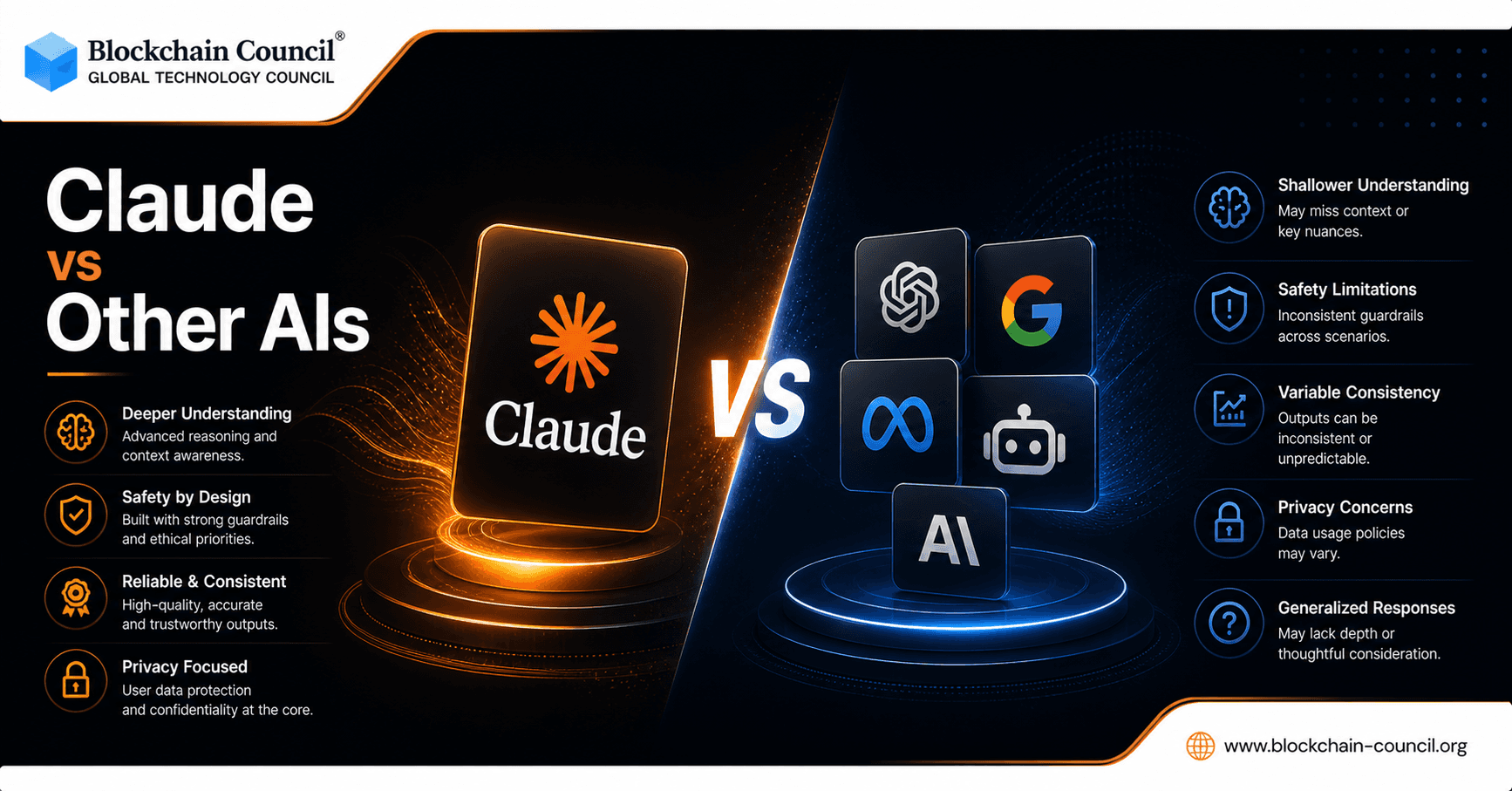
The AI space is evolving rapidly, with multiple powerful models competing for dominance. From content creation to coding and research, choosing the right AI tool can significantly impact your productivity.
Among the top contenders are Claude AI, ChatGPT, and Google Gemini - along with a growing ecosystem of open-source LLMs.

Each of these tools has unique strengths, limitations, and ideal use cases. Let’s break it down.
Claude vs ChatGPT (OpenAI Comparison)
Overview
ChatGPT, developed by OpenAI, is one of the most widely used AI tools globally.
Key Differences
Reasoning & Long Context
Claude: Strong long-form reasoning, better context retention
ChatGPT: Fast responses, strong general performance
Writing Quality
Claude: More natural, detailed, and structured
ChatGPT: More concise and versatile
Safety
Claude: Strong safety via Constitutional AI
ChatGPT: Balanced safety with flexibility
Best Use Cases
Claude → Research, long-form content, deep analysis
ChatGPT → General tasks, coding, quick responses
Claude vs Google Gemini
Overview
Google Gemini is designed to integrate deeply with Google’s ecosystem.
Key Differences
Ecosystem Integration
Gemini: Strong integration with Google tools (Docs, Gmail, etc.)
Claude: Independent ecosystem with flexible integrations
Data Access
Gemini: Better real-time data via Google
Claude: Strong reasoning but limited real-time access
Understanding
Claude: Better deep reasoning and structured outputs
Gemini: Strong multimodal capabilities
Best Use Cases
Claude → Analysis, writing, coding workflows
Gemini → Google ecosystem users, real-time queries
Claude vs Open-Source LLMs
Overview
Open-source LLMs (like LLaMA, Mistral, etc.) are gaining popularity for flexibility and control.
Key Differences
Customization
Open-source: Fully customizable
Claude: Managed and optimized system
Performance
Claude: More refined and reliable
Open-source: Depends on setup and tuning
Safety
Claude: Strong built-in safety
Open-source: Requires manual safeguards
Best Use Cases
Claude → Reliable, production-ready workflows
Open-source → Custom AI solutions, experimentation
Strengths of Claude AI
Key Advantages
Deep contextual understanding
Long-form reasoning
Strong safety and alignment
Agentic capabilities (automation, workflows)
High-quality writing
Weaknesses of Claude AI
Limitations
Limited real-time data
Less ecosystem integration than Google
Not as customizable as open-source models
Use-Case Comparisons
Content Creation
Best: Claude
Alternative: ChatGPT
Coding & Development
Best: Claude (agentic workflows)
Alternative: ChatGPT
Research & Analysis
Best: Claude
Alternative: Gemini (for real-time data)
Ecosystem Integration
Best: Gemini
Alternative: Claude
Custom AI Development
Best: Open-source LLMs
Alternative: Claude API
Why Developers & Professionals Prefer Claude
The growing shift toward Claude is driven by:
Better reasoning
Workflow automation
High-quality outputs
Reliable performance
It’s especially powerful for:
Developers
Writers
Analysts
Creators
AI Learning Path Recommendation
To stay ahead:
Step 1: Learn AI Basics
Step 2: Master Tools (Claude, ChatGPT, Gemini)
Step 3: Build Workflows & Systems
A structured program like the Certified Claude AI Expert Program helps you:
Master Claude deeply
Build real-world projects
Create income opportunities
Tech Certifications for Future AI Careers
Recommended
Business Certifications for Growth
Top Certifications
Conclusion
There is no single “best” AI - it depends on your use case.
However, Claude AI stands out for:
Deep thinking
Structured outputs
Agentic capabilities
If your goal is serious productivity, development, and analysis, Claude is one of the strongest choices in 2026.
FAQs
1. Is Claude better than ChatGPT?
It depends on use case; Claude excels in reasoning and long-form tasks.
2. What is Claude AI best for?
Writing, analysis, and coding workflows.
3. How is Gemini different from Claude?
Gemini integrates with Google tools and offers real-time data.
4. Are open-source LLMs better?
They are more customizable but less polished.
5. Which AI is best for coding?
Claude and ChatGPT both perform well.
6. Is Claude safer than other AIs?
Yes, due to Constitutional AI principles.
7. Can I use multiple AI tools?
Yes, combining tools is often best.
8. What is the future of AI tools?
More integration and automation.
9. Is Claude good for beginners?
Yes, but learning prompts is helpful.
10. Which AI is best for research?
Claude is strong for deep analysis.
11. Does Gemini have real-time data?
Yes, it leverages Google’s ecosystem.
12. Are open-source models free?
Many are free but require setup.
13. Can Claude replace developers?
No, it enhances productivity.
14. What is agentic AI?
AI that performs tasks autonomously.
15. Which AI is best for business?
Claude for insights, Gemini for integration.
16. Is Claude good for writing?
Yes, it produces high-quality content.
17. Can Claude access the internet?
Limited compared to Gemini.
18. What skills are needed?
Prompt engineering and AI workflows.
19. Is Claude worth learning?
Yes, it offers strong career advantages.
20. Which AI is future-proof?
Those with strong ecosystems and capabilities.
Related Articles
View All
Claude Ai
Claude Sonnet 5 in AI-Powered Crypto Trading: Opportunities, Risks, and Best Practices
Claude Sonnet 5 can support AI-powered crypto trading through research, monitoring, and strategy support, but execution needs strict controls.

Claude Ai
Claude Prompt vs Claude Looping: Key Differences, Use Cases, and Best Practices
Learn the practical difference between Claude prompting and Claude looping, including when to use each, key risks, agent workflows, and best practices.

Claude Ai
Best Claude Fable Alternatives: Top LLMs for Coding, Automation, Research, and AI Agents
Compare the best Claude Fable alternatives for coding, automation, research, AI agents, IDE workflows, and self-hosted enterprise deployments.
Trending Articles
How Blockchain Secures AI Data
Understand how blockchain technology is being applied to protect the integrity and security of AI training data.
What is AWS? A Beginner's Guide to Cloud Computing
Everything you need to know about Amazon Web Services, cloud computing fundamentals, and career opportunities.

Can DeFi 2.0 Bridge the Gap Between Traditional and Decentralized Finance?
The next generation of DeFi protocols aims to connect traditional banking with decentralized finance ecosystems.