

Top Claude Fable 5 Use Cases in Education, Automation, Coding, and Content Creation

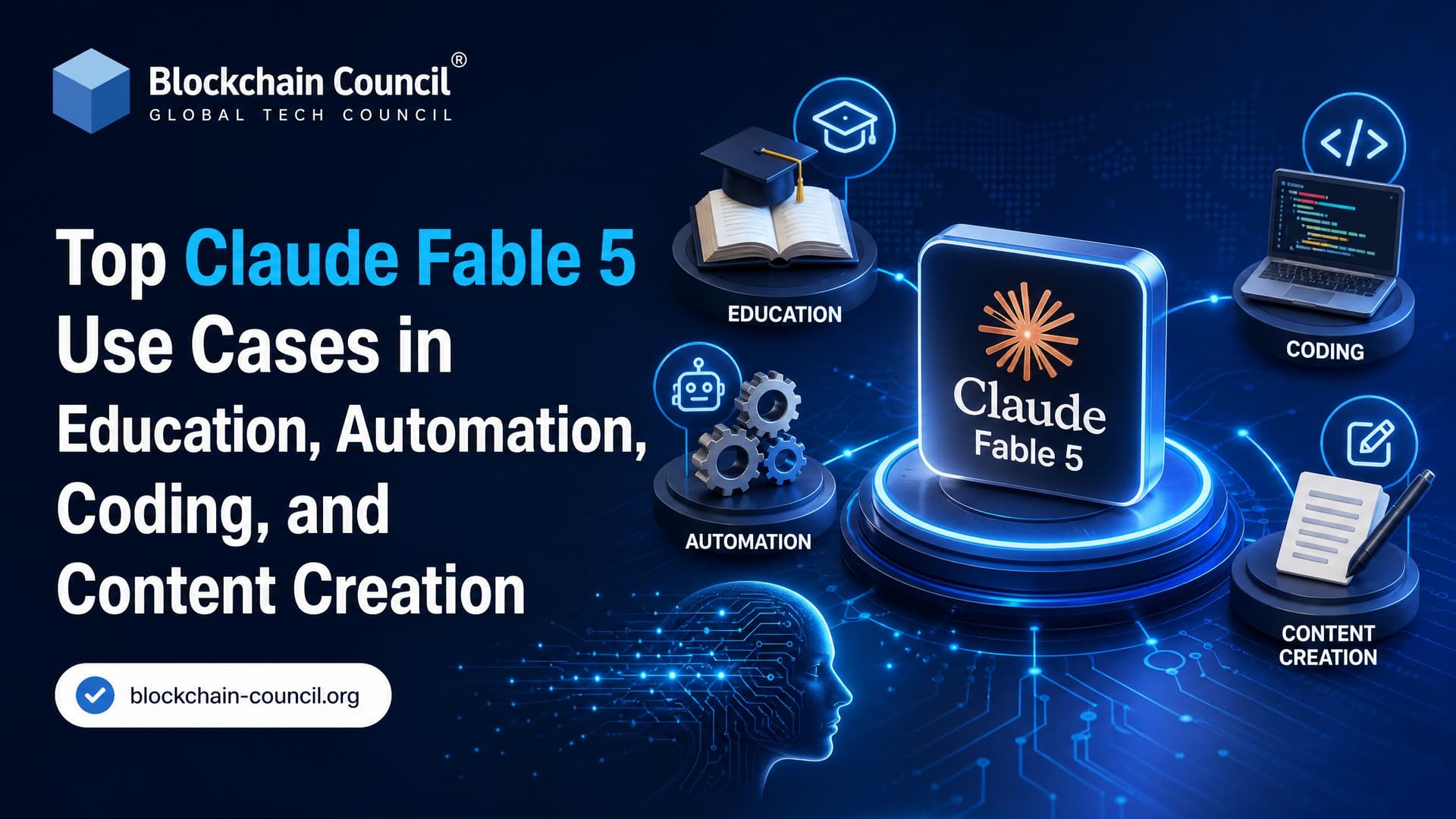
Claude Fable 5 use cases are expanding quickly across education, automation, coding, and content creation because the model combines long-context reasoning, multimodal understanding, advanced software engineering performance, and stronger safeguards for public use. Anthropic positions Claude Fable 5 as its first generally available Mythos-class model, designed for demanding knowledge work, agentic workflows, coding, vision, and large-scale analysis.
For professionals and enterprises, the most important shift is not simply that Claude Fable 5 can answer harder questions. It can work across larger bodies of information, sustain longer tasks, and coordinate multi-step workflows with fewer handoffs. That makes it relevant for educators building AI tutors, developers modernizing codebases, teams automating research, and content professionals producing complex technical material.

What Makes Claude Fable 5 Different?
Claude Fable 5 is available through the Claude API and major cloud platforms, including Amazon Bedrock, Google Cloud Vertex AI, Microsoft Foundry, and other AI gateways. It supports text, images, and files, with a context window of up to 1,000,000 tokens. This matters because many enterprise and education tasks require more than a short prompt. They depend on full syllabi, code repositories, policies, reports, transcripts, diagrams, and historical notes.
Anthropic describes Fable 5 as state of the art for coding, knowledge work, vision, and computer use. GitLab has reported that Fable 5 can sustain multi-day, goal-directed runs while maintaining strong instruction adherence. On SWE-Bench Pro, Anthropic and partners report an 80.3% result, highlighting its strength in software engineering tasks.
Safety is also central to the model's positioning. Anthropic has described Fable 5 as a safer public counterpart to more capable internal Mythos-class systems, with routing and classifiers for sensitive areas such as cybersecurity, biology, chemistry, and model distillation. This makes governance and human oversight essential, especially in regulated environments.
Claude Fable 5 Use Cases in Education
Long-Horizon AI Tutors
One of the most promising Claude Fable 5 use cases in education is personalized tutoring over extended periods. With a 1,000,000-token context window and support for external notes, an education platform can maintain a learner profile that includes prior misconceptions, learning goals, preferred explanations, quiz history, and project progress.
This supports AI tutors that do more than answer isolated questions. They can adapt over a semester, revisit earlier weaknesses, and connect new lessons to previous work. For professional learners in AI, blockchain, and cybersecurity, such tutors can help structure certification preparation and reinforce concepts through targeted practice.
Readers interested in AI learning pathways can explore Blockchain Council programs such as Certified AI Expert and Certified Prompt Engineer.
Curriculum Design and Course Alignment
Fable 5's long-document analysis makes it useful for curriculum planning. Instructional designers can provide course outcomes, policy documents, reading lists, accreditation requirements, and existing lesson materials in a single workflow. The model can then identify gaps, suggest module sequences, and recommend assessments aligned with learning objectives.
This is particularly valuable in fast-changing fields like Web3, AI governance, smart contracts, and cybersecurity. Course teams can use Fable 5 to compare existing materials against new technical standards or market developments, then propose updates for instructor review.
Coding Labs and Automated Feedback
Programming education benefits directly from Fable 5's coding capabilities. Instructors can use it to review multi-file submissions, explain errors, suggest refactors, and generate test cases. Unlike basic code assistants, Fable 5 can reason across larger projects, making it suitable for capstone work, team repositories, and advanced software engineering courses.
For blockchain education, this can support smart contract review exercises, Solidity debugging labs, or secure development assignments. Human instructors should still validate feedback, especially where security or financial logic is involved.
Claude Fable 5 Use Cases in Automation
Research and Analysis Agents
Automation is one of the strongest areas for Claude Fable 5 use cases. Its long-context capacity and multi-day autonomy make it suitable for research agents that gather material, summarize evidence, compare sources, and maintain an evolving research notebook.
Enterprises can apply this to market intelligence, policy monitoring, vendor evaluation, legal research, and technical due diligence. Instead of generating a one-time summary, an agent can continue refining its findings as new documents are added.
Workflow Orchestration
Fable 5 can also coordinate multi-step workflows that involve tools, APIs, files, and human approvals. For example, an automation agent could process data, generate scripts, inspect outputs, update a report, and flag exceptions for review.
In business settings, this pattern can support contract intake, compliance checklists, vendor onboarding, incident reporting, and knowledge-base maintenance. The best implementations use Fable 5 for planning and reasoning while keeping high-risk actions behind permissions, logs, and human checkpoints.
Operations and Incident Support
Because Fable 5 can maintain large context, it can assist with incident timelines, system logs, alerts, runbooks, and post-incident reviews. It can suggest next steps based on documented procedures, compare a current outage to prior incidents, and generate structured summaries for engineering or leadership teams.
Cybersecurity-related usage must respect Anthropic's safety routing. The model is better suited for defensive support, documentation, triage, and awareness training than for offensive exploit development.
Claude Fable 5 Use Cases in Coding
Large-Scale Codebase Migration
Coding is the domain with the strongest public evidence for Fable 5. Anthropic and partners have highlighted its ability to work on very large codebases, including a reported 50-million-line migration completed in a day in a benchmark-style scenario. This points to significant potential for modernization projects.
Enterprises can use Fable 5 to support framework upgrades, API migrations, language transitions, dependency cleanup, and architecture refactoring. Its long context helps it understand cross-file dependencies, coding conventions, and architectural constraints.
Autonomous Feature Implementation
Fable 5 can support autonomous coding agents that interpret a specification, inspect the repository, propose an implementation plan, write code, run tests, and revise based on results. GitLab has reported stronger first-shot correctness and fewer iterations on complex tasks compared with earlier models.
This does not remove the need for developers. Instead, it changes the workflow. Engineers increasingly become spec writers, reviewers, test designers, and supervisors of AI-assisted implementation.
Code Review, Bug Finding, and Test Generation
Another high-value use case is repository-aware code review. Fable 5 can inspect diffs, identify logic issues, suggest edge cases, and recommend targeted tests. Its broader context can reduce the risk of reviewing code only at the local file level.
For blockchain developers, this is especially relevant. Smart contracts, token logic, DeFi protocols, and decentralized applications require careful review because small errors can create major losses. Fable 5 can assist with review, but expert human audit remains essential.
Blockchain Council's Certified Blockchain Developer and smart contract focused programs can help professionals understand the technical foundations needed to supervise AI coding tools effectively.
Claude Fable 5 Use Cases in Content Creation
Long-Form Research-Backed Writing
Fable 5's knowledge work capabilities make it useful for technical writing, whitepapers, policy briefs, research reports, and educational content. Teams can provide source documents, transcripts, product notes, charts, and style guidance, then ask the model to synthesize structured drafts.
This is especially useful for AI, Web3, cybersecurity, and enterprise technology topics where content must be accurate, nuanced, and supported by source material. The model can help create outlines, compare viewpoints, identify missing context, and refine drafts for different audiences.
Editorial Operations and Content Governance
Fable 5 can support multi-stage editorial workflows. It can maintain a content memory that includes style rules, terminology preferences, compliance constraints, and prior articles. This allows teams to create more consistent content across newsletters, blogs, documentation, reports, and learning materials.
For regulated industries, the model can help flag unsupported claims, detect inconsistencies, and prepare review checklists. Final publication decisions should still involve human editors and subject matter experts.
Multimodal Content Transformation
Because Fable 5 accepts images and files, it can help transform slide decks, diagrams, charts, and screenshots into written explanations. It can generate captions, accessibility descriptions, study notes, and article sections from visual material.
CNET reported that Fable 5 completed Pokémon FireRed using a vision-only setup, a sign of stronger visual perception and sequential planning. In content workflows, similar capabilities can support richer interpretation of visual assets, especially for tutorials and technical documentation.
Best Practices for Using Claude Fable 5
- Use external memory carefully: Store notes, decisions, and lessons outside the model, then reload them into context when needed.
- Define clear goals: Long-running agents need precise objectives, constraints, success criteria, and stop conditions.
- Add human review: Use expert oversight for education, code, compliance, security, and regulated content.
- Control costs: Large contexts and long outputs can be expensive, so use prompt caching and context pruning where appropriate.
- Respect safety boundaries: Design workflows around defensive, educational, and compliant use cases.
Conclusion
The top Claude Fable 5 use cases show a clear pattern: the model is most valuable when work is complex, long-running, context-heavy, and requires structured reasoning. In education, it can power persistent tutors, curriculum design, and coding feedback. In automation, it can coordinate research agents, workflows, and operations support. In coding, it can assist with migrations, feature implementation, reviews, and tests. In content creation, it can synthesize research, transform multimodal assets, and support editorial pipelines.
For professionals and enterprises, the opportunity is to learn how to specify, supervise, and govern advanced AI systems. As models like Claude Fable 5 become embedded in development tools, cloud platforms, and learning environments, practical AI literacy will become a core professional skill across blockchain, AI, cybersecurity, and deeptech.
Related Articles
View All
Claude Ai
Best Claude Fable Alternatives: Top LLMs for Coding, Automation, Research, and AI Agents
Compare the best Claude Fable alternatives for coding, automation, research, AI agents, IDE workflows, and self-hosted enterprise deployments.
Claude Ai
Top Fable 5 Use Cases in Business: Operations to Support
Explore the top Fable 5 use cases in business, including software engineering, operations, marketing, customer support, and strategic planning.

Claude Ai
Fable 5 for Coding and Debugging: Practical Use Cases for Developers
Learn how Fable 5 supports coding, debugging, migrations, architecture review, and multi-agent developer workflows in practical software projects.
Trending Articles
AWS Career Roadmap
A step-by-step guide to building a successful career in Amazon Web Services cloud computing.

Top 5 DeFi Platforms
Explore the leading decentralized finance platforms and what makes each one unique in the evolving DeFi landscape.

Can DeFi 2.0 Bridge the Gap Between Traditional and Decentralized Finance?
The next generation of DeFi protocols aims to connect traditional banking with decentralized finance ecosystems.