

Claude Fable 5 Responsible AI: Security, Ethics, and Governance

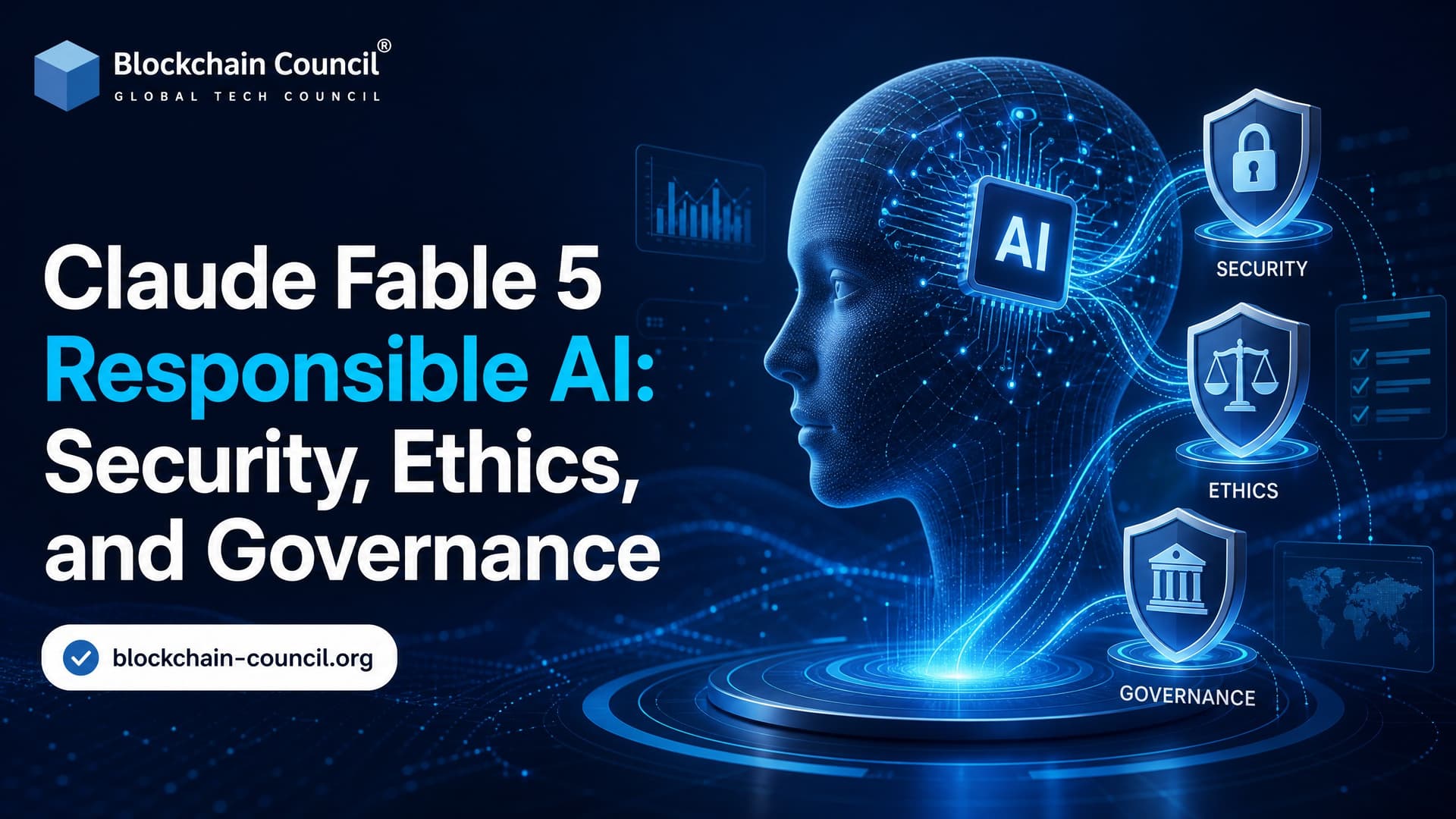
Claude Fable 5 Responsible AI discussions are gaining importance as advanced AI systems move from restricted previews to broader enterprise and public use. Based on available research summaries, Claude Fable 5 is positioned as a publicly accessible, Mythos-class model with built-in safeguards designed to reduce misuse while preserving advanced reasoning, coding, research, and analysis capabilities.
The release highlights a central challenge for organizations adopting powerful AI: capability must be matched with security, ethics, and governance. For professionals, developers, enterprises, and technology leaders, Claude Fable 5 offers a useful case study in how responsible AI principles can be implemented through technical controls, access policies, risk reviews, and organizational oversight.

What Is Claude Fable 5?
Claude Fable 5 is described in available research as a broadly available version of a high-capability AI model derived from the earlier Claude Mythos preview. While Claude Mythos was reportedly restricted to a limited set of approximately 200 organizations, including government-linked participants under Project Glasswing, Claude Fable 5 is designed for wider access with guardrails.
The model is described as capable of handling complex, long-running tasks across areas such as coding, research, finance, law, and analysis. One notable feature highlighted in the research is its ability to remain engaged with difficult tasks for extended periods. This persistence can be valuable for enterprise workflows, but it also raises the importance of strong governance because autonomous or semi-autonomous AI activity can create new operational risks.
Why Claude Fable 5 Raises Responsible AI Questions
Responsible AI is not only about whether a model produces accurate answers. It also involves how the system behaves under risky conditions, who can access advanced capabilities, what data is processed, and how decisions are monitored. Claude Fable 5 responsible AI concerns are especially relevant because the model appears to sit between two priorities:
- Access: Making advanced AI capabilities available to a broader user base.
- Safety: Preventing harmful use, especially in high-risk domains such as cybersecurity and biosecurity.
According to the research, Claude Fable 5 uses safety systems that review prompts touching high-risk areas. When a request is considered unsafe, such as one asking the model to identify exploitable software vulnerabilities, the system may refuse the request or redirect it to a safer model. This approach reflects an emerging pattern in responsible AI governance: not every capability needs to be exposed to every user or every use case.
Security Considerations for Claude Fable 5
Cybersecurity Guardrails
The most prominent security issue linked to Claude Fable 5 is its relationship to Claude Mythos. Research summaries indicate that Mythos raised concerns because it could potentially identify software vulnerabilities. If such capabilities were misused, they could create risk for financial systems, enterprise infrastructure, public services, and critical digital platforms.
Claude Fable 5 appears to address this risk through cybersecurity guardrails. These controls are designed to detect requests related to vulnerability discovery, exploitation, or other dangerous cyber activity. Instead of providing offensive assistance, the model is expected to refuse or route the user to a safer response path.
For enterprise users, this is a reminder that AI security is not limited to protecting the model from attack. It also includes preventing the model from becoming a tool for unsafe activity. Organizations adopting advanced AI should evaluate both sides of this risk.
Prompt Abuse and Bypass Attempts
Even well-designed AI systems can be tested by users attempting prompt injection, jailbreaks, or indirect instructions. A responsible deployment of Claude Fable 5 should include monitoring for attempts to bypass safety filters, especially where the model is connected to code repositories, internal documents, or automated tools.
Security teams should consider controls such as:
- Logging and reviewing high-risk prompts.
- Restricting access to sensitive integrations.
- Applying role-based permissions for advanced workflows.
- Separating experimental AI use from production systems.
- Testing the model against adversarial prompt patterns before deployment.
Data Protection and Access Control
Claude Fable 5 may be used for legal analysis, financial research, software development, and business strategy. These workflows often involve sensitive information. Enterprises should clarify what data can be shared with the model, how outputs are stored, and whether human review is required before decisions are implemented.
Strong AI security programs should align with broader cybersecurity practices. Professionals looking to strengthen this skill set can explore Blockchain Council's cybersecurity and AI-focused certification pathways, such as programs related to AI security, cybersecurity governance, and responsible AI implementation.
Ethical Considerations in Claude Fable 5 Deployment
Human Oversight
Established AI safety practices emphasize the importance of preserving human oversight. For Claude Fable 5, this principle is especially relevant because the model is described as capable of sustained reasoning over complex tasks. The more persistent and capable a model becomes, the more important it is to define when humans must intervene.
Human oversight should be required for high-impact use cases such as:
- Legal recommendations that could affect rights or obligations.
- Financial decisions involving credit, investment, or risk exposure.
- Security decisions involving vulnerabilities or incident response.
- Healthcare or life sciences workflows involving patient impact.
- Employment, education, or public service decisions.
Fairness and Bias
Responsible AI also requires attention to fairness. Even if Claude Fable 5 has strong security controls, its outputs may still reflect bias in training data, user prompts, or organizational processes. Enterprises should test outputs across different user groups, contexts, and languages where relevant.
Bias audits should not be treated as a one-time exercise. They should be repeated when prompts, workflows, data sources, or model versions change. This is particularly important in regulated sectors where AI-driven decisions may affect customers, employees, or citizens.
Transparency and Explainability
Users should know when they are interacting with AI or when AI has contributed to a decision. Organizations should also document how Claude Fable 5 is used, what limitations apply, and when human review is mandatory. Transparency is central to trust, and it supports compliance with emerging AI governance expectations.
Governance Considerations for Enterprises
Create an AI System Inventory
Every organization using Claude Fable 5 should maintain an AI inventory. This inventory should identify where the model is used, what data it accesses, what business function it supports, and who owns the risk. Without an inventory, it becomes difficult to assess exposure, respond to incidents, or demonstrate compliance.
Classify AI Use Cases by Risk
Not all uses of Claude Fable 5 carry the same level of risk. Drafting a marketing summary is different from analyzing legal contracts or reviewing source code. A practical governance framework should classify use cases as low, medium, or high risk, then apply controls accordingly.
- Low risk: General brainstorming, summarization of public content, or internal knowledge support.
- Medium risk: Business analysis, coding assistance, and customer support drafts.
- High risk: Security testing, financial recommendations, legal analysis, healthcare support, and automated decisions.
Build Cross-Functional AI Governance
Claude Fable 5 shows why AI governance cannot sit only with data science teams. It requires collaboration across cybersecurity, legal, compliance, privacy, risk, engineering, and business leadership. The boundary between AI ethics and cybersecurity is becoming less distinct because advanced models can influence both decisions and technical systems.
Professionals seeking structured knowledge in this area can consider learning pathways linked to Blockchain Council programs such as Certified AI Expert, Certified AI Developer, and cybersecurity-focused certifications. These programs can help teams understand model risk, AI governance, secure deployment, and responsible automation.
Practical Responsible AI Checklist for Claude Fable 5
Organizations evaluating Claude Fable 5 can use the following checklist:
- Define approved use cases: Identify where the model can and cannot be used.
- Set data rules: Specify what confidential, regulated, or personal data may be entered.
- Apply access controls: Limit high-risk workflows to trained and authorized users.
- Monitor outputs: Review model behavior in sensitive domains.
- Test safeguards: Conduct red-team exercises against prompt injection and bypass attempts.
- Require human review: Mandate approval for legal, financial, security, and safety-critical outputs.
- Document decisions: Keep records of AI use, risk assessments, and governance approvals.
- Update policies: Revise governance rules as model capabilities and regulations evolve.
The Future of Responsible AI After Claude Fable 5
Claude Fable 5 signals a broader shift in AI deployment. Instead of releasing a single unrestricted model, providers may increasingly use tiered access, safer fallback models, domain-specific restrictions, and trusted-access programs. This layered approach could become common as models gain stronger reasoning, coding, and autonomous task execution abilities.
Regulators are also expected to focus more on system-level AI risk. Organizations may need to demonstrate not only that their AI tools are useful, but also that they are monitored, auditable, secure, and aligned with human oversight. The future of AI governance will likely combine technical controls with organizational accountability.
Conclusion
Claude Fable 5 responsible AI considerations show how advanced AI adoption must balance innovation with security, ethics, and governance. Its reported guardrails, fallback mechanisms, and restricted handling of high-risk requests illustrate one model for safer deployment. However, technical safeguards alone are not enough.
Enterprises should combine model-level protections with clear policies, risk classification, data controls, human review, and cross-functional governance. As AI systems become more capable and persistent, responsible AI will depend on both strong engineering and disciplined organizational oversight.
Related Articles
View All
Claude Ai
How to Use Claude Fable 5.1 for Free
Find out whether Claude Fable 5.1 is available for free, which Claude plans provide access, and what users need to know before trying Anthropic’s latest AI model.
Claude Ai
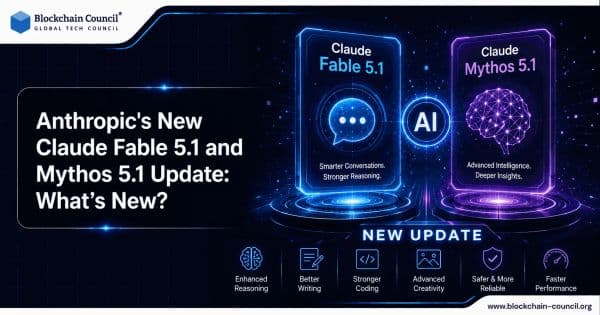
Anthropic's New Claude Fable 5.1 and Mythos 5.1 Update: What's New?
Anthropic’s Claude Fable 5.1 and Mythos 5.1 update brings stronger coding, long-running agentic workflows, research, vision, and knowledge-work capabilities. Fable 5.1 is generally available and introduces cheaper cache reads, potentially reducing typical workload costs by about 25% and highly agentic workloads by up to 45%. Mythos 5.1 uses the same underlying model but offers expanded cybersecurity and biology capabilities to vetted organizations through trusted-access programs.

Claude Ai
Fable 5 vs Claude vs ChatGPT: Which AI Model Should You Choose?
Compare Fable 5, Claude, and ChatGPT across coding, research, DevOps, cost, context, and governance to choose the right AI model.
Trending Articles
The Role of Blockchain in Ethical AI Development
How blockchain technology is being used to promote transparency and accountability in artificial intelligence systems.

Top 5 DeFi Platforms
Explore the leading decentralized finance platforms and what makes each one unique in the evolving DeFi landscape.
How to Install Claude Code
Learn how to install Claude Code on macOS, Linux, and Windows using the native installer, plus verification, authentication, and troubleshooting tips.