
Claude AI for DevOps Engineers

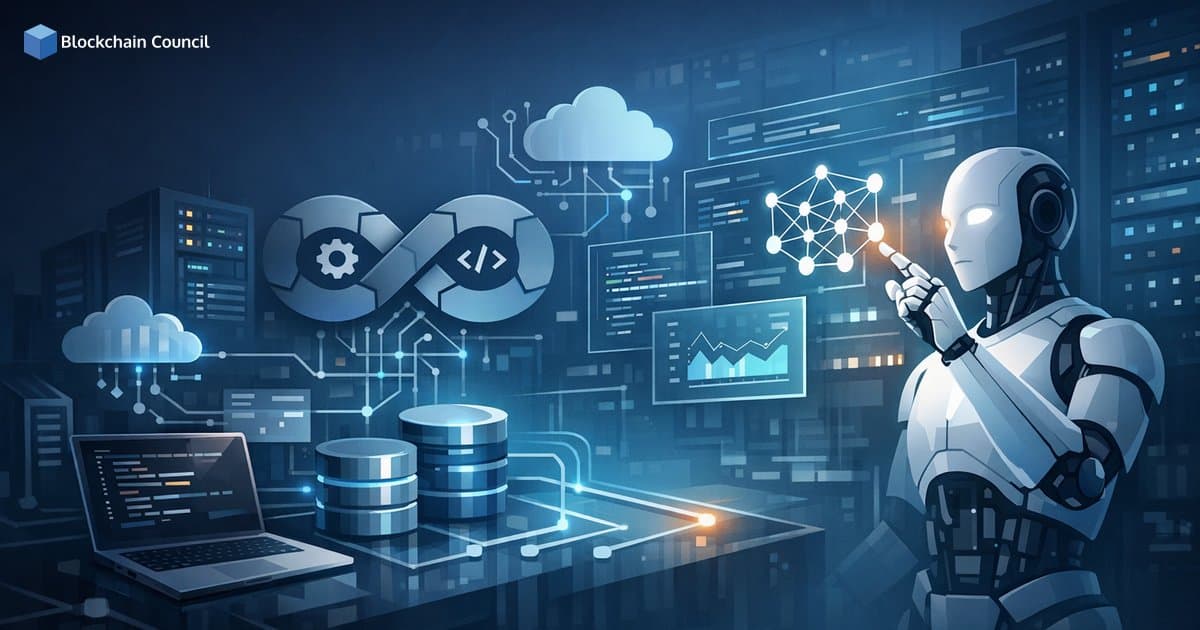
DevOps with AI is moving from experimentation to day-to-day operations, and Claude AI is becoming a practical assistant for infrastructure, pipelines, and reliability work. For a DevOps engineer, the real value is not just code completion, but end-to-end assistance across infrastructure as code (IaC), CI/CD, monitoring, incident response, and documentation. Claude's combination of a large context window, adaptive reasoning, and DevOps-focused capabilities has made DevOps with LLM workflows more consistent and operationally safer when deployed with the right guardrails.
Why Claude AI Fits DevOps Work
DevOps work is multi-system by nature: cloud resources, Kubernetes manifests, CI/CD YAML, secrets management, monitoring dashboards, and runbooks all intersect. Claude is well-suited to this complexity because it maintains broad context and applies structured reasoning across many files and tools simultaneously.

Large context for real systems: Claude Opus supports a large context window, enabling analysis of sizeable repositories, multi-environment configs, and lengthy incident timelines within a single session.
Adaptive reasoning: Claude adjusts reasoning depth based on task complexity, which is useful for pipeline optimization, threat modeling, and reliability trade-offs.
DevOps-specific capabilities: Claude can be configured to apply conventions such as production Kubernetes management, cost optimization across AWS, Azure, and GCP, GitOps practices, and SRE patterns including SLOs, SLIs, and error budgets.
Integration and orchestration: A plugin ecosystem with enterprise partners and collaboration extensions allows Claude to function as an orchestration layer across tools rather than a standalone chat interface.
Claude is used across a significant portion of Fortune 500 enterprises and is commonly applied to professional engineering workflows. Users report meaningful productivity gains for experienced developers, which aligns with the high-context, cross-system work that DevOps teams routinely handle.
Core DevOps with AI Use Cases for DevOps Engineers
1. Infrastructure as Code: Safer, More Complete IaC Outputs
IaC is a strong starting point for DevOps with LLM workflows because it involves explicit syntax, repeatable patterns, and measurable outcomes. Claude can generate or refactor Terraform, Pulumi, CloudFormation, Helm charts, and Kubernetes manifests. The most significant advantage is completeness: IAM policies, logging, monitoring, and rollback procedures are frequently overlooked in time-pressured implementations.
A practical example reported by practitioners: using Pulumi, Claude can provision an S3 and CloudFront static site and proactively add CloudWatch alarms and SNS alerts. This shifts a baseline deployment from functional to observable and tunable.
Prompts that produce useful results:
"Review this Terraform module for least-privilege IAM and missing monitoring. Propose changes as a patch and explain the risk reduction."
"Generate a Pulumi program for a static site with CloudFront, WAF rules, access logs, and alerting for 4xx and 5xx error spikes."
"Given these Kubernetes manifests, add resource requests and limits, a PodDisruptionBudget, and readiness and liveness probes. Keep changes minimal."
2. CI/CD Pipelines: Faster Creation with Consistent Guardrails
Claude can draft GitHub Actions workflows, GitLab CI pipelines, and build scripts, then iterate to improve caching, artifact handling, parallelization, and security scanning. With DevOps-oriented configuration, Claude can generate templated CI/CD patterns and enforce conventions such as environment promotion flows and approval gates.
Pipeline scaffolding: build, test, containerize, scan, and deploy stages with consistent naming and artifact flow.
Security checks: SAST, dependency scanning, container scanning, and policy checks that prevent plaintext secrets from being committed.
Release strategies: blue-green or canary deployment strategies and progressive delivery patterns for Kubernetes environments.
Teams that use Claude as an integration layer tend to extract more value than those using it purely for code generation. A GitLab integration, for example, can assist with merge request analysis and CI results interpretation, while parallel task decomposition can reduce cycle time on multi-component builds.
3. GitOps Automation: Repeatable Cluster Changes with Better Reviews
GitOps depends on consistency. Claude can generate ArgoCD or Flux configurations, environment overlays, and app-of-apps patterns, then review pull requests for drift, unsafe settings, or missing rollback steps.
A GitOps review checklist Claude can apply:
Are image tags immutable or pinned to digests?
Are RBAC roles and service accounts scoped correctly?
Are namespaces and network policies defined for workload isolation?
Are config changes linked to corresponding runbook updates?
4. Monitoring and SRE: From Dashboards to Error Budgets and Runbooks
Reliability engineering is a strong fit for Claude because it requires synthesis across metrics, logs, traces, and service-level objectives. Claude can draft Prometheus alerting rules, Grafana dashboards, alert routing policies, and incident runbooks, and can calculate error budgets from a defined SLO target.
SRE tasks Claude can accelerate:
Define SLIs and SLOs for an API, then propose alert thresholds tied to error budget burn rate.
Generate incident runbooks that include detection signals, mitigation steps, and escalation criteria.
Analyze operational toil and propose automation candidates with associated risk and rollback plans.
How to Use Claude Effectively in DevOps with LLM Workflows
Step 1: Build a Persistent Project Session
Many teams underuse Claude by prompting sequentially without maintaining session continuity. For DevOps work, context persistence matters. Use one session per system or service and include:
Architecture overview and critical service paths
Environments and their promotion flow
Operational constraints such as maintenance windows and compliance requirements
Known failure modes and relevant past incidents
Step 2: Specify Constraints as You Would in a Production Design Review
To make DevOps with AI safer, define non-negotiables upfront:
No production deployments without explicit human approval
No secrets committed to code repositories or log outputs
Least-privilege IAM and scoped service accounts for all resources
A rollback plan required for every proposed change
Step 3: Request Diffs, Not Prose
In DevOps, output format is as important as content. Request patches, YAML snippets, and file-by-file changes rather than narrative explanations. For example:
"Return a unified diff against these files."
"Create a new workflow file at .github/workflows/build.yml and list all required secrets."
Step 4: Use Claude as a Reviewer and Failure Simulator
Claude can function like a senior peer reviewer by validating assumptions and identifying edge cases. Use it to simulate failure scenarios before deploying changes:
"What breaks if the primary database fails over during a deploy?"
"What happens if the container registry is rate-limited mid-pipeline?"
"How do our alerts behave when a rolling deployment is in progress?"
Enterprise Patterns: Plugins, Parallel Agents, and Collaboration
As Claude has expanded its integrations, DevOps teams have begun using it as an operational coordination layer:
CI/CD integration: GitLab integrations can interpret pipeline failures, summarize merge requests, and propose targeted fixes.
Data access: Integrations with analytics platforms enable natural language exploration of schemas, which is useful for ops analytics and incident forensics when combined with appropriate governance controls.
Parallel agents: Splitting tasks such as frontend build, backend build, infrastructure updates, and security scanning across parallel agents can reduce cycle time for large changes.
Collaboration channels: Embedding Claude into messaging workflows supports real-time triage, change review, and knowledge sharing across distributed teams.
These patterns work best when combined with clear access controls, comprehensive auditability, and runbook-driven operations.
Risks and Guardrails for DevOps with AI
AI assistance can introduce failure modes that do not exist in purely manual workflows. The most common in DevOps contexts are over-permissioned IAM configurations, incorrect assumptions about environment-specific details, and unsafe remediation steps generated during live incidents.
Always validate infrastructure changes: run policy checks, terraform plan reviews, and staged rollouts before applying changes to production.
Keep secrets out of prompts: use redaction and secret references. Prefer placeholders such as ${{ secrets.PROD_TOKEN }} rather than actual values.
Enforce approval gates: require human sign-off for production deployments and any destructive operations.
Measure outcomes: track lead time, change failure rate, MTTR, and alert noise before and after AI adoption to validate that changes are improving reliability.
Skills Development: Building Expertise to Get the Most from Claude
Claude is most effective when engineers can specify requirements precisely and evaluate outputs critically. Structured upskilling in AI, security, and DevOps fundamentals directly improves the quality of results. Relevant learning paths include:
AI-focused training: prompt engineering and applied generative AI for software and infrastructure teams
DevOps and cloud certifications: CI/CD, Kubernetes, and infrastructure automation tracks
Cybersecurity certifications: secure DevOps practices, secrets management, and policy-as-code
Combining these disciplines helps teams adopt DevOps with LLM workflows responsibly and at production scale.
Conclusion
Claude AI addresses the real shape of operations work: multi-file changes, cross-tool coordination, and reliability trade-offs. With large-context reasoning, configurable DevOps capabilities, and integrations that support orchestration across tools, DevOps with AI can accelerate IaC, CI/CD, GitOps, and SRE workflows while improving consistency. Teams that treat Claude as a structured collaborator, pair it with clear guardrails, and measure outcomes in deployment safety and operational reliability will be best positioned to extract lasting value from these workflows.
Related Articles
View All
Claude Ai
Claude AI for Sr. DevOps Engineers and Devlopers
Learn how Claude AI helps DevOps engineers automate incident triage, response communications, remediation guidance, and postmortems with skills, runbooks, and SLOs.

Claude Ai
Using Claude AI in DevOps Pipelines
Learn how using Claude AI in DevOps pipelines improves CI/CD automation, runbooks, and incident response with safer deployments, SLO-driven operations, and smarter troubleshooting.

Claude Ai
Securing DevOps with Claude AI
Learn how securing DevOps with Claude AI supports secrets management, OPA policy-as-code, and supply chain security with human-reviewed fixes and pipeline guardrails.
Trending Articles
The Role of Blockchain in Ethical AI Development
How blockchain technology is being used to promote transparency and accountability in artificial intelligence systems.

AWS Career Roadmap
A step-by-step guide to building a successful career in Amazon Web Services cloud computing.

Top 5 DeFi Platforms
Explore the leading decentralized finance platforms and what makes each one unique in the evolving DeFi landscape.