

Claude AI Coding Prompts for Developers
 Suyash Raizada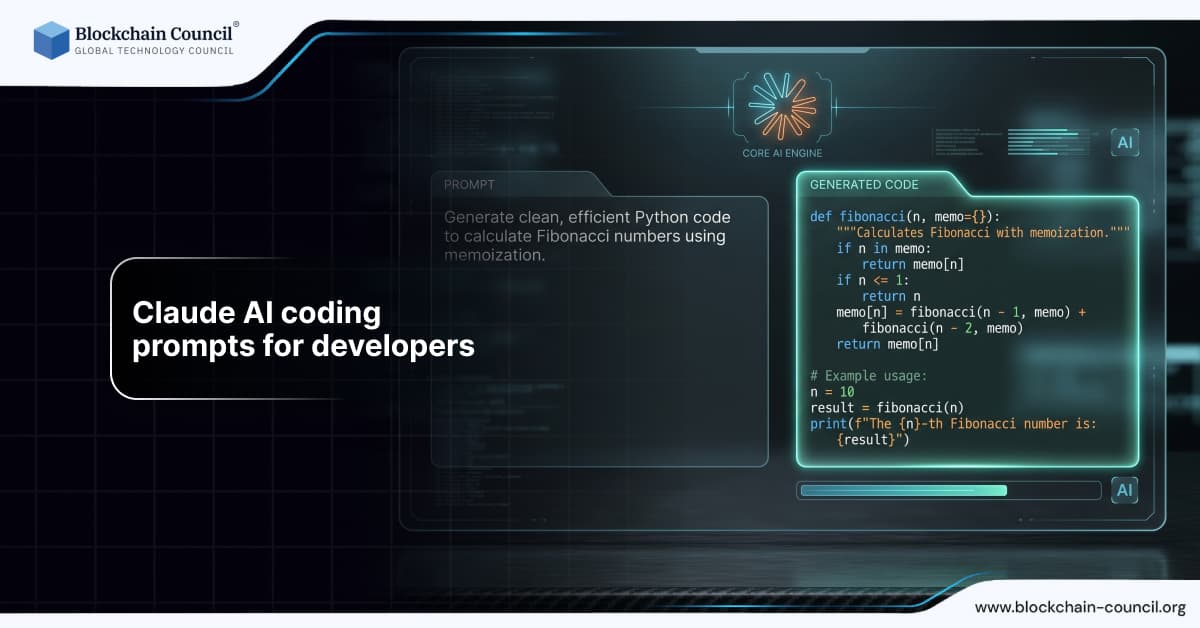
Artificial intelligence is rapidly transforming software development, enabling developers to write code faster, debug efficiently, and build complex systems with ease. Among modern AI tools, Claude AI stands out for its ability to generate structured, accurate, and context-aware responses. One of the most powerful ways to leverage Claude AI is through well-designed coding prompts.
Using Claude AI coding prompts for developers allows faster development, better debugging, and improved code quality. Well-structured prompts can guide Claude to produce accurate and optimized solutions. However, mastering this requires understanding both coding logic and prompt engineering. The Claude Code Certification helps you refine these advanced techniques.

This article explores Claude AI coding prompts for developers, including examples, best practices, and real-world applications.
What Are Claude AI Coding Prompts?
Claude AI coding prompts are structured instructions that guide the AI to generate, analyze, or improve code. These prompts define the programming language, task, and expected output.
For example:
“Write a Python function to calculate the Fibonacci sequence with comments explaining each step.”
The more detailed the prompt, the more accurate and useful the output.
Why Coding Prompts Matter
Claude AI is highly capable, but it relies on user input to deliver meaningful results. Well-crafted prompts help developers:
Generate accurate code
Debug errors quickly
Optimize performance
Learn new concepts
To ensure secure and responsible use of AI in development, professionals often pursue an AI Security Certification.
Types of Claude AI Coding Prompts
Code Generation Prompts
These prompts are used to create code from scratch.
Example:
“Create a JavaScript function to validate user input in a form.”
Debugging Prompts
These prompts help identify and fix errors.
Example:
“Find and fix errors in this Python code and explain the solution.”
Code Optimization Prompts
These prompts improve code efficiency.
Example:
“Optimize this algorithm for better performance and readability.”
Code Explanation Prompts
These prompts explain how code works.
Example:
“Explain this code step by step in simple terms.”
Best Claude AI Coding Prompts for Developers
Full Stack Development Prompt
“Build a simple full stack application using Node JS and React with authentication and database integration.”
Developers often enhance their backend skills through a Node JS Course.
API Development Prompt
“Create a REST API in Python for managing user data, including authentication and CRUD operations.”
Data Processing Prompt
“Write a Python script to analyze CSV data and generate summary statistics.”
Many professionals improve their expertise through a Python certification.
Bug Fixing Prompt
“Identify and resolve performance issues in this code and suggest improvements.”
Automation Prompt
“Write a script to automate file organization based on file type.”
Advanced Prompt Techniques
Role Based Prompting
Assign a role to the AI.
Example:
“Act as a senior software engineer and review this code for best practices.”
Step by Step Prompting
Break tasks into smaller steps.
Example:
“First create an outline of the application, then generate code for each module.”
Iterative Prompting
Refine outputs through multiple prompts.
Real World Applications
Web Development
Developers use Claude AI to build and debug web applications.
Data Science
Claude AI assists in data analysis and visualization.
DevOps
AI helps automate deployment and monitoring tasks.
Software Testing
Claude AI generates test cases and identifies bugs.
Real World Example
A developer working on a web application used Claude AI to debug a complex issue in their backend system. By providing the code and error message, they received a detailed explanation and solution, saving several hours of troubleshooting.
This highlights the practical value of AI in development workflows.
Benefits of Claude AI Coding Prompts
Increased Efficiency
Claude AI speeds up coding tasks.
Improved Accuracy
Well-structured prompts produce reliable outputs.
Faster Learning
Developers can quickly understand new concepts.
Enhanced Productivity
Developers can focus on complex problem-solving.
Challenges and Limitations
Despite its advantages, Claude AI has some limitations:
Requires clear and detailed prompts
May generate incorrect or incomplete code
Needs human verification
Developers should always test and validate outputs.
Best Practices for Developers
Be Specific
Provide detailed instructions in prompts.
Include Context
Share relevant code and requirements.
Test Outputs
Always run and verify code.
Refine Prompts
Improve prompts based on results.
Expanding Skills Beyond Coding
Developers can also explore other fields such as marketing and business using AI tools.
For example, professionals can enhance their knowledge through an AI powered marketing course.
Latest Developments in Claude AI
In 2026, Claude AI has improved in:
Advanced reasoning capabilities
Better code generation
Enhanced debugging features
Integration with development tools
These improvements make it more effective for developers.
Future of AI in Software Development
The future of AI in development includes:
Automated coding systems
Intelligent debugging tools
Personalized learning experiences
Developers who adopt AI early will gain a competitive advantage.
Conclusion
Claude AI coding prompts are a powerful tool for developers. By using structured prompts, developers can generate code, debug issues, and optimize performance efficiently.
However, success depends on combining AI capabilities with human expertise and critical thinking. By mastering prompt design and refining outputs, developers can significantly enhance their productivity and stay ahead in the evolving tech landscape.
Frequently Asked Questions
1. What are Claude AI coding prompts?
They are instructions used to generate or analyze code.
2. Why are prompts important?
They determine the quality of outputs.
3. Can beginners use coding prompts?
Yes, with practice.
4. Can Claude AI generate code?
Yes, it supports multiple languages.
5. Is Claude AI accurate?
Generally yes, but should be verified.
6. Can Claude AI fix bugs?
Yes, it helps debug code.
7. Which languages are supported?
Python, JavaScript, and more.
8. Do I need technical skills?
Basic knowledge is helpful.
9. Can Claude AI replace developers?
No, it supports development.
10. How do I improve prompts?
Be specific and provide context.
11. Can Claude AI optimize code?
Yes, it improves performance.
12. What are common mistakes?
Vague prompts and not testing code.
13. Can Claude AI help with projects?
Yes, it guides development.
14. Is AI coding safe?
Yes, with proper usage.
15. Can Claude AI teach programming?
Yes, step by step guidance.
16. Are certifications useful?
Yes, they validate skills.
17. Can developers use Claude AI daily?
Yes, for productivity.
18. What is the future of AI coding?
More automation and smarter tools.
19. Can Claude AI generate applications?
Yes, with proper prompts.
20. How can I start using coding prompts?
Begin with simple tasks and refine gradually.
Related Articles
View All
Claude Ai
Best Fable 5 Prompts for Writing, Coding, Research, and Automation
Learn the best Fable 5 prompts for writing, coding, research, and automation, with practical templates, verification rules, and effort-setting tips.

Claude Ai
Fable 5 for Coding and Debugging: Practical Use Cases for Developers
Learn how Fable 5 supports coding, debugging, migrations, architecture review, and multi-agent developer workflows in practical software projects.

Claude Ai
Claude Sonnet 5 for Developers: Building Smarter AI Agents and Enterprise Applications
Claude Sonnet 5 for Developers is a practical guide to building AI agents, coding workflows, and enterprise applications with Anthropic's latest Sonnet model.
Trending Articles
The Role of Blockchain in Ethical AI Development
How blockchain technology is being used to promote transparency and accountability in artificial intelligence systems.
AWS Career Roadmap
A step-by-step guide to building a successful career in Amazon Web Services cloud computing.
How Blockchain Secures AI Data
Understand how blockchain technology is being applied to protect the integrity and security of AI training data.