
Building Apps Faster with Claude AI

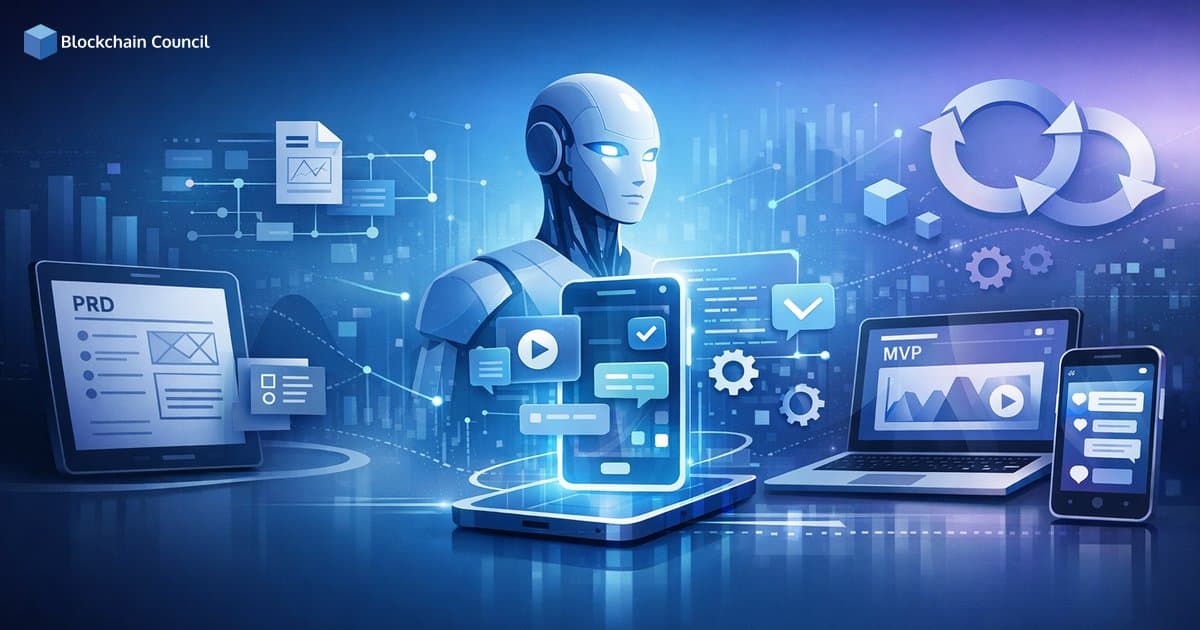
Building apps faster with Claude AI is becoming a practical engineering workflow in 2026. Anthropic's latest models, including Claude Opus 4.5, power agentic development experiences that move teams from a Product Requirements Document (PRD) to a working Minimum Viable Product (MVP), then through structured iteration loops covering testing, debugging, and incremental shipping. Tools like Claude Code and MCP Apps help developers maintain context, reduce hand-offs, and translate high-level prompts into functional interfaces and services.
What Makes AI-Assisted App Development Different in 2026
Earlier AI coding assistants functioned primarily as autocomplete engines or chat-based helpers with limited context. Claude's current developer ecosystem emphasizes agentic execution: you describe intent, constraints, and acceptance criteria, and Claude plans the work and carries it forward with minimal manual micromanagement.

Two developments are particularly significant:
Claude Code is a developer tool that runs in terminals and common environments including VS Code, JetBrains, Slack, and the web. It can read and write across a codebase, maintain project context, and iteratively refine changes across sessions.
MCP Apps, launched in January 2026, render interactive app interfaces directly inside Claude conversations using the open Model Context Protocol (MCP). This reduces context switching and lets teams act on data and tasks without leaving the conversation thread.
For teams building in Web3, AI, or security-sensitive domains, this plan-implement-test-fix-ship loop aligns with standard engineering practices and supports structured skill development for developers seeking formal credentials in these areas.
Phase 1: Converting PRDs to MVPs with Claude Code
The PRD stage is where project velocity is typically lost: unclear requirements, missing edge cases, and misaligned assumptions slow everything downstream. Claude Code can help convert PRDs into implementation-ready plans and scaffold a project quickly.
Using a CLAUDE.md File to Lock In Project Context
A practical pattern in Claude Code workflows is maintaining a CLAUDE.md file that contains project-specific rules and conventions, such as:
Architecture decisions (monolith vs. services, folder layout, API style)
Security and privacy requirements
Linting, formatting, and testing rules
Definition of done for MVP features
This reduces repeated prompting and helps Claude operate as a consistent pair programmer across sessions without losing prior context.
From Prompt to Scaffolded Codebase
Developers are increasingly using Claude to handle full-stack tasks at speed. In practice, that means requesting an MVP skeleton and refining it feature by feature. Early 2026 tutorials demonstrate complete apps built in under 20 minutes of prompted steps, including React Native frontends, camera upload widgets, API integrations, and user-specific saved sections.
Phase 2: MVP Build with Agentic Integration and Feature Delivery
Once the scaffold exists, building apps faster with Claude AI depends on how effectively the model can integrate components and deliver features without requiring constant human coordination.
Common MVP tasks Claude handles well include:
Frontend UI generation for mobile and web, including state management and basic navigation.
Backend endpoints and request validation aligned with the PRD's acceptance criteria.
Third-party integrations such as calling external APIs for domain-specific logic.
Lean setups that avoid over-engineering and minimize custom framework overhead when delivery speed is the priority.
A representative example is the math helper app workflow: generate the React Native UI, add camera-based upload, send the image or prompt to a math-solving API, then store results and surface quiz sections. The core pattern is consistent across projects - describe user journeys, request a plan, implement in small slices, and validate correctness at each step.
Phase 3: Iteration Loops Driven by Tests and Error-Aware Debugging
Iteration is where agentic tools compound their value. Rather than only suggesting code, Claude can follow a test-driven loop: run tests, read failures, propose fixes, apply changes, and repeat until the suite passes.
A Repeatable Iteration Loop
Define acceptance tests for each PRD requirement, covering unit, integration, and basic UI checks.
Ask Claude Code to implement the smallest testable slice of each feature.
Run tests locally and have Claude interpret error output.
Apply targeted fixes and re-run until all checks pass.
Refactor with guardrails once correctness is established.
This loop maps well to enterprise requirements around CI hygiene and reproducibility. For teams with security and auditability requirements, pairing this workflow with formal training in cybersecurity or Web3 development can help ensure that speed does not come at the expense of compliance.
Where MCP Apps Fit: Conversational Interfaces That Do Real Work
MCP Apps extend the concept of operational interfaces inside chat. Rather than returning a static summary, Claude can render interactive components, for example:
Project planning with task views embedded directly in the conversation.
Data analysis with interactive charts from tools like Hex or Amplitude.
Prospecting workflows that research companies and draft outreach using integrated data sources.
MCP is designed as cross-platform infrastructure for AI-connected apps. If the same integration patterns can be reused across multiple assistants and environments, teams can avoid rebuilding connectors for each tool they adopt.
Best Practices for Shipping Faster Without Losing Quality
Keep PRDs testable: write requirements as observable behaviors and explicit edge cases, not vague goals.
Constrain the agent: define approved libraries, version pins, and non-negotiable security rules in CLAUDE.md.
Prefer small commits: MVP speed comes from incremental merges, not single large code generations.
Use checkpoints: after each feature, run tests and basic security checks before moving forward.
Conclusion: Claude AI as a PRD-to-MVP-to-Iteration Engine
Building apps faster with Claude AI in 2026 is best understood as an end-to-end discipline. The process involves translating PRDs into executable plans, generating MVP scaffolds and integrations with Claude Code, and maintaining momentum through test-driven iteration loops. With MCP Apps adding interactive, in-conversation operational interfaces, teams can reduce context switching and accelerate decisions. The organizations that benefit most will be those that combine agentic speed with engineering rigor - clear requirements, incremental delivery, and repeatable verification at every stage.
Related Articles
View All
Claude Ai
Learning Faster with Claude AI
Learn faster with Claude AI using personalized learning paths, iterative practice, and spaced repetition-style review plans for better retention in coding, math, and professional skills.

Claude Ai
Building Reproducible Data Science Notebooks With Claude AI
Learn how to build reproducible data science notebooks with Claude AI using modular SQL-to-Python scripts, kernel-restart validation, and file-based visualizations.

Claude Ai
Building Marketing Funnels with Claude AI
Learn how to build marketing funnels with Claude AI using lead magnets, personalized nurture flows, and conversion copy, plus testing workflows for faster iteration.
Trending Articles

The Role of Blockchain in Ethical AI Development
How blockchain technology is being used to promote transparency and accountability in artificial intelligence systems.

AWS Career Roadmap
A step-by-step guide to building a successful career in Amazon Web Services cloud computing.

Top 5 DeFi Platforms
Explore the leading decentralized finance platforms and what makes each one unique in the evolving DeFi landscape.