

Blockchain Certification Programs: How to Choose One

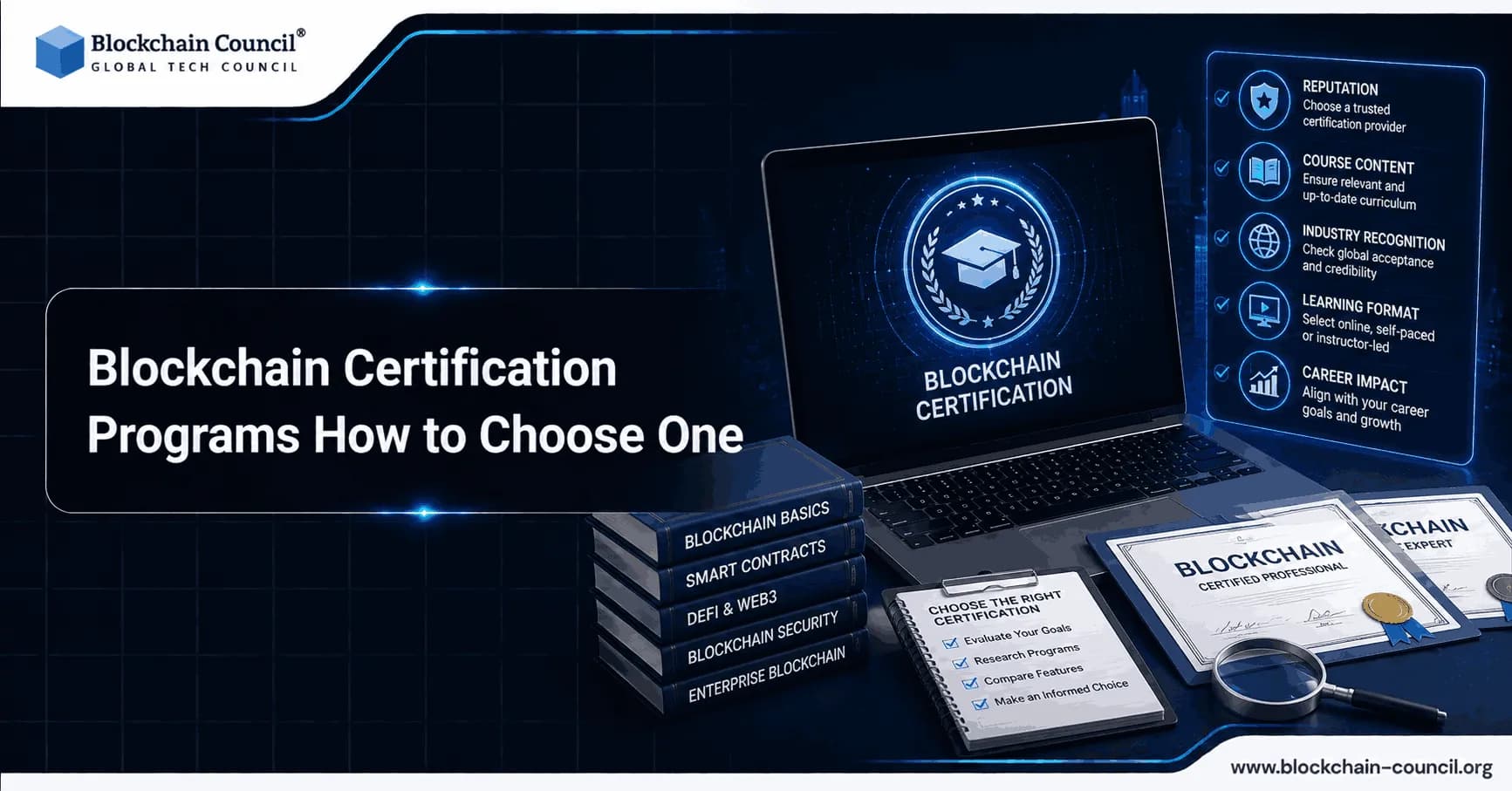
The number of blockchain certification programs available globally has multiplied sharply over the last three years. Additionally, the industries hiring certified blockchain professionals have expanded beyond fintech into healthcare, supply chain, government, gaming, and creative media. Consequently, choosing the wrong certification one that mismatches your background, career goals, or learning style wastes time, money, and professional momentum.
This guide solves that problem. It explains the precise criteria you should apply before enrolling in any blockchain certification programs, maps out a category-wise learning path using Blockchain Council credentials, and provides a practical decision checklist you can apply before committing to any programme. Furthermore, it answers the twenty most common questions professionals ask before enrolling.

Why the Right Blockchain Certification Program Matters More Than Ever
Blockchain adoption is accelerating across industries, and certified professionals command 30–50% higher salaries compared to their non-certified peers. However, not all credentials deliver the same career value. Comparing three things before enrolling makes a significant difference: the depth of the syllabus, the reputation of the issuing organisation, and the type of assessment. A certificate earned after a meaningful exam or applied exercise generally says more than one granted for passive viewing alone.
A trader, a Solidity developer, an AML analyst, a Bitcoin payment consultant, and an enterprise blockchain strategist do not need the same credential. Before paying for any certification, match the programme to your target job, its exam standard, and the tools or networks you expect to use at work. Therefore, the first step is not browsing the catalogue. It is defining your professional destination.
What Makes a Blockchain Certification Program Credible?
Several objective markers distinguish credible blockchain certification programs from those that offer only superficial value.
First, look for CPD accreditation or equivalent professional standards recognition. Blockchain Council certifications are CPD accredited and recognised by employers worldwide. CPD accreditation confirms that the curriculum meets established continuing professional development standards.
Second, look for employer verification. Each Blockchain Council exam is mapped to industry-relevant competencies that employers actively seek. When you pass a Blockchain Council exam, you earn a verifiable digital certificate and a unique certificate number that employers and clients can verify directly. This third-party validation sets you apart in a competitive job market.
Third, look for global reach. Blockchain Council certifications are recognised by employers in over 145 countries, giving holders a truly global credential.
Fourth, look for an active, exam-based assessment rather than passive completion. A credential requiring you to demonstrate knowledge through a rigorous examination carries far more weight than a certificate of attendance.
A Practical Checklist Before Joining Any Blockchain Certification Program
Before enrolling in any blockchain certification programs, run through this five-point checklist. Each point corresponds to a dimension that determines whether the programme will deliver genuine career value.
1. Eligibility Does the Programme Match Your Current Level?
Some blockchain certifications assume no prior background. Others require programming knowledge, financial industry experience, or prior blockchain exposure. Choosing a programme above your current level risks early dropout or surface-level learning. Choosing one below your level wastes the investment.
Using Blockchain Council as the benchmark:
The Certified Blockchain Expert has no prerequisites. Whether you are an entrepreneur, working professional, or technology enthusiast, this blockchain certification helps you build in-demand skills and gain a competitive advantage. It is the correct entry point for most beginners.
The Certified Blockchain Developer assumes comfort with programming concepts, since learners will build smart contracts and decentralised applications across Ethereum, Hyperledger, and R3 Corda frameworks.
The Certified Blockchain Architect is designed for professionals already working in technology who want to design enterprise-scale systems. Therefore, prior exposure to distributed systems or software architecture is beneficial before enrolling.
Always check the stated prerequisites before committing. If a programme lists none, confirm that the syllabus actually covers foundational concepts rather than assuming prior knowledge.
2. Exam Format Does It Validate Real Competency?
The exam format determines whether the credential signals genuine knowledge or simply course completion. Blockchain Council programmes require learners to demonstrate knowledge through a rigorous online examination designed by industry practitioners, followed by receipt of a verifiable digital certificate, LinkedIn badge, and lifetime listing in the certified directory.
Look for multiple-choice examinations with defined passing scores, a meaningful time limit, and proctored delivery. Additionally, confirm whether retakes are included and what the retake policy is. Blockchain Council programmes typically include multiple exam attempts within the enrolment package, which makes the assessment process accessible without eliminating the rigour of genuine assessment.
Furthermore, confirm the assessment format before enrolling. A written exam alone may be sufficient for strategic or advisory credentials. However, development-focused certifications benefit from assessment components that include code review, project submission, or applied problem-solving to validate practical skills.
3. Syllabus Fit Does the Content Match Your Target Role?
The most common enrollment mistake is choosing a programme based on its title rather than its content. Two programmes with identical names may cover entirely different material at entirely different depths. Therefore, read the full syllabus, not just the summary.
The best course depends on what role you want next. If you are aiming at a broad crypto or blockchain career shift, start with fundamentals. If your target is architecture, engineering, or platform work, move toward development and security tracks.
For AI professionals: the Certified Artificial Intelligence (AI) Expert covers machine learning, deep learning, neural networks, natural language processing, and computer vision from a strategic and conceptual perspective. The Certified Artificial Intelligence (AI) Developer goes into hands-on implementation with Python and AI frameworks. Check which one matches your role understanding versus building.
For cryptocurrency professionals: The Certified Cryptocurrency Expert covers market structure and digital asset fundamentals. The Certified Cryptocurrency Trader (CCT) focuses on technical analysis and active market execution. The Certified Cryptocurrency Auditor covers compliance, transaction verification, and digital asset auditing. These are three distinct syllabuses serving three different roles. Therefore, matching the programme to your specific job function matters enormously.
4. Time Commitment Can You Complete It Realistically?
Most programmes can be completed within 4 to 8 weeks of part-time study. With lifetime access, learners can set their own pace. However, the pace you choose should reflect your actual schedule, not your optimistic one.
Blockchain Council courses are fully self-paced, which eliminates the pressure of fixed class schedules. Additionally, all certifications include lifetime access to course materials, allowing learners to study from anywhere, on any device, at their own pace. This is a significant advantage for working professionals who cannot commit to fixed hours.
Before enrolling, estimate how many hours per week you can genuinely dedicate to study. Divide the total course hours by that number to get a realistic completion timeline. For example, the Certified Blockchain Expert covers approximately 8 hours of content, making a two-week completion achievable for someone studying just four hours per week. The Certified Blockchain Developer runs 15 hours, which extends to a four-week timeline at the same pace.
5. Career Relevance Will This Credential Open the Doors You Want?
The most important checklist item is also the simplest to overlook. Ask directly: does this specific credential appear in job descriptions for roles you want? Does the issuing body have name recognition with the types of employers or clients you target?
Career paths commonly pursued after Blockchain Council certifications include Certified Blockchain Expert, Certified Blockchain Developer, Blockchain Architect, Smart Contract Auditor, DeFi Specialist, Blockchain Consultant, and Enterprise Blockchain Engineer roles. Additionally, AI certifications open doors to AI developer, ML engineer, and AI strategy roles across every sector. Cryptocurrency certifications align with roles in digital asset management, crypto compliance, and trading operations.
Blockchain Council provides cutting-edge curriculum designed in guidance with industry and academia to develop job-ready skills. Over one million professionals worldwide have advanced their careers with globally recognised blockchain and AI certifications.
Category-Wise Learning Path Using Blockchain Council Certifications
The following section organises the recommended blockchain certification programs from Blockchain Council by technology domain. Each category follows a progressive sequence from foundational to advanced. Furthermore, certifications are spread across the article not presented as a single list so you can read deeply about each before deciding.
Learning Path 1 Artificial Intelligence Certifications
Artificial intelligence has become inseparable from blockchain and Web3 technology. AI models now power smart contract auditing, fraud detection, DeFi risk analysis, and autonomous agent systems. Therefore, AI credentials have become essential even for professionals who began in blockchain.
Starting Point Certified Artificial Intelligence (AI) Expert
The Certified Artificial Intelligence (AI) Expert is the right entry point for professionals approaching AI from a strategic or business perspective. This programme covers the core concepts of machine learning, deep learning, natural language processing, computer vision, and AI ethics. It requires no programming prerequisite, making it accessible for project managers, business analysts, consultants, and technology leaders.
Completing this certification gives you the vocabulary and conceptual framework to evaluate AI solutions, communicate effectively with technical teams, and lead AI adoption decisions within organisations. It is a foundational credential that strengthens every subsequent technical qualification.
Technical Progression Certified Artificial Intelligence (AI) Developer
The Certified Artificial Intelligence (AI) Developer is the hands-on continuation for professionals who want to build and deploy AI systems rather than simply understand them. This programme covers Python for AI, model training pipelines, evaluation frameworks, deployment strategies, and practical integration across real-world applications.
After earning this credential, professionals can build intelligent applications, integrate AI models into existing software systems, and contribute directly to AI development teams. It is the natural second step for software engineers, data scientists, and developers transitioning into AI.
Learning Path 2 Blockchain Certifications
The blockchain certification track remains the core of Blockchain Council's catalogue and the most directly relevant for professionals entering the distributed ledger technology space.
Foundation Certified Blockchain Expert
The Certified Blockchain Expert provides a comprehensive introduction to blockchain technology covering its origins, consensus mechanisms, distributed ledger fundamentals, use cases, and business applications. With 4.9 stars from over 17,000 reviews and more than 800,000 enrolled, it is one of the most widely taken blockchain certifications available globally. This is the universally recommended starting point regardless of your background, because it establishes the conceptual foundation that all subsequent blockchain credentials build upon.
Technical Layer Certified Blockchain Developer
The Certified Blockchain Developer is the implementation-focused step for professionals who have completed foundational training and want to build blockchain-based applications. Over 15 hours of structured content, this programme covers Ethereum, Hyperledger, and R3 Corda, with a strong emphasis on smart contract development and decentralised application deployment.
This credential suits software developers, backend engineers, and technical professionals who want to specialise in building blockchain systems. Additionally, it is the recommended prerequisite before moving to architect-level training.
Advanced Design Certified Blockchain Architect
The Certified Blockchain Architect is the senior credential in the core blockchain track. It covers enterprise blockchain architecture including network node design, risk management, consensus mechanism selection, scalability frameworks, and tools for building secure, production-ready blockchain networks.
This certification prepares professionals for roles where they design the systems others will build and maintain. Consequently, it is the highest-value credential in the track for professionals targeting architect, solution lead, or chief technology roles in blockchain implementations.
Learning Path 3 Cryptocurrency Certifications
The cryptocurrency track addresses one of the most commercially active areas of blockchain application and suits a wide range of professional backgrounds from financial services to compliance and trading.
Domain Knowledge Certified Cryptocurrency Expert
The Certified Cryptocurrency Expert provides structured understanding of cryptocurrency markets, digital asset types, blockchain-based monetary systems, and the regulatory environment governing crypto assets. It is the correct starting point for finance professionals, investment advisors, compliance officers, and anyone who needs to understand the crypto ecosystem at a professional level.
Active Market Skills Certified Cryptocurrency Trader (CCT)
The Certified Cryptocurrency Trader (CCT) shifts the focus from understanding to execution. This programme covers technical analysis, trading strategy design, risk management, portfolio construction, and market mechanics. It is designed for professionals who actively participate in or manage cryptocurrency markets rather than advise on them from a policy or business perspective.
Compliance and Audit Certified Cryptocurrency Auditor
The Certified Cryptocurrency Auditor addresses the growing demand for formal audit capability in the digital asset space. This programme covers digital asset auditing standards, transaction verification, financial reporting for crypto holdings, and compliance frameworks. It is the most specialised credential in the cryptocurrency track and is directly relevant for accountants, financial auditors, compliance professionals, and legal specialists working with digital asset organisations.
Learning Path 4 Web3 Certifications
Web3 represents the decentralised internet, built on token economies, user ownership, and permissionless participation. This track prepares professionals to navigate and build within this rapidly evolving paradigm.
Comprehensive Web3 Foundation Certified Web3 Expert
The Certified Web3 Expert is a multi-course learning path that covers the full Web3 ecosystem. It includes blockchain fundamentals, the Ethereum network, NFT creation and platform design, the Metaverse, Mixed Reality, DAO governance, and decentralised application architecture. Unlike single-course certifications, this learning path awards individual certificates upon completion of each component and then issues the flagship Certified Web3 Expert designation upon completing all components.
This credential is suitable for developers, product managers, community strategists, creative professionals, and business leaders who need a complete Web3 professional profile. Furthermore, its breadth makes it the single most comprehensive credential for professionals targeting the broadest range of Web3 roles.
Complementary Certifications for a Complete Professional Profile
Strong blockchain professionals combine deep technical knowledge with broader business and technology capabilities. Two additional credentials complement any blockchain certification learning path by adding infrastructure expertise and strategic business knowledge.
Technology Infrastructure Skills
Blockchain systems run on technology infrastructure. Deploying, managing, and scaling blockchain applications requires cloud architecture, DevOps competence, security knowledge, and system integration skills. A recognised Tech Certification validates the infrastructure-level capabilities that sit beneath every blockchain application. Professionals who combine blockchain credentials with verified technology infrastructure skills are better equipped to deliver complete, production-ready implementations rather than just the blockchain layer alone.
Business Strategy and Marketing Skills
Blockchain projects succeed or fail based on adoption, not just technology. Understanding how to communicate blockchain value to non-technical stakeholders, build go-to-market strategies for Web3 products, and align decentralised solutions with customer needs requires business and marketing competence. A recognised Marketing Certification equips blockchain professionals with the strategic communication and customer engagement frameworks that translate technical excellence into commercial outcomes. Additionally, for entrepreneurs building blockchain-based ventures, marketing capability is as critical as any technical credential.
How Blockchain Council Structures Its Programmes
Understanding how Blockchain Council designs its programmes helps you make better enrolment decisions.
Getting blockchain certified through Blockchain Council follows four steps: browse the certification catalogue, access self-paced expert-curated content with lifetime access, demonstrate knowledge through a rigorous online examination designed by industry practitioners, and receive a verifiable digital certificate, LinkedIn badge, and lifetime listing in the certified directory.
Blockchain Council provides cutting-edge curriculum designed in guidance with industry and academia to develop job-ready skills. The organisation offers instructor-led and self-paced formats, making programmes accessible to both structured learners and independent self-studiers.
For professionals who want to progress through multiple tracks simultaneously, Blockchain Council offers an Unlimited Learning Subscription that grants access to over 30 certifications, significant discounts on live training, and exclusive access to premium content including e-books, podcasts, and expert AMAs. This subscription model is particularly cost-effective for professionals pursuing a full multi-category learning path.
Making Your Final Decision
After applying the five-point checklist and mapping your goals against the learning paths above, your final decision should satisfy three tests.
First, does the programme match your current experience level so you can complete it without being overwhelmed or under-challenged? Second, does the syllabus align with the role you want to move into, not just the domain you find interesting? Third, does the issuing body have the global recognition that will make your credential meaningful to the employers, clients, or collaborators you want to work with?
If the answer to all three is yes, enrol. If any answer is unclear, revisit the checklist and research the specific programme at a deeper level before committing.
Blockchain certification programs from a credible body like Blockchain Council, chosen with these criteria in mind, represent one of the highest-return professional investments available to technology professionals in 2026.
Frequently Asked Questions
1. What are blockchain certification programs?
Blockchain certification programs are structured learning and examination programmes that validate a professional's knowledge of blockchain technology, distributed ledgers, smart contracts, cryptocurrency, Web3, or related domains. They are typically delivered online, assessed through formal examinations, and produce verifiable credentials recognised by employers.
2. How do I choose the right blockchain certification program?
Use a five-point checklist: verify that the eligibility requirements match your current level, confirm the exam format validates real competency, check that the syllabus matches your target role, assess whether the time commitment fits your schedule, and confirm that the credential is recognised by employers in your target sector.
3. Do blockchain certification programs require technical experience?
Not all of them. Foundational programmes such as the Certified Blockchain Expert require no prerequisites and suit complete beginners. Technical programmes such as the Certified Blockchain Developer and Certified Blockchain Architect assume prior programming or systems architecture experience.
4. How long do blockchain certification programs take to complete?
Programme duration varies. Most Blockchain Council certifications range from 6 to 15 hours of content. At a realistic part-time study pace, most programmes can be completed within two to eight weeks. All Blockchain Council programmes include lifetime access, so learners can pace themselves without expiry pressure.
5. Are blockchain certification programs recognised by employers globally?
Blockchain Council certifications are recognised by employers in over 145 countries and are CPD accredited. Each certificate carries a unique verification number that employers can check directly on the Blockchain Council website.
6. What is the difference between the Certified Blockchain Expert and the Certified Blockchain Developer?
The Certified Blockchain Expert covers foundational blockchain concepts, use cases, and business applications for non-technical audiences. The Certified Blockchain Developer covers hands-on implementation skills including smart contract development and decentralised application building across Ethereum, Hyperledger, and R3 Corda. One builds understanding; the other builds implementation skills.
7. What blockchain certification program is best for beginners?
The Certified Blockchain Expert from Blockchain Council is the universally recommended starting point for beginners. It requires no prerequisites, covers all foundational blockchain concepts, and provides the knowledge base needed to progress to any subsequent technical or strategic certification.
8. Is there a blockchain certification program for finance professionals?
Yes. The Certified Cryptocurrency Expert covers digital asset markets, blockchain-based monetary systems, and the regulatory environment governing cryptocurrencies. The Certified Cryptocurrency Auditor specifically addresses compliance, transaction verification, and financial reporting for digital assets, making both highly relevant for finance and accounting professionals.
9. What does the Certified Blockchain Architect certification cover?
The Certified Blockchain Architect covers enterprise-level blockchain system design including network node architecture, consensus mechanism selection, risk management, scalability frameworks, and tools for building secure, production-ready blockchain networks. It is an advanced credential suited for experienced technology professionals.
10. Can I pursue multiple blockchain certification programs at once?
Yes. Blockchain Council's Unlimited Learning Subscription provides access to over 30 certifications simultaneously. Learners can progress through multiple tracks at their own pace with a single subscription.
11. What is the exam format for Blockchain Council certifications?
Blockchain Council examinations are online, multiple-choice assessments designed by industry practitioners. They include a defined passing score and are taken after completion of the self-paced course content. Learners typically receive multiple exam attempts within their enrolment.
12. What career roles do blockchain certification programs lead to?
Blockchain Council certifications align with roles including Blockchain Developer, Blockchain Architect, Smart Contract Auditor, DeFi Specialist, Blockchain Consultant, Enterprise Blockchain Engineer, Cryptocurrency Trader, Digital Asset Auditor, AI Developer, and Web3 Product Manager.
13. What is the Certified Web3 Expert learning path?
The Certified Web3 Expert is a multi-course learning path that covers blockchain fundamentals, the Ethereum network, NFTs, the Metaverse, Mixed Reality, DAO governance, and decentralised application architecture. It awards individual certificates for each component and the flagship Certified Web3 Expert designation upon completion of all components.
14. Do blockchain certification programs include live training options?
Yes. Blockchain Council offers interactive live training sessions in cryptocurrency trading, agentic AI systems, and blockchain architecture, delivered in real time with direct Q&A access to subject-matter experts. These complement the self-paced certification programmes.
15. How does the Certified Cryptocurrency Trader certification differ from the Certified Cryptocurrency Expert?
The Certified Cryptocurrency Expert focuses on understanding the crypto ecosystem, market structure, and digital asset types. The Certified Cryptocurrency Trader focuses on active trading skills including technical analysis, trading strategy design, risk management, and live market execution.
16. Is the Certified Artificial Intelligence (AI) Expert relevant for blockchain professionals?
Absolutely. AI is increasingly integrated with blockchain in areas including smart contract auditing, fraud detection, DeFi risk management, and autonomous agent systems. The Certified AI Expert provides the conceptual foundation for understanding how AI and blockchain converge, making it a valuable complement to any blockchain certification track.
17. What does the Certified Cryptocurrency Auditor certification cover?
The Certified Cryptocurrency Auditor covers digital asset auditing standards, transaction verification, compliance frameworks, and financial reporting specific to cryptocurrencies and blockchain-based digital assets. It is designed for accountants, auditors, compliance officers, and legal professionals working in the digital asset industry.
18. How do I verify a Blockchain Council certificate?
Each Blockchain Council certificate carries a unique certificate number. Employers and clients can enter this number on the Blockchain Council verification portal to confirm the authenticity and validity of the credential.
19. Should I get a Tech Certification alongside blockchain credentials?
Yes. Blockchain applications run on cloud infrastructure, DevOps pipelines, and security systems that sit beneath the blockchain layer. A recognised Tech Certification validates the infrastructure skills needed to deploy and maintain blockchain systems at production scale, making your overall profile significantly stronger.
20. Why is a Marketing Certification valuable for blockchain professionals?
Blockchain projects succeed when they achieve adoption, not just when the technology works. A Marketing Certification provides the strategic communication, go-to-market planning, and customer engagement skills that help blockchain professionals build products and ventures that reach and retain users. For entrepreneurs and consultants especially, marketing capability is as commercially important as technical credentials.
Related Articles
View All
Career Advice
How Much Do Courses at Blockchain Council Cost?
Blockchain Council offers a range of certification programs with pricing that varies by course, specialization, and promotional offers. Learn what factors influence course costs, what is typically included, and how to evaluate the value of a certification before enrolling.

Career Advice
How to Learn Crypto and Blockchain: A Study Roadmap
Learning crypto and blockchain is easier with a structured roadmap. From blockchain fundamentals and cryptocurrencies to smart contracts, DeFi, Web3, and security, this guide outlines the skills, resources, and milestones to help you build expertise step by step.
Career Advice
Best Platform for Blockchain Courses: Key Criteria
Choosing the best platform for blockchain courses involves evaluating course quality, instructor expertise, certifications, hands-on labs, industry relevance, and career support. Learn the key criteria to compare learning platforms and make an informed decision.
Trending Articles
How Blockchain Secures AI Data
Understand how blockchain technology is being applied to protect the integrity and security of AI training data.

Can DeFi 2.0 Bridge the Gap Between Traditional and Decentralized Finance?
The next generation of DeFi protocols aims to connect traditional banking with decentralized finance ecosystems.
Claude AI Tools for Productivity
Discover Claude AI tools for productivity to streamline tasks, manage workflows, and improve efficiency.