Why AI Needs Blockchain for Trust and Security
 Michael Willson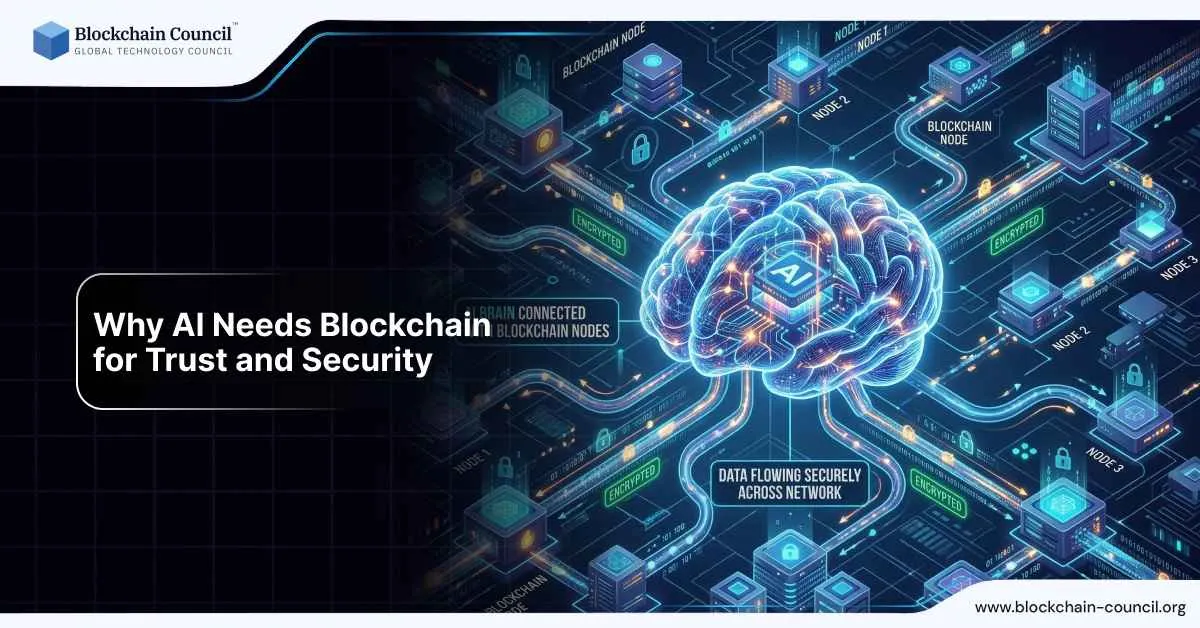
Introduction
Artificial Intelligence (AI) has become one of the most powerful technologies driving digital transformation across industries. From healthcare diagnostics and financial fraud detection to recommendation systems and autonomous vehicles, AI systems are increasingly responsible for making critical decisions that affect businesses and individuals.
However, as AI systems become more advanced and widely adopted, concerns about trust, transparency, security, and data integrity have grown significantly. Many AI models operate as complex systems that are difficult to understand, often referred to as the “black box” problem. Additionally, AI systems rely heavily on large datasets that may contain sensitive or manipulated information.

These challenges raise an important question: How can organizations ensure that AI systems remain trustworthy and secure?
Blockchain technology offers a powerful solution. Blockchain provides a decentralized and tamper-proof infrastructure that can improve transparency, protect data integrity, and enhance trust in AI systems.
By combining blockchain with artificial intelligence, organizations can create secure ecosystems where data, models, and decisions are transparent and verifiable.
As this technological convergence continues to grow, professionals with expertise in both AI and blockchain are becoming increasingly valuable. Certifications such as the Blockchain Expert certification from Blockchain Council and the Agentic AI Expert program from Blockchain Council provide the skills required to build secure AI systems powered by decentralized technologies.
In this article, we will explore why AI needs blockchain for trust and security, how these technologies work together, and why their integration represents the future of reliable digital intelligence.
Understanding the Trust Problem in AI
Artificial intelligence systems rely on complex algorithms and large datasets to make decisions. These systems are capable of analyzing patterns and generating insights that humans may not easily detect.
However, several factors make trust in AI systems difficult.
The Black Box Problem
Many AI models—particularly deep learning systems—operate in ways that are difficult for humans to interpret.
For example, an AI system may approve or reject a loan application, but understanding exactly how the decision was made can be challenging.
This lack of transparency reduces trust in AI systems.
Data Manipulation Risks
AI models learn from training data. If this data is inaccurate, biased, or manipulated, the AI system may produce unreliable outcomes.
Malicious actors may also perform data poisoning attacks, where harmful data is intentionally introduced into training datasets.
Centralized Data Control
Most AI systems rely on centralized infrastructure controlled by a single organization.
Centralized systems create several risks:
- single points of failure
- potential misuse of data
- vulnerability to cyberattacks
These challenges highlight the need for systems that ensure data integrity, transparency, and accountability.
Blockchain technology provides exactly these capabilities.
What Makes Blockchain Ideal for AI Security
Blockchain is a decentralized digital ledger that records transactions across multiple computers.
Each transaction is stored in a block that is linked to previous blocks using cryptographic techniques.
Key characteristics of blockchain include:
- decentralization
- immutability
- transparency
- cryptographic security
Because blockchain records cannot easily be altered, they provide a secure and trustworthy environment for managing data used by AI systems.
How Blockchain Improves Trust in AI Systems
Blockchain technology can strengthen trust in AI systems in several ways.
Transparent Data Records
AI models depend heavily on training datasets.
Blockchain allows organizations to record the origin and history of datasets used in AI training.
This ensures that data sources are transparent and verifiable.
Participants in the AI ecosystem can track:
- where data originated
- when it was collected
- how it has been modified
This transparency improves trust in AI outcomes.
Immutable Data Storage
Blockchain’s immutable ledger ensures that once data is recorded, it cannot easily be modified.
This prevents unauthorized changes to:
- AI training datasets
- model updates
- decision logs
Immutability ensures that AI systems operate on reliable and verified data.
Decentralized AI Infrastructure
Traditional AI systems often rely on centralized servers and databases.
Blockchain enables decentralized AI ecosystems where data and computing resources are distributed across multiple participants.
Decentralization reduces the risk of single points of failure and improves system resilience.
Secure Data Sharing
AI development often requires collaboration between multiple organizations that share datasets.
However, organizations may hesitate to share sensitive information.
Blockchain enables secure data-sharing platforms where access to data is controlled through encryption and smart contracts.
Participants can collaborate without compromising security.
Verifiable AI Decisions
Blockchain can record the outputs and decisions made by AI systems.
This creates a transparent audit trail that allows organizations to review how AI systems operate.
Auditors and regulators can analyze these records to ensure that AI systems comply with ethical and regulatory standards.
Blockchain and the Rise of Agentic AI
A major trend in artificial intelligence is the development of Agentic AI—autonomous AI systems capable of making decisions and performing tasks independently.
Agentic AI systems may operate across digital ecosystems with minimal human supervision.
However, ensuring trust and accountability for autonomous systems is critical.
Blockchain can support Agentic AI by:
- recording decisions made by AI agents
- maintaining transparent logs of agent activities
- verifying data used in decision-making
- enabling decentralized governance
Professionals interested in building such systems can develop their expertise through the Agentic AI Expert certification from Blockchain Council, which focuses on designing and deploying autonomous AI agents.
Infrastructure Technologies Supporting AI and Blockchain
Developing secure AI systems powered by blockchain requires strong backend infrastructure.
Technologies such as Node.js and Python play critical roles in building scalable AI platforms.
Node.js for AI Applications
Node.js enables developers to build scalable backend services that support AI applications.
Developers use Node.js to:
- build APIs for machine learning models
- process real-time data streams
- integrate AI services with applications
- manage server-side operations
The Node.js certification from Global Tech Council helps developers gain expertise in building high-performance backend systems for modern applications.
Python for AI Deployment
AI systems require continuous updates, monitoring, and deployment across distributed environments.
Python helps organizations support these processes through automation, scripting, data handling, and model integration.
professionals work with:
- automation scripts
- data processing and analysis
- model integration
- testing and performance optimization
The Python certification from Global Tech Council equips professionals with the skills required to build, support, and maintain complex AI systems.
Digital Marketing and Trust in AI Solutions
Technology alone does not guarantee adoption. Organizations must also communicate how their AI systems prioritize security and transparency.
Digital marketing plays a crucial role in educating users about AI technologies and building trust in AI-powered products.
Companies use strategies such as:
- educational blog content
- SEO-driven resources
- product marketing campaigns
- thought leadership articles
Professionals with expertise in Digital Marketing help organizations promote AI technologies and explain their benefits to a global audience.
A Digital Marketing Expert certification provides the knowledge required to market advanced technology solutions effectively.
Real-World Applications of Blockchain-Secured AI
Several industries are already exploring the combination of blockchain and AI.
Healthcare
AI analyzes medical data to assist with diagnosis, while blockchain secures patient records.
Financial Services
AI detects fraudulent transactions, while blockchain ensures transparent financial records.
Supply Chain
AI optimizes logistics operations, while blockchain tracks product origins and shipment data.
Cybersecurity
AI detects threats, while blockchain maintains tamper-proof security logs.
These applications demonstrate how blockchain strengthens trust and security in AI ecosystems.
The Future of Blockchain and AI Integration
The integration of blockchain and artificial intelligence is expected to grow rapidly in the coming years.
Future developments may include:
- decentralized AI marketplaces
- blockchain-based AI governance systems
- tokenized data-sharing networks
- autonomous AI-driven organizations
These innovations will create new opportunities for businesses, developers, and technology professionals.
Certifications such as the Blockchain Expert and Agentic AI Expert program from Blockchain Council, along with Node.js and Python certification from Global Tech Council, help individuals develop the skills required to participate in this evolving technological landscape.
Conclusion
Artificial intelligence is transforming industries across the world, but its continued growth requires systems that ensure trust, transparency, and security.
Blockchain technology provides the infrastructure needed to support reliable AI ecosystems by offering decentralized data storage, immutable records, and transparent decision tracking.
By integrating blockchain with AI systems, organizations can ensure that data remains secure, models are transparent, and decisions are accountable.
This powerful combination will play a critical role in shaping the future of digital innovation.
As industries increasingly adopt blockchain-powered AI systems, professionals with expertise in blockchain, AI infrastructure, Python, and digital marketing will be well-positioned to lead the next generation of technological advancement.
FAQs
1. Why does AI need blockchain?
AI needs blockchain to ensure secure data storage, transparent processes, and trustworthy decision-making systems.
2. How does blockchain improve trust in AI?
Blockchain records datasets, model updates, and AI decisions in an immutable ledger that cannot easily be altered.
3. What is the black box problem in AI?
The black box problem refers to the difficulty in understanding how complex AI algorithms produce decisions.
4. Can blockchain prevent AI data manipulation?
Yes, blockchain’s immutable ledger prevents unauthorized modifications to data used by AI systems.
5. How does blockchain improve AI security?
Blockchain uses cryptographic techniques and decentralized storage to protect sensitive data.
6. What industries use blockchain-powered AI?
Healthcare, finance, logistics, cybersecurity, and government sectors use blockchain-enhanced AI systems.
7. What is Agentic AI?
Agentic AI refers to autonomous AI systems capable of making decisions and performing tasks independently.
8. How does blockchain support Agentic AI systems?
Blockchain records AI agent activities and ensures transparency in autonomous decision-making.
9. What role does Node.js play in AI platforms?
Node.js helps developers build scalable backend systems and APIs for AI applications.
10. Why is Python important for AI infrastructure?
Python is important for AI infrastructure because it supports development, automation, deployment support, data processing, and monitoring for AI systems.
11. How does blockchain enable secure data sharing?
Blockchain allows encrypted and decentralized data-sharing networks where participants control access.
12. What skills are required to work with AI and blockchain?
Skills include programming, machine learning, blockchain architecture, and cloud infrastructure management.
13. How can professionals learn blockchain and AI technologies?
Professionals can learn through certifications, practical projects, and specialized training programs.
14. What is the future of blockchain and AI integration?
Future developments include decentralized AI ecosystems, transparent AI governance systems, and secure data marketplaces.
15. Why is trust important for AI adoption?
Trust ensures that users and organizations feel confident using AI systems for critical decisions.