

RecordsKeeper.AI: The Future of AI & Blockchain-Powered Record Management
 Toshendra Kumar Sharma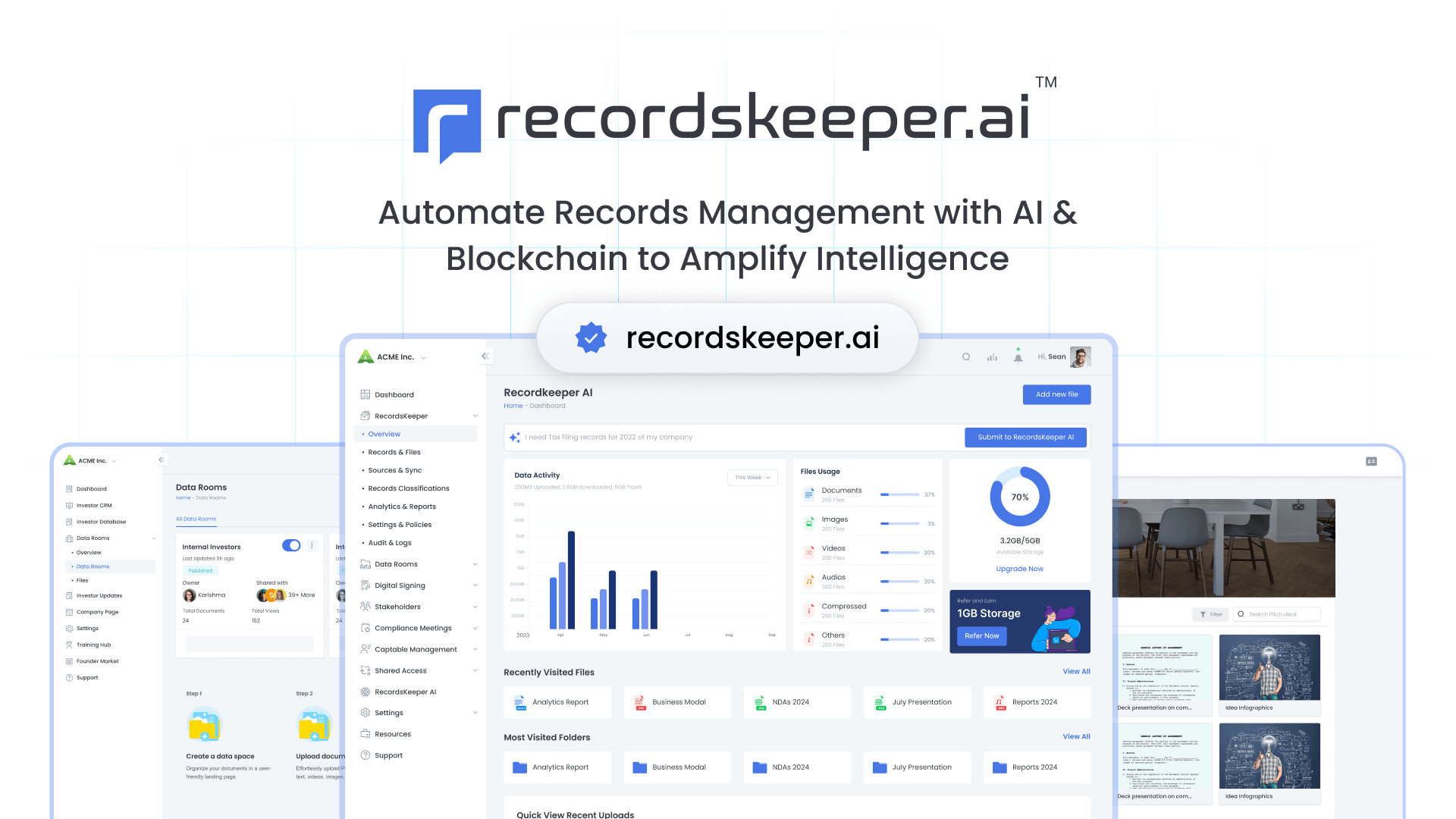
Record management is at the heart of every organization whether it's financial institutions handling sensitive transactions, legal firms managing case files, healthcare providers maintaining patient records, or businesses ensuring regulatory compliance. Yet, traditional record-keeping methods are still plagued by inefficiencies, security risks, and compliance challenges heading into 2026.
Enter RecordsKeeper.AI, a revolutionary AI & Blockchain-powered record management platform designed to eliminate manual inefficiencies, ensure compliance, and secure data like never before. As organizations increasingly formalize their understanding of this technology, many professionals are turning to a Certified Blockchain Expert credential to better evaluate platforms exactly like this one.

In this article, we'll explore what RecordsKeeper.AI is, how it works, why it's a game-changer, and how it compares to traditional and existing digital record-keeping solutions.
What is RecordsKeeper.AI?
RecordsKeeper.AI is a next-generation SaaS platform that automates record management using AI-driven intelligence and blockchain-backed security.
It transforms the way businesses handle records by:
✅ Automating document classification & tagging using AI
✅ Ensuring compliance with regulations like GDPR, HIPAA, and SOX
✅ Providing blockchain-backed, tamper-proof security
✅ Offering instant, natural language search for quick retrieval
✅ Enabling seamless, secure collaboration with access controls
The Core Mission of RecordsKeeper.AI
💡 To turn records from a compliance burden into a strategic advantage through automation, security, and intelligence.
🔗 Visit RecordsKeeper.AI: https://www.recordskeeper.ai
How Does RecordsKeeper.AI Work?
The platform's AI layer has become significantly more capable heading into 2026, and much of that progress traces back to how natural language processing and document intelligence have matured across the industry. Professionals building or evaluating this kind of system often pursue a Certified Artificial Intelligence (AI) Expert credential to understand exactly how AI driven classification, tagging, and retrieval actually work under the hood.
Step 1: Seamless Data Integration
RecordsKeeper.AI automatically syncs with your existing data sources, including:
Google Drive, Dropbox, OneDrive
Email-based document ingestion
WhatsApp & bulk uploads
This ensures all records are centralized in one secure platform, eliminating the hassle of scattered document storage.
Step 2: AI-Powered Organization & Categorization
Unlike traditional systems where records are stored in unstructured folders, RecordsKeeper.AI automatically categorizes and tags documents using AI.
Pattern Recognition: AI understands document types and organizes them accordingly.
Smart Tagging: Automated metadata generation for quick search and retrieval.
Context-Aware Recommendations: AI suggests related documents, improving workflow efficiency.
Step 3: Blockchain Security & Compliance
Security and compliance are non-negotiable for record management, especially for industries dealing with:
🔹 Financial transactions
🔹 Legal documentation
🔹 Healthcare records
🔹 Corporate governance files
With RecordsKeeper.AI's blockchain integration:
✅ Every document is stored with a tamper-proof, immutable audit trail.
✅ Unauthorized changes are impossible, ensuring document authenticity.
✅ Automated compliance tracking keeps businesses audit-ready, including evolving frameworks that regulators continue to update through 2026.
This is also where the platform's technical depth becomes most relevant. Many IT and compliance teams building internal expertise around blockchain backed audit trails and automated regulatory tracking now pursue a broader Tech Certification to keep pace with how quickly compliance technology continues to evolve.
Step 4: AI-Powered Smart Search & Retrieval
One of the most time-consuming aspects of record-keeping is finding the right document.
Traditional systems rely on exact keyword matching, which often results in frustrating and time-wasting searches.
RecordsKeeper.AI solves this with an AI-powered, natural language search that:
🔍 Understands human queries (e.g., "Find the latest contract with Vendor XYZ").
📂 Instantly retrieves the right documents based on context & relevance.
🤖 Chat-based search allows users to interactively refine searches.
Step 5: Secure Collaboration & Workflow Automation
Managing records isn't just about storage, it's about efficiently sharing and collaborating on them.
With RecordsKeeper.AI:
✅ Granular access control ensures only authorized personnel can view/edit files.
✅ Secure Data Rooms provide OTP-based access for sensitive documents.
✅ Digital Signing & Approval Workflows streamline contract approvals.
Step 6: Business Intelligence & Analytics
Records aren't just compliance obligations, they are valuable data assets.
RecordsKeeper.AI transforms static records into actionable insights, helping businesses:
📊 Identify trends & patterns
📈 Generate compliance & performance reports
🤖 Automate decision-making with AI-powered analytics
Comparison: RecordsKeeper.AI vs. Traditional Record-Keeping
Organizations have three primary approaches to record-keeping. Let's see how they compare:
Feature | Traditional Paper-Based | Basic Digital Storage | RecordsKeeper.AI |
|---|---|---|---|
Accessibility | Physical, hard to retrieve | Digital, but scattered | AI-powered instant search |
Security | Prone to loss & damage | Vulnerable to cyber threats | Blockchain-backed, tamper-proof |
Compliance | Manual, time-consuming | Requires manual tracking | Automated compliance monitoring |
Collaboration | Limited & slow | Cloud-based but risky | Secure Data Rooms with granular access control |
Search & Retrieval | Manual lookup | Keyword-based, slow | AI-powered, natural language search |
Workflow Automation | None | Basic workflow tools | Smart automation & digital signatures |
Business Intelligence | None | Some analytics | AI-driven insights & predictive analysis |
👉 RecordsKeeper.AI clearly outperforms both paper-based and traditional digital storage methods.
Who Needs RecordsKeeper.AI?
If you manage records, you need RecordsKeeper.AI.
Industries That Benefit the Most:
🏦 Financial Services - Ensures bank-grade security & regulatory compliance.
⚖️ Legal Firms - Organizes case files & legal contracts securely.
🏥 Healthcare Providers - Maintains HIPAA-compliant patient records.
🏢 Corporate Compliance Officers - Automates regulatory tracking.
📊 Government Agencies - Manages public records with transparency & security.
🚀 Startups & SMBs - Eliminates manual record-keeping burdens.
Key Roles That Need RecordsKeeper.AI:
✔️ CFOs & Finance Teams - Ensure secure financial recordkeeping & audits.
✔️ Legal Professionals - Protect confidential case files.
✔️ IT Managers - Manage enterprise-wide data governance.
✔️ Compliance Officers - Automate regulatory documentation.
✔️ CEOs & Entrepreneurs - Securely manage business-critical documents.
Why RecordsKeeper.AI is a Game-Changer
🚀 Saves 85% of Manual Effort - AI-powered automation reduces human workload.
🔐 Unparalleled Security - Blockchain-backed tamper-proof records.
⚡ 90% Faster Search & Retrieval - AI-driven instant access to documents.
📊 Converts Data into Insights - Business intelligence for better decision-making.
✔️ Ensures 100% Compliance - Stay audit-ready at all times.
Final Thoughts: Future-Proof Your Record Management
Records are the foundation of every organization's success. But managing them manually or with outdated digital solutions is costly, risky, and inefficient, and that gap only grows more expensive as regulatory expectations tighten in 2026.
With RecordsKeeper.AI, businesses can:
✅ Automate workflows
✅ Ensure compliance effortlessly
✅ Eliminate security risks
✅ Turn records into actionable intelligence
💡 The future of record management is AI-powered, blockchain-secured, and completely automated. As more platforms like this one enter the market, businesses positioning these tools to compliance officers, executives, and everyday teams need messaging that actually lands, which is exactly why a Marketing Certification focused on emerging tech has become valuable for teams responsible for explaining AI and blockchain products in plain, trustworthy terms.
🚀 Adopt RecordsKeeper.AI today & transform the way you manage records forever!
🔗 Try it Now: https://www.recordskeeper.ai
📢 Have questions? Drop a comment or reach out to us today!
🔖 #RecordsKeeperAI #AI #Blockchain #RecordManagement #Compliance #Automation
FAQs
1. What is RecordsKeeper.AI?
RecordsKeeper.AI can be understood as an AI- and blockchain-powered approach to digital record management that combines intelligent document processing with tamper-evident record verification. Such a platform can use artificial intelligence to classify, search, summarize, and analyze documents while blockchain technology records proofs, timestamps, ownership information, or audit events. The combination is designed to make large collections of business records easier to manage while improving trust in their authenticity and history.
2. How does AI and blockchain work together in record management?
AI and blockchain solve different problems within record management. Artificial intelligence can understand document content, extract information, classify files, identify patterns, and automate workflows. Blockchain can create a verifiable record showing when information was created, modified, approved, or transferred. Together, they can provide intelligent record processing alongside stronger integrity and auditability, which is considerably more useful than forcing an AI model to become an unusually enthusiastic filing clerk.
3. How can RecordsKeeper.AI improve document management?
An AI-powered record system can automatically classify documents, extract metadata, recognize entities, generate summaries, and organize files according to their content. Blockchain can then record cryptographic proofs of important documents or actions. This reduces dependence on manual filing and helps organizations find relevant records more quickly while maintaining a trusted history of document activity.
4. How does blockchain protect digital records?
Blockchain can generate and store cryptographic hashes representing digital documents. If a document is later changed, its new hash will differ from the original blockchain record, making unauthorized modification detectable. The actual document does not necessarily need to be stored on-chain. In most practical systems, records remain in secure databases or cloud storage while blockchain stores verification information and timestamps.
5. Can RecordsKeeper.AI make records immutable?
Blockchain can make recorded verification data highly resistant to unauthorized alteration, but describing every business record as completely immutable would be misleading. Organizations often need to correct, update, archive, or delete information according to legal requirements. A better design preserves an auditable history of changes while keeping sensitive or editable information off-chain. This gives organizations integrity without turning every typo into a permanent monument.
6. How can AI improve record search and retrieval?
AI can make record retrieval more intelligent than conventional keyword search. Users can potentially search using natural-language questions, concepts, dates, names, entities, or relationships rather than remembering exact file names. AI can also summarize long records, identify relevant sections, and connect information across multiple documents. This can significantly reduce the time employees spend searching through archives, contracts, policies, reports, and compliance records.
7. How can RecordsKeeper.AI automate document classification?
AI models can examine the content and metadata of incoming files and automatically classify them into categories such as contracts, invoices, legal records, HR documents, compliance reports, or customer correspondence. The system can then apply retention policies, access controls, approval workflows, or verification requirements according to the document type. This reduces manual administrative work and helps organizations maintain more consistent record-management practices.
8. How can blockchain improve audit trails?
Blockchain can create a tamper-evident history showing when a record was created, accessed, approved, updated, or transferred. Auditors can use this history to verify whether important actions occurred in the expected sequence. Because these verification records are difficult to alter retrospectively, blockchain can strengthen confidence in audit evidence and reduce disputes about who performed a particular action and when.
9. How can RecordsKeeper.AI help with regulatory compliance?
An AI- and blockchain-based record-management system can help organizations apply retention rules, monitor access, identify missing documents, classify sensitive information, and maintain verifiable audit trails. AI can flag potential compliance issues, while blockchain can preserve evidence of approvals and record history. Compliance still requires appropriate policies, legal interpretation, and human oversight, because neither a neural network nor a distributed ledger has yet volunteered to appear before a regulator on the company's behalf.
10. Can RecordsKeeper.AI improve contract management?
Yes. AI can extract clauses, dates, obligations, renewal terms, payment conditions, and parties from contracts. It can also identify missing provisions or compare documents against approved templates. Blockchain can record contract hashes, approval events, signatures, or amendments. Smart contracts may automate selected obligations where appropriate, creating a more transparent contract lifecycle from creation and negotiation through execution and renewal.
11. How can RecordsKeeper.AI help legal departments?
Legal teams manage large numbers of contracts, case files, evidence records, correspondence, policies, and regulatory documents. AI can assist with document review, classification, summarization, and information extraction, while blockchain can strengthen chain-of-custody and document-integrity records. This can improve legal discovery, evidence management, contract administration, and compliance without replacing lawyers or professional judgment.
12. How can healthcare organizations use AI and blockchain record management?
Healthcare organizations can use AI to organize medical documents, extract information, and improve record retrieval, while blockchain can support consent management, credential verification, and tamper-evident audit histories. Sensitive medical information should generally remain encrypted and off-chain. Blockchain is better suited to recording permissions, hashes, and verification proofs rather than turning a patient's complete medical history into a permanent public artifact.
13. How can financial institutions use RecordsKeeper.AI?
Banks, insurers, FinTech companies, and investment firms can use AI-powered record management for KYC documentation, transaction records, contracts, regulatory reports, customer communications, and audit evidence. AI can classify and analyze financial documents, while blockchain can verify critical records and approval histories. This can improve compliance, fraud investigation, document retrieval, and operational efficiency in heavily regulated environments.
14. How can RecordsKeeper.AI improve enterprise knowledge management?
Enterprise knowledge is often scattered across documents, emails, policies, reports, presentations, and databases. AI can index and understand this information, allowing employees to retrieve answers using natural language. Blockchain can help establish which documents are authoritative and verify their provenance. This combination can reduce duplicated work and help employees distinguish current approved information from the ancient spreadsheet someone found in a folder named “Final_Final_v7.”
15. What are the main benefits of AI and blockchain-powered record management?
The main benefits include faster document search, automated classification, improved auditability, tamper-evident verification, better compliance monitoring, stronger data provenance, reduced administrative work, and more intelligent knowledge retrieval. The combination is especially useful for organizations managing large volumes of sensitive or regulated records where both information discovery and trust are important.
16. What challenges does an AI and blockchain record platform face?
Major challenges include data privacy, AI accuracy, blockchain scalability, integration with existing systems, cybersecurity, regulatory compliance, model governance, storage costs, and user adoption. AI can misclassify or misinterpret documents, while blockchain can preserve incorrect information perfectly once it is recorded. Human review and strong data-governance processes therefore remain essential.
17. Should organizations store documents directly on blockchain?
Usually not. Large documents, confidential records, and personal information are better stored in secure off-chain databases, cloud platforms, or controlled storage systems. Blockchain can store document hashes, timestamps, signatures, permissions, and other verification data. This hybrid architecture provides blockchain integrity without creating unnecessary storage costs or privacy problems.
18. What are best practices for implementing RecordsKeeper.AI?
Organizations should begin with clearly defined record-management problems such as slow retrieval, weak audit trails, inconsistent classification, or compliance risk. Sensitive information should remain off-chain, AI outputs should be reviewed for important decisions, blockchain records should contain only necessary verification data, and strong identity, access control, encryption, and retention policies should be applied. Integration with existing document-management and enterprise systems is usually more practical than attempting to replace everything at once.
19. What trends are shaping AI and blockchain record management in 2026?
Important trends include generative AI search, retrieval-augmented generation, automated document intelligence, verifiable AI outputs, decentralized identity, zero-knowledge proofs, confidential computing, AI agents, blockchain-based data provenance, digital signatures, and privacy-preserving record verification. Another major trend is combining AI-generated summaries and decisions with verifiable source records so users can trace conclusions back to trusted evidence instead of accepting an exceptionally confident machine paragraph on faith.
20. What is the future of RecordsKeeper.AI and intelligent record management?
The future of record management is likely to combine AI-powered understanding with cryptographically verifiable information. Instead of manually searching through folders and databases, users could ask natural-language questions and receive answers drawn from authorized enterprise records. AI could identify the relevant information, blockchain could verify the provenance and integrity of the underlying records, and automated workflows could route approvals or compliance actions.
This model could transform traditional document repositories into intelligent, searchable, and auditable knowledge systems. Blockchain would provide the trust layer, while AI would provide the understanding and automation layer.
The real opportunity is therefore not simply creating another place to store files. It is creating a system where organizations can quickly determine what information they have, what it means, whether it can be trusted, who changed it, and what should happen next. That is a considerably more useful future for record management than maintaining increasingly elaborate folder structures and hoping everyone remembers where the important PDF went.
Related Articles
View All
Blockchain
Stakeholder Management in Web3: Aligning DAOs, Developers, Token Holders, and Investors
Learn how stakeholder management in Web3 aligns developers, token holders, DAOs, and investors through better governance, incentives, and legal design.

Blockchain
Crypto Wallet Product Management: Building Secure, User-Friendly Wallet Experiences
A practical guide to crypto wallet product management, covering custody models, secure UX, threat modeling, metrics, compliance, and wallet roadmap decisions.

Blockchain
Crypto Wallet Product Management: Features, Security, and UX Priorities
Crypto wallet product management requires secure key design, clear UX, MPC workflows, AI risk controls, and recovery-first product strategy.
Trending Articles
The Role of Blockchain in Ethical AI Development
How blockchain technology is being used to promote transparency and accountability in artificial intelligence systems.

Top 5 DeFi Platforms
Explore the leading decentralized finance platforms and what makes each one unique in the evolving DeFi landscape.
How to Create Claude Skills?
Claude Skills are one of the most important features Anthropic has introduced for users who want automation that is structured, consistent and reusable. Instead of giving Claude long instructions ever