

Privacy-Preserving AI with Blockchain
 Suyash Raizada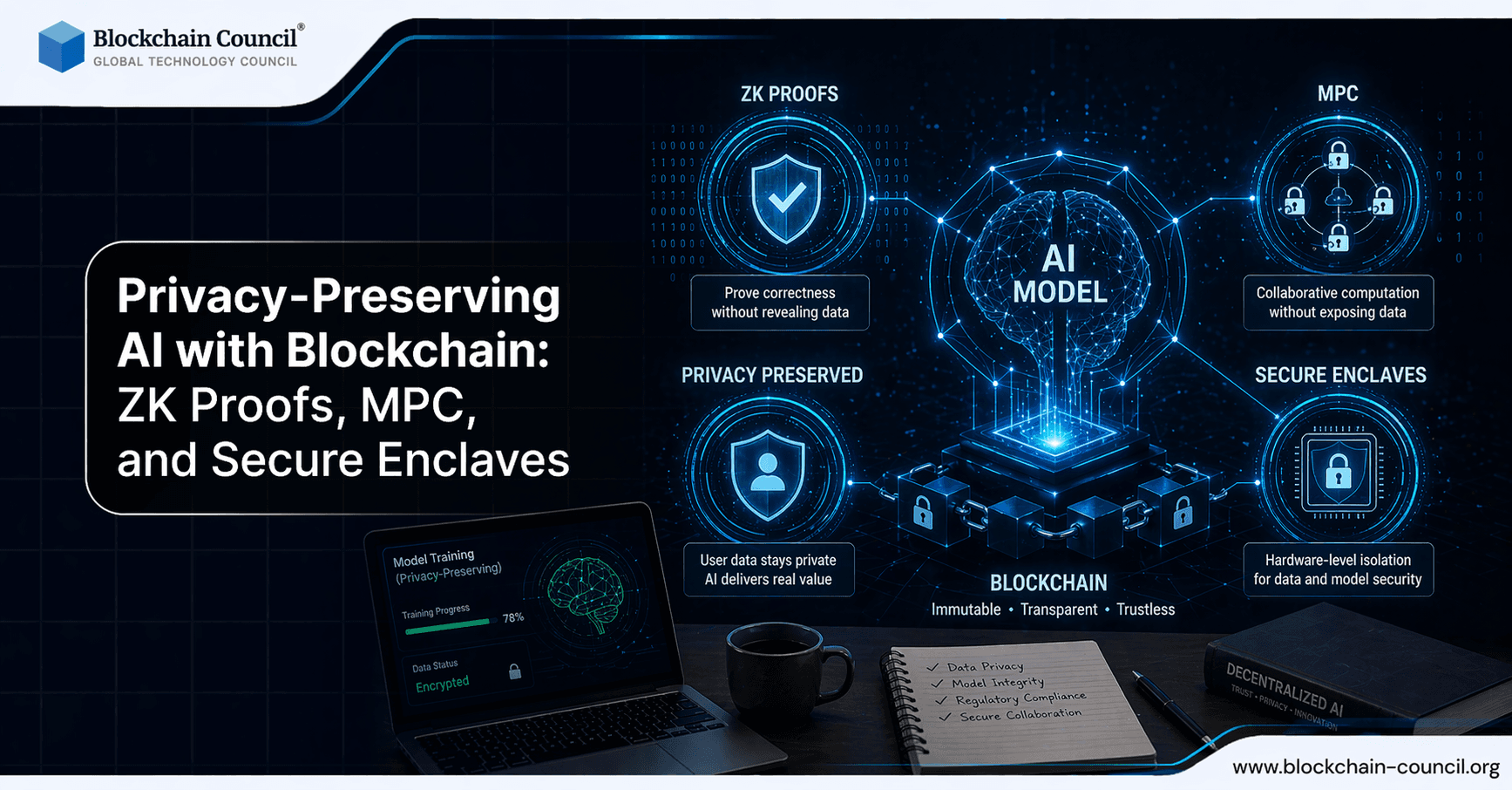
Privacy-preserving AI with blockchain is moving from research into real deployments as organizations seek to extract value from sensitive data without exposing it. The core idea is straightforward: let AI compute insights while minimizing what any participant, validator, or service provider can learn about the underlying data. Achieving this in practice requires a toolbox that includes zero-knowledge proofs (ZKPs), secure multiparty computation (MPC), and trusted execution environments (TEEs), often combined in hybrid architectures to balance performance, verifiability, and trust assumptions. Develop secure AI models that maintain data privacy across decentralized environments by gaining expertise through an AI Security Certification, building blockchain integrations using a Node JS Course, and promoting privacy-focused AI platforms using an AI powered marketing course.
This article covers the current state of privacy-preserving AI, why blockchain matters for governance and auditability, and how ZK proofs, MPC, and secure enclaves fit together for enterprise and Web3 use cases.

Why Privacy-Preserving AI Needs Blockchain
AI projects frequently stall on data constraints rather than model quality. In regulated sectors like finance, healthcare, and insurance, organizations cannot simply pool data due to confidentiality obligations and legal requirements such as GDPR and HIPAA. Privacy-preserving AI addresses this by keeping raw data private while still enabling joint computation.
Blockchain contributes three critical properties:
Verifiable coordination: smart contracts can encode who is permitted to run which computation and under what conditions.
Auditability and policy enforcement: on-chain logs and proofs can demonstrate compliance without exposing private data.
Composable incentives: tokens, fees, or credits can fund compute and reward data contributors while preserving confidentiality.
In privacy-first settings, blockchain also reduces reliance on trusted intermediaries by replacing informal trust with cryptographic proofs and controlled execution.
The Privacy Stack: ZK Proofs, MPC, and Secure Enclaves
No single privacy technology suits every AI workflow. Most practical systems combine multiple techniques because each optimizes a different axis: verifiability, speed, and trust minimization.
Zero-Knowledge Proofs (ZKPs) for Verifiable Privacy
ZK proofs allow one party to prove a statement is true without revealing the underlying data. For privacy-preserving AI with blockchain, ZKPs are particularly useful for:
Proving correct inference: confirming that a prediction was generated by model X on input Y under policy P, without revealing Y.
Proving compliance: KYC-verifiable transactions or access control checks where a user proves membership, eligibility, or threshold satisfaction.
Verifiable compute in Layer 2: ZK rollups and zkVMs can execute logic off-chain and post succinct proofs on-chain.
Multiple zkVMs are live or in advanced testnets, and ZK rollups such as zkSync Era and Starknet process substantial on-chain activity. Polygon zkEVM has reached mainnet-beta, emphasizing EVM compatibility while using ZK proofs for verification.
Performance continues to improve but remains a constraint. Current Ethereum zkEVM rollups commonly achieve roughly 20-50 transactions per second with proving delays of around 10-30 seconds, still well below non-private execution speeds. Research forecasts suggest prover overhead could drop materially by the end of 2026, improving feasibility for more complex AI-related verification tasks.
Secure Multiparty Computation (MPC) for Shared Secrecy
MPC enables multiple parties to compute a function over their combined inputs while keeping those inputs private from one another. No participant learns the other parties' data, yet everyone receives a correct output. For privacy-preserving AI, MPC supports:
Cross-institution training or analytics: banks or hospitals compute aggregated signals without sharing raw records.
Distributed key management: encryption keys are split across participants so no single party can decrypt data unilaterally.
Client-side encryption workflows: data remains encrypted, and only authorized computations can be performed using shared control.
MPC's trade-off involves coordination and operational complexity. Parties must remain online or adhere to protocols, latency can increase, and the system must handle failures or dropouts. Even so, MPC is increasingly used to reduce reliance on a single custodian or service provider, especially for key management and authorization workflows.
Trusted Execution Environments (TEEs) for Practical Speed
TEEs, also called secure enclaves, run code inside hardware-isolated environments designed to protect data while it is being processed. They are attractive because they can be significantly faster than ZK proofs for many workloads, including AI inference.
TEEs are already deployed in enterprise confidential computing, including tests by major cloud providers for secure AI scenarios. Their primary drawback is a different trust model: you must trust the hardware vendor, the enclave attestation mechanism, and the surrounding supply chain. For many enterprises, this trade-off is acceptable when combined with additional safeguards such as on-chain attestation checks and periodic ZK-based audits of enclave outputs.
Hybrid Architectures as the Near-Term Standard
Hybrid design has become the dominant approach because:
ZKPs provide strong verifiability but can be expensive to generate for large AI computations.
TEEs provide speed but introduce hardware trust assumptions.
MPC reduces single-party trust but requires careful protocol engineering and coordination.
A common pattern for privacy-preserving AI with blockchain follows this structure:
Client-side encryption protects raw data before it leaves the user or institution.
MPC-based key control ensures decryption or access requires multi-party authorization.
TEE-based inference runs the model inside an enclave, producing outputs and attestations efficiently.
ZK proofs verify policy compliance or correctness constraints, then anchor results on-chain for auditability.
This combination keeps high-cost ZK proofs focused on what must be publicly verifiable, while enclaves or MPC handle the portions where they are most efficient.
Where FHE Fits: Promising but Still Constrained
Fully homomorphic encryption (FHE) allows computation directly on encrypted data, which is conceptually well suited to privacy-preserving AI. Progress has accelerated with demonstrations of encrypted execution for limited smart contract logic and basic financial calculations in controlled environments.
The biggest blocker remains performance: FHE is still orders of magnitude slower than plaintext computation, which makes many real-time on-chain use cases impractical at present. A more realistic near-term path is selective use of FHE for small, high-value computations in regulated environments, combined with ZK proofs, MPC, or TEEs for the broader workflow.
Enterprise and Web3 Use Cases Gaining Traction
Privacy-preserving AI enables collaboration and data monetization without the same level of leakage risk. Use cases with strong near-term demand include:
Cross-Institution Healthcare Research
Hospitals across regions can collaborate on sensitive datasets such as oncology research while keeping patient records confidential. Privacy-preserving AI enables joint analytics and model training with stronger alignment to GDPR and HIPAA obligations.
Multi-Bank Fraud Detection
Fraud patterns frequently span institutions. MPC and privacy-preserving analytics allow banks to compute shared risk signals without revealing customer-level transaction histories to each other or to a central operator.
Regulated Personalization
Industries such as finance and healthcare can deliver more personalized recommendations while minimizing exposure of protected attributes. This is particularly relevant when models require sensitive features that organizations cannot legally or commercially disclose.
Private Transactions and Programmable Compliance
On-chain privacy infrastructure is maturing through ZK rollups and zkVMs. Payment networks have also tested ZK-based recurring payment schemes that enable automated payment behavior without broadcasting sensitive details. For enterprises, this points toward programmable compliance where users can prove eligibility without disclosing full identity or transaction metadata.
Market Signals and Institutional Adoption
Institutional interest is growing as privacy shifts from optional to necessary. Market research groups have forecast significant growth in the privacy sector's market capitalization, driven by demand for confidentiality and increasing regulatory clarity for crypto markets, particularly in the United States.
On the infrastructure side, Ethereum has invested in dedicated privacy research capacity, including specialist working groups and new developer toolkits aimed at improving privacy and security across the ecosystem.
Privacy as a Network Effect and Strategic Moat
Privacy can create meaningful switching costs. Once users operate in a shielded environment, moving assets out can expose transaction patterns and enable correlation attacks based on timing and amounts. This makes privacy self-reinforcing as a network effect: users and institutions prefer ecosystems where their history remains confidential, and that preference compounds over time.
For organizations exploring privacy-preserving AI with blockchain, this has clear strategic implications:
Confidential systems can attract more high-value activity by reducing commercial leakage.
Once workflows are built around private attestations and proof systems, migrating to transparent infrastructure may become commercially unacceptable.
Protocol-level privacy can become an enterprise requirement rather than a product feature.
Cross-Chain Privacy Challenges to Plan For
Cross-chain interoperability remains a privacy weak point. Many bridging designs leak metadata through notary schemes, smart contract traces, or observable message patterns, which can enable tracing and re-identification. Emerging research covers privacy-preserving multi-party protocols and specialized signature constructions intended to preserve atomicity and decentralization with less metadata leakage, but these approaches are still early-stage.
Practically, teams should treat cross-chain moves as potentially deanonymizing unless the bridge is explicitly designed for privacy and has been threat-modeled for metadata leakage.
Implementation Checklist for Teams
When evaluating privacy-preserving AI with blockchain, the following design decisions deserve early attention:
Threat model first: define what must be hidden (inputs, outputs, model weights, metadata) and from whom (counterparties, validators, cloud operators).
Choose verification boundaries: decide which claims must be publicly verifiable via ZK proofs versus privately verifiable via TEEs and attestations.
Key management and authorization: use MPC or threshold schemes to avoid single-party key control.
Performance budgets: account for proving latency, enclave throughput, and coordination overhead early in the architecture phase.
Compliance mapping: align proof outputs and audit logs with your regulatory and governance requirements.
Build privacy-preserving AI systems using ZK proofs, MPC, and secure enclaves to protect sensitive data during computation by mastering security through an AI Security Certification, implementing cryptographic workflows using a Python certification, and scaling privacy-first solutions via a Digital marketing course.
Conclusion
Privacy-preserving AI with blockchain is becoming practical through hybrid architectures that combine ZK proofs, MPC, and secure enclaves. ZK systems provide verifiability and compliance-friendly proofs, MPC enables shared secrecy and distributed control, and TEEs offer the performance required for real-world AI workloads. While FHE remains a longer-term frontier for fully encrypted computation at scale, near-term progress will come from carefully engineered combinations of these tools, particularly in regulated enterprise environments.
As AI agents and automated workflows become economically active, privacy infrastructure will increasingly determine which networks and platforms can support high-value adoption without forcing organizations to choose between utility and confidentiality.
FAQs
1. What is privacy-preserving AI?
Privacy-preserving AI refers to techniques that allow models to learn and make predictions without exposing sensitive data. It ensures data remains confidential during training and inference. This is critical for regulated and sensitive environments.
2. How does blockchain support privacy-preserving AI?
Blockchain provides a secure and transparent framework for managing data access and verification. It ensures tamper-resistant records of transactions and permissions. This builds trust in decentralized AI systems.
3. What are zero-knowledge proofs (ZK proofs)?
Zero-knowledge proofs allow one party to prove a statement is true without revealing the underlying data. They enable verification without disclosure. This is useful for protecting sensitive information in AI workflows.
4. How are ZK proofs used in AI systems?
ZK proofs can verify model outputs or data integrity without exposing raw data. They are used in secure data sharing and validation. This enhances privacy while maintaining trust.
5. What is multi-party computation (MPC)?
MPC is a cryptographic method where multiple parties compute a result together without sharing their private inputs. Each party’s data remains secure. It enables collaborative AI training across organizations.
6. How does MPC improve AI data privacy?
MPC allows models to be trained on distributed data without centralizing it. Sensitive data never leaves its source. This reduces the risk of data breaches and misuse.
7. What are secure enclaves in AI?
Secure enclaves are hardware-based environments that protect data during processing. They isolate sensitive computations from the rest of the system. This ensures data confidentiality even during execution.
8. How do secure enclaves work with AI models?
AI models run inside the enclave, where data is decrypted and processed securely. External systems cannot access the data during computation. This provides strong protection for sensitive workloads.
9. Why is privacy important in AI development?
AI often relies on large datasets that may include personal or confidential information. Protecting this data is essential for compliance and trust. Privacy-preserving methods reduce legal and ethical risks.
10. What are the benefits of combining blockchain with privacy-preserving AI?
Combining both technologies enhances security, transparency, and trust. Blockchain manages access and verification, while privacy techniques protect data. This creates a robust framework for secure AI systems.
11. Can privacy-preserving AI be used in healthcare?
Yes, it is widely used to protect patient data while enabling analysis and research. Techniques like MPC and secure enclaves ensure confidentiality. This supports compliance with data protection regulations.
12. What are the challenges of privacy-preserving AI?
Challenges include computational overhead, complexity, and scalability. Implementing advanced cryptographic techniques can be resource-intensive. Balancing performance and privacy is a key concern.
13. How do ZK proofs differ from MPC?
ZK proofs focus on verifying information without revealing it. MPC focuses on jointly computing results without sharing inputs. Both enhance privacy but serve different purposes.
14. Is privacy-preserving AI scalable?
Scalability depends on the chosen techniques and infrastructure. Some methods like MPC can be resource-intensive. Advances in optimization are improving scalability over time.
15. What industries benefit from privacy-preserving AI?
Industries such as finance, healthcare, and government benefit the most. They handle sensitive data and require strong privacy measures. These techniques enable secure data usage.
16. How does blockchain ensure trust in AI systems?
Blockchain provides immutable records of data access and model operations. This ensures accountability and transparency. Users can verify actions without relying on central authorities.
17. Can privacy-preserving AI prevent data breaches?
It significantly reduces the risk by limiting data exposure. Techniques ensure data is not directly shared or stored in vulnerable ways. However, no system is completely risk-free.
18. What role does encryption play in privacy-preserving AI?
Encryption protects data at rest, in transit, and during processing. It ensures only authorized parties can access sensitive information. Strong encryption is foundational to these systems.
19. How can businesses implement privacy-preserving AI?
Businesses can adopt tools and frameworks that support ZK proofs, MPC, and secure enclaves. They should also assess regulatory requirements. Proper integration ensures secure and compliant AI deployment.
20. What is the future of privacy-preserving AI with blockchain?
The integration of AI and blockchain will continue to evolve with better efficiency and usability. Privacy techniques will become more practical and scalable. This will enable wider adoption across industries.
Related Articles
View All
Blockchain
Beyond Cryptocurrency: How Blockchain Is Transforming Real-World Industries
Explore how blockchain works beyond cryptocurrency in banking, supply chains, healthcare, tokenisation, CBDCs, and government, plus key challenges and career paths.

Blockchain
Smart Contracts & dApps: How Blockchain Becomes Programmable
Learn how smart contracts and dApps make blockchain programmable, from Ethereum and tokens to DeFi, NFTs, real use cases, benefits, and key risks.

Blockchain
Behind the Blocks: How Blockchain Transactions Actually Work
Go behind the blocks to see how a blockchain transaction really works: wallets and keys, digital signatures, verification, hashing, blocks, consensus, proof of work vs proof of stake, and how miners and validators secure the network.
Trending Articles
What is AWS? A Beginner's Guide to Cloud Computing
Everything you need to know about Amazon Web Services, cloud computing fundamentals, and career opportunities.

Can DeFi 2.0 Bridge the Gap Between Traditional and Decentralized Finance?
The next generation of DeFi protocols aims to connect traditional banking with decentralized finance ecosystems.
How to Install Claude Code
Learn how to install Claude Code on macOS, Linux, and Windows using the native installer, plus verification, authentication, and troubleshooting tips.