
How Machine Learning Is Transforming Blockchain Applications for AI Engineers and Blockchain Developers


AI engineers and blockchain developers are increasingly building the same future: decentralized systems that can learn, adapt, and defend themselves. As machine learning in blockchain matures, it is reshaping core blockchain tasks such as smart contract security, fraud detection, performance optimization, and on-chain analytics. The result is a new class of hybrid applications where blockchain provides integrity and auditability, while machine learning provides prediction, automation, and intelligence.
This convergence is also changing career paths. Teams now look for professionals who understand Solidity and cryptography, but also Python, data science, and ML frameworks like TensorFlow and PyTorch. In many organizations, the competitive edge comes from combining trustworthy decentralized data with models that can detect risk, forecast outcomes, and automate decisions.

Why Machine Learning in Blockchain Is Accelerating Now
Blockchain systems face persistent constraints: scalability limits, complex security risks, and the challenge of extracting value from large volumes of decentralized data. Machine learning helps address these gaps by turning on-chain and off-chain signals into actionable insights and by automating security and operational monitoring.
At the same time, AI-driven use cases are pushing demand for decentralized infrastructure. Tokenization, real-world asset management, and AI-enhanced financial protocols increasingly require verifiable data provenance, transparent execution, and tamper-resistant logs. Blockchain fills those needs, while ML delivers adaptive decision-making on top.
What Each Technology Contributes
Blockchain: integrity, consensus, audit trails, programmable value via smart contracts, and decentralized coordination.
Machine learning: classification, anomaly detection, prediction, clustering, natural language processing, and automated reasoning workflows.
For AI engineers and blockchain developers, the practical question is not which one wins. It is how to design systems where each technology compensates for the other's weaknesses.
Key Ways Machine Learning Is Transforming Blockchain Applications
1) Smart Contract Auditing and Security Automation
Smart contracts are powerful, but small implementation errors can lead to significant losses. Common vulnerability classes include reentrancy attacks, flawed access controls, and unsafe external calls. Machine learning techniques are increasingly used to assist auditing by identifying suspicious code patterns and surfacing risky logic paths.
In practice, ML-assisted security complements traditional static analysis and formal verification methods. Rather than replacing auditors, it improves throughput and prioritization, helping teams review more contracts and direct human attention where it matters most.
Pattern detection for known vulnerability signatures in Solidity code.
Risk scoring to triage contracts for deeper review.
Gas optimization suggestions by learning from contract execution patterns and common inefficiencies.
Because smart contract audits are high-stakes, this area is driving demand for specialized hybrid roles. Market salary ranges often reflect that value, with smart contract auditors commonly reported in the $150,000 to $300,000 range.
2) Fraud Detection and Anomaly Detection on Decentralized Networks
Blockchains are transparent, but fraud remains a significant risk. Wash trading, address poisoning, Sybil behaviors, and cross-chain bridge exploits can be partially detected through machine learning models trained on transaction graphs, behavioral patterns, and time-series signals.
This is one of the most practical applications of machine learning in blockchain because it aligns naturally with the data available: addresses, transfers, contract calls, and event logs. Predictive and anomaly models can be deployed in monitoring pipelines that alert exchanges, protocols, and compliance teams to emerging threats.
Graph-based ML to identify suspicious clusters of addresses and movement patterns.
Time-series anomaly detection to catch unusual spikes in volume, gas usage, or contract interactions.
Classification models to label transactions or addresses by risk category.
3) Predictive Analytics on On-Chain and Off-Chain Data
Decentralized data is increasingly valuable, but raw data does not automatically translate into actionable decisions. Predictive analytics in blockchain applications includes forecasting demand, predicting liquidation risk in DeFi, modeling supply chain disruptions, and estimating network congestion to tune transaction strategies.
Many stacks combine blockchain event ingestion with Python-based analytics services. Tooling often includes Python, Pandas, and model frameworks, while the application layer may rely on Solidity smart contracts and off-chain services for compute-intensive workloads.
A common architecture for predictive analytics blockchain solutions follows this pattern:
Index on-chain events into an analytics store.
Feature-engineer datasets from transaction histories, wallet behaviors, and protocol metrics.
Train models for forecasting, risk scoring, or classification.
Deliver outputs back to applications via APIs, dashboards, or oracle mechanisms.
4) Network Optimization and Consensus Support
Consensus mechanisms like proof-of-work and proof-of-stake involve complex tradeoffs across security, decentralization, and performance. While core consensus rules remain deterministic, ML can help optimize network operations and client behavior - for example, predicting congestion, improving fee estimation, and detecting network-level anomalies.
In enterprise and permissioned networks, ML also supports capacity planning and performance tuning, aligning infrastructure costs with transaction demand patterns.
5) Decentralized AI Agents and Autonomous On-Chain Workflows
One of the most forward-looking developments is the emergence of decentralized AI agents that coordinate actions across protocols, manage tokenized assets, and execute predefined strategies under transparent rules. Blockchain provides verifiable execution and ownership constraints, while ML enables agents to select actions based on predictions and learned behaviors.
Examples include AI-assisted treasury management, automated market monitoring, and risk-aware execution strategies for DeFi protocols. Teams are also exploring how generative AI and blockchain can combine to create secure environments for sensitive industries, where decentralized data handling and encryption increase accountability and trust.
Shared Skills and Tooling for AI Engineers and Blockchain Developers
The talent market increasingly rewards professionals who can operate across both domains. Reported salary bands reflect strong demand: blockchain developers typically fall in the $90,000 to $150,000 range, with seniors reaching up to $225,000, while AI developers often start at $100,000 to $160,000 and can reach $300,000 in specialized roles. The hybrid profile remains rare, which is precisely why this intersection carries growing importance.
Core Skill Overlap
Programming: Python for ML and data pipelines; Solidity for Ethereum smart contracts; strong version control practices with Git.
Security mindset: cryptography basics, secure coding, threat modeling, and adversarial thinking.
Data structures and networking: essential for both distributed systems and ML pipelines.
Math foundations: linear algebra, probability, calculus, and statistics for model development and evaluation.
Practical Learning Paths
Certified Blockchain Developer to strengthen smart contract development, Ethereum basics, and dApp architecture.
Certified Smart Contract Auditor to build vulnerability research skills and auditing workflows.
Certified AI Engineer to validate ML fundamentals, model training, and production deployment practices.
For most professionals, pairing a smart contract track with a production ML track is the most direct path to contributing in real projects - particularly where compliance, security, and system reliability are non-negotiable.
Real-World Applications Across Industries
Finance and DeFi
Machine learning supports fraud detection, credit and risk scoring, liquidation prediction, and market anomaly detection, while blockchain enforces settlement rules and auditability. This combination reduces manual monitoring overhead and improves response times to emerging risks.
Supply Chain and Logistics
Blockchain provides traceability and tamper-evident records. ML improves demand forecasting, route optimization, and anomaly detection for suspicious events across suppliers and shipments.
Healthcare and Sensitive Data Environments
Teams are building platforms that combine decentralized data handling with AI capabilities. The goal is to improve trust, governance, and auditability while enabling analytics and model-driven workflows on authorized datasets - without compromising patient or organizational data privacy.
Challenges and Design Considerations
Hybrid systems introduce real architectural complexity:
Data privacy and governance: on-chain transparency conflicts with sensitive ML datasets, so architectures typically require off-chain storage, encryption, and strict access controls.
Model integrity: ML outputs can be manipulated through adversarial inputs or poisoned training data. Continuous monitoring and validation are essential.
Compute constraints: heavy ML workloads are rarely executed directly on-chain due to cost and performance limitations, so teams rely on off-chain compute with verifiable reporting mechanisms.
Learning curve breadth: decentralization, consensus, and smart contract security are technically demanding, while ML requires strong mathematical foundations and rigorous evaluation discipline.
Hiring for Web3 skills also remains difficult for many organizations. Screening for genuine on-chain thinking and experience is a known challenge, which further raises the value of verified credentials and demonstrable project portfolios.
Future Outlook: The Rise of the AI Blockchain Engineer
Across industry perspectives, a consistent view is emerging: AI engineers and blockchain developers who can work across both domains will define the next hiring wave in Web3 and decentralized infrastructure. Through 2025 and 2026, generative AI advancements and broader adoption of tokenized systems are expected to accelerate hybrid job creation, particularly in smart contract security, decentralized agents, and AI-driven financial applications.
The most resilient career strategy is to build competence in three layers:
Protocol and smart contract fundamentals: Solidity, EVM concepts, secure development patterns, and auditing.
ML engineering: data pipelines, model training, evaluation, deployment, and monitoring.
System design: integrating on-chain logic with off-chain compute, oracles, indexing, and security controls.
Conclusion
Machine learning in blockchain is not a niche trend. It is becoming a practical toolkit for making decentralized systems safer, smarter, and more operationally efficient. From ML-assisted smart contract auditing to predictive analytics on decentralized data and autonomous agents that execute transparent strategies, this convergence is producing real applications and reshaping technical roles across industries.
For AI engineers and blockchain developers, this represents an opportunity to build rare, high-impact expertise. Focus on secure smart contract development, production ML skills, and real-world system integration. Supporting that expertise with portfolio projects and role-aligned credentials - such as Blockchain Council pathways in blockchain development, smart contract auditing, and AI engineering - strengthens both credibility and career positioning.
Related Articles
View All
Blockchain
How to Build an AI Blockchain App: Step-by-Step Guide for Developers
Learn how to build AI blockchain app projects with smart contracts, off-chain AI inference, secure oracles, testing, and deployment best practices for Web3.

Blockchain
Real-World AI Blockchain Applications: Security, Compliance, and Enterprise Innovation
AI blockchain applications power real-world security, compliance, smart contract auditing, and supply chain transparency, helping enterprises scale trusted blockchain systems.

Blockchain
How Blockchain Supply Chain Systems Are Transforming Supply Chain Management in 2026
In 2026, blockchain supply chain systems boost transparency, traceability, and automation with DLT, smart contracts, and real-time data sharing across partners.
Trending Articles
The Role of Blockchain in Ethical AI Development
How blockchain technology is being used to promote transparency and accountability in artificial intelligence systems.
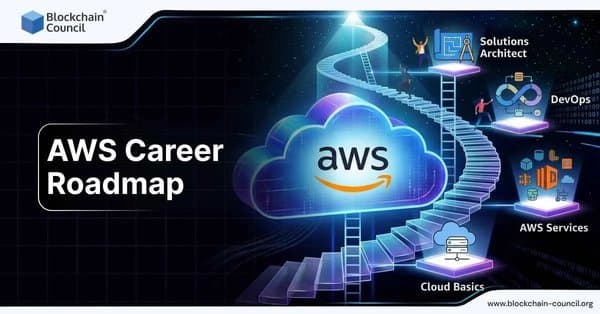
AWS Career Roadmap
A step-by-step guide to building a successful career in Amazon Web Services cloud computing.
Top 5 DeFi Platforms
Explore the leading decentralized finance platforms and what makes each one unique in the evolving DeFi landscape.