

Episode 6 Blockchain Relevant to Self-Driving cars
 Toshendra Kumar Sharma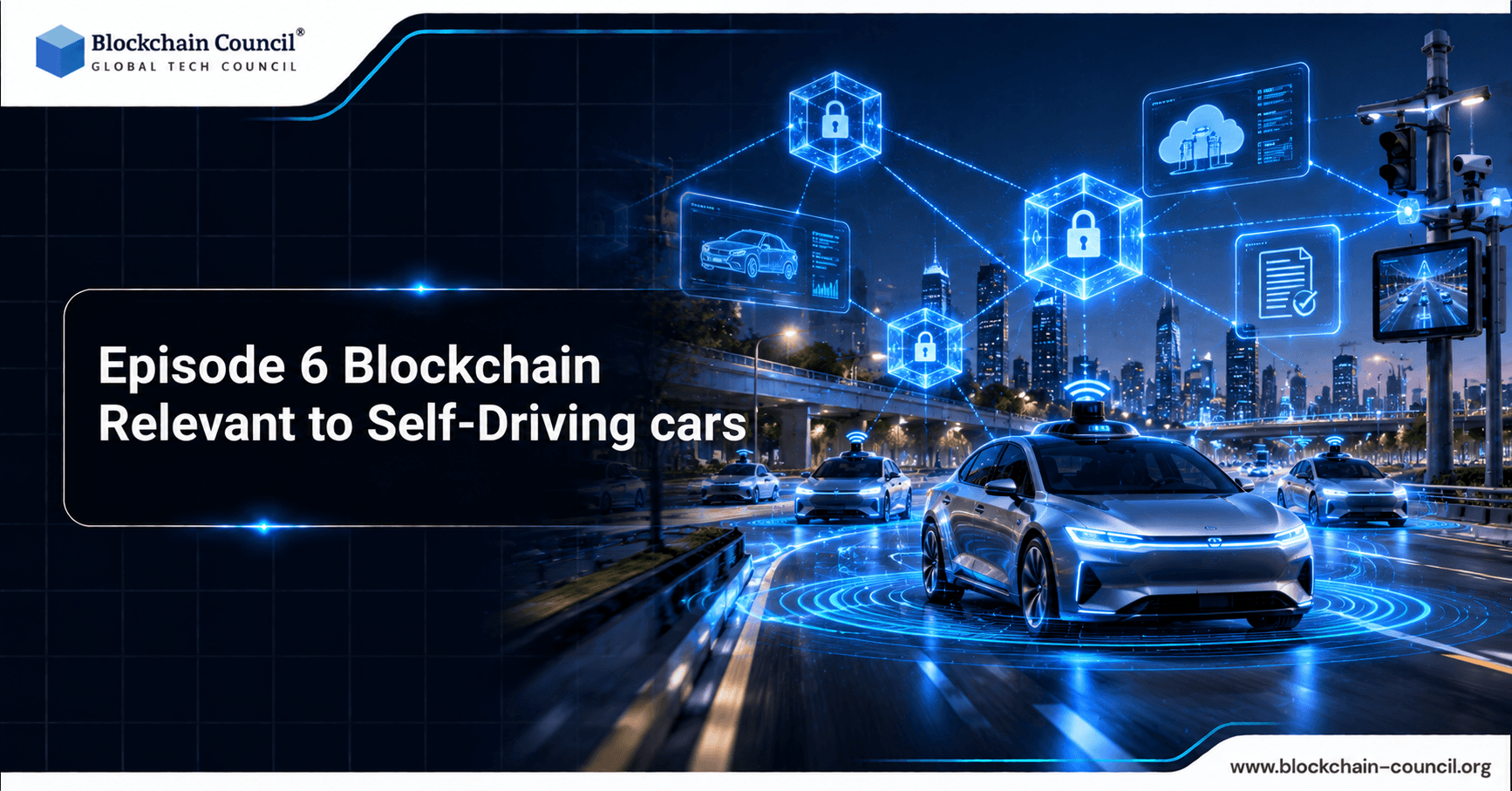
Self-driving cars create and depend on huge amounts of data. They read sensors, talk to other vehicles, download software updates, and make split-second decisions. Every one of those steps needs trust. That is where Blockchain Relevant to Self-Driving cars becomes a serious topic. Blockchain is a shared digital record that is very hard to alter, so it can help vehicles, manufacturers, insurers, and cities trust the same data without relying on a single middleman. If you want to understand this field from the ground up, a credential like the Certified Blockchain Expert can give you the foundation to follow how these systems are designed.
This episode explains the topic in plain language. Beginners will get clear definitions, and professionals will find the technical context and the honest limits.

What Is Blockchain, and How Does It Connect to Self-Driving Cars?
A blockchain is a digital ledger copied across many computers. Once a record is added, changing it is extremely difficult, because the other copies would disagree. Smart contracts, which are small programs stored on the ledger, can then run automatically when set conditions are met.
A self-driving car, also called an autonomous vehicle, uses cameras, radar, sensors, and software to drive with little or no human input. It does not work alone. It is part of a connected system known as Vehicle-to-Everything communication, or V2X, where cars exchange information with other cars, traffic signals, roads, and cloud services.
Here is the link. Whenever many parties must share data and nobody fully trusts anybody else, a shared and tamper-resistant record helps. Cars, makers, repair shops, insurers, and governments all need to rely on the same facts. That is the core idea behind Blockchain Relevant to Self-Driving cars.
Why Blockchain Relevant to Self-Driving cars Matters Today
Modern vehicles are software platforms on wheels. A single flaw in code, or a fake message from an attacker, can affect safety. Researchers who study autonomous vehicle security have shown how connected cars can be attacked, which is why trust in data and software is now a safety issue and not only an IT concern.
Blockchain does not drive the car. It protects the information around the car. Studies of this area point to several benefits: shared storage, stronger security, better coordination between vehicles, and support for related industries such as insurance and payments.
Building these systems takes real engineering skill. Developers who want to write secure smart contracts for mobility projects can learn the practical side through the Certified Blockchain Developer program, which focuses on building and testing blockchain applications.
Five Ways Blockchain Supports Self-Driving Cars
1. Trusted Data Sharing Between Vehicles
Cars on the road can warn each other about hazards, traffic jams, and weather. The question is whether a car can trust a warning from a stranger. Research on vehicle-to-blockchain designs describes using a ledger to record and validate shared data, keep an accurate timestamp, and make records hard to alter.
For example, if a car reports black ice, the network can store that report with proof of where it came from. Other vehicles can weigh it against other reports instead of accepting it blindly. This reduces the chance that a fake message causes real harm.
2. Safer Over-the-Air Software Updates
Autonomous vehicles receive frequent over-the-air updates for everything from entertainment features to braking and driving software. A fake or tampered update could be dangerous.
Research proposes a model where manufacturers and approved suppliers appear on the ledger with verifiable keys. Before installing anything, the vehicle checks the ledger to confirm that the sender is authorized and that the update matches the registered, unrevoked version. If anything does not match, the car rejects it. Think of it as a digital seal that the car inspects before it opens the package.
3. A Digital Identity for Every Vehicle
Every car has a history: where it was built, who owned it, how far it has driven, and what repairs it has had. Today that information sits in separate databases, and paper records can be lost or faked.
The Mobility Open Blockchain Initiative, known as MOBI, is a nonprofit group formed by automakers, suppliers, and technology firms to work on this. Members have included BMW, Ford, General Motors, Renault, and Honda. In 2019, MOBI released a first standard for a blockchain-based vehicle identity, often described as a passport for a car. It is built around a vehicle's creation record and is designed to grow into ownership history and key life events. MOBI also uses W3C standards for decentralized identifiers, which give each vehicle a unique and verifiable identity.
Professionals who want to see how this fits into wider technology strategy, including cloud, AI, and data, often add a general Tech Certification to their blockchain knowledge. That broader view matters because a vehicle identity system only works when it connects well to the other systems around it.
4. Fairer Insurance and Faster Claims
Who is responsible when a self-driving car is in an accident? The owner, the maker, or the software provider? Clear, trusted data makes that question easier to answer.
Research and patent filings describe blockchain records that store insurance policies and verified vehicle data. Smart contracts could then handle usage-based insurance, adjusting premiums using verified driving data and rewarding safe behavior. After an incident, stored data could help confirm what happened and speed up payouts. The same shared record can also help detect fraud, since the history is hard to change after the fact.
5. Automatic Payments and Vehicle Sharing
An autonomous vehicle may one day pay its own tolls, charge at a station, or pay for parking without a person touching a screen. Smart contracts can make those small payments automatic. In ride-sharing and car-sharing, blockchain can let people book, use, and pay for a vehicle with fewer middlemen.
MOBI's early project list included payments for autonomous machines and vehicles, data markets for both autonomous and human driving, and usage-based pricing for insurance, energy, and congestion. Most of this is still at the pilot and research stage, so treat it as a direction of travel and not as an everyday reality.
Challenges and Honest Limits
It would be misleading to say blockchain solves everything for self-driving cars. These are the main obstacles:
Speed: Large public blockchains process only a small number of transactions per second. A car cannot wait for a slow network to decide whether to brake. Real-time driving decisions must stay inside the vehicle. Blockchain is better suited to records, updates, identity, and payments, and researchers often favor faster permissioned networks for this reason.
Privacy: Driving data can reveal where people live, work, and travel. Putting it on a ledger that is hard to delete can clash with privacy laws such as GDPR. Designs usually keep personal data off-chain and store only proofs or fingerprints on-chain.
Standards: Different carmakers use different systems. Without shared rules, a vehicle identity from one brand may not work with another. This is exactly why groups like MOBI exist.
Cost and complexity: Adding a new technology layer takes money, testing, and skilled people.
Regulation: Laws for autonomous vehicles and digital records vary by country and keep changing.
Blockchain also does not fix bad sensor data. If a sensor reports something wrong, a ledger will faithfully record the wrong value. Good hardware and careful validation are still essential.
Where This Is Heading
Most of the work in Blockchain Relevant to Self-Driving cars is still in research, standards, and pilot projects. The most realistic near-term uses are vehicle identity, secure software updates, usage-based insurance, and battery and maintenance records. Fully automatic vehicle-to-vehicle commerce is further away.
New fields need people who can explain them clearly. Teams that build mobility technology still have to win trust from drivers, cities, and investors, and plain-language messaging makes a real difference. A Marketing Certification can help professionals present complex technology to the public in a way that builds confidence instead of confusion.
Conclusion
Self-driving cars need trust in their data, software, identity, and payments. That is why Blockchain Relevant to Self-Driving cars keeps appearing in research and industry groups. A shared, tamper-resistant record can support secure vehicle communication, trusted updates, digital vehicle identity, smarter insurance, and automatic payments. It cannot replace the car's onboard intelligence, and it faces real limits in speed, privacy, and standards. Used for the right jobs, it can make autonomous mobility safer and more transparent.
FAQs
1. How is blockchain relevant to self-driving cars?
Blockchain can provide a decentralized and tamper-resistant way to manage data and trust between connected and autonomous vehicles. It can support applications such as vehicle communication, data sharing, identity management, cybersecurity, and machine-to-machine transactions.
2. Can blockchain improve the security of self-driving cars?
Yes. Blockchain can help protect vehicle data and communications by providing tamper-resistant records and decentralized authentication mechanisms. Research has explored blockchain as a way to address security threats affecting connected and autonomous vehicles.
3. How can blockchain protect data from self-driving cars?
Autonomous vehicles generate large amounts of information from sensors, cameras, navigation systems, and vehicle-to-vehicle communication. Blockchain can help establish a trusted record of selected data and transactions, making unauthorized changes easier to detect.
4. Can blockchain help self-driving cars communicate with each other?
Blockchain can support trusted communication between vehicles by providing mechanisms for authentication, data integrity, and reputation management. This is particularly relevant to vehicle-to-vehicle and vehicle-to-infrastructure communication networks.
5. Can blockchain prevent hackers from attacking autonomous vehicles?
Blockchain cannot prevent every type of cyberattack. However, it can strengthen authentication, data integrity, and accountability, potentially making certain attacks more difficult and helping participants identify unauthorized or manipulated information.
6. What is MOBI?
MOBI is the Mobility Open Blockchain Initiative, a nonprofit consortium of automakers, suppliers, and technology companies. It works on standards for blockchain in mobility, including a vehicle identity standard released in 2019.
7. Can blockchain help self-driving cars share traffic information?
Yes. Vehicles could share selected information about road conditions, accidents, traffic, or other events through blockchain-supported systems. Research on blockchain-based Internet of Vehicles systems specifically examines trusted data sharing between vehicles and infrastructure.
8. Can blockchain improve trust between autonomous vehicles?
Blockchain can provide a shared record that participating vehicles and infrastructure can independently verify. This can reduce reliance on a single central authority when establishing trust among multiple participants.
9. Can self-driving cars use blockchain for payments?
Potentially, yes. Blockchain and smart contracts can support machine-to-machine transactions, allowing connected vehicles to interact with services such as tolling, charging, parking, or other digital services.
10. How can smart contracts be used with autonomous vehicles?
Smart contracts can automatically execute predefined rules when specified conditions are met. For example, a vehicle could potentially trigger an authorized payment after using a charging station or passing through a tolling system.
11. Can blockchain help with autonomous vehicle software updates?
Blockchain can provide a tamper-resistant record for software-update information and help verify the authenticity or integrity of update-related data. It should complement, rather than replace, established automotive cybersecurity and software-update mechanisms.
12. How can blockchain help prevent fake vehicle data?
Blockchain can make records tamper-resistant after they are added to the network, helping participants detect unauthorized changes. However, blockchain cannot automatically determine whether information entered into the system was truthful in the first place.
13. Can blockchain improve privacy in self-driving cars?
Blockchain-based architectures can incorporate privacy-preserving identity and data-sharing mechanisms. However, public or poorly designed blockchain systems can also create privacy risks, so sensitive vehicle and location information should not automatically be placed directly on a public ledger.
14. How can blockchain support vehicle-to-infrastructure communication?
Blockchain can provide a trusted layer for interactions between vehicles and infrastructure such as traffic systems, charging stations, tolling systems, and smart-city services. This can help with authentication, data integrity, and transaction management.
15. What role can blockchain play in autonomous vehicle cybersecurity?
Blockchain can support cybersecurity through decentralized authentication, tamper-resistant records, trusted data exchange, and accountability. Current research continues to investigate these applications because connected vehicles face security and privacy threats.
16. What are the challenges of using blockchain in self-driving cars?
Important challenges include scalability, latency, storage requirements, privacy, interoperability, energy consumption for some consensus mechanisms, and integration with existing automotive systems. Autonomous vehicles often require extremely fast responses, so blockchain operations must not interfere with safety-critical decisions.
17. Can blockchain process self-driving car data fast enough?
Blockchain is generally not suitable for processing every sensor reading or making immediate driving decisions. A more practical architecture can use edge computing or other low-latency systems for real-time processing while using blockchain selectively for trust, verification, identity, and important records.
18. Does a self-driving car need blockchain to operate?
No. Blockchain is not a fundamental requirement for autonomous driving. Self-driving systems primarily depend on sensors, computing, artificial intelligence, mapping, vehicle control systems, and communications, while blockchain can potentially provide additional infrastructure for security and trusted data exchange.
19. Is blockchain already widely used in self-driving cars?
Blockchain applications for autonomous and connected vehicles remain an active area of research and development. There are proposed architectures, academic studies, and experimental frameworks, but this does not mean blockchain is universally deployed in production self-driving vehicles.
20. What is the future of blockchain in self-driving cars?
Blockchain could become useful as part of a broader connected-mobility infrastructure for trusted data sharing, vehicle identity, cybersecurity, autonomous payments, and coordination between vehicles and smart-city systems. Its practical adoption will depend on solving latency, scalability, privacy, interoperability, and integration challenges.
Related Articles
View All
Blockchain
Beyond Cryptocurrency: How Blockchain Is Transforming Real-World Industries
Explore how blockchain works beyond cryptocurrency in banking, supply chains, healthcare, tokenisation, CBDCs, and government, plus key challenges and career paths.

Blockchain
Smart Contracts & dApps: How Blockchain Becomes Programmable
Learn how smart contracts and dApps make blockchain programmable, from Ethereum and tokens to DeFi, NFTs, real use cases, benefits, and key risks.

Blockchain
Behind the Blocks: How Blockchain Transactions Actually Work
Go behind the blocks to see how a blockchain transaction really works: wallets and keys, digital signatures, verification, hashing, blocks, consensus, proof of work vs proof of stake, and how miners and validators secure the network.
Trending Articles
AWS Career Roadmap
A step-by-step guide to building a successful career in Amazon Web Services cloud computing.
How to Install Claude Code
Learn how to install Claude Code on macOS, Linux, and Windows using the native installer, plus verification, authentication, and troubleshooting tips.
Blockchain in Supply Chain Provenance Tracking
Supply chains are under pressure to prove not just efficiency, but also authenticity, sustainability, and fairness. Customers want to know if their coffee really is fair trade, if the diamonds are con