

Data DAOs for AI Training
 Suyash Raizada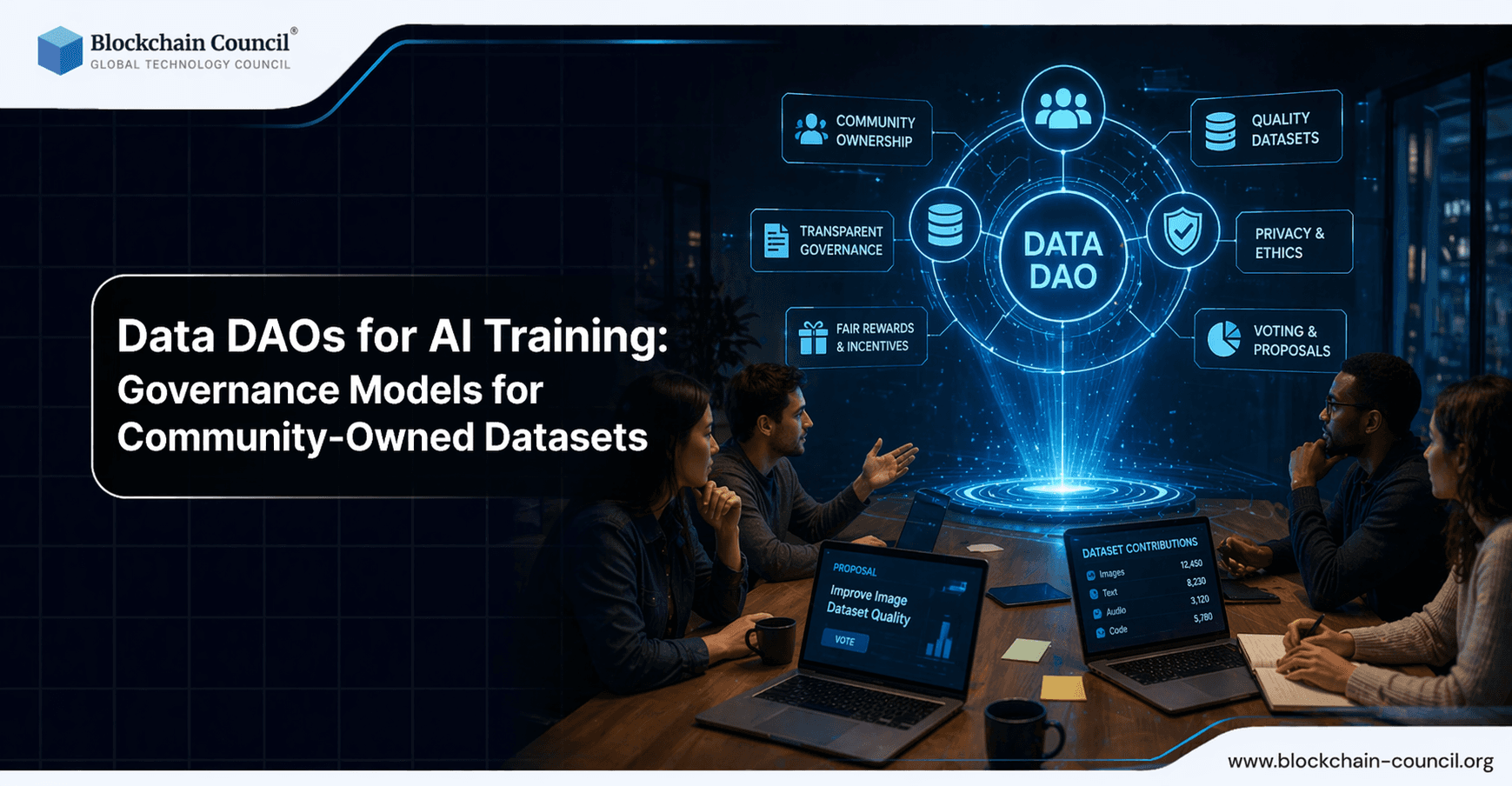
Data DAOs for AI training are emerging as a practical governance pattern for communities that want to collectively own, curate, and license datasets used to build machine learning and generative AI systems. AI data governance is no longer optional - it has become an operational requirement shaped by regulatory pressure and enterprise risk management. Frameworks such as the EU AI Act require organizations to prove data quality, representativeness, accuracy, and documentation for high-risk AI systems, while the NIST AI Risk Management Framework reinforces continuous risk controls across the AI lifecycle.
Understand how Data DAOs enable decentralized governance of AI training datasets through token incentives, voting mechanisms, and transparent ownership models by mastering AI security through an AI Security Certification, building data pipelines using a Python certification, and scaling decentralized ecosystems via an AI-powered marketing course.

This environment creates both a challenge and an opportunity. Centralized governance models dominate today, but community-owned datasets can meet the same standards if they adopt rigorous, auditable governance. Data DAOs provide on-chain decision-making, transparent incentives, and programmable enforcement that can align contributors, curators, and dataset consumers. Understanding Data DAOs for AI Training: Governance Models for Community-Owned Datasets shows how decentralized systems can enable transparent and fair AI training. These models ensure data ownership and collaborative governance in AI ecosystems. However, implementing such systems requires both technical and strategic expertise. The Claude Code Certification helps you build practical AI and workflow skills.
Data DAO in the Context of AI Training
A Data DAO is a decentralized autonomous organization designed to manage a dataset (or collection of datasets) as a shared resource. Instead of a single company controlling collection, labeling, access, and pricing, the community sets and enforces rules through blockchain-based governance.
In Data DAOs for AI training, the dataset is treated as an asset with the following properties:
Ownership: represented through tokens, membership NFTs, or stake-based rights.
Governance: proposals and voting to define quality standards, licensing terms, and acceptable use.
Auditability: immutable records for provenance, approvals, and access events.
Monetization: revenue sharing to contributors and curators when the data is licensed for model training.
Many industry discussions continue to emphasize centralized AI data governance councils and embedded data stewardship roles. The same governance requirements can, however, be expressed in a DAO structure if roles, controls, and escalation paths are clearly defined.
Why Governance Matters More Now: Compliance and Runtime Evidence
AI governance has shifted from static policy documents to runtime evidence. Enterprises increasingly need to demonstrate that training data and model behavior meet requirements continuously, not only at design time. Several trends reinforce this shift:
Compliance pressure: Many organizations cite regulatory readiness as the primary barrier to AI adoption, with frameworks that demand documentation and risk controls throughout the data lifecycle.
Operational governance: Governance is being embedded directly into AI pipelines, with lineage tracking, automated guardrails, and monitoring spanning data collection through post-deployment validation.
Investment focus: A significant share of organizations now prioritize governance frameworks and semantic layers as core investments for AI analytics infrastructure.
For Data DAOs, community ownership alone is not sufficient. A dataset must also be governed like a product, with measurable quality, clear licensing, and controls for privacy, bias, and security.
Core Components of Data DAOs for AI Training
A robust Data DAO typically combines token governance, defined roles, and verifiable processes. The following components align most closely with modern AI governance requirements.
1) Dataset Charter and Policy Layer
The DAO should establish a dataset charter that defines:
Purpose: what the dataset is intended to train (for example, medical imaging classification or multilingual speech recognition).
Scope and exclusions: prohibited content and sensitive data categories.
Quality metrics: representativeness, label accuracy targets, duplication limits, and temporal freshness requirements.
Documentation requirements: dataset cards, labeling guidelines, collection methods, and known limitations.
This mirrors enterprise governance requirements for documentation, quality, and risk controls, expressed as DAO policies that can be updated through formal proposals.
2) Provenance, Lineage, and Licensing Verification
Generative AI has intensified scrutiny of training data sourcing, particularly web-scraped content with unclear licensing. A Data DAO should treat provenance as a first-class feature:
Provenance attestations: contributor declarations about source and rights.
Lineage records: transformation logs covering cleaning, augmentation, and labeling, ideally hashed and anchored on-chain.
Licensing registry: standardized licenses for training use, commercial use, redistribution, and derivative datasets.
This aligns with the broader shift toward lifecycle management and evidence-based governance, where governance bodies review dataset risk before models are trained.
3) Access Control and Usage Enforcement
Community-owned does not mean unrestricted. Data DAOs need access controls that satisfy privacy and security requirements:
Tiered access: public samples, researcher access, and commercial access tiers.
Purpose limitation: access granted only for approved use cases.
Auditable access logs: on-chain approvals paired with off-chain secure storage controls.
Revocation mechanisms: ability to pause access or revoke keys if misuse is detected.
In practice, this is typically implemented as a hybrid architecture: sensitive data remains off-chain in secure storage, while governance decisions and cryptographic proofs are recorded on-chain.
4) Incentives for Quality, Not Just Volume
Token incentives can easily drift toward rewarding more data rather than better data. Modern AI governance emphasizes quality, representativeness, and continuous monitoring, so Data DAOs should reward outcomes such as:
Validated contributions: rewards issued after passing automated and human review.
Bias and representativeness improvements: bounties for filling documented gaps in the dataset.
Ongoing maintenance: rewards for refreshing time-sensitive data and correcting labels.
Automated quality assessments embedded in pipelines, combined with curator review, reflect the industry trend toward real-time guardrails and scalable governance.
Governance Models: From Token Voting to Hybrid Councils
DAO governance is often associated with token-weighted voting, but AI dataset governance has unique constraints: regulatory expectations, safety risks, and the need for specialized expertise. As a result, hybrid governance is increasingly practical for Data DAOs.
Model A: Token-Weighted Governance (Simple DAO)
How it works: token holders vote on proposals covering dataset inclusion rules, licensing terms, and budget decisions.
Pros: straightforward structure, transparent incentives, and rapid bootstrapping of community participation.
Cons: vulnerable to whale influence, may underweight specialized expertise, and can be slow for urgent safety or compliance actions.
Model B: Role-Based Governance with Delegated Voting
How it works: token holders delegate voting power to expert stewards such as privacy stewards, domain reviewers, and labeling leads. Proposals can be filtered through domain-specific committees.
Pros: reduces bottlenecks while maintaining accountability, and aligns with enterprise patterns of distributed responsibility including stewards, architects, and governance councils.
Cons: requires careful transparency to prevent capture by a small group of delegates.
Model C: Hybrid DAO with a Standards Council and Emergency Controls
How it works: the community votes on strategy and standards, while a council enforces baseline requirements and can trigger emergency pauses. Decisions and justifications are logged for auditability.
Pros: aligns with the move toward runtime oversight and escalation paths for autonomous systems, and supports compliance-driven controls without abandoning community ownership.
Cons: council authority must be clearly bounded to maintain community legitimacy.
How Data DAOs Can Meet AI Governance Requirements in Practice
To function in regulated or high-stakes environments, Data DAOs should operationalize governance across the full AI data lifecycle:
Pre-training: automated checks for quality, duplication, PII leakage risk, licensing completeness, and representativeness gaps.
In-training: monitor training runs for data memorization risk signals, distribution drift, and anomalous sampling behavior where applicable.
Post-deployment: track model outcomes and feed issues back into dataset updates, including removals or re-labeling decisions.
This lifecycle approach mirrors how enterprises embed governance into pipelines using lineage tools, data catalogs, and continuous validation.
Challenges and Design Considerations
Provenance at scale: documenting sources and transformations for large, diverse datasets remains difficult, particularly for unstructured content.
Privacy and sensitive data: community contributions increase the risk of inadvertent sensitive data inclusion, requiring robust screening and incident response procedures.
Bias and representativeness: token voting alone cannot guarantee fairness; DAOs need measurable targets and specialist review processes.
Legal enforceability: licensing terms must translate into enforceable agreements for commercial model training and redistribution scenarios.
Skills and Learning Path for Building Governed Data DAOs
Implementing Data DAOs for AI training spans blockchain governance, security, AI data governance, and compliance. For teams building in this area, relevant learning paths include:
DAO design and token governance, including Web3 governance frameworks.
Blockchain security and smart contract auditing principles.
AI governance, risk, and compliance concepts covering responsible AI foundations.
Data management fundamentals for AI pipelines and analytics infrastructure.
This combination reflects where the field is heading: governance expertise must connect technical controls with audit-ready evidence that satisfies both regulatory and enterprise requirements.
Build community-owned AI datasets with governance frameworks and secure data sharing protocols by gaining expertise through an AI Security Certification, developing DAO infrastructure using a Node JS Course, and promoting Web3 data platforms using a Digital marketing course.
Conclusion: Data DAOs as an Auditable Path to Community-Owned AI Datasets
AI data governance has become a foundational requirement for trust, compliance, and scalable deployment. Although most organizations still rely on centralized councils and stewardship models, Data DAOs for AI training offer an alternative that preserves community ownership while meeting modern governance expectations. The most viable approach is typically hybrid: token-based participation paired with documented standards, expert delegation, automated quality checks, and clear escalation paths.
For teams exploring community-owned datasets, the benchmark is no longer decentralization alone. It is whether the dataset can demonstrate provenance, licensing, quality, and risk controls across the full lifecycle, backed by transparent decision-making that can withstand regulatory and enterprise scrutiny.
FAQs
1. What are Data DAOs in AI training?
Data DAOs are decentralized organizations that manage datasets collectively using blockchain governance. Members contribute, curate, and control how data is used for AI training. This ensures shared ownership and transparency.
2. Why are Data DAOs important for AI development?
They address issues like data ownership, privacy, and fairness in AI systems. By decentralizing control, they reduce reliance on centralized data providers. This leads to more ethical and diverse datasets.
3. How do Data DAOs work?
Data DAOs operate through smart contracts and token-based governance. Members vote on decisions such as data usage, access permissions, and revenue sharing. This creates a transparent and automated system.
4. What is community-owned data in AI?
Community-owned data refers to datasets contributed and governed by a group rather than a single entity. Contributors retain partial ownership and decision rights. This model promotes fairness and accountability.
5. How do Data DAOs ensure data quality?
They use community validation, reputation systems, and incentives to maintain data standards. Contributors are rewarded for accurate and useful data. Poor-quality submissions can be flagged or rejected.
6. What are governance models in Data DAOs?
Governance models define how decisions are made within the DAO. Common approaches include token-weighted voting, quadratic voting, and delegated governance. These models balance influence and participation.
7. What is token-based governance in Data DAOs?
Token-based governance allows members to vote based on the number of tokens they hold. Tokens often represent ownership or contribution. This system aligns incentives with decision-making power.
8. How do Data DAOs handle data privacy?
They use encryption, access controls, and privacy-preserving techniques like differential privacy. Sensitive data can be restricted or anonymized. Governance rules ensure compliance with privacy standards.
9. Can Data DAOs be used for AI training datasets?
Yes, they are designed to create and manage datasets for AI models. Contributors supply diverse data, improving model performance. Governance ensures ethical and controlled usage.
10. What are the benefits of Data DAOs for contributors?
Contributors can earn rewards, retain ownership, and influence how their data is used. This creates a fairer data economy. It also encourages higher-quality contributions.
11. What challenges do Data DAOs face?
Challenges include scalability, regulatory uncertainty, and governance complexity. Ensuring consistent data quality can also be difficult. Adoption depends on user trust and technical maturity.
12. How do Data DAOs compare to traditional data platforms?
Unlike centralized platforms, Data DAOs distribute control among members. They offer greater transparency and shared incentives. However, they may be slower in decision-making.
13. What is quadratic voting in Data DAO governance?
Quadratic voting allows users to allocate votes based on preference intensity rather than token quantity alone. It reduces the dominance of large token holders. This creates more balanced decision-making.
14. How do Data DAOs incentivize participation?
They offer tokens, rewards, or revenue sharing for contributions and governance participation. Incentives align user interests with DAO goals. Active members benefit the most.
15. Are Data DAOs secure for managing datasets?
Security depends on smart contract design and governance practices. Proper audits and safeguards reduce risks. However, vulnerabilities can still exist if systems are poorly implemented.
16. What role do smart contracts play in Data DAOs?
Smart contracts automate governance rules, payments, and data access. They ensure transparency and reduce manual intervention. This makes operations more efficient and trustless.
17. Can businesses use Data DAOs for AI training?
Yes, businesses can collaborate with Data DAOs to access diverse and ethically sourced data. This improves AI model performance. It also supports decentralized data ecosystems.
18. How do Data DAOs support ethical AI?
They promote transparency, consent, and fair compensation for data contributors. Governance models ensure responsible data usage. This reduces bias and improves trust in AI systems.
19. What are examples of Data DAO use cases?
Use cases include healthcare data sharing, autonomous vehicle training, and language model datasets. These applications benefit from diverse and community-managed data. They improve AI accuracy and fairness.
20. What is the future of Data DAOs in AI training?
Data DAOs are expected to grow as demand for ethical and decentralized data increases. Governance models will become more refined. They may play a key role in the next generation of AI development.
Related Articles
View All
Blockchain
Zero-Knowledge Proofs for Tax Compliance: Verifying Taxpayer Information Without Exposing Sensitive Data
Zero-Knowledge Proofs (ZKPs) could make tax compliance more privacy-preserving by allowing taxpayers to prove specific claims, such as income falling within a required range or eligibility for a deduction, without exposing an entire tax return. MIT’s zkTax prototype demonstrates this approach using digitally signed tax records, selective disclosure, and independently verifiable proofs. Such systems could reduce unnecessary exposure of sensitive financial and personal information while preserving auditability and verification.

Blockchain
Stakeholder Management in Web3: Aligning DAOs, Developers, Token Holders, and Investors
Learn how stakeholder management in Web3 aligns developers, token holders, DAOs, and investors through better governance, incentives, and legal design.

Blockchain
Why Blockchain Is the Future of Digital Trust, Finance, and Data Security
Blockchain is becoming core infrastructure for digital trust, finance, and data security through shared ledgers, stablecoins, smart contracts, and verifiable records.
Trending Articles
The Role of Blockchain in Ethical AI Development
How blockchain technology is being used to promote transparency and accountability in artificial intelligence systems.
Blockchain in Supply Chain Provenance Tracking
Supply chains are under pressure to prove not just efficiency, but also authenticity, sustainability, and fairness. Customers want to know if their coffee really is fair trade, if the diamonds are con
How to Create Claude Skills?
Claude Skills are one of the most important features Anthropic has introduced for users who want automation that is structured, consistent and reusable. Instead of giving Claude long instructions ever