

How to Write a PRD for Blockchain Products: Key Sections, Examples, and Best Practices
 Suyash Raizada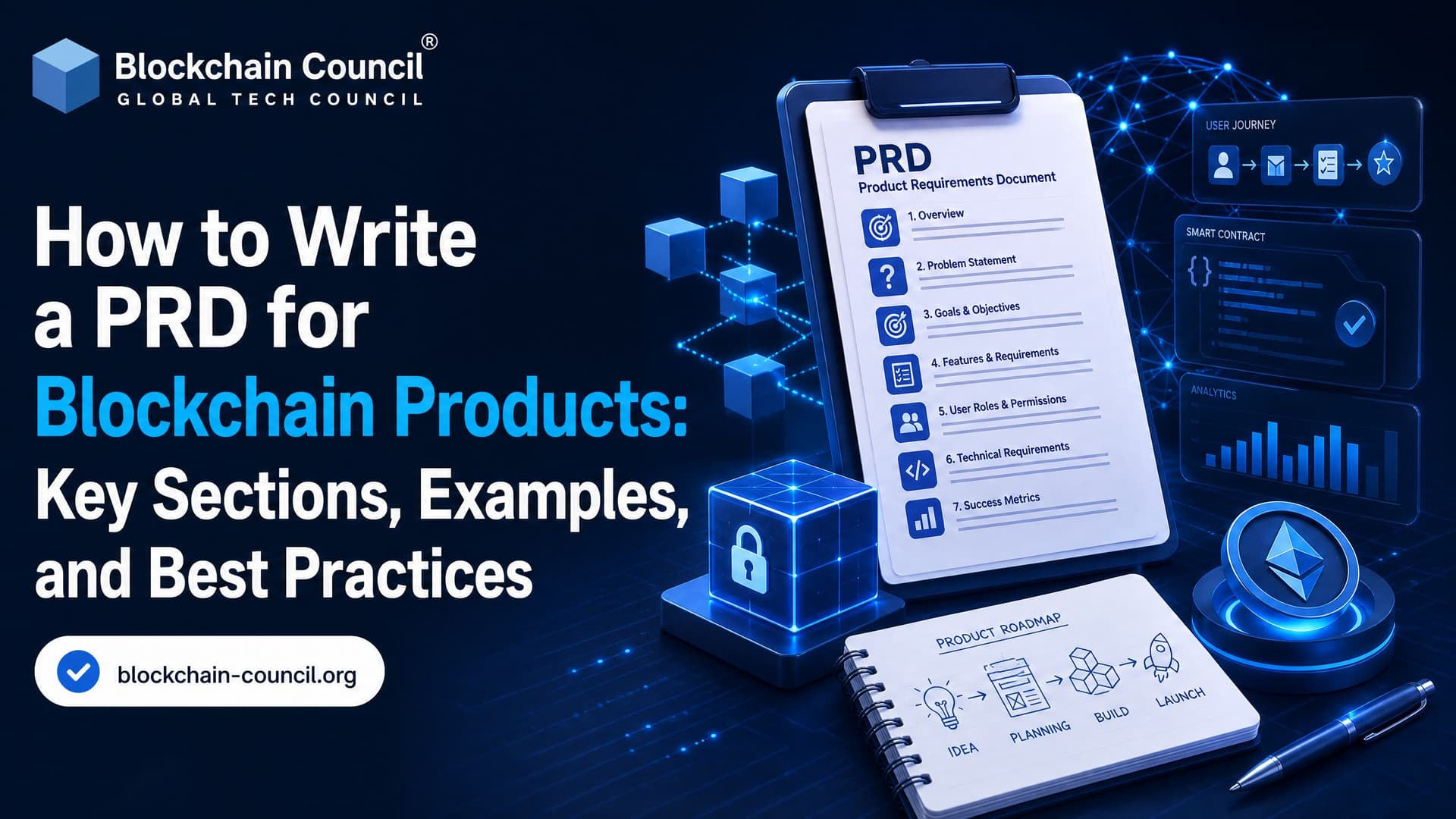
A PRD for blockchain products has to do two jobs at once: explain the product like any serious product requirements document, then define the parts that only exist because you are building on blockchain. So your PRD should cover the problem, users, scope, features, and success metrics, plus on-chain architecture, smart contracts, tokenomics, governance, security, and compliance.
If your PRD only says "build a decentralized marketplace," engineering will fill in the blanks. Legal will ask questions too late. Security will find risk after the architecture is already baked in. I have watched teams lose a week over one missing line: whether a fee was calculated off-chain in the API or inside the smart contract. Write it down early.

What Is a PRD for Blockchain Products?
A product requirements document, or PRD, aligns product managers, developers, designers, legal teams, auditors, and stakeholders around what is being built and why. Modern PRD guidance from teams such as Atlassian and Product School treats the PRD as a living document, not a static spec dumped into a folder and forgotten.
For blockchain products, the PRD carries extra weight. Your product may include irreversible transactions, public smart contracts, real user funds, token incentives, DAO voting, and jurisdiction-specific compliance rules. A normal SaaS PRD is not enough.
A good blockchain PRD answers one blunt question near the top: why does this need blockchain at all? If a centralized database gives users the same result at lower cost and with fewer risks, say so, and do not force blockchain into the design.
Core Sections Every Blockchain PRD Needs
1. Title, Owner, Stakeholders, and Version History
Start with the boring details. They prevent real confusion.
Title: Decentralized Lending Protocol v1 PRD
Owner: Product Lead, DeFi
Stakeholders: Engineering, security, legal, risk, DAO treasury, support
Status: Draft, review, approved, frozen for build
Version history: v0.4 added liquidation flow and oracle dependency
Blockchain teams should also track protocol versioning, target chain, and fork decisions. If you deploy on Ethereum mainnet, note that chain ID 1 is the production network. If you test on Sepolia, state that too. Small details stop expensive deployment mistakes.
2. Problem Statement and Blockchain Justification
This is the most important part of the PRD. Do not start with features. Start with the pain.
Weak example: Users need a Web3 wallet rewards platform.
Better example: Independent creators cannot reliably track secondary sales across marketplaces, which makes royalty enforcement opaque and inconsistent. A blockchain-based product can expose ownership history and sale events through public smart contract records.
Your blockchain justification should name the specific advantage: transparency, composability, shared settlement, censorship resistance, auditability, or multi-party coordination. If the reason is only "users like crypto," keep researching.
3. Target Users, Personas, and Non-Users
Never write "all crypto users." That phrase hides product risk.
Separate users by behavior and responsibility:
End users: borrowers, collectors, traders, creators, students, enterprise operators
On-chain actors: validators, liquidity providers, stakers, DAO voters
Off-chain stakeholders: auditors, regulators, support teams, integration partners
Non-target users: unsupported regions, high-frequency traders, minors, anonymous institutional users
For teams building foundational expertise, Blockchain Council's Certified Blockchain Expert and Certified Blockchain Developer programs make sense as internal learning links here, especially for product managers working closely with engineering.
4. Product Overview and Scope
Your overview explains what you are building. The scope section protects the team from building everything.
Use a simple IN/OUT table inside the PRD:
In scope: Wallet connection, token minting, listing, purchase, royalty payout, admin dashboard
Out of scope: Cross-chain bridging, fiat payments, leverage trading, mobile app, DAO voting in v1
For blockchain products, also mark what lives on-chain and what stays off-chain. Search, recommendations, image moderation, and analytics usually belong off-chain. Ownership transfer, escrow, staking, and fee settlement may belong on-chain. Be explicit.
Blockchain-Specific PRD Sections
5. On-Chain Architecture
This section tells engineers, auditors, and product reviewers how the protocol behaves on-chain. Keep it readable, but do not let it drift into vague.
Include:
Target chain or chains, such as Ethereum, Polygon, Arbitrum, or a permissioned network
Smart contracts and their responsibilities
Token standards, such as ERC-20, ERC-721, or ERC-1155
State transitions, such as listed, sold, withdrawn, liquidated, or challenged
Events emitted for indexers and analytics
Upgrade model, including proxy pattern or immutable contracts
A practical note: in Solidity 0.8.x, arithmetic overflow and underflow revert by default. Older tutorials often sprinkle SafeMath everywhere, but it is not required for basic overflow protection in Solidity 0.8 and later. That kind of version detail belongs in a serious PRD or technical appendix.
6. Off-Chain Services and Integrations
Most blockchain products are not fully on-chain. The PRD should describe APIs, indexers, wallets, dashboards, notifications, databases, analytics, customer support tools, and compliance systems.
Take an NFT marketplace. It may use ERC-721 contracts for ownership, IPFS or Arweave for media references, a backend indexer for fast search, and MetaMask for wallet signing. If the indexer lags, the UI may show stale ownership even though the chain is correct. Write the expected behavior.
7. User Stories and Transaction Flows
User stories should include blockchain states, not just screen states.
Example story: As a creator, I can mint an NFT, sign the transaction in my wallet, wait for confirmation, and see the asset listed in my dashboard after the indexing service reads the emitted Transfer event.
Add acceptance criteria:
User sees estimated gas before confirming
Transaction uses EIP-1559 fee fields where supported
UI shows pending, confirmed, and failed states
If the wallet rejects the transaction, no listing is created
If indexing fails, the app retries and shows a clear message
Include real error states. In Hardhat, a common build-time issue is HH700: Artifact for contract "X" not found, usually caused by a mismatch between the contract name and the deployment script. You do not need every developer error in the PRD, but you should document deployment dependencies and release checks.
8. Functional Requirements
Prioritize requirements as P0, P1, and P2.
P0: Required for launch. Deposit collateral, borrow asset, repay loan, liquidate unsafe position.
P1: Important soon after launch. Portfolio export, advanced alerts, governance parameter dashboard.
P2: Useful later. Social profile, badges, referral campaigns.
Make requirements testable. "The protocol should be secure" is not testable. "Only addresses with the RISK_ADMIN role can update collateral factors, and every update emits a CollateralFactorUpdated event" is testable.
9. Non-Functional Requirements
Blockchain non-functional requirements need more than uptime.
Performance: confirmation target, API response time, indexer delay tolerance
Reliability: node provider failover, retry policy, alerting thresholds
Security: access control, key management, rate limits, audit scope
Interoperability: supported wallets, token standards, chain support
Decentralization: validator or signer assumptions, admin controls, upgrade limits
Be honest about trade-offs. A fully immutable contract may reduce governance abuse, but it can also make bug recovery impossible. For early products holding user funds, a time-locked upgrade path plus multi-signature control is often more practical than pretending immutability solves every risk.
10. Tokenomics, Fees, and Incentives
If your product has a token, the PRD needs an economic model. Do not bury it in a pitch deck.
Document:
Token purpose: utility, governance, collateral, rewards, or access
Supply model and distribution
Fee structure and who receives fees
Reward schedules and vesting
Slashing, penalties, or anti-abuse rules
Economic invariants, such as minimum collateral ratio
Many token designs fail because they reward activity without checking quality. Paying users for volume can attract wash trading. Rewarding liquidity without lockups can create mercenary capital that disappears the moment incentives end. Say what behavior the token should encourage, then define the safeguards.
11. Governance Model
If users or token holders can change protocol parameters, spell out the governance mechanics.
Who can submit proposals?
What voting power model is used?
What quorum is required?
Is there a time lock before execution?
Who can pause the protocol during an emergency?
How are disputes handled?
DAO governance is often overhyped for v1 products. To be blunt, if your community is small and the protocol is still changing weekly, a limited admin model with public transparency may be safer than fake decentralization.
12. Security, Audit Plan, and Incident Response
Smart contracts are publicly callable. Attackers do not need permission to test your assumptions.
Your PRD should name critical assets, trust boundaries, admin keys, oracle dependencies, and bridge dependencies. Include audit timing, internal review gates, bug bounty plans, and incident response steps.
For a lending product, the PRD should define what happens if an oracle stops updating or reports an abnormal price. For a marketplace, it should cover fake collections, compromised admin keys, metadata abuse, and phishing surfaces.
13. Compliance and Data Handling
Compliance is not an afterthought. If the product touches payments, identity, securities-like assets, or user data, the PRD should list target jurisdictions and restrictions.
KYC and AML requirements
Restricted regions
Data retention rules
Privacy obligations
Reporting and audit requirements
Disclosures shown before high-risk actions
Enterprise blockchain products need extra care here. A supply chain PRD may require role-based access, audit logs, data localization, and integration with ERP systems rather than open public access.
Example: Mini PRD Outline for an NFT Marketplace
Problem: Creators lack transparent royalty tracking across secondary sales.
Users: Digital artists, collectors, marketplace operators, curators.
Solution: ERC-721 minting, listing, bidding, purchase, royalty payout, creator dashboard.
On-chain: NFT contract, marketplace escrow contract, royalty event logs.
Off-chain: Media storage, moderation workflow, search index, analytics dashboard.
Out of scope: Cross-chain listings, fiat checkout, lending against NFTs.
Security: Contract audit, verified collections, admin key multi-signature wallet.
Metrics: Monthly active wallets, completed sales, creator revenue, failed transaction rate, royalty payout accuracy.
Success Metrics for Blockchain PRDs
Use metrics that cover adoption, protocol health, and risk. Product School and other PRD templates push for measurable outcomes because they keep PRDs from turning into wish lists.
User metrics: active wallets, retention, conversion, completed onboarding
Protocol metrics: total value locked, transaction volume, validator participation, governance turnout
Reliability metrics: failed transaction rate, indexer lag, API uptime
Risk metrics: security incidents, oracle failures, liquidation failures, compliance escalations
Set targets and timeframes. "Increase adoption" is weak. "Reach 10,000 monthly active wallets within 90 days of mainnet launch while keeping the failed transaction rate below 2 percent" gives the team a real goal.
Best Practices Before You Share the PRD
Keep the first page sharp. Include problem, users, scope, success metrics, status, and owner.
Separate facts from assumptions. Label assumptions about regulation, liquidity, chain fees, and partner integrations.
Review with security early. Every on-chain feature adds attack surface.
Use AI carefully. AI tools can draft structure, user stories, and checklists, but human experts must review cryptography, economics, and compliance.
Link learning resources. Product managers can pair this workflow with Blockchain Council's Certified Blockchain Architect, Certified Smart Contract Developer, or Certified DeFi Expert depending on the product type.
Final Checklist for Your Blockchain PRD
Problem is validated with evidence
Blockchain use is justified against centralized alternatives
Users, stakeholders, and non-users are clearly defined
On-chain and off-chain responsibilities are separated
Smart contracts, token standards, and events are listed
Tokenomics and governance are written in plain language
Security, audit, and incident response plans exist
Compliance and data handling rules are explicit
Scope in and scope out are visible
Success metrics cover adoption, protocol health, and risk
Your next step is simple. Take one blockchain product idea and draft only five sections first: problem, target users, proposed solution, scope, and success metrics. Once those hold up under review, add architecture, tokenomics, governance, security, and compliance. If you are preparing to lead or review these documents professionally, start with Blockchain Council's Certified Blockchain Expert or Certified Blockchain Developer and build a sample PRD alongside the course work.
Related Articles
View All
Blockchain
Roadmap Planning for Blockchain Products: Best Practices for Web3 Teams
Learn how Web3 teams can plan blockchain product roadmaps with security milestones, governance alignment, flexible timelines, and clear feedback loops.

Blockchain
How to Write Product Requirements Documents for Blockchain Products
Learn how to write PRDs for blockchain products with sections for smart contracts, tokenomics, security, compliance, metrics, and launch readiness.

Blockchain
Blockchain Wallets Explained: How They Work, Types, and Security Best Practices
Blockchain wallets manage keys, sign transactions, and secure digital assets. Learn wallet types, risks, best practices, and how to choose the right setup.
Trending Articles
The Role of Blockchain in Ethical AI Development
How blockchain technology is being used to promote transparency and accountability in artificial intelligence systems.
How Blockchain Secures AI Data
Understand how blockchain technology is being applied to protect the integrity and security of AI training data.

Can DeFi 2.0 Bridge the Gap Between Traditional and Decentralized Finance?
The next generation of DeFi protocols aims to connect traditional banking with decentralized finance ecosystems.