

Optimize Your Bitcoin Mining Rig for Maximum Efficiency
 Michael Willson
You want the lowest cost per bitcoin mined. The fastest way to get there is simple. Lower your joules per terahash, keep chips in a safe temperature range, feed the rig clean and stable power, cut stale shares, and run during cheaper electricity windows. Follow the playbook below and you will get more hash for every watt without risking your hardware.
If you are new to tuning and want a short primer on mining fundamentals before you start, the Crypto Certification offers a quick foundation in mining workflow, wallets, and risk control. It will help you read dashboards and pool stats with confidence.

What mining efficiency really means
Efficiency is how much energy you burn to produce work. In Bitcoin mining the key metric is J per TH. Lower is better. A rig at 25 J per TH beats one at 30 J per TH even if their headline hashrate looks similar. Track this over full days, not five minute spikes.
Targets to watch
- Average J per TH over 24 hours
- Inlet air temperature and outlet temperature delta
- Stale and rejected share rate
- Power factor and breaker headroom
Quick wins before deep tuning
Start with the simple fixes that remove waste without touching chip voltages.
- Clean dust, seal recirculation gaps, and straighten airflow paths
- Balance intake and exhaust so the case does not fight negative pressure
- Shorten power runs, use correct cable gauge, and verify tight connectors
- Add a failover pool and a wired Ethernet path to reduce share losses
Efficiency tuning map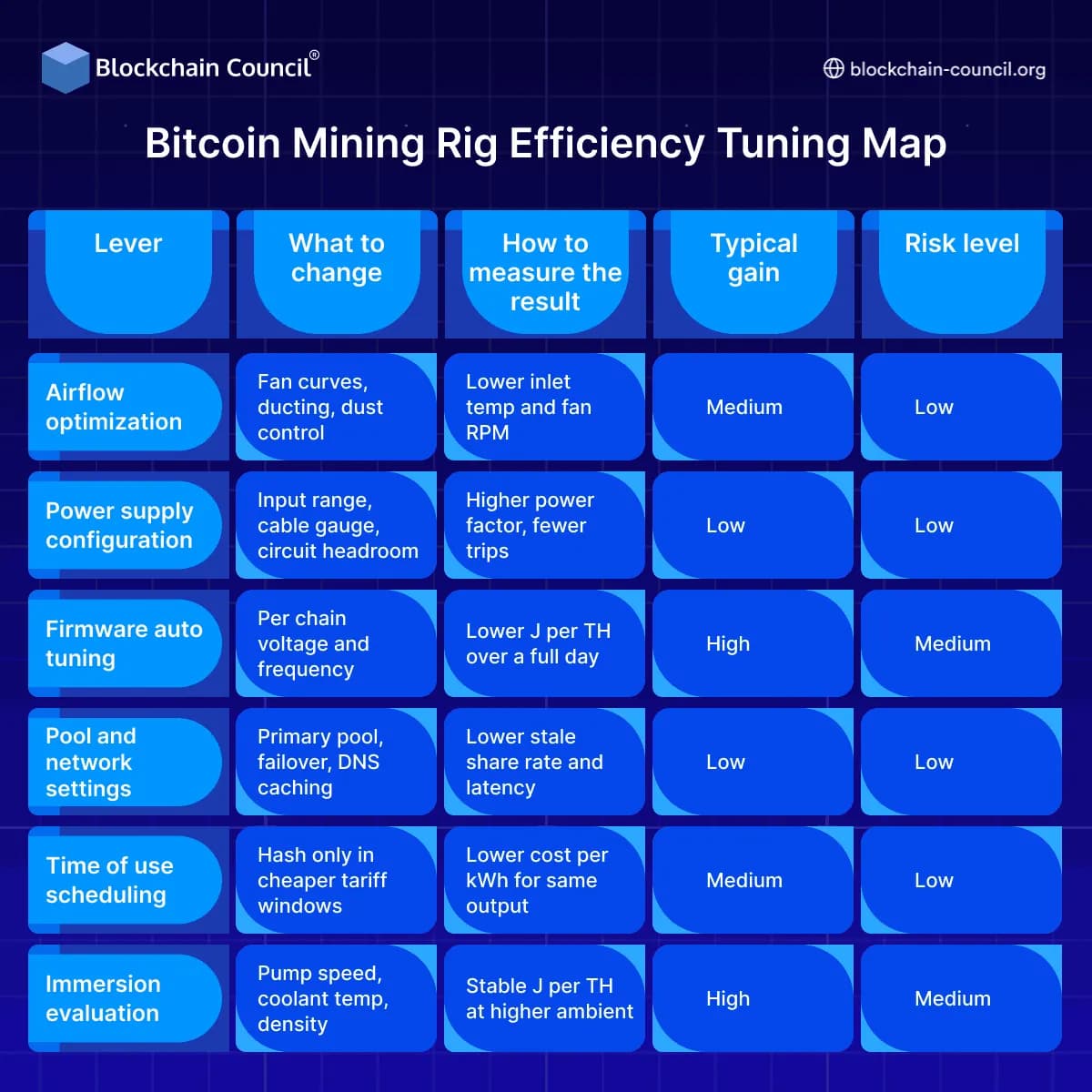
Use this map in order from top to bottom. Most sites see the biggest early wins from airflow and power basics, then firmware tuning, then schedules.
Power and electrical setup
Bad power wastes money and shortens component life. Measure voltage at the outlet while hashing. Keep PSUs in their optimal input range. Leave 15 to 20 percent headroom on each circuit. Aim for a power factor near 1.0 with quality PSUs and short runs.
Safe wiring checklist
- Correct breaker size for continuous load
- C13 or C19 cables rated for the current
- No warm plugs, no browning on connectors
- Smart PDU or meter to log amps and volts
Firmware and auto tuning
Modern ASICs allow per chain tuning. Use manufacturer firmware or a trusted alternative with hard temperature and amperage limits. Run three profiles for 24 hours each, record power and output, then pick the best performer.
Profile tips
- Start conservative, then step up if temps are stable
- Avoid settings that sit just below thermal throttle points
- Lock a profile only after a full day that includes warm afternoons
Thermal management that saves watts
Heat is wasted energy. Removing it efficiently is the cheapest path to lower J per TH.
- Keep intake paths straight and free from leaks
- Use filters you can clean often
- Match fan curves so the rig does not fight the room
- In hot climates, consider immersion for stable performance
If you plan to log temperature, fan RPM, and J per TH to prove gains over time, the Data Science Certification will help you build clean dashboards and simple models that catch problems early.
Cooling and energy options comparison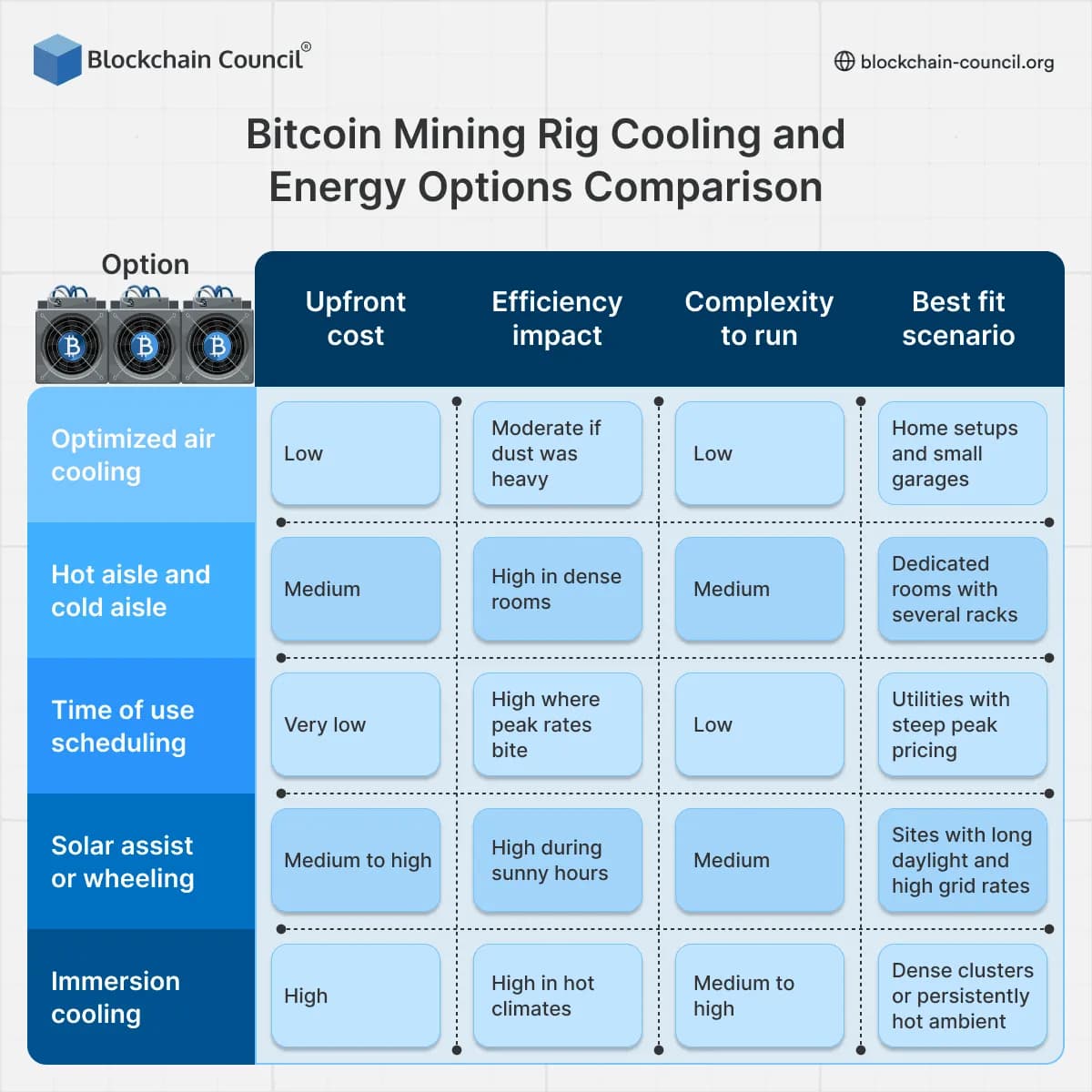
Pick the first option that fits your budget and climate. Many operators see the fastest payback from air path fixes and tariff scheduling before bigger investments.
Network and pool settings
Stale shares are paid work that never gets credited. Use wired Ethernet, keep cables short, and point DNS to your router. Set a secondary pool so your rigs do not sit idle during outages. Place pools by geography to lower latency.
Scheduling for cheaper energy
If your utility uses time bands, hash less during peak hours and more during off peak hours. Many controllers and PDUs can automate this with a simple schedule. If you have solar, align the highest profile with your production curve.
Maintenance that protects efficiency
Weekly
- Blow out dust with dry air, clean filters, check fan bearings
- Inspect plugs for heat marks, tighten any loose connections
- Export logs and review temps, watts, and errors
Monthly
- Check thermal paste if your model allows it
- Update firmware after reading release notes
- Test alarms by simulating a failed fan or hot inlet
Common mistakes that waste power
Chasing top hashrate
Headline TH looks good, but bills are paid in kWh. Tune for the lowest J per TH, not the biggest number on a screenshot.
Ignoring the room
If the room is hot, fan curves spike and erase gains. Fix the room first. Seal gaps, add make up air, and vent exhaust out of the space.
One pool only
A single pool means downtime during outages. Always set a failover. Lost minutes add up faster than you think.
Skipping little checks
Loose plugs and dusty filters raise resistance and heat. Five minutes with a flashlight each week can save real money.
Home rigs versus small farms
Home miners share power with appliances. Respect breaker limits, add a smart PDU, and schedule hashing while you sleep to avoid peak pricing. Small farms can use ducting, aisle layouts, and metered PDUs to balance rows. Both benefit from clear labels, simple SOPs, and consistent logs.
If you plan to scale from one rig to a small hosting business, the Marketing and Business Certification can help you build pricing, cost models, and a basic go to market plan that treats efficiency as a competitive edge.
Step by step playbook you can follow today
- Record a 24 hour baseline for watts, TH, inlet temp, and stale shares
- Clean intake paths and fix recirculation leaks
- Set conservative auto tune limits and test three profiles for full days
- Create an on off schedule that avoids peak utility windows
- Add a failover pool and confirm latency and stale rates are low
- Lock the best profile, label the rig, and write a short SOP
- Repeat the same steps on your next rig and compare results
FAQs
What is a good J per TH target
Lower is always better for your climate and power price. Compare your result to the same model running in similar ambient conditions, not to screenshots from colder sites.
Does under clocking cut profit
It can raise profit if the watt savings are larger than the lost TH. Only a full day test tells the truth.
When dos immersion make sense
When ambient is hot for many months, when you run many rigs in one room, or when noise limits force you to move a lot of air with fans.
How do I know if a pool is a good match
Look at latency, stale rates, fees, and payout method. Test for a week and keep the one that gives stable daily credit with low rejects.
Conclusion
Maximum efficiency is a process, not a single tweak. Fix airflow and power basics, tune firmware within safe limits, keep shares flowing with a stable network, and run during cheaper hours. Measure results over full days and change one lever at a time. Do this and your cost per bitcoin mined will fall, which is the only metric that really matters over time.
Related Articles
View All
Bitcoin
How to set Bitcoin Mining Rig
BTC Mining Setting up a Bitcoin mining rig may sound complex, but with the right steps and components, anyone can get started. If you’re looking to mine Bitcoin from home or want to scale into a larger setup, this guide walks you through everything clearly. From choosing hardware to configuring…

Bitcoin
How to Set Up a Bitcoin Mining Rig?
Setting up a Bitcoin mining setup might appear difficult initially, but with proper guidance, it’s completely manageable. Basics of Bitcoin Mining Explained Bitcoin mining involves verifying transactions on the Bitcoin blockchain. Miners utilize specific hardware to solve challenging…

Bitcoin
Bitcoin Minor Codes: Roblox Rewards, Not Bitcoin Mining
Bitcoin minor codes are Roblox Bitcoin Miner promo codes, not real Bitcoin tools. Learn what they do, how to redeem them, and how they differ from real mining.
Trending Articles

Top 5 DeFi Platforms
Explore the leading decentralized finance platforms and what makes each one unique in the evolving DeFi landscape.
How Blockchain Secures AI Data
Understand how blockchain technology is being applied to protect the integrity and security of AI training data.
What is AWS? A Beginner's Guide to Cloud Computing
Everything you need to know about Amazon Web Services, cloud computing fundamentals, and career opportunities.