

BTC Pizza Day: The Story Behind the 10,000 BTC Pizza Order
 Suyash Raizada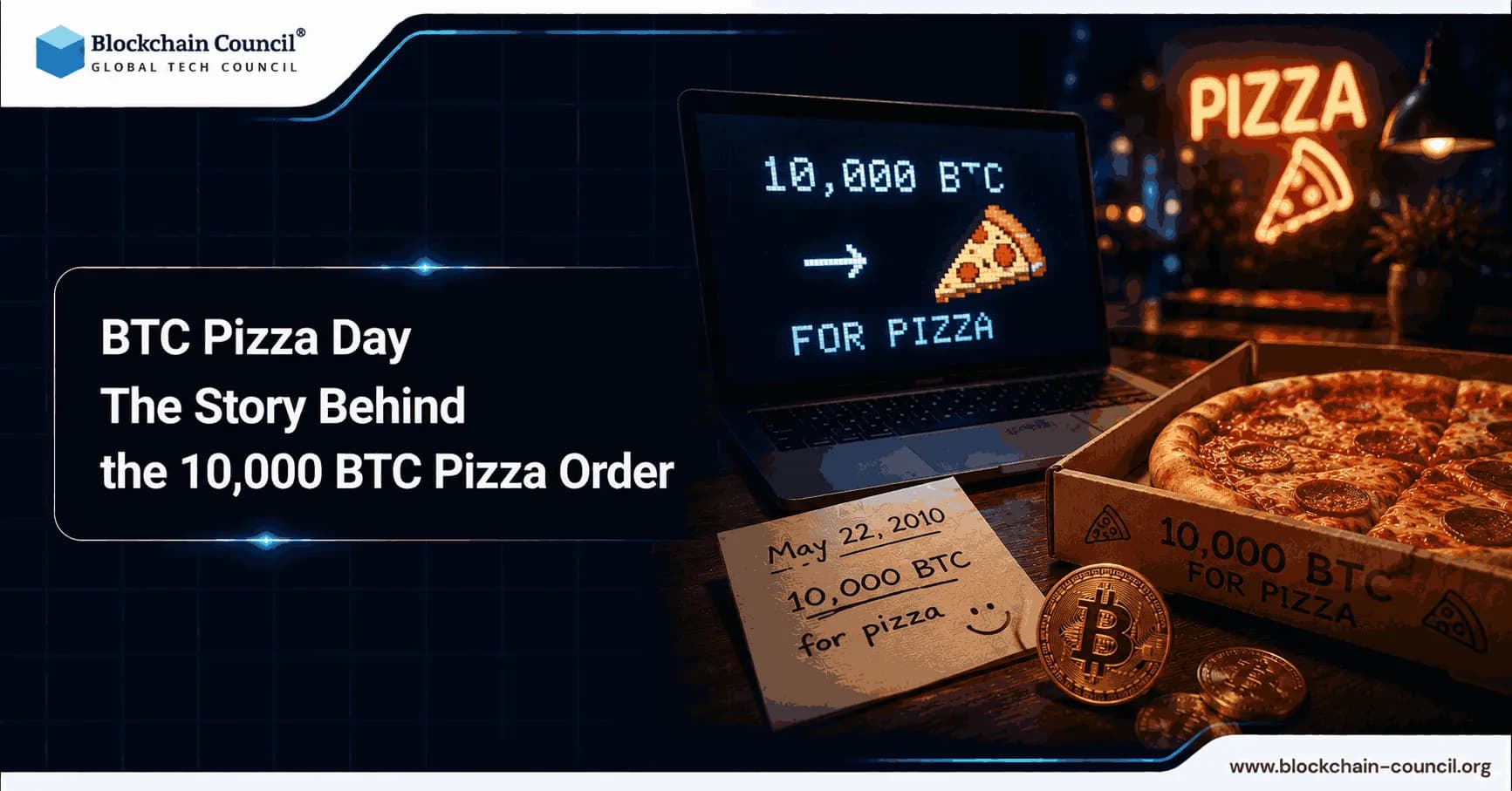
BTC Pizza Day is more than a crypto meme. Observed every year on May 22, it marks the first widely recognized real-world purchase made with Bitcoin: two pizzas bought for 10,000 BTC in 2010. What looked like a small forum experiment became a defining proof that Bitcoin could function as money, not just code.
Today, BTC Pizza Day is celebrated globally with meetups, educational sessions, and merchant promotions. It remains a useful lens for understanding Bitcoin's early history, its growth into a trillion-dollar asset class, and why real-world transactions matter in the evolution of financial technology.

What is BTC Pizza Day?
BTC Pizza Day commemorates the first documented commercial transaction using Bitcoin. On May 22, 2010, Laszlo Hanyecz, a Florida-based programmer, posted on the Bitcointalk forum offering 10,000 BTC to anyone who would order and deliver two pizzas to him.
A user identified by the online handle "jercos" - later reported to be Jeremy Sturdivant - accepted the offer, arranged for two large Papa John's pizzas to be delivered in Jacksonville, Florida, and received 10,000 BTC in exchange. At the time, the pizzas cost approximately $41, implying a BTC price of roughly $0.0041. Learn the story behind Bitcoin Pizza Day and how the famous 10,000 BTC transaction became one of the most iconic moments in cryptocurrency history by building expertise through a Cryptocurrency Expert, analyzing Bitcoin transaction history and blockchain data using a Python certification, and growing crypto-focused communities with a Digital marketing course.
The 10,000 BTC Pizza Order: Why It Mattered
In 2010, Bitcoin was still an emerging project used by a small, technical community. There was no mainstream market infrastructure, limited liquidity, and few ways to translate BTC into everyday utility. The 10,000 BTC pizza order mattered because it:
Proved Bitcoin could be used as a medium of exchange, not just held or mined.
Created a price reference based on a real consumer good, not speculation alone.
Demonstrated peer-to-peer commerce without banks or card networks, aligning with Bitcoin's original design goals.
Hanyecz reportedly continued making similar offers for several weeks. May 22 became the symbolic milestone because it represents the first clean, widely cited example of Bitcoin being used to buy something tangible.
From $41 to Over $1 Billion: The Numbers Behind BTC Pizza Day
BTC Pizza Day is frequently revisited because the price comparison is so striking. The same 10,000 BTC that bought two pizzas in 2010 later became worth hundreds of millions, then exceeded a billion dollars during peak price periods.
Key Stats to Remember
May 22, 2010: 10,000 BTC approximately equal to $41 (about $0.0041 per BTC).
2024 estimates: At roughly $71,000 per BTC, the same 10,000 BTC would have been worth approximately $710 million.
May 2025 milestone: With Bitcoin reaching all-time highs near $109,450, 10,000 BTC would be worth approximately $1.09 billion.
Peak comparisons: At price levels near $110,000 to $120,000, the value exceeded $1.2 billion.
The move from approximately $0.0041 to over $110,000 per coin represents appreciation on the order of tens of millions of times. Even simple comparisons illustrate the magnitude of Bitcoin's rise over that period.
Is BTC Pizza Day Just a Meme?
It is easy to treat BTC Pizza Day as a humorous reminder of the most expensive pizza ever purchased. The deeper value, however, is educational. It captures how a new monetary network bootstraps itself:
Early adopters test utility through low-stakes experiments.
Community coordination on forums and developer channels establishes norms.
Price discovery emerges through repeated exchanges, not official declarations.
This is also why Hanyecz has often said he does not regret the trade. By most accounts, he viewed it as a successful proof-of-concept at a time when Bitcoin had little established value. Without transactions like this, Bitcoin's credibility as usable money would have taken longer to develop.
How Bitcoin Evolved Since the Pizza Purchase
BTC Pizza Day highlights the shift in Bitcoin's narrative - from "digital cash" toward "store of value." Both frameworks exist within the community, but market emphasis has changed considerably over time.
From Experimental Payments to Global Infrastructure
In 2010, buying pizza with Bitcoin required a motivated counterparty and manual coordination. By the mid-2020s, Bitcoin payments could be routed through payment processors and Layer-2 networks that abstract complexity away from the end user.
Merchant acceptance is now commonly enabled by:
Payment processors such as BitPay, which help merchants accept BTC while managing volatility exposure.
Lightning Network-enabled applications such as Strike, designed for faster, lower-fee payments.
BTC Pizza Day also arrives in a more institutionally mature era. The mid-2020s brought significant regulatory and market structure developments, including spot Bitcoin ETF approvals in the United States and the European Union's MiCA framework for crypto-asset regulation. These milestones reflect a market that has grown far beyond hobbyist forums.
How BTC Pizza Day is Celebrated Today
Bitcoin Pizza Day remains a global crypto community staple. Celebrations range from casual pizza meetups to formal educational events hosted by local communities, online groups, and industry organizations. Cities including Milan and Catania have hosted Pizza Day gatherings in recent years.
Typical BTC Pizza Day activities include:
Meetups and community dinners focused on Bitcoin education and networking.
Merchant promotions where participants pay with BTC or Lightning for food and merchandise.
Online retrospectives analyzing adoption trends, price evolution, and technology upgrades.
Lessons Professionals Can Take from BTC Pizza Day
For professionals working in finance, technology, or compliance, BTC Pizza Day offers practical insights into adoption, incentives, and product design.
1) Utility Drives Adoption
People adopt new technology faster when they can use it for something familiar. Pizza became the simplest possible demonstration of real-world utility for a digital asset that had previously existed only as code and speculation.
2) Price is a Story, Not Just a Number
The pizza trade is often cited to illustrate opportunity cost, but it also reflects early-stage uncertainty. In emerging technologies, early transactions are rarely optimal in hindsight. They are experiments that make later growth possible.
3) Payments Infrastructure Matters
Bitcoin's early limitation was not only price volatility. It was user experience. Modern wallets, payment processors, and Layer-2 solutions exist because usability is essential for scale.
4) Education Reduces Risk
Whether you are a developer, compliance professional, or business leader, understanding Bitcoin fundamentals helps you evaluate custody models, security tradeoffs, regulatory obligations, and integration options. Structured learning paths covering Bitcoin fundamentals, crypto compliance, and blockchain security provide a practical foundation for navigating this space with confidence.
Future Outlook: What BTC Pizza Day Suggests About Bitcoin's Next Phase
BTC Pizza Day is a snapshot of how far Bitcoin has come, but it also invites debate about where it is heading. Market analysts frequently connect Bitcoin's long-term trajectory to halving cycles and to demand drivers such as institutional access through regulated products.
Some projections place BTC in the $150,000 to $200,000 range during the next cycle, which would value the original 10,000 BTC pizza order between $1.5 billion and $2 billion. Such forecasts are inherently uncertain. The logic most commonly cited includes historical post-halving performance patterns and growing accessibility through regulated market infrastructure.
Meaningful risks remain:
Volatility continues to limit day-to-day payment use cases.
Regulatory changes can affect on-ramps, custody arrangements, and merchant acceptance.
Competition from alternative networks can fragment payment adoption, even as Bitcoin retains strong market dominance.
Conclusion: Why BTC Pizza Day Still Matters
BTC Pizza Day endures because it captures a foundational truth about Bitcoin: value is proven through use. The 10,000 BTC pizza order was not significant because it predicted Bitcoin's future price. It was significant because it demonstrated that a decentralized digital asset could be exchanged for something real.
Whether you view Bitcoin primarily as digital cash, digital gold, or a new financial rail, May 22 remains a compelling reminder that major technological shifts often begin with simple, human transactions. Two pizzas helped validate an idea that would go on to reshape global conversations about money, markets, and trust. Understand what BTC Pizza Day teaches about digital asset adoption, value creation, and the evolution of decentralized finance ecosystems by mastering blockchain-driven financial systems through a Certified Blockchain Expert, building crypto analytics tools using a Node JS Course, and scaling Web3 engagement using an AI powered marketing course.
FAQs
1. What is BTC Pizza Day?
BTC Pizza Day is celebrated every year on May 22 to mark the first known real-world Bitcoin purchase. It honors the famous transaction where 10,000 BTC was exchanged for two pizzas. Humanity’s financial revolution apparently began with takeout food.
2. Who bought the pizzas with Bitcoin?
Laszlo Hanyecz, a programmer from Florida, made the famous Bitcoin pizza purchase in 2010. He offered 10,000 BTC in exchange for two delivered pizzas. Few people accidentally spend future fortunes quite this dramatically.
3. Why is BTC Pizza Day important?
BTC Pizza Day proved that Bitcoin could function as a medium of exchange in the real world. It showed that digital currency could buy physical goods and services. Sometimes history changes because someone wanted dinner.
4. How much were the pizzas worth in 2010?
The two pizzas purchased with Bitcoin cost approximately $41 at the time of the transaction. This valued Bitcoin at around $0.0041 per coin. Financial historians now analyze pizza receipts like sacred artifacts.
5. How much would 10,000 BTC be worth today?
At modern Bitcoin price levels, 10,000 BTC would be worth hundreds of millions or even billions of dollars. The value depends on current market prices. Those pizzas aged into the world’s most expensive fast-food order.
6. Was the Bitcoin pizza purchase considered unusual at the time?
Yes, Bitcoin was still experimental in 2010, and very few businesses accepted it as payment. The transaction was mostly viewed as a community experiment. Early crypto adoption looked more like internet hobby culture than finance.
7. Who accepted the Bitcoin payment for the pizzas?
A Bitcointalk user known as “jercos,” later identified as Jeremy Sturdivant, arranged the pizza delivery. He received 10,000 BTC for completing the order. Somewhere in internet history sits the most legendary food delivery ever recorded.
8. Why did Laszlo Hanyecz not regret the transaction?
Hanyecz reportedly viewed the purchase as proof that Bitcoin could work as usable money. The transaction helped demonstrate practical value beyond mining or speculation. Sometimes progress matters more than maximizing future profits. Rare human behavior, honestly.
9. What did BTC Pizza Day prove about Bitcoin?
The transaction proved that Bitcoin could be exchanged for real goods between individuals without banks. It validated Bitcoin’s original peer-to-peer payment concept. Digital money became slightly less theoretical and slightly more edible.
10. How is BTC Pizza Day celebrated today?
People celebrate BTC Pizza Day through meetups, educational events, online discussions, and Bitcoin-funded pizza purchases. Many crypto communities organize local gatherings worldwide. Humans will invent a holiday for almost anything involving food and money.
11. What role did forums play in early Bitcoin adoption?
Forums like Bitcointalk helped early Bitcoin users exchange ideas, coordinate transactions, and build community trust. These spaces supported experimentation during Bitcoin’s earliest years. Entire financial movements apparently begin in internet message boards sometimes.
12. How has Bitcoin changed since the pizza transaction?
Bitcoin evolved from a niche digital experiment into a globally recognized financial asset and payment network. It now includes institutional investment products and broader infrastructure. One pizza order eventually triggered endless financial debates worldwide.
13. What is the Lightning Network in Bitcoin?
The Lightning Network is a Layer-2 Bitcoin solution designed for faster and lower-cost transactions. It improves scalability and payment efficiency for everyday use. Humans solved slow payments by building additional layers on top of complicated systems.
14. Why is BTC Pizza Day educational for professionals?
BTC Pizza Day highlights how technology adoption begins through practical use rather than speculation alone. It demonstrates the importance of real-world utility in financial innovation. Revolutionary systems often start with surprisingly ordinary transactions.
15. What lessons does BTC Pizza Day teach about adoption?
The event shows that users adopt technology faster when they can apply it to familiar everyday activities. Practical utility builds trust and encourages experimentation. Apparently pizza remains one of humanity’s strongest motivational forces.
16. How did Bitcoin payments become easier over time?
Modern wallets, payment processors, and Layer-2 systems simplified Bitcoin transactions for merchants and users. These tools reduced complexity and improved usability significantly. Early Bitcoin users basically assembled transactions with determination and forum posts.
17. Why is BTC Pizza Day linked to opportunity cost discussions?
People often use the transaction to illustrate how valuable Bitcoin later became compared to its early price. It highlights the uncertainty of emerging technologies. Hindsight continues to be humanity’s favorite financial superpower.
18. What risks still affect Bitcoin adoption today?
Bitcoin still faces challenges such as price volatility, regulation changes, and competition from other payment networks. These factors influence broader everyday adoption. Revolutionary technology unfortunately still answers to governments and market panic.
19. Could Bitcoin prices continue rising in the future?
Some analysts believe Bitcoin could reach higher price levels through institutional demand and market cycles. However, predictions remain uncertain because crypto markets are highly volatile. Financial forecasting remains sophisticated guesswork with charts attached.
20. Why does BTC Pizza Day still matter today?
BTC Pizza Day remains important because it symbolizes the moment Bitcoin proved practical real-world value. It reminds people that major innovations often begin with simple experiments. Two pizzas unexpectedly helped reshape global conversations about money.
Related Articles
View All
Bitcoin
Why is Bitcoin crashing today? Key reasons behind the BTC crash
Bitcoin is falling as geopolitical risk, weak macro data, ETF outflows, corporate selling, and leveraged liquidations pressure BTC.

Bitcoin
Why Is Bitcoin Price Down Today? Key Reasons Behind the BTC Drop
Bitcoin Price is down today as BTC faces risk-off sentiment, leveraged liquidations, technical breakdowns, and a broader crypto market selloff.

Bitcoin
The Real Story Behind WLFI
World Liberty Financial (WLFI) has quickly become one of the most polarizing projects in crypto. Branded under the Trump family name, WLFI launched in 2025 with promises to “democratize DeFi” and bring everyday users into Web3. The launch sparked excitement, speculation, and plenty of controversy.…
Trending Articles
The Role of Blockchain in Ethical AI Development
How blockchain technology is being used to promote transparency and accountability in artificial intelligence systems.

Top 5 DeFi Platforms
Explore the leading decentralized finance platforms and what makes each one unique in the evolving DeFi landscape.
How to Install Claude Code
Learn how to install Claude Code on macOS, Linux, and Windows using the native installer, plus verification, authentication, and troubleshooting tips.