

Bitcoin ETF vs Buying Bitcoin Directly: Pros, Cons and Risks
 Suyash Raizada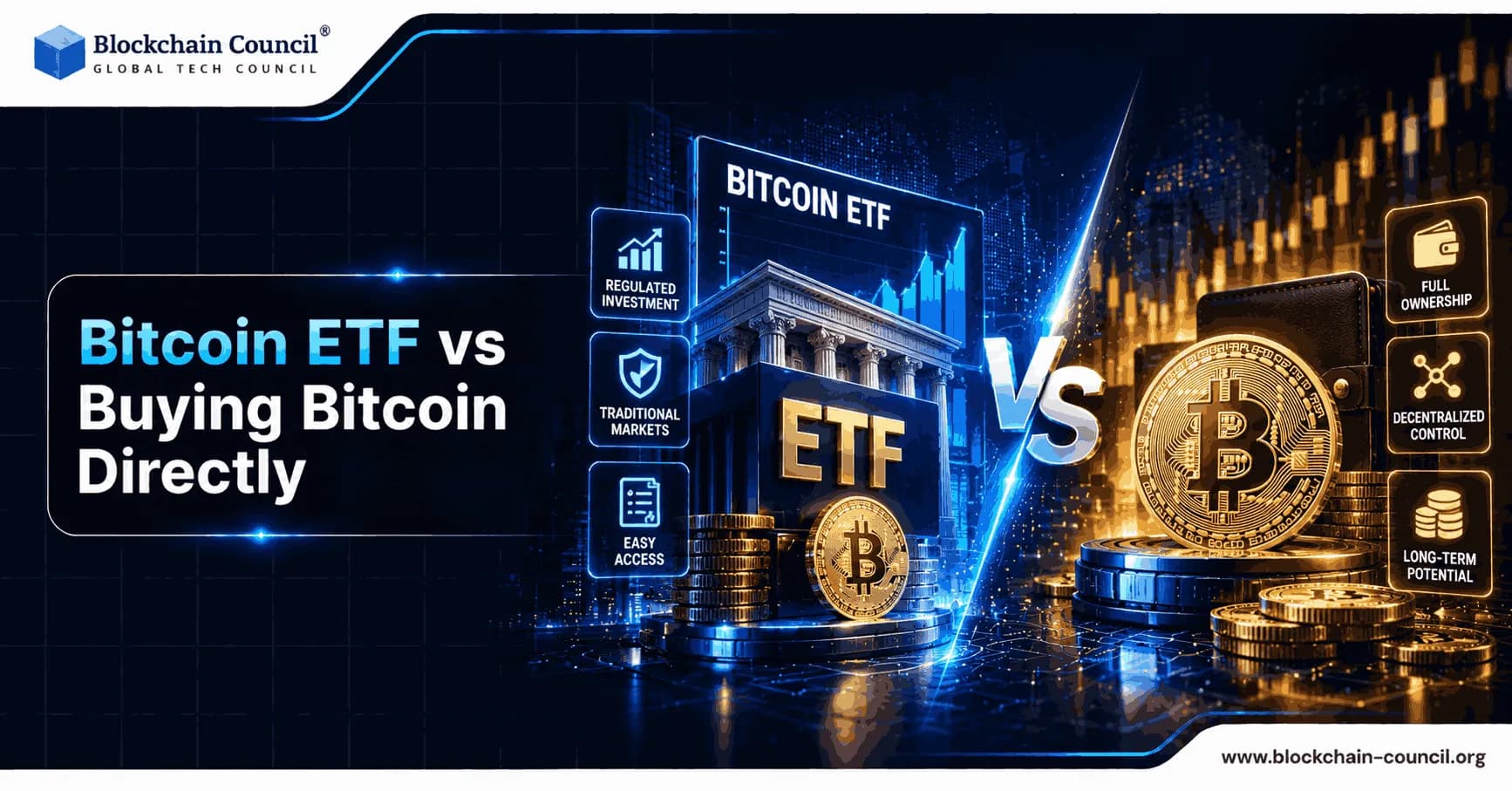
Bitcoin has two main doors for ordinary investors. One is a spot Bitcoin exchange-traded fund, which you buy through a regular brokerage account. The other is buying Bitcoin itself through a crypto exchange and, if you like, moving it into your own wallet. Both give you exposure to Bitcoin's price, but they work very differently. The question of Bitcoin ETF vs Buying Bitcoin Directly matters even more in 2026, since US spot Bitcoin funds now hold about $108.9 billion in assets and Bitcoin trades around $86,000 after a sharp rebound from its June low.
This guide compares the two paths in plain language, covering fees, taxes, security, flexibility, and risks. If you are new to Bitcoin, a program like the Certified Bitcoin Expert course can help you build a strong foundation first. This article is for education only and is not financial advice, and tax rules vary by country and personal situation.

Quick Answer: Which Is Better, a Bitcoin ETF or Direct Bitcoin?
Neither is better for everyone. A spot Bitcoin ETF is usually better if you want simplicity, a regulated brokerage account, outsourced security, and retirement account access. Buying Bitcoin directly is usually better if you want full control, the ability to move or spend your coins, and no annual fund fee. The right choice depends on your goals, your comfort with technology, and how long you plan to hold.
What Is a Bitcoin ETF and What Does Buying Directly Mean?
What Is a Spot Bitcoin ETF?
A spot Bitcoin ETF is a fund that holds real Bitcoin and trades on a stock exchange like a share. When you buy a share, you own a piece of the fund, not the coins themselves. The fund's custodian holds the Bitcoin, and you never see a private key. Since their launch in January 2024, these funds have gathered about $57.8 billion in cumulative net inflows, with BlackRock's IBIT as the largest.
What Does Buying Bitcoin Directly Mean?
Buying directly means purchasing actual Bitcoin through a crypto exchange or broker. You can leave it on the exchange, which is simple but means the platform holds it for you, or move it to your own wallet, which gives you full control through private keys. Owning directly lets you send Bitcoin to anyone, anywhere, at any hour.
To understand how Bitcoin fits within the wider crypto world, including tokens, exchanges, and market cycles, the Certified Cryptocurrency Expert program offers a clear and structured overview.
Side-by-Side Comparison
Feature | Bitcoin ETF | Buying Bitcoin Directly |
|---|---|---|
What you own | Shares in a fund that holds Bitcoin | Bitcoin itself |
Private keys | None, the custodian holds them | Yours if you self-custody |
Annual fee | About 0.12% to 0.25% for most major funds | None for holding |
Other costs | Brokerage fees or spreads | Exchange fees, spreads, network fees |
Trading hours | Stock market hours | 24 hours a day, 7 days a week |
Retirement accounts | Easy in most IRAs and some 401(k) plans | Usually needs a self-directed IRA |
Spending or sending | Not possible | Possible |
Security responsibility | Fund and custodian | You, or the exchange |
Setup difficulty | Very easy | Easy on exchanges, harder with self-custody |
Pros of a Bitcoin ETF
Simple and Familiar
You buy and sell through the same brokerage account you may already use for stocks. There is no wallet to set up, no seed phrase to protect, and no need to learn about network fees.
Retirement Account Access
Most IRA and 401(k) providers do not allow direct crypto but do allow Bitcoin ETFs. In a Roth IRA, gains can grow tax-free if you follow the rules, which is a big advantage. For reference, the 2026 Roth IRA contribution limit is $7,500 for people under 50, subject to income limits.
Professional Custody
The fund's custodian handles security, which removes the risk of losing your own keys. This protection matters for people who worry about making a costly mistake.
Lower Fees Than Many Alternatives
Most major spot Bitcoin ETFs charge between about 0.12% and 0.25% per year. By comparison, self-directed crypto IRAs often charge 1% to 2% or more through transaction and custody fees.
Easier Tax Reporting
ETF gains and losses show up on normal brokerage tax forms, which can make filing simpler.
Cons of a Bitcoin ETF
You Do Not Own the Coins
You own fund shares, not Bitcoin. You cannot withdraw coins, send them, or use them for payments.
Annual Fees Add Up
A 0.25% fee costs $25 per year on $10,000 and $250 per year on $100,000. Over many years, the fees can compound into a real cost.
Limited Trading Hours
Funds trade only when the stock market is open. Bitcoin itself trades around the clock, so a big move on a weekend can leave ETF holders unable to react until markets reopen.
Custodian Concentration
One report noted that a single custodian holds the Bitcoin for 9 of 13 US funds. If something goes wrong at a major custodian, many funds could be affected.
No Use Beyond Price Exposure
An ETF cannot be used in decentralized finance, sent as a payment, or moved to cold storage.
Pros of Buying Bitcoin Directly
Full Ownership and Control
With self-custody, you hold the private keys. No company can freeze your coins or deny you access.
No Annual Management Fee
You pay trading fees when you buy and a small network fee when you move coins. Network withdrawal fees averaged roughly $0.49 to $1.79 per transaction in mid-2026, though they can spike when the network is busy.
Always-Open Market
You can buy or sell at any hour, including weekends and holidays.
Real-World Use
You can send Bitcoin anywhere, use it for payments where accepted, and use it with other crypto tools.
Easy Automation
Many exchanges let you set up recurring buys, which suits a dollar-cost averaging plan.
Cons of Buying Bitcoin Directly
Security Is Your Job
If you lose your private keys or your recovery phrase, your coins can be gone forever. Scams, fake apps, and phishing attacks are common.
Exchange Risk
If you leave coins on an exchange, you rely on that company to be secure and honest. Poorly run platforms have failed in the past.
More Complex Tax Records
In the US, Bitcoin is treated as property, so selling, trading, or spending it can trigger taxes. Exchanges now issue Form 1099-DA for sales, with cost basis reported only for coins purchased after January 1, 2026. Older purchases may need careful record keeping. In India, gains on virtual digital assets have been taxed at a flat 30% since 2022, so check your local rules.
Retirement Account Hurdles
Holding Bitcoin directly in a retirement account usually requires a self-directed IRA with a specialized provider, which adds paperwork and higher fees.
Fees and Total Cost: A Simple Example
Say you invest $10,000.
ETF at 0.25% a year: You pay about $25 in the first year, and roughly $250 over ten years if the balance stays flat. Your balance will move with price, so the real dollar amount changes.
Direct purchase: You pay an upfront exchange fee or spread, which varies by platform and payment method, plus any network fees to move coins. After that, there is no yearly management fee.
For small amounts and short holding times, the difference is tiny. For large amounts held for decades, direct ownership can be cheaper, but only if you keep your costs and risks under control.
Taxes and Retirement Accounts
Taxable Accounts
In the US, long-term gains on Bitcoin held for more than a year are taxed between 0% and 20%, and short-term gains between 10% and 37%, depending on income. These general rates apply whether you hold an ETF or Bitcoin directly in a normal account. Tax rules differ in other countries and can change, so check current rules or speak with a qualified tax professional.
Retirement Accounts
The ETF's biggest edge is access to IRAs and 401(k) plans. A Roth IRA with a Bitcoin ETF can let gains grow tax-free if you follow withdrawal rules. A self-directed IRA can hold real Bitcoin, but it often costs more and takes more work.
Custody and Security
How ETF Custody Works
Large institutions hold the Bitcoin for the fund and are regulated, which many investors find comforting. The trade-off is that you must trust the fund and its custodian.
How Direct Custody Works
You can keep coins on an exchange, which is easier but depends on the platform. You can also use a software or hardware wallet, which gives you control but makes you responsible for protecting the keys. Whichever route you choose, due diligence matters. Professionals who review these controls often study the Certified Cryptocurrency Auditor program, which focuses on verifying crypto transactions, controls, and compliance.
Basic Safety Rules
Use only regulated, well-known platforms.
Turn on two-factor security.
Never share your recovery phrase with anyone.
Be careful with links, giveaways, and unknown apps.
Back up your keys in more than one safe place.
Trading Hours, Flexibility, and Market Behavior
ETFs and direct Bitcoin behave differently when markets get wild. ETF shares trade only during market hours, and their price can drift slightly above or below the value of the Bitcoin they hold. Direct Bitcoin trades constantly and reacts instantly to news. Active investors who want a structured approach to charts, risk limits, and position sizing often study the Certified Cryptocurrency Trader (CCT) path, which focuses on disciplined trading rather than guesswork.
Risks That Apply to Both
Price volatility: Bitcoin has fallen more than 50% from its peak this cycle and has rebounded more than 40% from its June low. Both ETFs and direct holdings follow the same price.
Regulation: Rules can change, and the CLARITY Act stalled in the Senate this year.
Market mood and leverage: Heavy borrowing in crypto markets can trigger sharp drops.
ETF flow swings: Recent weekly flows have ranged from about $241 million to about $2.4 billion, and they can reverse quickly.
Which Option Fits You?
An ETF May Fit If You
Want a simple, regulated way to invest
Prefer to use a retirement account
Do not want to manage private keys
Are comfortable paying a small annual fee
Mainly want price exposure, not the coins themselves
Direct Bitcoin May Fit If You
Want full control and self-custody
Plan to hold for many years and avoid yearly fees
Want to send or use Bitcoin
Are comfortable learning security basics
Believe in the idea of owning the asset itself
A Mix May Fit If You
Many investors use both. For example, they may hold an ETF inside a retirement account and keep a smaller amount of Bitcoin in a wallet. This approach spreads the risks, though it also means managing two sets of records.
How to Decide in Five Steps
Write down your goal, such as retirement savings or long-term ownership.
Choose how much control and responsibility you want.
Compare fees, taxes, and account options in your country.
Start with a small amount to learn.
Review your plan calmly and avoid changing it after every price move.
Conclusion
The Bitcoin ETF vs Buying Bitcoin Directly debate is really about trade-offs. ETFs give you convenience, regulated custody, and retirement account access, with small yearly fees and no ownership of the coins. Direct ownership gives you control, flexibility, and no management fee, with more responsibility for security and records. Both carry Bitcoin's price swings and regulatory uncertainty. The best choice matches your goals, your skills, and your comfort with risk, and many people find that a mix works well.
Crypto skills grow stronger when paired with broader technology knowledge. If you want to build expertise in cloud, security, data, and emerging tech, explore the Tech Certification programs. And if you want to learn how to explain topics like Bitcoin investing and grow a brand in this space, a Marketing Certification is a smart next step.
FAQs
1. What is the difference between a Bitcoin ETF and buying Bitcoin directly?
A Bitcoin ETF or spot Bitcoin exchange-traded product gives investors exposure to Bitcoin through shares traded on a traditional securities exchange. Buying Bitcoin directly means purchasing the actual BTC through a crypto platform and holding it through an exchange or wallet. The main difference is that direct ownership gives you control over the Bitcoin, while an ETF gives you exposure through a financial product.
2. Is buying a Bitcoin ETF the same as owning Bitcoin?
No. When you buy a Bitcoin ETF, you own shares of the investment product rather than Bitcoin in your personal wallet. The product holds Bitcoin on behalf of investors and is designed to track its price. Direct Bitcoin ownership gives you control over the underlying BTC and its private keys if you use self-custody.
3. What are the main advantages of a Bitcoin ETF?
A Bitcoin ETF can provide convenient access to Bitcoin through a traditional brokerage account. Investors do not need to set up a crypto wallet, manage private keys, or directly transfer Bitcoin between blockchain addresses. ETF shares can also be traded through established securities-market infrastructure.
4. What are the advantages of buying Bitcoin directly?
Direct Bitcoin ownership provides greater control and flexibility over the asset. Investors can transfer BTC to their own wallet, use it in supported applications, or hold it through self-custody. Direct ownership also avoids the ongoing sponsor fee charged by many Bitcoin ETPs, although trading, withdrawal, and network fees may still apply.
5. Which is safer, a Bitcoin ETF or buying Bitcoin directly?
Neither option eliminates Bitcoin's market risk. A Bitcoin ETF reduces some operational risks associated with wallet management and private-key security, but introduces product, custodian, issuer, and market-structure risks. Direct Bitcoin ownership provides control but places more responsibility on the investor for account and wallet security.
6. What are the risks of buying Bitcoin directly?
Direct Bitcoin ownership can involve exchange security risks, wallet vulnerabilities, phishing, fraud, and permanent loss of access if private keys or recovery information are lost. Third-party custody can also create counterparty risk if an exchange or custodian experiences financial or operational problems. Self-custody removes some third-party dependence but makes the investor responsible for protecting the keys.
7. What are the risks of investing in a Bitcoin ETF?
Bitcoin ETFs or spot Bitcoin ETPs remain exposed to Bitcoin's high price volatility. They can also have sponsor fees, custodian risks, tracking differences, liquidity risks, and potential premiums or discounts relative to the underlying Bitcoin value. Regulatory disclosures also warn that these products can lose some or all of their value.
8. Does a Bitcoin ETF charge fees?
Yes. Spot Bitcoin ETPs generally charge a sponsor or management fee that is reflected in the product's expenses. Over long periods, these fees can reduce the amount of Bitcoin exposure represented by an investor's shares. Direct Bitcoin ownership does not have an equivalent ETF sponsor fee, although other transaction and custody costs may exist.
9. Can I lose money with both a Bitcoin ETF and direct Bitcoin?
Yes. Both investments are exposed to Bitcoin's price movements. If Bitcoin's market price falls significantly, the value of a Bitcoin ETF and directly held BTC can also decline. Neither approach guarantees a profit or protects investors from Bitcoin's volatility.
10. Which option gives better control over Bitcoin?
Buying Bitcoin directly generally provides greater control. With self-custody, the investor controls the private keys and can directly transfer the BTC to compatible blockchain addresses. ETF investors cannot normally withdraw the ETF's underlying Bitcoin to a personal crypto wallet.
11. Is a Bitcoin ETF easier for beginners?
For many beginners, a Bitcoin ETF can be operationally simpler because it works through a familiar brokerage account. The investor does not have to learn wallet management, blockchain transfers, or private-key security. However, beginners should still understand Bitcoin's volatility and the specific risks and fees of the ETF.
12. Which is more liquid, Bitcoin or a Bitcoin ETF?
Both can offer substantial liquidity, but they operate in different markets. Direct Bitcoin trades continuously on crypto markets, including outside traditional stock-market hours, while a Bitcoin ETF generally trades during the hours of the securities exchange where it is listed. Actual liquidity varies by platform, product, market conditions, and trading volume.
13. Can Bitcoin ETFs track the price of Bitcoin exactly?
Not necessarily. Spot Bitcoin ETPs generally seek to track Bitcoin's price, but fees, expenses, pricing methodologies, market conditions, and other factors can cause differences in performance. Some products may also trade above or below their net asset value.
14. Can I use Bitcoin after buying a Bitcoin ETF?
Generally, no. ETF shares provide financial exposure to Bitcoin rather than direct control of transferable BTC. If you want to send Bitcoin to another wallet, use it in a blockchain application, or hold it through self-custody, you generally need to own Bitcoin directly.
15. Does buying Bitcoin directly avoid all fees?
No. Direct Bitcoin ownership can involve trading spreads, exchange fees, withdrawal fees, blockchain network fees, and potentially wallet-related costs. The difference is that direct ownership does not normally have the ongoing sponsor fee associated with a Bitcoin ETP.
16. Is a Bitcoin ETF better for long-term investors?
It can be convenient for investors who want long-term Bitcoin price exposure through a traditional investment account. However, the suitability depends on factors such as fees, investment goals, risk tolerance, tax rules, and access to the product. A Bitcoin ETF is not automatically better than direct ownership.
17. Is buying Bitcoin directly better for long-term holding?
Direct ownership can be attractive to investors who want control over their BTC and are comfortable managing custody. Self-custody can provide independence from an exchange or ETF structure, but it requires careful management of private keys and recovery information. Losing access to those credentials can permanently prevent access to the Bitcoin.
18. What is the biggest advantage of a Bitcoin ETF over direct Bitcoin?
The major advantage is convenience. A Bitcoin ETF can provide Bitcoin exposure through a conventional brokerage account without requiring the investor to personally manage a crypto wallet or private keys. This can simplify portfolio management for investors who primarily want price exposure.
19. What is the biggest advantage of buying Bitcoin directly over a Bitcoin ETF?
The biggest advantage is direct ownership and control. Investors who hold Bitcoin directly can choose their own custody method and transfer the asset to compatible wallets or blockchain services. This flexibility is not available in the same way when holding ETF shares.
20. Should I buy a Bitcoin ETF or Bitcoin directly?
The choice depends on what you want from the investment. A Bitcoin ETF may suit someone who prioritizes brokerage convenience and simplified custody, while direct Bitcoin may suit someone who wants ownership, transferability, and control over their BTC. Before investing, consider volatility, fees, custody, liquidity, taxes, security, and your overall investment objectives rather than assuming one option is universally better.
Related Articles
View All
Bitcoin
Pros and Cons of Joining a Bitcoin Mining Pool
Joining a Bitcoin mining pool can be an appealing option for those looking to venture into cryptocurrency mining, especially if you’re starting. However, it’s essential to recognize the benefits and possible drawbacks before deciding. To earn rewards, miners need a solid understanding…

Bitcoin
Bitcoin ETF Inflows: How Institutional Money Is Affecting BTC Price
Learn how Bitcoin ETF inflows affect BTC price, what the latest October 2026 numbers show, and how to read institutional money flows in simple language.

Bitcoin
How much will 1 Bitcoin be worth in 2030? Forecasts, scenarios, and risks
How much will 1 Bitcoin be worth in 2030? Explore realistic BTC price ranges, major forecasts, adoption drivers, and key risks for investors and professionals.
Trending Articles
The Role of Blockchain in Ethical AI Development
How blockchain technology is being used to promote transparency and accountability in artificial intelligence systems.
AWS Career Roadmap
A step-by-step guide to building a successful career in Amazon Web Services cloud computing.
How Blockchain Secures AI Data
Understand how blockchain technology is being applied to protect the integrity and security of AI training data.