What Are AI Agents and How Are They Different From Chatbots?

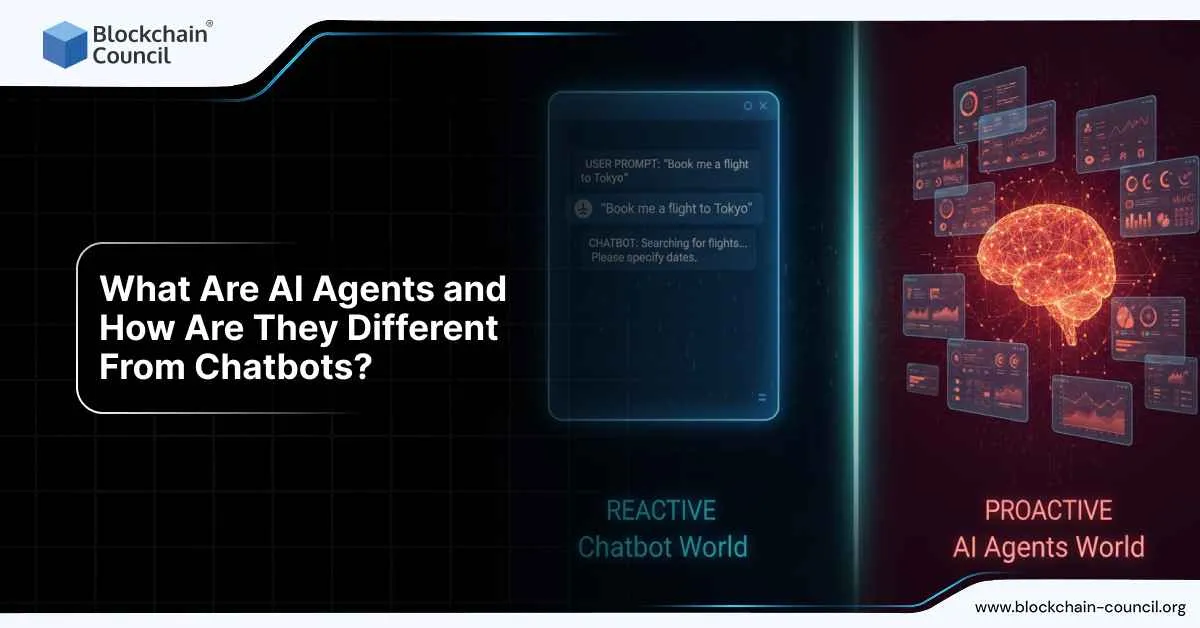
The rise of AI agents has sparked plenty of debate. Are they just chatbots with a fancy new name, or do they represent a real step forward? The answer is that AI agents are a different category altogether, built to act, not just talk. For professionals trying to understand where this shift is heading, an AI certification provides a structured way to learn the fundamentals and see how these systems fit into the broader AI ecosystem.
What Chatbots Do Best
Chatbots have been around for years, and most people have interacted with them on websites or in customer service portals. They’re designed to respond to questions, guide users through scripted flows, or provide answers from a knowledge base. Their strength lies in consistency and responsiveness, but they’re usually reactive: they wait for a prompt, then deliver a pre-determined response.

While modern Chatbots powered by large language models have become more conversational, they still lack the ability to plan multi-step actions or execute tasks beyond the chat window. They are assistants for dialogue, not autonomous actors.
How AI Agents Are Different
AI agents are built with more autonomy. They don’t just respond—they can take goals, plan steps, and carry out actions across multiple systems. For instance, an agent can search the web, extract information, write a report, and send it to your inbox without constant direction. Some can even monitor conditions, anticipate needs, and initiate tasks proactively.
This difference is visible in new launches. China’s Zhipu AI has introduced a free agent capable of planning and web navigation. Google’s Project Mariner is experimenting with agents that can browse websites like a human, interpreting forms and images to achieve a task. Amazon has doubled down on agent development, even restructuring teams to focus on bringing these tools to market. To learn more about AI agents, consider the expert-led Agentic AI courses to start your journey.
AI Agents vs Chatbots
| Feature | Chatbots | AI Agents |
| Primary Role | Answer questions and follow scripts | Plan, act, and complete multi-step tasks |
| Autonomy | Low — reactive to user input | High — can operate with minimal supervision |
| Integration | Limited to one system or chat | Can connect across apps, tools, and data sources |
| Proactivity | Rare, usually waits for input | Can anticipate needs and initiate actions |
| Memory | Shallow, limited to session | Contextual, often with long-term memory |
| Use Cases | Customer support, FAQs | Research, automation, workflow execution |
Why Agents Are on the Rise
2025 is shaping up to be the year of AI agents. OpenAI has predicted millions of agents running in the cloud within a few years. Businesses are already piloting them to handle scheduling, research, compliance, and customer engagement. Unlike chatbots, which are mostly confined to a single platform, agents are being designed to roam freely between tools and adapt to dynamic tasks.
This evolution creates opportunities for professionals with the right technical background. Enrolling in blockchain technology courses can help learners understand how secure, verifiable systems can support agentic AI by tracking interactions transparently.
Skills Needed for the Agentic Era
Adopting AI agents requires more than curiosity. Companies need experts who can evaluate outputs, manage integrations, and ensure safety. Data literacy is especially important, since agents rely heavily on real-time data. A Data Science Certification gives professionals the ability to validate agent performance and guard against errors that could multiply when tasks are automated.
Trust and Responsibility
One of the biggest questions around agents is accountability. If an agent makes a wrong decision or exposes sensitive data, who is responsible? Regulators are beginning to explore this, but companies are already seeking staff who understand both the technology and the ethical implications. [AI certs] are fast becoming a way for job seekers to prove that they can work with AI responsibly while being aware of risks.
Leadership is equally vital. Managers must align agent adoption with business strategies and ensure that agents support long-term goals rather than just short-term efficiency. The Marketing and Business Certification equips professionals with the skills to make these decisions thoughtfully, balancing innovation with oversight.
Conclusion
AI agents and chatbots are not the same. Chatbots excel at conversation and scripted support, while agents bring autonomy, planning, and integration across systems. The shift toward agents signals a move from reactive assistants to proactive digital coworkers. For businesses, this represents both opportunity and responsibility. And for professionals, it’s a chance to build new skills, blending technical know-how with ethics and strategy. Those who prepare now will be ready to guide this new chapter of AI adoption.