Tezos Tallinn Upgrade Now Live

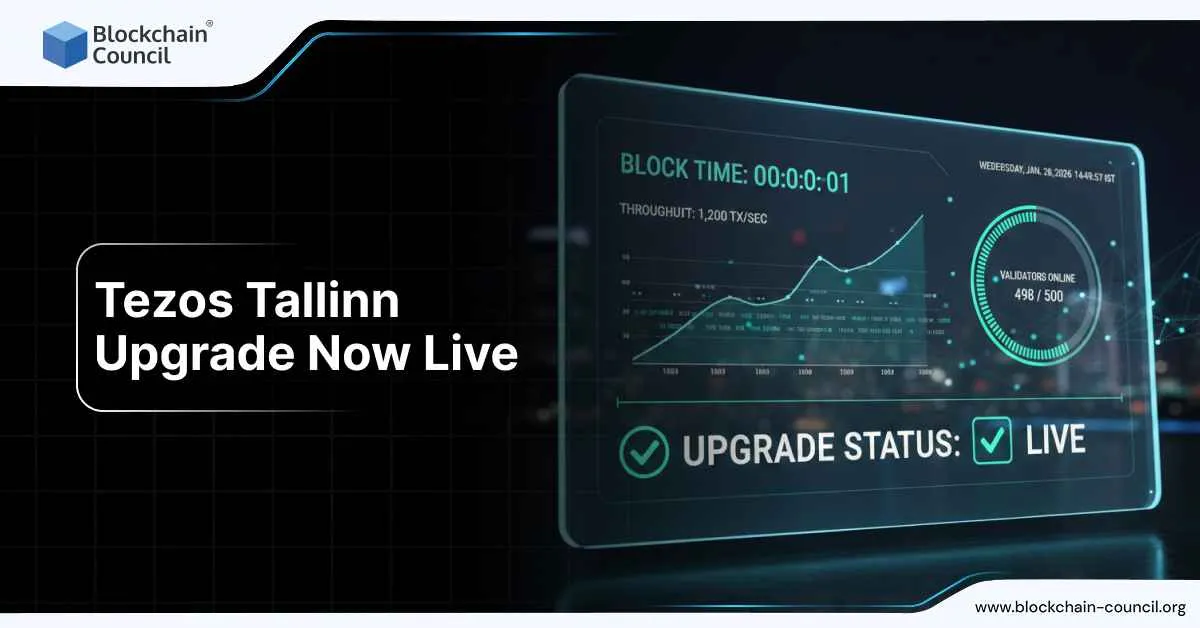
The protocol activated at block #11,640,289, marking Tezos’ 20th protocol upgrade, delivered through on-chain governance with no hard fork and no chain split. Tallinn focuses on three things that actually matter at the protocol level: faster Layer 1 blocks, stronger consensus security once adoption thresholds are met, and much cheaper on-chain storage for large applications.
This is not a cosmetic upgrade. It changes timing, consensus behavior, and how smart contracts can store data efficiently.

What went live and when
Tallinn activated in early 2026 through Tezos’ standard governance process.
Key facts:
- Protocol name: Tallinn
- Activation block: #11,640,289
- Upgrade type: On-chain governance, no fork
- Protocol number: 20
Because Tezos upgrades in place, all nodes that upgraded continued on the same chain.
Faster Layer 1 blocks
The most visible change is block speed.
Tallinn reduces Tezos Layer 1 block time:
- Before: 8 seconds per block
- Now: 6 seconds per block
This directly affects confirmation speed and user experience.
What this means in practice:
- Faster inclusion of transactions
- Two-block finality now happens in roughly 12 seconds
- Lower perceived latency for simple transfers and dApps
Under the hood, multiple protocol parameters were updated to make this safe.
Key parameter changes include:
- minimal_block_delay: 8 → 6
- delay_increment_per_round: 4 → 3
- blocks_per_cycle: 10800 → 14400
- blocks_per_commitment: 84 → 112
- max_operations_time_to_live: 450 → 600
- hard_gas_limit_per_block: 1386666 → 1040000
The gas limit per block was reduced intentionally to keep resource usage predictable under faster block production.
All bakers attesting every block, once threshold is reached
Tallinn introduces a major consensus change, but it activates only after adoption crosses a threshold.
The change:
- Every baker will attest every block
- This activates only when 50% of bakers switch to tz4 consensus keys
tz4 keys use BLS signatures, which allow aggregation and much more efficient attestation handling.
Why this matters:
- Stronger consensus security
- Lower variance in baker rewards
- Less load on nodes compared to committee-based attestations
Important nuance:
- Tallinn includes the mechanism
- It does not force immediate activation
- The feature turns on automatically once tz4 usage crosses 50%
This avoids breaking the network while still pushing consensus forward.
Much cheaper storage for large smart contracts
Tallinn introduces an Address Indexing Registry, which is one of the most important changes for developers.
The problem it addresses:
- Large contracts often store the same addresses repeatedly
- This inflates storage costs and state size
The solution:
- Addresses are stored once in a shared registry
- Contracts reference indexed addresses instead of duplicating data
Why this matters:
- Storage footprint reductions of 50x to 100x are cited for large ledgers
- NFT collections, token registries, and DAOs benefit the most
- Lower long-term storage costs for complex apps
Important caveat:
- Existing contracts must be updated to use the registry
- Old contracts do not automatically benefit
This is not a free win, but it unlocks a cleaner design pattern going forward.
Smart rollups adjustments
Tallinn also updates smart rollup parameters to match faster blocks.
What changed:
- Block-count based parameters were increased
- This preserves roughly the same real-world time windows
Example:
- Challenge periods measured in blocks were increased
- Time-based guarantees remain similar despite faster blocks
One notable detail from the protocol docs:
- A specific outbox storage limit was not updated
- As a result, the maximum withdrawal window from rollups to L1 is reduced
- Roughly from ~14 days down to ~10 days
This is not a breaking issue, but it matters for rollup operators and power users.
Why faster blocks did not break the chain
This was not a blind change.
Nomadic Labs and other ecosystem teams published testing results before activation.
Key points from testing notes:
- Experiments were run at 6-second block time
- No negative impact on chain health was observed
- Baker participation and block production remained stable
These results were shared publicly on Tezos Agora, not buried in marketing posts.
This testing is why the change could be rolled out with confidence.
Developer readiness
Tallinn is already reflected across the tooling stack.
Signs the ecosystem was prepared:
- Octez documentation includes a dedicated Tallinn protocol reference
- Breaking changes and parameter updates are clearly documented
- Taquito and other SDKs already reference Tallinn compatibility
For developers, this means:
- Clear migration paths
- No surprise protocol behavior
- Predictable deployment targets
What users are actually saying
Community reaction follows a familiar pattern.
In early Reddit threads:
- Users acknowledge the technical improvements
- Discussion quickly shifts to price and adoption
- The classic “tech vs market performance” debate reappears
Common themes in community posts:
- Faster blocks are welcomed
- Storage improvements are seen as genuinely useful
- Skepticism remains about whether upgrades translate to usage
This reaction is consistent with past Tezos upgrades. Strong protocol work does not automatically change market sentiment.
What this upgrade changes in practice
For everyday users:
- Faster confirmations
- Slightly quicker finality
- No action required
For bakers:
- Path toward more predictable rewards
- Consensus becomes more efficient after tz4 threshold
- Node operators should ensure compatibility
For developers:
- Cheaper storage if contracts are updated
- Better UX for apps due to faster blocks
- Clear incentives to migrate large ledgers to the registry pattern
For rollup builders:
- Slightly shorter withdrawal window
- Parameter changes require attention
- No fundamental redesign required
Bottom line
Tezos Tallinn Upgrade is live, and it is a real protocol-level improvement.
It delivers:
- Faster Layer 1 blocks
- A safer and more efficient consensus model once adoption thresholds are met
- Massive storage efficiency gains for applications that update
It does not promise price action, hype, or instant adoption.
It does what a serious blockchain upgrade should do: quietly improve performance, security, and developer economics without breaking the chain.