
CBS Atlanta to Introduce New AR/VR News Operation

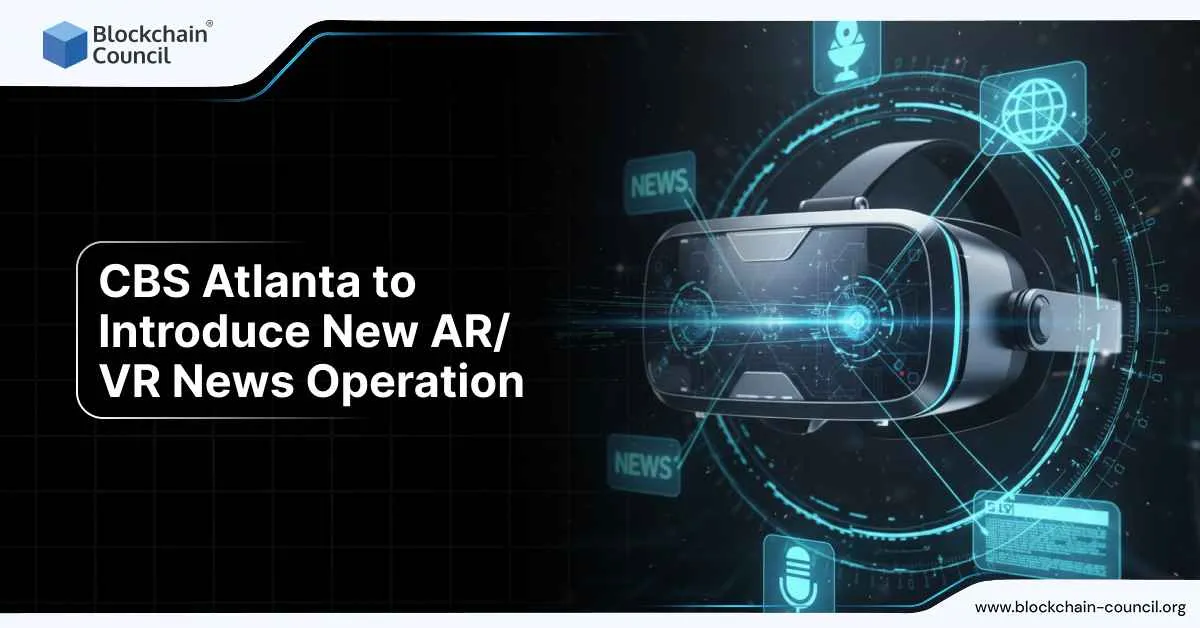
CBS Atlanta is taking a decisive step toward immersive journalism with the launch of a new AR and VR powered news operation that rethinks how local news is produced and presented. The initiative is not a visual refresh or a one-off experiment. It is a full newsroom rebuild designed to integrate augmented and virtual reality directly into daily broadcasts, studio workflows, and storytelling formats. The goal is simple but ambitious: make complex news clearer, more visual, and more engaging for viewers in the Atlanta market.
This shift also reflects how broadcast media is changing at a structural level. As immersive formats move from entertainment into information delivery, the skill set required to design, operate, and editorially control these environments is changing fast. That is why AR and VR capabilities, often formalized through pathways like an AR VR certification, are becoming central to modern newsroom production rather than niche add-ons.

Launch timeline and station context
CBS Atlanta officially launched its new AR and VR news operation on 15 September 2025, debuting immersive broadcasts during the 6 pm and 11 pm evening newscasts. The operation is housed within WUPA, channel 69, which became a CBS owned and operated station on 16 August 2025 following CBS’s realignment of local affiliates in the Atlanta market.
The AR and VR rollout was one of the first major infrastructure decisions made after the ownership transition. Rather than inheriting legacy studio layouts, CBS Atlanta built a dedicated virtual production environment from the ground up, signaling that immersive storytelling was a strategic priority rather than an experimental overlay.
Inside the AR and VR newsroom
The new CBS Atlanta studio replaces traditional physical sets with a fully virtual environment powered by advanced camera tracking and real-time rendering systems. Anchors are filmed against green screen stages that allow virtual sets, data visualizations, maps, and three-dimensional objects to be composited live during broadcasts.
This setup allows presenters to walk through weather systems, stand inside virtual crime scenes, or visually break down election data in ways that would be impossible on a flat screen. Importantly, the technology operates in real time, meaning these elements are not added in post-production but are part of the live broadcast workflow.
CBS engineers have emphasized that the system is designed for daily use, not special segments. The intent is to normalize immersive visuals so that viewers see them as part of standard news delivery rather than a novelty.
Leadership and editorial direction
The face of the new AR and VR operation is Jobina Fortson-Evans, a three-time Emmy Award winning journalist and Atlanta native. She was named lead anchor for the newscasts shortly before the AR and VR launch and plays a central role in shaping how immersive elements are editorially used.
Fortson-Evans has publicly emphasized that the technology is meant to serve storytelling, not distract from it. Editorial guidelines at CBS Atlanta require immersive elements to clarify context, scale, and impact, especially for complex local issues such as infrastructure projects, severe weather, and public safety incidents.
This editorial discipline is critical. Without it, immersive news risks becoming spectacle. CBS Atlanta’s approach positions AR and VR as explanatory tools rather than visual gimmicks.
Technology behind the scenes
The AR and VR system deployed at CBS Atlanta uses industry-grade virtual production software combined with precision camera tracking. Every camera movement is mapped in three-dimensional space, allowing virtual objects to maintain correct perspective and scale as anchors move through the set.
Lighting is also digitally synchronized so that virtual elements match real-world shadows and reflections. This level of integration requires close coordination between engineering, production, and editorial teams.
Operating this kind of system consistently demands strong technical foundations. Broadcasters increasingly rely on professionals with backgrounds in systems architecture, real-time graphics, and software integration, skills often formalized through programs like a Tech Certification that bridge creative production and technical execution.
Why local news is embracing immersive formats
Local news faces a unique challenge. Viewers expect clarity, speed, and trust, but they also consume content across platforms that are increasingly visual and interactive. AR and VR offer a way to meet those expectations without abandoning the credibility of broadcast journalism.
In Atlanta, immersive graphics are already being used to:
- Visualize storm paths during severe weather coverage
- Explain zoning changes and infrastructure projects
- Break down election results with geographic precision
- Reconstruct timelines in investigative reporting
These use cases are especially effective at the local level, where context and geography matter deeply to viewers.
Part of a wider CBS strategy
CBS Atlanta’s AR and VR operation is not isolated. It is part of a broader push by CBS News and Stations to modernize local newsrooms using immersive technology. Other CBS owned stations, including those in California and Texas, have expanded virtual production capabilities, though Atlanta is among the most comprehensive deployments to date.
By rolling out AR and VR at the same time as launching a new owned station, CBS avoided legacy constraints and aligned technology, branding, and editorial strategy from the start.
Business and audience implications
From a business perspective, immersive news production changes how stations think about audience engagement and advertising. Virtual sets can be reconfigured instantly, enabling sponsored segments, branded explainers, and customized visuals without physical set changes.
However, monetization only works if audience trust is preserved. That balance between innovation and credibility is where business strategy becomes as important as technology. News organizations navigating this shift often rely on frameworks similar to those taught in a Marketing and Business Certification to align immersive formats with long-term audience growth rather than short-term spectacle.
Conclusion
CBS Atlanta to introduce new AR and VR news operation is not just a headline about new studio tech. It signals how local news is adapting to a world where viewers expect information to be visual, spatial, and immediate.
By embedding immersive technology into everyday reporting rather than treating it as a novelty, CBS Atlanta is testing a model that could become standard across local broadcasting. If successful, it may redefine how audiences understand and trust news in an increasingly complex information environment.
Related Articles
View All
AI & ML
Claude’s New Constitution
Humanity has decided to build machines that can think, speak, reason, and possibly one day argue better than we do. Naturally, the next step is to write them a constitution. In January 2026, Anthropic published Claude’s New Constitution, a detailed document meant to guide how its AI model, Claude,…

AI & ML
AWS Career Roadmap
Cloud computing has transformed the way businesses build and deliver digital products. Today, companies no longer need to invest in expensive physical servers to run their applications. Instead, they rely on cloud platforms that provide scalable computing power over the internet. One of the most…
AI & ML
What is AWS? A Beginner’s Guide to Cloud Computing and Career Opportunities
Cloud computing has become the backbone of modern technology. From streaming services and online shopping platforms to AI applications and mobile apps, most digital services today run on cloud infrastructure. One of the most powerful platforms leading this transformation is Amazon Web Services…
Trending Articles

The Role of Blockchain in Ethical AI Development
How blockchain technology is being used to promote transparency and accountability in artificial intelligence systems.
AWS Career Roadmap
A step-by-step guide to building a successful career in Amazon Web Services cloud computing.

Top 5 DeFi Platforms
Explore the leading decentralized finance platforms and what makes each one unique in the evolving DeFi landscape.