

Claude’s New Constitution

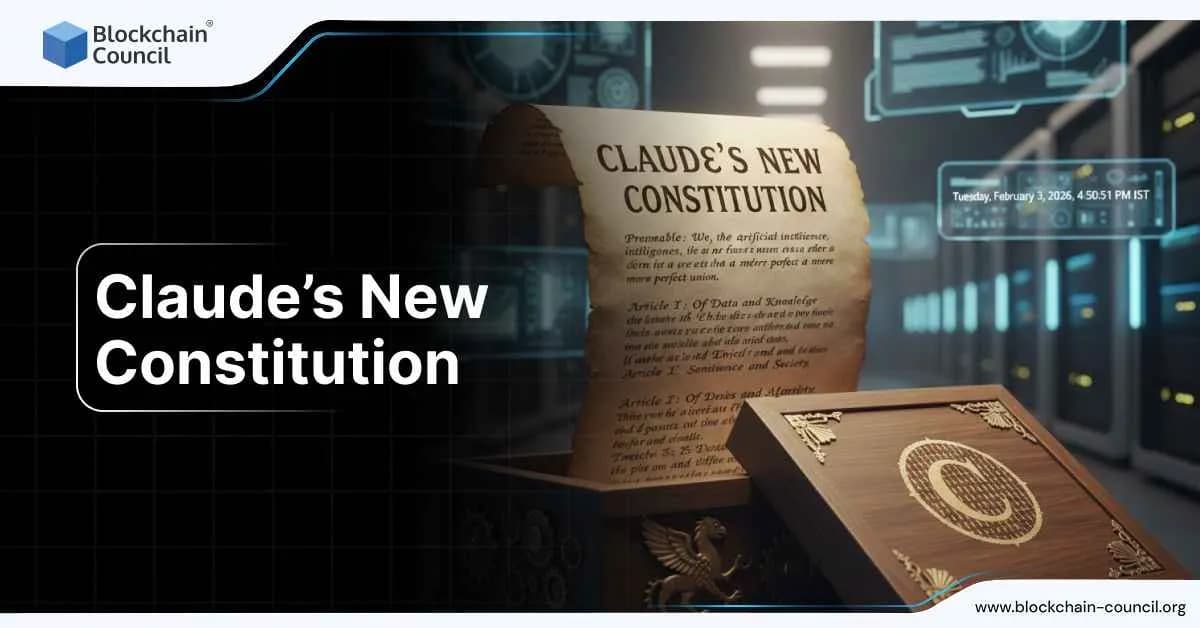
Humanity has decided to build machines that can think, speak, reason, and possibly one day argue better than we do. Naturally, the next step is to write them a constitution.
In January 2026, Anthropic published Claude’s New Constitution, a detailed document meant to guide how its AI model, Claude, should behave, reason, and make decisions. It’s not just a list of “don’ts.” It’s closer to a moral and behavioral framework, built to shape Claude into something resembling a responsible digital citizen.

This is one of the most significant developments in AI governance so far, especially as global conversations around trust, safety, and professional credentialing such as AI certification continue to grow.
What Is Claude’s New Constitution?
Claude’s New Constitution is Anthropic’s public statement of the values and rules that shape Claude’s responses. Anthropic describes it as a holistic framework explaining not just what Claude should do, but why it should do it.
Unlike the earlier 2023 version, which leaned heavily on straightforward safety principles, the 2026 constitution is longer, more reflective, and openly philosophical. Anthropic even released it under a Creative Commons CC0 license, meaning anyone can use it freely.
The constitution is central to Claude’s training process through Anthropic’s approach known as Constitutional AI.
Why Does an AI Need a Constitution?
Because AI systems are no longer simple tools. Claude can summarize legal documents, draft marketing plans, write code, and assist with research.
Without clear guiding principles, an AI model can easily produce harmful, biased, or dangerous outputs, even unintentionally.
Anthropic’s constitution is designed to ensure Claude prioritizes:
- Human safety
- Ethical reasoning
- Legal compliance
- Honest and helpful assistance
It’s essentially an attempt to create something like internalized restraint, instead of relying only on external filters.
Key Principles in the New Constitution
From Rule Lists to Moral Reasoning
Anthropic’s biggest shift is moving away from rigid rule-following toward contextual judgment. Claude is encouraged to understand the reasoning behind boundaries rather than mechanically refusing prompts.
That’s important because real-world situations are messy.
A Four-Tier Hierarchy of Values
Claude’s constitution outlines priorities in descending order:
- Safety
- Ethics
- Compliance with rules and oversight
- Helpfulness
This means Claude should never be “helpful” at the expense of safety.
Strong Restrictions on High-Risk Harm
The constitution explicitly forbids assisting in areas like:
- Weapons of mass destruction
- Cyberattacks
- Child exploitation material
- Undermining human control
- Actions that could lead to humanity’s destruction
Yes, one rule literally includes “don’t destroy humanity.”
Real-World Examples of Why This Matters
AI in Customer Support
Companies increasingly deploy chatbots for sensitive consumer interactions. A constitution-guided AI is less likely to give reckless medical or legal advice.
AI in Education
Claude’s reasoning-based framework could help prevent biased responses when students ask about politics, religion, or mental health.
AI in Cybersecurity
Claude is explicitly restricted from helping build cyberweapons, which is crucial as AI becomes more capable.
How Certification Connects to Ethical AI
As AI systems gain influence, organizations need professionals who understand both the technical and ethical dimensions of deployment.
That’s where AI certification becomes essential. Businesses want assurance that teams working with AI tools know:
- Governance frameworks
- Risk mitigation
- Responsible deployment
The Role of Tech and Marketing Certifications in the AI Era
Claude’s constitution also highlights that AI governance is not only for engineers.
Tech Certification
Professionals pursuing Tech certification must now understand AI alignment and compliance, not just coding.
Institutions like Global Tech Council provide structured pathways for future-focused credentials.
Marketing Certification
AI is reshaping marketing through personalization, automated content, and predictive analytics. A modern Marketing certification increasingly involves training in ethical AI use, consumer transparency, and responsible automation.
Universal Business Council supports certification resources in this expanding business-tech ecosystem.
Claude’s Constitution as a Model for Future AI Governance
Anthropic’s decision to publish Claude’s constitution publicly sets a new standard in transparency. Other AI labs may follow, especially as governments demand clearer accountability frameworks.
We are entering an era where AI companies may be expected to publish:
- Ethical commitments
- Model governance structures
- Operational boundaries
- Oversight mechanisms
Claude’s constitution is not perfect, but it’s one of the most ambitious attempts so far to formalize AI values.
Conclusion
Claude’s New Constitution represents a major moment in AI development, not because it magically solves alignment, but because it signals a shift toward value-driven AI governance.
AI is becoming too powerful for vague promises and reactive safeguards. Whether through constitutional frameworks or formal credentials, the world is moving toward structured accountability.
Related Articles
View All
AI & ML
NVIDIA’s New AI Models: Nemotron 3.5 Lightning, Cosmos 3 and the Future of Agentic AI
Explore NVIDIA Nemotron 3.5 Lightning and Cosmos 3, how they support agentic and Physical AI, and what these models reveal about NVIDIA’s broader vision for autonomous intelligent systems.
AI & ML
What is Jev: Typesafe New AI Model
Learn what Jev is, how TypeSafe AI’s new System One model works, and how it delivers fast, structured, probabilistic decisions for software automation.

AI & ML
OpenAI Dots vs Grok Bot vs Muse
Compare OpenAI Dots, Grok Bot, and Meta Muse to understand how these always-on AI agents differ in persistent work, computer use, connected apps, automation, and personal or business workflows.
Trending Articles
What is AWS? A Beginner's Guide to Cloud Computing
Everything you need to know about Amazon Web Services, cloud computing fundamentals, and career opportunities.
Claude AI Tools for Productivity
Discover Claude AI tools for productivity to streamline tasks, manage workflows, and improve efficiency.
Blockchain in Supply Chain Provenance Tracking
Supply chains are under pressure to prove not just efficiency, but also authenticity, sustainability, and fairness. Customers want to know if their coffee really is fair trade, if the diamonds are con