Is Combining Blockchain and AI the Future of Healthcare Data?

Healthcare
Healthcare is one of the most data-intensive industries in the world. From patient medical records to diagnostic imaging, genetic sequencing, and IoT-enabled wearables, the sector generates massive amounts of sensitive data every second. Yet, this valuable information often faces challenges such as data silos, lack of interoperability, privacy concerns, and security breaches.
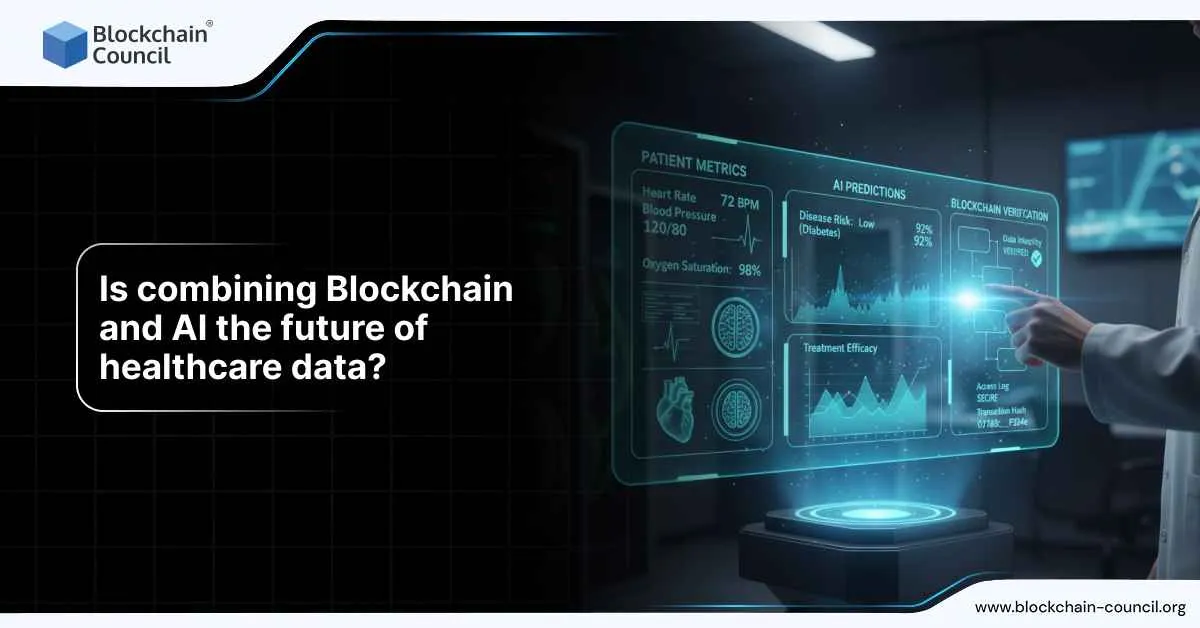
Two emerging technologies—Blockchain and Artificial Intelligence (AI)—are stepping up to transform healthcare data management. Blockchain offers security, transparency, and decentralization, while AI brings intelligence, automation, and predictive analytics. Together, they create a powerful combination that promises to revolutionize how healthcare data is stored, shared, and used for better decision-making.

This article explores whether combining Blockchain and AI is truly the future of healthcare data, the real-world applications already making an impact, challenges to overcome, and why professionals should prepare for this transformation through a Blockchain Course, AI Course, and Agentic AI Course (Blockchain Council), Python and Tech Courses (Global Tech Council), and Marketing and Business Related Courses (Universal Business Council).
The Current Challenges in Healthcare Data
- Data Fragmentation: Patient records are often scattered across hospitals, labs, and insurance providers, making them hard to consolidate.
- Privacy Concerns: Sensitive health data is vulnerable to leaks and breaches.
- Lack of Interoperability: Different healthcare systems and formats make data exchange difficult.
- Fraud and Errors: Medical billing fraud and inaccurate records are common.
- Slow Processes: Manual verification of insurance claims or data sharing slows down treatment.
These issues highlight the urgent need for secure, intelligent, and integrated solutions—a gap Blockchain + AI can fill.
How Blockchain Improves Healthcare Data
- Security and Immutability:
Blockchain records cannot be altered, ensuring trustworthy data.
- Decentralization:
Patient data is stored across multiple nodes, reducing risk of centralized breaches.
- Transparency:
Every data access or update is recorded on-chain, providing a full audit trail.
- Patient Ownership:
Patients control who can access their records, restoring trust in healthcare systems.
How AI Improves Healthcare Data
- Predictive Analytics:
AI analyzes medical history to predict diseases early.
- Personalized Medicine:
Tailors treatment plans based on genetics, lifestyle, and medical history.
- Automation:
Reduces administrative workloads like insurance claim verification.
- Medical Imaging:
AI outperforms humans in detecting anomalies in X-rays, MRIs, and CT scans.
The Power of Combining Blockchain and AI
Together, Blockchain and AI offer solutions that neither can achieve alone:
1. Secure and Intelligent Data Sharing
Blockchain ensures secure storage, while AI processes that data for insights.
- Example: Global databases of patient records shared securely via blockchain and analyzed by AI for medical research.
2. Fraud Detection in Healthcare
AI detects anomalies in billing or insurance claims, while blockchain provides immutable transaction records.
3. Improved Drug Development
AI predicts drug interactions; blockchain secures clinical trial data to prevent tampering.
4. Enhanced Patient Privacy
Patients control their blockchain-verified medical records, while AI analyzes anonymized data for population-level insights.
5. Decentralized AI in Healthcare
AI models themselves can be trained and deployed on decentralized blockchain platforms, avoiding bias and tampering.
Real-World Applications in 2025
- Hospitals:
Blockchain secures patient records, AI diagnoses faster and more accurately.
- Pharmaceuticals:
AI predicts effective compounds, blockchain secures trial results.
- Insurance Companies:
AI detects fraudulent claims, blockchain verifies transparency in payouts.
- Wearable Devices:
Data from wearables is logged on blockchain, AI analyzes for early health warnings.
- Public Health Authorities:
AI predicts outbreaks, blockchain secures anonymized health data sharing globally.
Skills Professionals Need in This Domain
Healthcare + tech convergence requires multi-disciplinary knowledge.
- Blockchain Course (Blockchain Council): Learn decentralized healthcare data management.
- AI Course (Blockchain Council): Master machine learning for predictive healthcare analytics.
- Agentic AI Course (Blockchain Council): Understand autonomous AI agents for healthcare monitoring.
- Python Course (Global Tech Council): Code AI models for medical imaging or fraud detection.
- Tech Courses (Global Tech Council): Advanced AI-blockchain integration, IoT in healthcare.
- Marketing Courses (Universal Business Council): Promote AI + blockchain healthcare products.
- Business Related Courses (Universal Business Council): Learn adoption strategy and compliance with HIPAA/GDPR.
Challenges of Combining Blockchain and AI in Healthcare
- Data Privacy vs. Transparency: Balancing blockchain immutability with patient privacy is complex.
- Regulatory Barriers: Strict healthcare laws may slow adoption.
- Integration Costs: Combining AI and blockchain is resource-intensive.
- Bias in AI Models: If trained on poor data, AI may misdiagnose or mispredict.
- Scalability: Processing millions of healthcare records requires efficient design.
The Future of Blockchain + AI in Healthcare
- Personal Health Wallets: Patients carry blockchain-based medical data accessible to AI for treatment.
- AI-Powered Clinical Trials: Blockchain verifies transparency while AI analyzes trial results faster.
- Global Health Networks: Pandemic data shared securely worldwide through blockchain, analyzed by AI in real time.
- Decentralized AI Doctors: AI diagnostic systems stored on blockchain for unbiased and transparent healthcare.
- Insurance Automation: Smart contracts + AI instantly process and verify medical claims.
Conclusion
Combining Blockchain and AI is not just an innovation—it’s the future of healthcare data. Blockchain ensures security, transparency, and patient ownership, while AI provides intelligence, predictions, and automation. Together, they solve problems of privacy, trust, and efficiency that have plagued healthcare for decades.
For professionals, this field is booming. By taking Blockchain, AI, and Agentic AI Courses from Blockchain Council, gaining coding expertise with Python and Tech Courses from Global Tech Council, and developing business foresight through Marketing and Business Related Courses from Universal Business Council, you can become a leader in healthcare technology innovation.
The future of healthcare data won’t be just digital—it will be blockchain-secured and AI-powered.