
Types of Artificial Intelligence Skills
 Michael Willson
To succeed in the age of artificial intelligence, you need the right mix of skills. Employers are not just looking for programmers anymore. They want people who can write effective prompts, evaluate AI outputs, and think creatively about how AI fits into business. This article explains the key types of AI skills you need to grow your career. Whether you are a developer, analyst, or leader, the path often begins with an AI Certification that shows you understand the fundamentals of artificial intelligence.
Technical and Core AI Skills
The technical side of AI remains the foundation. If you want to work in AI development, you need strong programming and model-building skills.

- Programming: Python is the most widely used, but R, Java, and C++ are also important. These languages allow you to build, test, and deploy models.
- Machine Learning and Deep Learning: Understanding how to design and train models is essential. This includes supervised learning, reinforcement learning, and neural networks.
- Data Management: AI runs on data. Skills in SQL, Spark, and data cleaning help ensure you work with reliable datasets.
- NLP and Computer Vision: Natural language processing and image recognition are core areas where AI is applied today.
These skills let you create systems that do more than just crunch numbers. They make AI practical and powerful.
AI Systems and Engineering Skills
Building a model is one step. Running it at scale is another. That is where engineering and system-level skills come in.
- AI Engineering and MLOps: MLOps is about managing AI models once they are deployed. It includes monitoring, retraining, and version control.
- Computational Intelligence: This field covers fuzzy logic, neural networks, and evolutionary algorithms. These tools let AI solve problems in flexible ways.
- Blended AI: Sometimes one model is not enough. Combining different models, or ensemble learning, improves accuracy and performance.
These skills matter because companies need AI that works at scale, not just in experiments.
AI Literacy and Human-AI Interaction Skills
You do not have to be a coder to use AI effectively. AI literacy is the ability to understand, use, and evaluate AI responsibly.
- Prompt Engineering: Knowing how to phrase prompts for generative AI is now a mainstream skill. Major companies are even training all new hires in it.
- AI Literacy: This means knowing what AI can and cannot do, how to check results, and how to avoid misuse.
- Generative AI Competencies: These include prompt writing, ethical use, and the ability to create with AI tools like chatbots, image generators, and productivity assistants.
These human-AI interaction skills are becoming just as valuable as coding, especially for non-technical roles.
Snapshot of Essential AI Skills
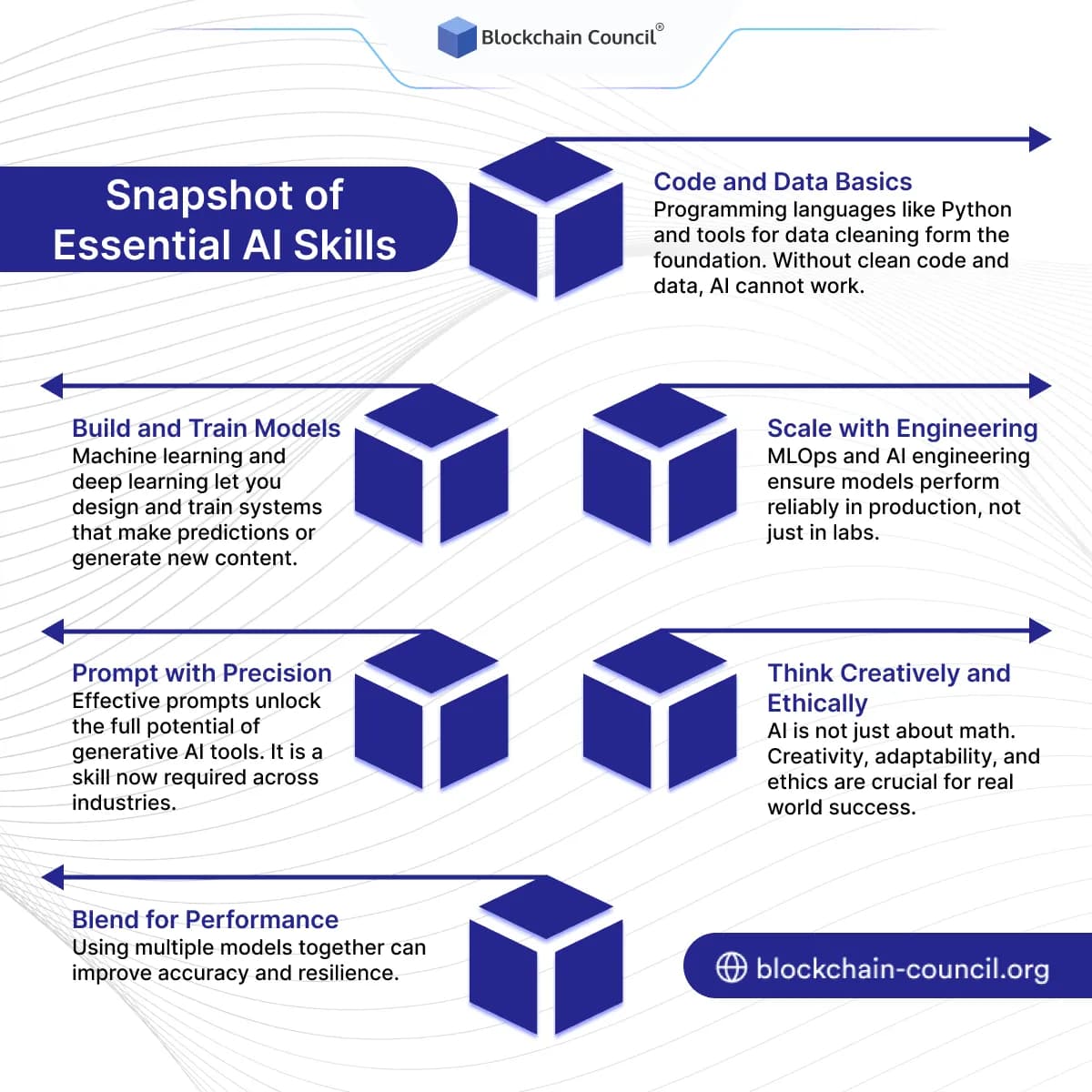
Code and Data Basics
Programming languages like Python and tools for data cleaning form the foundation. Without clean code and data, AI cannot work.
Build and Train Models
Machine learning and deep learning let you design and train systems that make predictions or generate new content.
Scale with Engineering
MLOps and AI engineering ensure models perform reliably in production, not just in labs.
Blend for Performance
Using multiple models together can improve accuracy and resilience.
Prompt with Precision
Effective prompts unlock the full potential of generative AI tools. It is a skill now required across industries.
Think Creatively and Ethically
AI is not just about math. Creativity, adaptability, and ethics are crucial for real-world success.
This snapshot captures the mix of technical and human skills needed to thrive in AI today.
Why Soft Skills Matter in AI
Technical expertise alone is not enough. Employers now expect adaptability, creativity, and critical thinking. These skills help workers use AI tools in smart, ethical, and innovative ways.
For example, prompt engineering combines communication and creativity. AI literacy combines judgment and awareness. These skills allow teams to use AI responsibly and get better results.
Industry Demand and Job Outlook
The demand for AI skills is growing fast across every industry. Companies are training employees in AI basics and paying premium salaries for advanced expertise.
Early-career professionals with AI skills are already earning salaries over $190,000 at leading tech firms. At the same time, non-technical employees are learning to use AI tools in daily work. By 2030, digital literacy will mean AI literacy—knowing how to use, check, and question AI systems.
Employers want people who can code, people who can think critically, and people who can guide AI projects strategically. This is why a combination of AI certs and practical skills is so valuable.
Growing Your AI Skillset
Building your AI career does not happen overnight, but there is a clear path. Start with fundamentals, then add advanced certifications and real-world practice.
Data professionals can grow by pursuing the Data Science Certification. Leaders aiming to shape business strategies around AI can prepare with the Marketing and Business Certification. Together, these AI certs cover the technical and strategic sides of AI adoption.
Conclusion
The types of artificial intelligence skills you need fall into three categories: technical, engineering, and human interaction. Technical skills like programming and model training form the base. Engineering skills like MLOps and blended AI make systems scale. Human-centered skills like prompt engineering and creativity ensure AI is used responsibly.
For professionals, the opportunity is clear. Build both technical and soft skills. Validate your expertise with certifications. Stay adaptable and curious. AI is reshaping the workforce, and those who master these skills will be in the best position to thrive.
Related Articles
View All
AI & ML
Mirofish: How This Open-Source Swarm Intelligence AI Tool Simulates Possible Futures
Mirofish is an open-source AI swarm intelligence engine that simulates social dynamics with autonomous agents to explore possible futures for markets, marketing, and public opinion.

AI & ML
How AI Certifications Help Professionals Build AI Skills and Stay Relevant in 2026
AI certifications help professionals build job-ready AI skills for 2026, proving practical ability in deployment, governance, security, and agentic AI across industries.

AI & ML
From Hello, World! to AI for Kids: Skills That Actually Prepare Students for the Future
AI for Kids is shifting from basic coding to AI literacy: prompting, critical thinking, ethics, and tool use. Learn what skills truly prepare students for an AI future.
Trending Articles
The Role of Blockchain in Ethical AI Development
How blockchain technology is being used to promote transparency and accountability in artificial intelligence systems.

AWS Career Roadmap
A step-by-step guide to building a successful career in Amazon Web Services cloud computing.
Top 5 DeFi Platforms
Explore the leading decentralized finance platforms and what makes each one unique in the evolving DeFi landscape.