
Tether Introduces Privacy Focused Health Platform With On Device AI

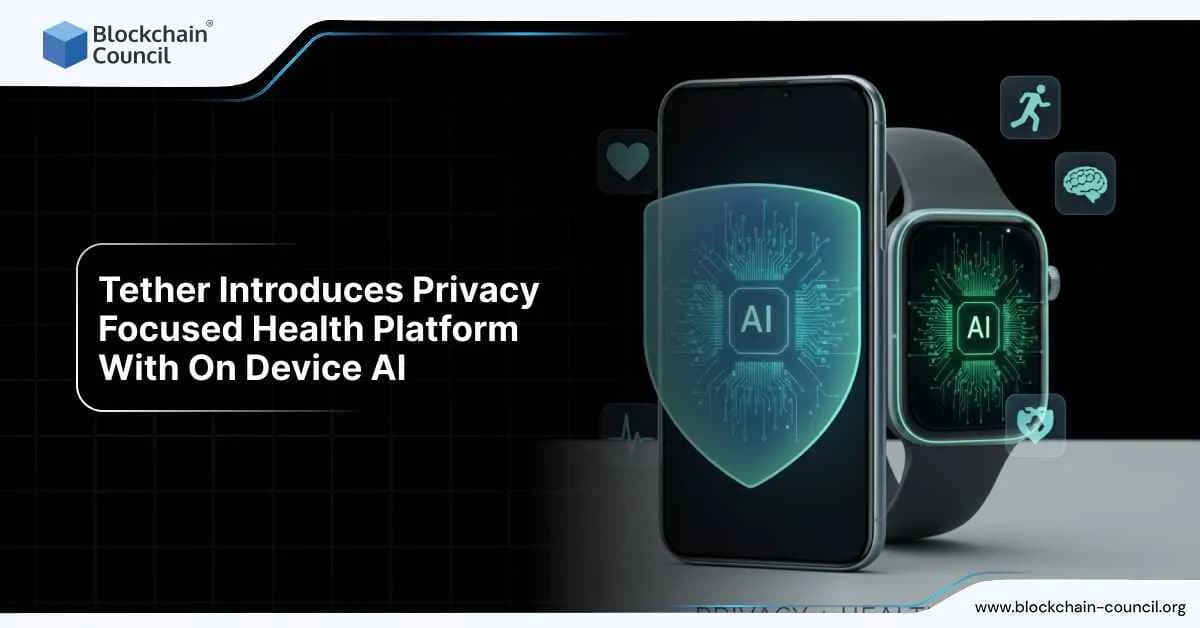
Tether has introduced QVAC Health, a new privacy first wellness platform that uses on device artificial intelligence to process health data directly on a user’s device instead of the cloud. This launch signals a major strategic shift for Tether as it expands beyond digital assets into secure personal technology. Companies and developers exploring this growing intersection of privacy, AI and user controlled data frequently build foundational knowledge with programs like the Blockchain Technology Course because the principles behind decentralization and user data sovereignty are central to QVAC Health’s design.
What QVAC Health Actually Is
QVAC Health is a unified wellness platform that aggregates data from multiple wearables and health apps into a single encrypted dashboard. Instead of routing user data through cloud servers or third party AI providers, QVAC Health processes everything directly on the user’s device. This ensures that biometric information, sleep analysis, fitness metrics and nutrition entries remain private and locally stored.

The app supports integrations with popular data sources such as Apple Health, Oura Ring, Google Health and other mainstream wearables. Users can analyze step counts, workouts, sleep quality, symptom logs, meal photos and medication history in one place without worrying about centralized data archives.
The Core Technology: On Device AI
A defining feature of QVAC Health is its use of on device artificial intelligence. All computation happens on the user’s hardware, including:
- Computer vision for analyzing food photos
- Natural language processing for voice or text based health logging
- Pattern detection in sleep, stress or movement data
- Consolidation of multi source biometric inputs
- Suggestive insights generated through local inference models
Because the AI runs on device, the system does not upload health data to remote servers. Tether also implemented a peer to peer update mechanism, allowing models to be distributed and upgraded without relying on centralized cloud infrastructure.
This type of architecture reflects a growing trend toward privacy preserving AI. Teams working in this direction often enhance their understanding of model behavior and secure deployment through programs like the AI Certification because on device intelligence requires careful engineering across both machine learning and privacy domains.
Why Tether Is Building a Health Platform
Tether’s expansion into personal health technology may seem unexpected, but it aligns with several broader shifts:
- Users are becoming increasingly uncomfortable with large tech companies storing sensitive biometric data.
- Governments are refining privacy laws that restrict how organizations collect and use health information.
- Wearables and fitness apps are producing more data than ever, yet fragmentation limits the usefulness of that information.
- On device intelligence is emerging as a viable alternative to cloud dominated AI architectures.
Paolo Ardoino, Tether’s CEO, emphasized that QVAC Health is designed to create a neutral, privacy preserving environment where individuals can consolidate and analyze their own health metrics without surveillance or data harvesting.
What Users Can Do With QVAC Health
QVAC Health provides several advanced features that differentiate it from traditional wellness apps.
Unified biometric dashboard
Instead of switching between multiple health apps, users can view steps, heart related metrics, sleep cycles, caloric intake and exercise logs within one secure interface.
Natural language health logging
Users can describe symptoms, mood changes, training sessions or meal details in everyday language and the on device NLP engine will categorize the information appropriately.
Food and nutrition analysis
The app uses computer vision to estimate calories and macronutrients from food photos. Since this analysis runs locally, no images are uploaded to external servers.
Encrypted storage
All personal information is encrypted and stored on the device, giving users complete control over their data.
Offline operation
AI functions continue working even without network connectivity, reinforcing user privacy.
Professionals working with data rich applications often expand their technical readiness using programs such as the Tech Certification because systems like QVAC Health require strong understanding of edge computing, encryption and distributed model deployment.
Key Features of Tether’s Privacy Focused Health Platform
| Category | Function | Why It Matters |
| On device AI | NLP, computer vision, pattern detection | Protects personal data from cloud exposure |
| Data integration | Apple Health, Oura, Google Health and others | Eliminates fragmentation across multiple apps |
| Local encryption | All health data stored securely on device | Enables full user data sovereignty |
| Offline capability | Works without internet connection | Ensures privacy and reliability |
| P2P model updates | Decentralized update distribution | Reduces dependency on centralized cloud systems |
This structure showcases why QVAC Health stands apart from conventional health trackers.
Risks and Challenges
Launching a privacy focused health ecosystem introduces several engineering and adoption challenges.
Model accuracy
On device AI is limited by hardware capabilities. Older devices may reduce accuracy or speed.
Regulatory scrutiny
Health data is highly regulated. Even with local processing, compliance requires careful ongoing attention.
User education
Individuals may misunderstand what on device privacy guarantees and what it does not. Clear communication is essential.
Wearable ecosystem complexity
Different wearables have different data formats and permissions. Maintaining uniform integrations is a continuous effort.
Limited cloud benefits
Cloud based AI can leverage larger models. On device execution trades power for privacy.
These challenges do not diminish the platform’s importance but highlight areas where Tether must innovate.
Why This Matters for the Future of Personal Health AI
QVAC Health enters the market at a moment when users demand more control over their data. The model of centralized health analytics is increasingly questioned. Platforms that respect privacy, operate locally and empower individuals to own their personal health history are becoming more relevant.
In a world where decentralized computing and personal ownership are rising trends, the architecture behind QVAC Health reflects a broader shift in technology philosophy. Health data does not need to leave the user’s device to be useful. AI does not need to run on a central server to be powerful.
Organizations exploring new digital health products, wellness ecosystems or data ethics strategies often find value in broader business education such as the Marketing and Business Certification because privacy first systems create new expectations for user experience, transparency and brand trust.
Final Thoughts
Tether’s introduction of QVAC Health marks one of the most significant moves toward privacy centered AI in the consumer wellness market. By combining on device processing, encrypted storage, multi source integration and peer to peer model updates, the platform demonstrates what the next generation of health technology can look like. Instead of trading convenience for privacy, QVAC Health attempts to deliver both.
Related Articles
View All
AI & ML
How NemoClaw Secures AI Agents: Sandbox, Policies & Privacy Controls
Explore sandboxing and policy controls in NemoClaw.

AI & ML
What Is OpenClaw? Complete Guide to the Open-Source AI Agent Platform (2026)
OpenClaw is an open-source AI agent platform that lets you automate tasks, run workflows, and control systems locally with powerful integrations.

AI & ML
Freelancing with Vibe Coding Skills
Learn how vibe coding empowers freelancers to deliver faster, smarter, and more efficient AI-driven projects.
Trending Articles

The Role of Blockchain in Ethical AI Development
How blockchain technology is being used to promote transparency and accountability in artificial intelligence systems.

AWS Career Roadmap
A step-by-step guide to building a successful career in Amazon Web Services cloud computing.

Top 5 DeFi Platforms
Explore the leading decentralized finance platforms and what makes each one unique in the evolving DeFi landscape.