

Strategic AI Program Management
 Michael Willson
Strategic AI program management is the structured way to move AI from isolated pilots to enterprise-wide value. It gives leaders a roadmap for choosing the right use cases, managing risks, and proving ROI. Without it, AI stays stuck in experiments that never scale. For many professionals, getting started often means upskilling through an AI Certification to understand both opportunities and risks.
What Is Strategic AI Program Management
Program management for AI is bigger than single projects. It looks at the entire portfolio, connects initiatives to business goals, and ensures that they deliver real results.

It also means putting in place the right governance, handling compliance, and setting up repeatable processes. This approach ensures AI is not just a shiny new tool but a reliable driver of business growth.
Why 2025 Is a Turning Point
This year has raised the bar for AI leaders everywhere. The EU AI Act now requires detailed documentation, transparency, and safety checks. These rules apply not only to European firms but also to anyone selling AI into the EU market.
At the same time, U.S. policy has tilted toward innovation, leaving standards like NIST AI RMF and ISO certifications as the main guides. On top of regulation, the rise of agentic AI systems has created new questions about governance, safety, and business use.
The Operating Model
Chief AI Officer
The Chief AI Officer is increasingly a must-have. This role ensures AI aligns with company strategy, balances risk, and drives adoption across departments.
A CAIO also coordinates with the CIO and CFO, making sure that technical efforts are matched with financial and operational goals.
Program Management Office
The PMO creates consistency and accountability. It ensures policies are applied across projects and audits are carried out.
It also gives program managers the tools and methods to track delivery, compliance, and business outcomes.
AI Center of Excellence
The CoE centralizes expertise and resources. It provides reusable tools, technical guidance, and training to different teams.
This reduces duplication, speeds up adoption, and ensures every team works from the same trusted playbook.
Governance and Standards
AI is no longer optional when it comes to governance. New regulations and standards now define how companies must build and scale AI.
- EU AI Act requires companies to classify systems by risk and meet documentation obligations. General-purpose AI is covered under a new code of practice.
- ISO/IEC 42001 sets a framework for AI management systems, guiding roles, audits, and responsibilities.
- ISO/IEC 23894 provides detailed methods for managing risk across the lifecycle.
- NIST AI RMF offers steps to map, measure, and manage AI risks, with profiles now available for generative AI.
These standards build trust with regulators and customers and make scaling easier.
Key Pillars of Strategic AI Program Management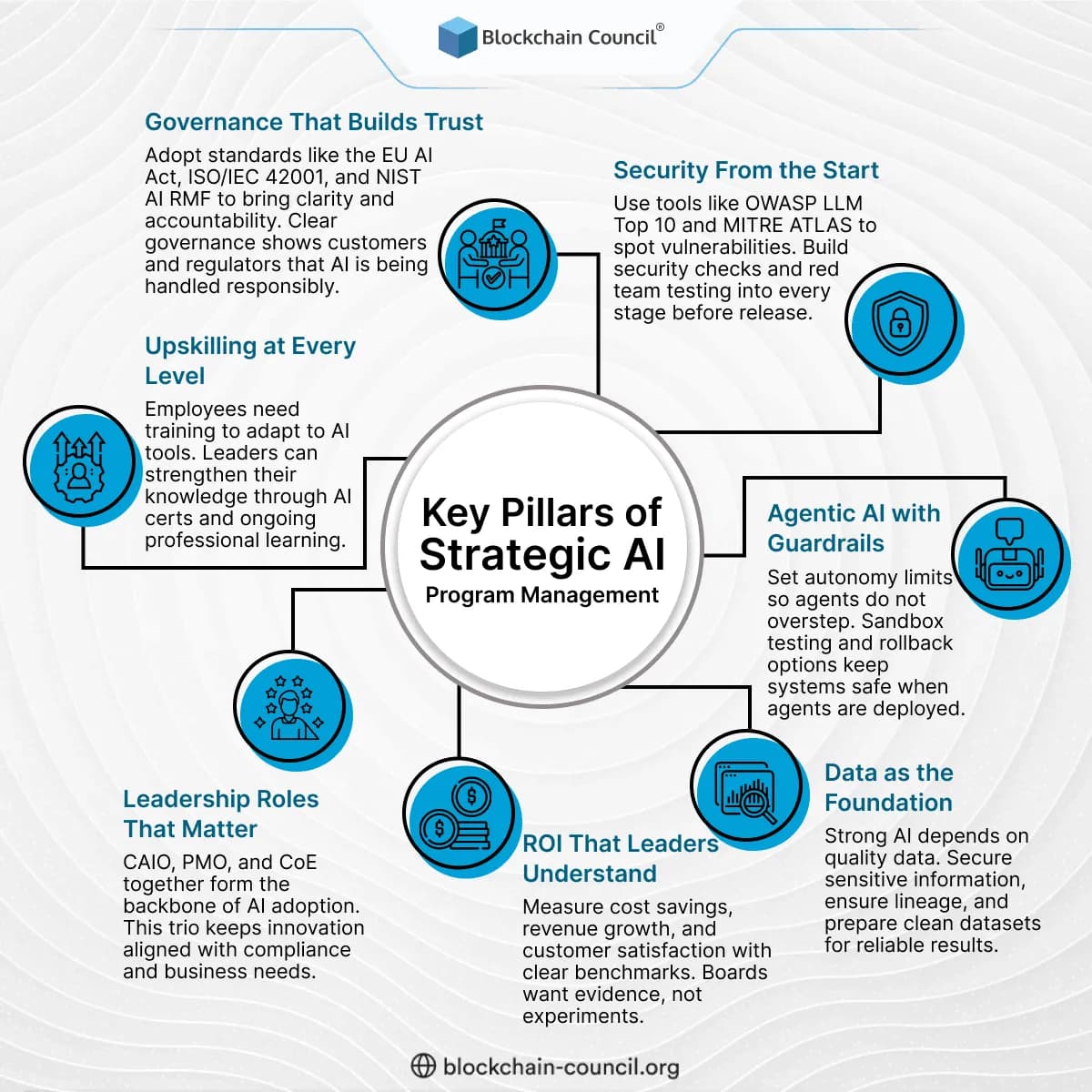
Governance That Builds Trust
Adopt standards like the EU AI Act, ISO/IEC 42001, and NIST AI RMF to bring clarity and accountability. Clear governance shows customers and regulators that AI is being handled responsibly.
Security From the Start
Use tools like OWASP LLM Top 10 and MITRE ATLAS to spot vulnerabilities. Build security checks and red-team testing into every stage before release.
Agentic AI with Guardrails
Set autonomy limits so agents do not overstep. Sandbox testing and rollback options keep systems safe when agents are deployed.
Data as the Foundation
Strong AI depends on quality data. Secure sensitive information, ensure lineage, and prepare clean datasets for reliable results.
ROI That Leaders Understand
Measure cost savings, revenue growth, and customer satisfaction with clear benchmarks. Boards want evidence, not experiments.
Leadership Roles That Matter
CAIO, PMO, and CoE together form the backbone of AI adoption. This trio keeps innovation aligned with compliance and business needs.
Upskilling at Every Level
Employees need training to adapt to AI tools. Leaders can strengthen their knowledge through AI certs and ongoing professional learning.
Security by Design
AI systems face attacks ranging from prompt injection to data poisoning. A weak system can damage reputation overnight.
By using frameworks like OWASP, MITRE ATLAS, and secure-by-default practices, companies can defend their AI assets and build trust.
Agentic AI and Autonomy
Agentic AI is no longer theory. These systems can take actions such as scheduling or automating workflows.
The benefits are huge, but risks are equally large. That is why program managers must set guardrails, define autonomy levels, and control deployment carefully.
Data as a Foundation
No AI program can succeed without strong data. Poor data quality leads to unreliable outcomes and compliance risks.
Program managers need to track data lineage, isolate sensitive data, and ensure it meets legal and ethical standards.
Measuring ROI
ROI is the metric that decides whether AI becomes mainstream in a company. Leaders expect numbers, not promises.
Program managers should track productivity gains, cost avoidance, and customer impact. Regular reviews keep projects accountable and aligned with strategy.
Change Management and Skills
AI changes how employees work. Without training and communication, resistance can slow adoption.
Upskilling is essential. Data teams can expand their knowledge with the Data Science Certification, while business leaders can prepare for market shifts through the Marketing and Business Certification. Together, these along with AI certs give teams the skills to lead change.
Common Pitfalls to Avoid
Companies often fall short by running pilots without scaling, ignoring compliance, or underestimating security risks.
Other mistakes include failing to measure ROI or forgetting to train staff. Program management reduces these risks by keeping projects aligned, secure, and results-driven.
Conclusion
Strategic AI program management is now essential for any organization serious about AI. Regulations, standards, and technologies in 2025 demand a structured, accountable approach.
By combining governance, security, strong data practices, and ROI tracking, leaders can make AI part of everyday business. Those who continue with uncoordinated pilots risk being left behind.
Related Articles
View All
AI & ML
How to Use GPT-6 Astra for Free
Find out whether GPT-6 Astra is available for free, which ChatGPT plans currently include access, and what options users have for trying OpenAI’s latest AI model.
AI & ML
Fable vs GPT: Fable 5.1 vs GPT-6 Astra Compared
A practical Fable vs GPT comparison covering Fable 5.1, GPT-6 Astra, Claude, ChatGPT, benchmarks, pricing, and real enterprise use cases.

AI & ML
GPT 6 Astra: What OpenAI's New Frontier LLM Means for AI, Cybersecurity, and Work
GPT 6 Astra is OpenAI's new frontier LLM, with gated access, Critical cybersecurity capability, and major implications for ChatGPT, developers, and enterprises.
Trending Articles
The Role of Blockchain in Ethical AI Development
How blockchain technology is being used to promote transparency and accountability in artificial intelligence systems.
AWS Career Roadmap
A step-by-step guide to building a successful career in Amazon Web Services cloud computing.
Claude AI Tools for Productivity
Discover Claude AI tools for productivity to streamline tasks, manage workflows, and improve efficiency.