
How to Stay Relevant in Your Job as AI Agents Are Rising

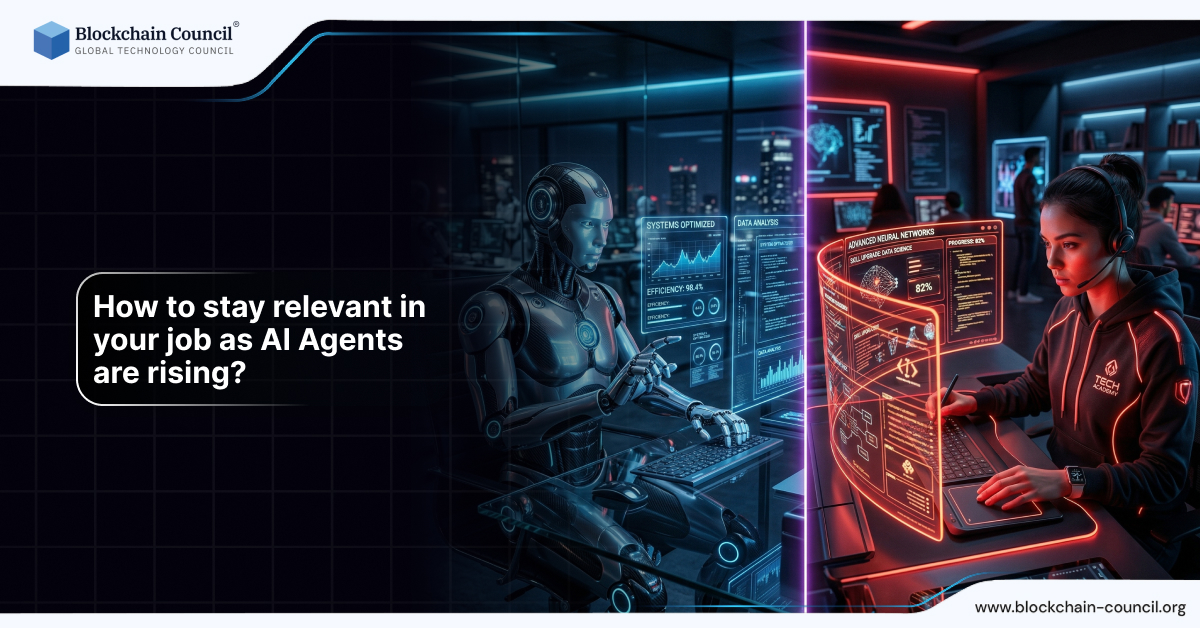
The question that millions of professionals are quietly asking themselves right now is not whether AI will affect their work. It is whether their work will still exist in the form they know it today. The rise of AI agents, systems capable of autonomously planning and executing complex, multi-step tasks across entire workflows, is accelerating a transformation of the modern workplace that is more structural and more rapid than any previous wave of technological change.
Unlike earlier automation technologies that targeted discrete, repetitive physical tasks, AI agents are moving into cognitive work: drafting communications, analyzing data, managing customer relationships, writing and reviewing code, conducting research, coordinating project workflows, and making routine decisions. The range of professional roles affected is broad, spanning software development, marketing, finance, legal services, human resources, and operations. No industry and no seniority level is insulated from this shift.

Yet the story of AI agents in the workplace is not simply a story of displacement. It is, more accurately, a story of transformation. The professionals who will thrive in the coming decade are not those who avoid AI or those who are replaced by it, but those who understand it deeply, direct it strategically, and build the human capabilities that AI consistently cannot replicate. For professionals who want to lead rather than follow in this transformation, formal expertise in autonomous AI systems is an increasingly powerful differentiator. An Agentic AI certification provides the structured knowledge of how AI agents work, how they are deployed, and how they are governed, equipping professionals with the foundational expertise to work alongside these systems as authoritative collaborators rather than passive bystanders.
This article provides a comprehensive, actionable guide for professionals at every career stage who want to understand what AI agents are doing to the job market, whose capabilities remain distinctly human, and how to invest in the skills, mindset, and credentials that will sustain and advance their careers in an AI-agent-driven world.
Understanding What AI Agents Can and Cannot Do
The first step in developing a strategy for staying relevant is developing an accurate understanding of AI agents' actual capabilities and genuine limitations. Both overestimating and underestimating AI leads to poor career decisions.
What AI Agents Are Currently Capable Of
AI agents in 2025 can autonomously execute a remarkable range of professional tasks. In software development, they can read an entire codebase, identify a bug from a natural language issue description, implement a fix, write a regression test, and open a pull request, all without human direction at each step. In sales and marketing, they can research target accounts, draft personalized outreach, manage multi-touch follow-up sequences, update CRM records, and analyze campaign performance across channels. In legal and financial services, they can review contracts for standard clauses, flag deviations from templates, extract financial data from unstructured documents, and generate structured summaries for human review.
The common thread in all of these applications is that AI agents excel at tasks that are clearly defined, information-rich, repetitive in structure, and evaluable against objective criteria. When the goal is clear, the inputs are available, and the success criteria can be specified, AI agents can often match or exceed the speed and consistency of human performance at a fraction of the cost.
Where AI Agents Consistently Fall Short
AI agents have well-documented and persistent limitations that create enduring zones of human irreplaceability. They cannot exercise genuine strategic judgment in novel, ambiguous situations where the criteria for success are themselves contested. They cannot build authentic human relationships, earn trust through demonstrated character, or navigate the political and social dynamics of organizational life. They cannot apply deep ethical reasoning to genuinely complex moral dilemmas where values conflict and context is everything. They cannot generate truly original creative visions that emerge from lived human experience, cultural understanding, and emotional depth.
Perhaps most importantly, AI agents cannot supervise, evaluate, and correct each other with the kind of principled, contextual judgment that prevents compounding errors in complex systems. Human oversight of AI outputs, by people who understand both the domain and the AI system well enough to recognize when something is wrong, remains a critical and growing professional function.
The Shift in the Value of Human Work
Understanding how the value of human work is shifting, not disappearing but transforming, is essential for designing a coherent career development strategy in the AI agent era.
From Execution to Direction and Judgment
The most significant shift is the migration of value from execution to direction and judgment. Work that involved executing defined processes with skill and speed is increasingly automatable. Work that involves determining which processes to execute, evaluating whether they are producing the right outcomes, and exercising judgment about how to adapt when they are not, is becoming more valuable. This is not a new pattern in technological disruption, but it is occurring at an unprecedented pace and across a much broader range of cognitive domains than previous waves of automation.
Real-world example: a content marketing team that previously spent 70 percent of its time producing content and 30 percent on strategy now uses AI agents to handle content production, spending 70 percent of its time on strategy, editorial judgment, brand voice direction, and creative oversight. The individuals who thrived in this transition were those who had invested in strategic marketing capabilities, not just production skills. Those who had only developed execution skills found their roles diminished.
The Rising Premium on Distinctly Human Capabilities
Several categories of human capability are experiencing rising organizational demand precisely because AI agents cannot replicate them. Empathy and interpersonal intelligence, the ability to understand and respond to human emotional states and to build genuine trust through personal interaction, remain deeply human. Complex ethical reasoning, the capacity to navigate situations where legitimate values conflict and where the right answer is not derivable from data, is irreducibly human. Creative leadership, the ability to inspire original thinking, to establish a compelling vision, and to create the cultural conditions in which innovation flourishes, requires human presence and human example. Organizational influence, the ability to build coalitions, navigate politics, and drive change through relationships, is a fundamentally social capability that AI cannot substitute.
Professionals who have invested in developing these capabilities have a natural resilience to AI-driven role displacement that those who have focused exclusively on technical execution skills do not.
Strategy 1: Become the Expert Who Directs and Governs AI Agents
The most direct strategy for staying relevant as AI agents rise is to become the professional who understands, directs, and governs those agents. Every deployed AI agent requires human oversight: someone who understands its capabilities and limitations, who evaluates its outputs for quality and alignment, who refines its instructions to improve performance, and who intervenes when it behaves unexpectedly. This is not a temporary transition role. It is a permanent and growing professional function.
Agent Supervision as a Core Professional Skill
Agent supervision is an emerging professional skill that is already creating meaningful career differentiation across industries. In software development, engineers who can design agentic coding workflows, evaluate agent-generated code at scale, and build the testing and monitoring infrastructure that makes agentic development reliable are in high demand. In marketing, professionals who can design multi-agent content and campaign workflows, set the brand and strategic guardrails within which agents operate, and evaluate the quality and effectiveness of agent-generated outputs are becoming indispensable team members. In operations, managers who understand how to structure goals for agentic systems, define appropriate autonomy boundaries, and build the escalation protocols that ensure human judgment is applied at the right moments are building roles that AI itself cannot fill.
Formal AI Expertise as a Career Foundation
Building agent supervision and governance capability on a foundation of formal AI expertise is significantly more effective than developing it through informal experience alone. An AI expert certification provides a comprehensive understanding of AI principles, machine learning concepts, and AI system architectures that allows professionals to engage with AI agents as informed supervisors rather than passive users. This foundational knowledge makes the difference between professionals who can identify subtle AI errors and those who cannot, between those who can advocate credibly for AI governance improvements and those who simply escalate problems upward.
Strategy 2: Build Deep Technical Foundations That AI Augments
The professional skills that are most resilient to AI displacement are those that are deep, domain-specific, and contextually rich in ways that allow practitioners to evaluate, refine, and direct AI-generated outputs with genuine authority. Building this kind of depth, rather than relying on AI to substitute for it, is a core career strategy for the AI agent era.
Python as the Language of AI-Era Professionals
Python has become the foundational programming language of the AI ecosystem. The frameworks that build and orchestrate AI agents, the data pipelines that feed them, the evaluation systems that assess their performance, and the automation workflows that deploy them are predominantly Python-based. For technology professionals, data analysts, researchers, and increasingly for professionals in adjacent fields such as finance, marketing, and operations, Python proficiency is transitioning from a specialist capability to a baseline professional expectation.
A structured python certification provides the rigorous, comprehensive Python knowledge that allows professionals to work confidently with AI systems, build custom automation workflows, evaluate and modify AI-generated code, and contribute meaningfully to AI system design discussions. This is not merely a technical skill. It is a professional enabler that expands the range of AI-related work a practitioner can credibly take on and evaluate.
Server-Side Architecture and API Integration
Many of the most valuable professional applications of AI agents involve integrating them with existing organizational systems: connecting AI-generated outputs to operational databases, building the API layers through which agents interact with enterprise software, and managing the real-time data flows that feed agent decision-making. Node.js is a widely used technology in this integration layer, valued for its event-driven architecture and compatibility with the JSON-based API ecosystems through which modern AI services communicate.
Professionals who develop server-side systems knowledge through a formal node.js certification are well positioned to design and evaluate the technical infrastructure that connects AI agents to organizational systems. This is a layer of work that requires both technical understanding and organizational context, combining AI literacy with knowledge of how enterprise systems actually function, a combination that remains distinctly human in the depth of judgment it requires.
Domain Expertise as an Irreplaceable Multiplier
Deep domain expertise, whether in finance, medicine, law, engineering, or any other specialized field, remains one of the most powerful forms of career resilience in the AI agent era. AI agents can generate technically plausible outputs across many domains, but they cannot evaluate those outputs against the nuanced, contextually rich standards of a genuine domain expert. The radiologist who understands not just how to read a scan but how to integrate imaging findings with clinical context, patient history, and institutional norms is not replaceable by an AI that can detect patterns in images. The corporate attorney who understands not just contract language but client relationships, risk tolerance, business context, and negotiation dynamics is not replaceable by an AI that can review documents for standard clauses.
Professionals who invest in deepening their domain expertise while simultaneously developing AI literacy and agent supervision skills are building the rarest and most defensible professional profiles in the AI-transformed job market.
Strategy 3: Specialize in AI-Augmented Domains with Growing Demand
Some professional domains are being transformed by AI agents in ways that are creating new roles and expanding demand for human practitioners with the right skill combinations, rather than reducing overall employment. Identifying and targeting these domains is a strategic opportunity for professionals planning their career development.
AI-Powered Marketing and Digital Strategy
Digital marketing is one of the domains undergoing the most rapid AI-driven transformation. AI agents can generate content, manage campaign workflows, optimize bidding strategies, personalize customer communications at scale, and analyze performance data continuously. But the strategic layer of marketing, defining brand positioning, interpreting cultural trends, designing customer experience architectures, and making the creative and ethical judgments that shape brand identity, requires human expertise that is growing in organizational value as AI handles more of the execution.
Marketing professionals who understand both how AI tools work and how to apply them within a sound strategic and ethical framework are in strong and growing demand. An AI Powered digital marketing certification provides exactly this combination: the integration of AI tool proficiency with strategic digital marketing knowledge that equips professionals to lead AI-powered marketing functions rather than simply execute within them. As organizations scale their marketing capacity with AI, the professionals who can govern and direct that scaling with strategic clarity become the critical human link in the marketing chain.
AI Governance, Ethics, and Compliance
A growing category of professional roles is emerging specifically to address the governance, ethical oversight, and regulatory compliance dimensions of AI deployment. These roles require a combination of AI technical knowledge, legal and regulatory understanding, organizational policy expertise, and the interpersonal skills needed to communicate AI governance requirements across diverse stakeholder groups. They are roles that AI itself cannot fill, because they exist specifically to ensure that AI is deployed responsibly by human organizations.
Professionals who develop this combination of technical AI knowledge, governance expertise, and policy communication skills are entering a field with strong and growing demand, particularly as AI legislation in major markets creates formal compliance requirements that organizations must meet. This is a field where an AI expert certification provides the technical foundation, complemented by domain knowledge in law, compliance, or organizational policy, to create a uniquely valuable professional profile.
Agentic AI System Design and Implementation
The professionals who design, build, and deploy the agentic AI systems that are transforming organizations are in exceptionally high demand and are likely to remain so for the foreseeable future. This is specialized work that requires deep technical knowledge of agent architectures, planning systems, tool use frameworks, and multi-agent coordination patterns, combined with the systems thinking and organizational understanding needed to design agents that serve genuine business goals reliably and safely.
Professionals who invest in developing this specialized expertise, through formal programs such as an Agentic AI certification alongside practical implementation experience, are building skills that are both currently scarce and increasingly critical. They are not competing with AI agents. They are the professionals who make AI agents useful, reliable, and trustworthy.
Strategy 4: Invest in Distinctly Human Capabilities
Technical and domain expertise, while necessary, are not sufficient for long-term career resilience in the AI agent era. The professionals who thrive will also be those who have invested in the distinctly human capabilities that AI consistently cannot replicate and that become more organizationally valuable as AI handles more cognitive execution work.
Communication, Narrative, and Influence
The ability to communicate complex ideas with clarity and impact, to construct compelling narratives that motivate action, and to exercise influence through authentic human connection is a capability of growing professional value. AI can generate technically coherent text, but it cannot give a speech that moves an audience to action, negotiate a deal by reading the room in real time, or build the kind of personal credibility that makes leadership communications genuinely persuasive. Professionals who invest in developing their communication and influence capabilities are building a form of career capital that AI cannot devalue.
Systems Thinking and Strategic Reasoning
The ability to understand complex systems, to recognize how changes in one part of an organizational or market system will propagate through to others, and to reason about long-term strategic implications of decisions made under uncertainty is a cognitive capability that AI agents struggle with in genuinely novel and complex situations. Professionals who develop systems thinking and strategic reasoning skills are building the kind of analytical depth that makes their judgment genuinely valuable in contexts where AI-generated analysis reaches its limits.
Adaptability and Continuous Learning
Perhaps the most important metacapability for career relevance in an era of rapid AI advancement is adaptability: the ability to recognize when the professional landscape is shifting, to identify which new capabilities are becoming important, and to learn them efficiently and apply them effectively. Professionals who have built strong learning habits, who regularly engage with new ideas and new tools, and who treat their professional development as an ongoing investment rather than a periodic event are structurally better positioned to stay relevant through technological transitions than those who rely on established expertise without refreshing it.
Strategy 5: Build Your Professional Brand Around AI Fluency
In a job market increasingly shaped by AI, the professionals who are most visible and most valued are those who are publicly associated with AI expertise and AI-augmented work. Building a professional brand around AI fluency is both a career development strategy and a signal to employers, clients, and collaborators that you are a practitioner who is actively engaging with the most important transformation in the professional landscape.
Demonstrating AI Competence Through Credentials
Professional credentials in AI-related domains serve two purposes simultaneously. They ensure that the knowledge they represent has been developed systematically and completely, rather than through the selective, gap-prone exposure of self-directed learning. And they signal that competence to the external professional world in a verifiable, standardized form that employers, clients, and professional communities can evaluate consistently.
For professionals across all functions, the most directly career-relevant certifications are those that align with both their current domain and the AI transformation of that domain. A python certification demonstrates the programming foundation needed to work with AI systems. A node.js certification demonstrates server-side architecture knowledge relevant to AI system integration. An AI Powered digital marketing certification demonstrates the combination of AI literacy and marketing strategy expertise that is transforming the commercial function. An AI expert certification demonstrates comprehensive AI knowledge suitable for technical leadership and governance roles. And an Agentic AI certification demonstrates frontier expertise in the autonomous systems that represent the most significant current development in AI.
Content, Community, and Thought Leadership
Publishing content about AI applications in your professional domain, contributing to communities where AI tools and techniques are discussed and shared, and taking on visible roles in AI-related initiatives within your organization are all ways of building a professional brand that communicates genuine engagement with AI rather than passive observation of it. The professionals who will be most sought after in the AI agent era are those who are perceived as part of the transformation, not those who are perceived as being transformed against their will.
Conclusion
The rise of AI agents is not the end of human professional relevance. It is a redefinition of what professional relevance means and what it requires. The professionals who will thrive are not those who resist this redefinition or wait for it to resolve itself. They are those who engage with it actively, strategically, and with genuine intellectual curiosity about what the new landscape makes possible.
The strategies outlined in this article, becoming expert directors and governors of AI agents, building deep technical and domain foundations, specializing in AI-augmented domains with growing demand, investing in distinctly human capabilities, and building professional brands around AI fluency, are not mutually exclusive. The most resilient professionals will pursue all of them in some combination, calibrated to their specific domain, their current skill profile, and the particular trajectory of AI adoption in their industry.
The AI agent era will produce extraordinary opportunities for professionals who position themselves well. It will produce genuine disruption for those who do not. The difference between these outcomes is not determined by technology. It is determined by the choices that individual professionals make about how they invest their time, what capabilities they build, which credentials they pursue, and how they present their value to the organizations and clients they serve. The window for making those choices wisely is open. The time to act on it is now.
Frequently Asked Questions (FAQs)
Q1. Will AI agents replace my job?
AI agents will reshape many jobs more than fully replace them. People who combine AI fluency with strong human skills like judgment, creativity, and leadership will be the most resilient.
Q2. What is an AI agent?
An AI agent can plan and carry out multi-step tasks on its own using tools like browsers, APIs, and software. Unlike regular AI tools, it can manage parts of a workflow with less human input.
Q3. Which industries are most affected?
Software, marketing, legal, finance, customer service, sales, and HR are already seeing major impact. In reality, most knowledge-work industries will be affected.
Q4. What technical skills should I develop?
Focus on skills that help you work with and evaluate AI, especially Python, AI systems knowledge, and agentic AI. Node.js is also useful for integration and technical architecture roles.
Q5. How can marketing professionals stay relevant?
They should shift from routine execution to strategy, brand judgment, creative oversight, and AI governance. AI may produce content, but humans still direct meaning and market fit.
Q6. What non-technical skills matter most?
The most valuable are empathy, ethical judgment, communication, leadership, and adaptability. Those are the things machines keep trying to imitate and keep fumbling.
Q7. Should I pursue certifications?
Yes. Certifications build structured knowledge and make your skills easier to prove to employers or clients, especially in AI, agentic AI, Python, Node.js, or AI-powered marketing.
Q8. What should I think about AI agents at work?
Treat them like capable but imperfect junior colleagues. They can handle execution, but humans still need to provide direction, review, and accountability.
Q9. How can I show AI fluency without being an engineer?
Use AI visibly in your work, earn relevant certifications, lead small AI projects, and show that you can guide and improve AI outputs effectively.
Q10. What is the best career investment right now?
Build practical AI fluency in your field through structured learning and real-world use. The best path depends on your role, but generic awareness is not enough anymore.
Related Articles
View All
AI & ML
NemoClaw + Open Models: Nemotron, OpenShell & Self-Evolving Agents
Discover how NemoClaw works with open AI models like Nemotron.

AI & ML
How NemoClaw Secures AI Agents: Sandbox, Policies & Privacy Controls
Explore sandboxing and policy controls in NemoClaw.

AI & ML
What Is NemoClaw? NVIDIA’s Secure Layer for AI Agents
Learn what NemoClaw is and how it secures AI agents.
Trending Articles

The Role of Blockchain in Ethical AI Development
How blockchain technology is being used to promote transparency and accountability in artificial intelligence systems.

AWS Career Roadmap
A step-by-step guide to building a successful career in Amazon Web Services cloud computing.

Top 5 DeFi Platforms
Explore the leading decentralized finance platforms and what makes each one unique in the evolving DeFi landscape.