

SLMs vs LLMs
 Michael Willson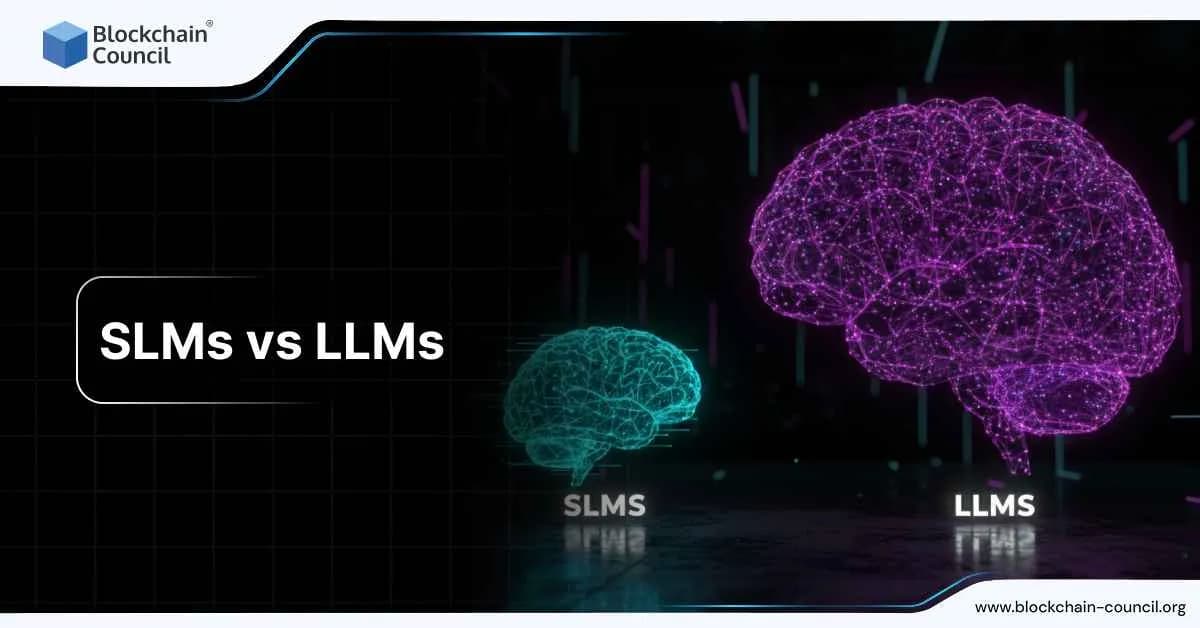
Small Language Models (SLMs) and Large Language Models (LLMs) are built on the same transformer architecture but serve very different purposes. SLMs are smaller, faster, and optimized for privacy and efficiency. LLMs are massive, creative, and general-purpose, designed for reasoning across multiple domains. Knowing the difference helps businesses, developers, and learners choose the right tool for the right job. For professionals looking to build expertise, an AI certification provides structured knowledge of both.
What Are Small Language Models (SLMs)?
A Small Language Model is a compressed AI model with millions to a few billion parameters. They are trained with efficiency in mind, often fine-tuned for narrow or domain-specific use cases. Experts have tested SLMs in mobile keyboards, where they provide predictive text suggestions offline with minimal latency. In healthcare, SLMs have been used to draft patient notes locally, protecting sensitive information from leaving the device. These examples show that SLMs are not just “mini LLMs” but purpose-built systems optimized for speed, privacy, and cost.

What Are Large Language Models (LLMs)?
Large Language Models, by contrast, are designed with tens or even hundreds of billions of parameters. They are trained on massive, multi-domain datasets and excel at generalization. Researchers reported that models like GPT-5.2 and Gemini Ultra can generate essays, software code, or creative content across unrelated subjects within a single session. This makes them powerful, but also resource-heavy. Running LLMs typically requires specialized hardware or cloud infrastructure.
How Do SLMs and LLMs Work?
Both SLMs and LLMs use transformers to predict the next token in a sequence. The difference is in optimization. LLMs rely on size and scale to capture broad knowledge, while SLMs achieve efficiency through compression, quantization, and specialized training.
Techniques That Make SLMs Efficient and LLMs Powerful
| Technique | Role in SLMs | Role in LLMs |
| Knowledge Distillation | A smaller “student” model learns from a larger “teacher” to mimic its outputs, reducing size but retaining ability. | Not used for size reduction, but often used to improve robustness by training auxiliary models. |
| Pruning | Removes less important parameters, shrinking the model. | Rarely applied, as pruning may degrade performance at scale. |
| Quantization | Converts high-precision weights into lower-precision formats to save memory. | Applied only in deployment for efficiency, not during core training. |
| Domain-Focused Training | SLMs are trained on narrower, high-quality datasets to specialize. | LLMs are trained on broad, multi-domain data for general reasoning. |
| Depth and Attention | Fewer transformer layers and simpler attention mechanisms to improve speed. | Many layers and attention heads to handle complex reasoning. |
Experts highlight that this balance allows SLMs to run efficiently on mobile devices, while LLMs dominate in open-ended problem-solving.
Key Differences Between SLMs and LLMs
- Size: SLMs range from millions to a few billion parameters; LLMs range from tens to hundreds of billions.
- Compute Requirements: SLMs can run on laptops and smartphones; LLMs require GPU clusters or cloud servers.
- Privacy: SLMs process data locally, making them suitable for regulated industries; LLMs often require sending data to remote servers.
- Speed: SLMs deliver near real-time responses; LLMs are slower due to their complexity.
- Cost: SLMs are affordable to train and deploy; LLMs require significant resources.
- Scope: SLMs excel at focused tasks; LLMs excel at broad reasoning and creativity.
When to Use SLMs Instead of LLMs
SLMs are the better choice when efficiency and privacy matter most. Expert evaluations show that hospitals deploy medical SLMs to draft documentation quickly without exposing sensitive records. Mobile developers use SLMs for predictive typing and voice input, ensuring users get instant results without internet connectivity. Travel apps rely on SLMs for offline translation, allowing communication even in areas with no network coverage.
Professionals exploring how to apply such systems in real-world workflows can strengthen their knowledge through AI certs designed to cover practical deployment.
When to Use LLMs Instead of SLMs
LLMs remain the right option for complex, creative, or cross-domain tasks. Analysts have demonstrated that GPT-5.2 can generate investment strategies combining insights from blockchain, biotech, and energy sectors. This kind of multi-domain reasoning is currently beyond SLMs. Enterprises also rely on LLMs to support customer service chatbots that handle diverse queries at scale.
For professionals building advanced AI agents that combine LLM reasoning with automation, pursuing an Agentic AI certification ensures the right expertise to manage complexity.
Can SLMs Replace LLMs?
SLMs cannot fully replace LLMs because their strengths are different. Case studies show that SLMs handle routine queries and domain-specific tasks well, while LLMs excel at multi-step reasoning and creativity. Many companies now adopt a hybrid approach, routing simple queries to SLMs to save cost and latency, while reserving LLMs for more challenging tasks.
Why SLMs vs LLMs Matters for the Future of AI
The rise of SLMs demonstrates that AI doesn’t always need to be massive. Efficiency, privacy, and cost are becoming as important as raw intelligence. Experts believe the future will combine both: lightweight SLMs for everyday use and powerful LLMs for high-end reasoning.
For professionals preparing for this future, a Data Science Certification provides the foundation for model development, while a Marketing and Business Certification equips leaders to apply AI in growth strategies. Learners interested in distributed systems can also benefit from blockchain technology courses, where SLMs are beginning to intersect with decentralized data flows.
Conclusion
SLMs and LLMs are complementary technologies. SLMs excel at efficiency, privacy, and affordability, while LLMs dominate in creativity, reasoning, and generalization. Expert evaluations confirm that hybrid AI systems — where SLMs handle everyday tasks and LLMs tackle complexity — are becoming the norm. For professionals, understanding both is essential, and structured certifications provide the path to mastering this balance.
Related Articles
View All
AI & ML
How LLMs Work in Openclaw: Models, Agents, Tools, and Local Setups
Learn how OpenClaw uses LLMs as pluggable reasoning engines for agents, tools, local models, cloud providers, and JSON-based workflows.

AI & ML
Kimi AI and the Future of Chinese LLMs in the Global AI Race
Kimi AI shows how Chinese LLMs are moving into coding, multimodal reasoning, open-weight models, and agentic AI workflows at global scale.
AI & ML
Meet KIMI K3
KIMI K3 is the latest AI model in the Kimi family, designed to deliver stronger reasoning, coding, multilingual capabilities, and agentic workflows. Discover its key features, use cases, and how it compares with other leading AI models.
Trending Articles
What is AWS? A Beginner's Guide to Cloud Computing
Everything you need to know about Amazon Web Services, cloud computing fundamentals, and career opportunities.
How to Create Claude Skills?
Claude Skills are one of the most important features Anthropic has introduced for users who want automation that is structured, consistent and reusable. Instead of giving Claude long instructions ever

Claude Code Vs Cursor
Claude Code vs Cursor compares two AI coding tools based on features, automation, and developer workflows.