

Securing the AI/ML Pipeline End-to-End: From Data Collection to Deployment and Monitoring
 Suyash Raizada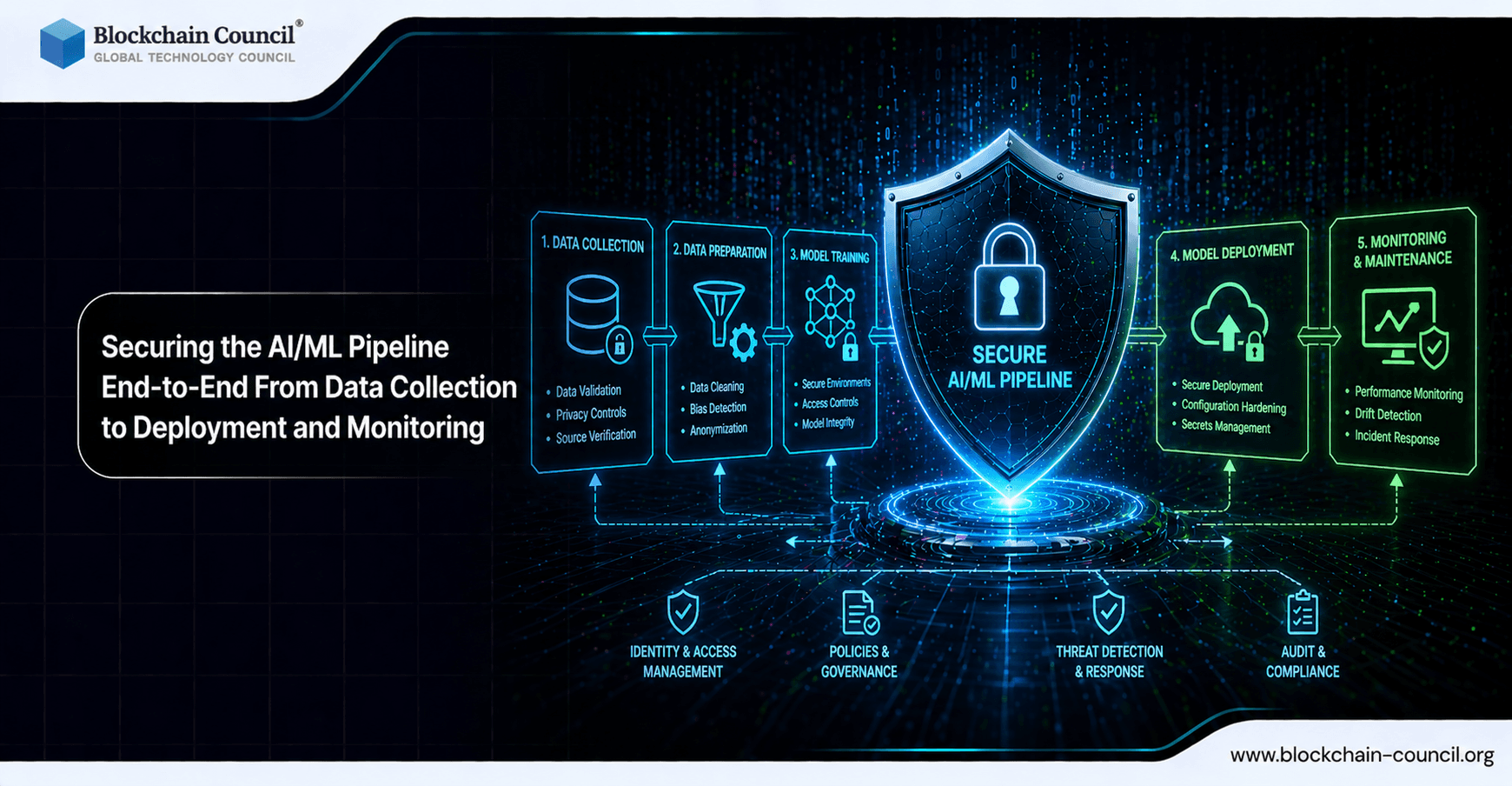
Securing the AI/ML pipeline end-to-end is now a core requirement for organizations deploying machine learning and generative AI in production. Unlike traditional software, AI systems can be compromised not only through code, but also through data, prompts, model artifacts, and the tooling used to build and ship them. Threats like data poisoning, prompt injection, model inversion, and supply-chain attacks can appear at any stage, which makes defense-in-depth and continuous monitoring essential.
Industry research consistently identifies operational gaps as a primary reason many AI initiatives fail to reach production. Gartner has reported that a large share of AI projects stall beyond proof-of-concept due to poor data quality, inadequate monitoring, and weak controls. The practical takeaway is clear: repeatable processes, security guardrails, and observability must be built in from the start.

An AI Certification can help professionals develop expertise in AI governance, deployment, monitoring, and risk management, while a Machine Learning Certification can strengthen understanding of model development, evaluation, performance optimization, and the operational practices required to support reliable AI systems in production environments.
Why Securing the AI/ML Pipeline End-to-End Differs from AppSec
Application security focuses on code, dependencies, and runtime behavior. AI/ML security expands the attack surface in distinct ways:
Data is executable influence: attackers can manipulate training data to change model behavior.
Prompts are an input interface: prompt injection can steer LLM behavior, exfiltrate secrets, or bypass policies.
Models are sensitive artifacts: weights can leak information about training data through inversion or membership inference attacks.
Pipelines are supply chains: datasets, checkpoints, and libraries often come from public sources and must be verified before use.
Modern MLSecOps frameworks adapt software supply-chain practices to AI workflows, drawing on guidance from SLSA, Sigstore, and OpenSSF Scorecard to strengthen provenance, reproducibility, and integrity checks throughout CI/CD.
Threat Model Overview Across the AI/ML Lifecycle
Aligning controls to the threats most likely at each stage is the foundation of a workable security strategy:
Data poisoning: malicious or low-quality records degrade performance or embed backdoors into trained models.
Prompt injection and jailbreaks: crafted inputs cause unsafe actions, policy bypass, or sensitive data leakage.
Model inversion and membership inference: adversaries infer training data characteristics or recover sensitive examples from model outputs.
Supply-chain attacks: tampered datasets, compromised checkpoints, or malicious dependencies in training or serving stacks.
Unauthorized access: weak identity management, poorly configured role-based access control (RBAC), or insecure secrets handling exposes data and model artifacts.
Stage-by-Stage Controls for Securing the AI/ML Pipeline End-to-End
1. Data Collection and Ingestion
Data is often the earliest and most overlooked entry point. Governance and provenance should be treated as first-class controls from the outset.
Data provenance tracking: record source, license, collection method, timestamps, and transformations. Treat data lineage with the same rigor as code change history.
Access controls and segmentation: isolate raw data zones, apply least privilege with RBAC, and require strong identity verification for data pulls.
Encryption: enforce encryption in transit (TLS) and at rest, and protect keys with centralized key management systems (KMS) and rotation policies.
Integrity checks: verify cryptographic hashes for all files, particularly for externally sourced datasets.
Privacy controls: minimize sensitive fields, apply masking or tokenization where appropriate, and define retention policies aligned to regulatory requirements.
2. Data Preprocessing and Feature Engineering
Preprocessing pipelines can silently introduce leakage, bias, or vulnerabilities if they are not tested and versioned consistently.
Version datasets and features: maintain immutable versions of training, validation, and test datasets to support reproducibility and incident response.
Validation gates: enforce schema checks, outlier detection, duplicate detection, and drift checks before data enters training.
Secure execution environments: run ETL jobs with minimal permissions, restrict network egress, and use audited container images.
Secrets hygiene: prevent API keys and credentials from being embedded in notebooks, logs, or feature stores.
Data lifecycle protection also serves as a resilience strategy. Maintaining backups for training and validation sets and keeping immutable, object-locked copies of production model artifacts preserves traceability during investigations.
3. Training and Fine-Tuning
Training is where poisoning, compromised dependencies, and configuration drift can create outcomes that are difficult or impossible to reverse. A compromised training pipeline can render a model permanently untrustworthy.
Reproducible builds for models: pin dependency versions, capture training configurations, and store environment metadata including container images, GPU drivers, and library hashes.
Checkpointing and rollback: maintain periodic snapshots of model states. Checkpointing is a practical control that supports detection of tampering or bias and enables rollback to a known safe state.
Data poisoning detection: use statistical tests and anomaly detection on training batches, label distributions, and embedding clusters to identify injected patterns.
Secure artifact management: store weights, tokenizers, and configurations in controlled registries with RBAC, audit logs, and immutability controls where appropriate.
Model evaluation beyond accuracy: test for robustness, out-of-distribution behavior, and privacy leakage risks alongside standard performance metrics.
4. Model Packaging and Supply-Chain Security (MLSecOps)
Most production AI stacks depend heavily on open-source components. Open-source tools underpin the majority of deployed systems, which makes supply-chain verification a central part of securing the AI/ML pipeline end-to-end.
Signed model artifacts: sign model files and images and verify signatures at deployment time, following the same approach used for signed container workflows.
Provenance attestations: record who trained the model, which data version was used, and which pipeline run and build steps produced the artifact.
Dependency scanning and policy enforcement: scan training and serving dependencies, enforce allowlists, and block known malicious packages.
Dataset and checkpoint verification: verify downloads and prefer authenticated, integrity-checked sources to reduce exposure to tampered artifacts.
AI-specific supply-chain verification still has tooling gaps, which is why many teams extend established controls from software CI/CD into ML workflows rather than building from scratch.
5. Deployment and Inference Security
Deployment introduces runtime risks including adversarial inputs, prompt injection, excessive token usage, and data exfiltration through model responses.
Runtime isolation: use Kubernetes namespaces, network policies, and multi-tenant isolation to reduce blast radius in the event of a compromise.
RBAC and audit logging: enforce least privilege for model endpoints, feature stores, and vector databases. Ensure logs are tamper-resistant and centrally collected.
Prompt security controls: implement input validation, jailbreak detection, tool-use restrictions, and safe output filters for LLM applications.
Rate limiting and circuit breakers: throttle abuse, prevent token spikes, and fail safely when anomalies are detected.
Secret and connector governance: tightly control which external systems the model can call, and scope credentials to minimum required access.
6. Monitoring, Observability, and Incident Response
Comprehensive observability across prompts, model behavior, and infrastructure is consistently cited as one of the most critical and most neglected aspects of production AI. Weak monitoring is a leading contributor to stalled rollouts and undetected security events.
Prompt-response monitoring: track injection patterns, policy violations, and unsafe completion categories. Tools such as LangKit support analysis of prompt-response patterns in LLM applications.
Model performance monitoring: watch latency, error rates, drift, and segmentation metrics to detect silent degradation before it affects users.
Anomaly detection for abuse: metrics systems like Prometheus and dashboards like Grafana can surface token spikes, throughput anomalies, and suspicious access patterns.
Experiment and pipeline tracking: platforms such as Weights and Biases support traceability across runs, metrics, and artifacts.
SIEM integration: forward logs and alerts into centralized security monitoring for correlation with identity and network events.
Build playbooks for AI-specific incidents, including data poisoning suspicion, prompt injection surges, and data leakage indicators. Playbooks should cover rollback steps, artifact quarantine, credential rotation, and post-incident retraining criteria.
Practical End-to-End Checklist
Use this checklist to operationalize AI/ML pipeline security across your organization:
Provenance: dataset lineage, training configurations, and artifact metadata captured automatically at every stage.
Integrity: cryptographic hashes and signatures for datasets, containers, and model artifacts.
Access: RBAC, least privilege, and audited access for data stores, registries, and model endpoints.
Reproducibility: pinned dependencies, repeatable pipelines, and documented execution environments.
Observability: prompt monitoring, drift detection, infrastructure telemetry, and SIEM integration.
Resilience: checkpointing, immutable backups, and defined rollback paths for models and training data.
Skills and Governance for Sustainable MLSecOps
Security controls fail without accountable ownership and skilled operators. Many organizations formalize MLSecOps as a cross-functional discipline spanning ML engineering, platform teams, and security functions. Clear ownership of each pipeline stage - along with defined escalation paths - is as important as the technical controls themselves.
For teams building capability in this area, structured training in AI and ML security, cybersecurity, and blockchain-based integrity and auditability provides a solid foundation. Blockchain Council offers relevant programs including the Certified Artificial Intelligence (AI) Expert, Certified Machine Learning Expert, and cybersecurity certifications that support secure deployment and monitoring practices.
A Marketing Certification can complement these technical skills by helping professionals communicate security priorities, explain AI governance requirements, align risk management initiatives with business objectives, and strengthen stakeholder engagement across the organization.
Conclusion
Securing the AI/ML pipeline end-to-end is not a single tool or point solution. It is a lifecycle discipline built on defense-in-depth: trusted data ingestion, controlled preprocessing, reproducible and auditable training, verified supply chains, hardened deployment, and continuous monitoring. With generative AI, prompt injection, hallucination risks, and new abuse patterns raise the stakes further, making observability and automated response mechanisms increasingly important.
Organizations that treat machine learning as a governed, testable, and monitored production system will reduce failure rates, build stakeholder trust, and be better prepared for compliance and incident response as AI adoption continues to scale.
FAQs
1. What is an AI/ML pipeline?
An AI/ML pipeline is the end-to-end process of building and deploying models. It includes data collection, preprocessing, training, deployment, and monitoring. Each stage has unique security risks.
2. Why is end-to-end security important in AI pipelines?
Threats can occur at any stage of the pipeline. Weakness in one step can compromise the entire system. End-to-end security ensures consistent protection.
3. What are the main stages of an AI/ML pipeline?
Key stages include data collection, data preprocessing, model training, deployment, and monitoring. Each stage requires specific controls. Securing all stages reduces risk.
4. How can data collection be secured in AI systems?
Use trusted data sources and validate incoming data. Apply access controls and encryption. This prevents data poisoning and unauthorized access.
5. What is data preprocessing security?
Preprocessing security ensures that data is cleaned and validated safely. It removes corrupted or malicious inputs. This protects model training quality.
6. How can model training be secured?
Use secure environments, validate datasets, and monitor training processes. Prevent unauthorized access to models and data. This reduces risks of tampering.
7. What are risks during model deployment?
Deployment risks include API vulnerabilities, unauthorized access, and data leakage. Exposed endpoints can be exploited. Secure deployment reduces attack surfaces.
8. How can APIs be secured in AI systems?
Implement authentication, rate limiting, and monitoring. Restrict access to authorized users. Secure APIs prevent misuse and attacks.
9. What is model monitoring in AI pipelines?
Monitoring tracks model performance and system behavior after deployment. It detects anomalies, drift, and security issues. Continuous monitoring ensures reliability.
10. How does model drift affect pipeline security?
Model drift can reduce accuracy and create vulnerabilities. It may lead to incorrect or unsafe outputs. Regular updates and monitoring help mitigate drift.
11. What is data poisoning in AI pipelines?
Data poisoning involves injecting malicious data into the pipeline. It affects model training and outputs. Preventing poisoning is critical for security.
12. How can access control improve pipeline security?
Access control limits who can interact with each stage of the pipeline. It prevents unauthorized changes. Strong controls reduce risk.
13. What role does encryption play in pipeline security?
Encryption protects data during storage and transmission. It ensures confidentiality and integrity. This is essential for secure pipelines.
14. How do you detect anomalies in AI pipelines?
Use monitoring tools and anomaly detection algorithms. Identify unusual patterns in data or outputs. Early detection improves response.
15. What are common tools for securing AI pipelines?
Tools include monitoring platforms, security frameworks, and access management systems. These tools automate protection. Selection depends on system complexity.
16. How does logging improve AI pipeline security?
Logging records system activity and changes. It helps track issues and investigate incidents. Detailed logs support accountability.
17. What is the role of governance in AI pipeline security?
Governance defines policies, roles, and responsibilities. It ensures compliance and structured management. Strong governance supports secure operations.
18. How often should AI pipelines be audited?
Pipelines should be audited regularly and after major updates. Frequent audits identify vulnerabilities early. Continuous review improves security.
19. What are best practices for securing AI pipelines?
Use layered security, validate data, and monitor continuously. Apply least-privilege access and regular testing. Combine automation with human oversight.
20. What is the future of AI/ML pipeline security?
Security will become more automated and integrated across all stages. Advanced tools will improve detection and response. End-to-end protection will be a standard requirement.
Related Articles
View All
AI & ML
Jev Decision-Making Pipeline
Learn how Jev’s decision-making pipeline transforms structured program state and predefined questions into typed, probabilistic decisions for automated software workflows.

AI & ML
Jev Decision Pipeline
Learn how the Jev decision pipeline works, from structured program state and predefined questions to parallel processing, typed outputs, calibrated probabilities, and software actions.

AI & ML
OpenAI Launches GPT-6.1 Terra: What’s New?
OpenAI has launched GPT-6.1 Terra, a faster and cheaper mid-tier model with stronger computer use, better image understanding and fewer errors. See what is new, what it costs, and who can use it.
Trending Articles
AWS Career Roadmap
A step-by-step guide to building a successful career in Amazon Web Services cloud computing.

Top 5 DeFi Platforms
Explore the leading decentralized finance platforms and what makes each one unique in the evolving DeFi landscape.
How Blockchain Secures AI Data
Understand how blockchain technology is being applied to protect the integrity and security of AI training data.