
OpenAI’s GPT-5
 Michael Willson
OpenAI’s GPT-5 is the next-generation language model set to succeed GPT-4, and it’s already in training. As of July 2025, OpenAI has confirmed that GPT-5 is expected to release before the end of the year. It will bring improved reasoning, memory, reliability, and possibly multimodal capabilities that are better than anything seen so far. This article breaks down everything you need to know: what GPT-5 is, what it can do, how it compares to current models, and what it means for users and developers.
What Is GPT-5?
GPT-5 is the fifth major release in OpenAI’s Generative Pretrained Transformer series. It builds on the foundation laid by GPT-4 and GPT-4o. The model is expected to feature enhanced memory, better real-time performance, and broader general intelligence across tasks. OpenAI CEO Sam Altman confirmed that GPT-5 is “in training” as of early 2025, with internal testing already underway.

Unlike GPT-4o, which focused on speed and multimodal input, GPT-5 is rumored to bring persistent memory, better long-term reasoning, and even more accurate coding and conversation abilities.
Expected Release Date
OpenAI has not released an exact launch date. However, based on the company’s updates, GPT-5 is expected to roll out by late 2025. It may initially launch to enterprise users or API clients before being integrated into consumer tools like ChatGPT.
Some signs that point to an upcoming launch include:
- Ongoing GPT-5 training since early 2025
- Testing by select enterprise partners
- Preparations for memory features in ChatGPT Pro
Features Expected in GPT-5
GPT-5 is not just about writing better responses. It’s expected to significantly improve how the model understands, remembers, and reasons across conversations. Below are some of the most anticipated features.
Key Technical Upgrades
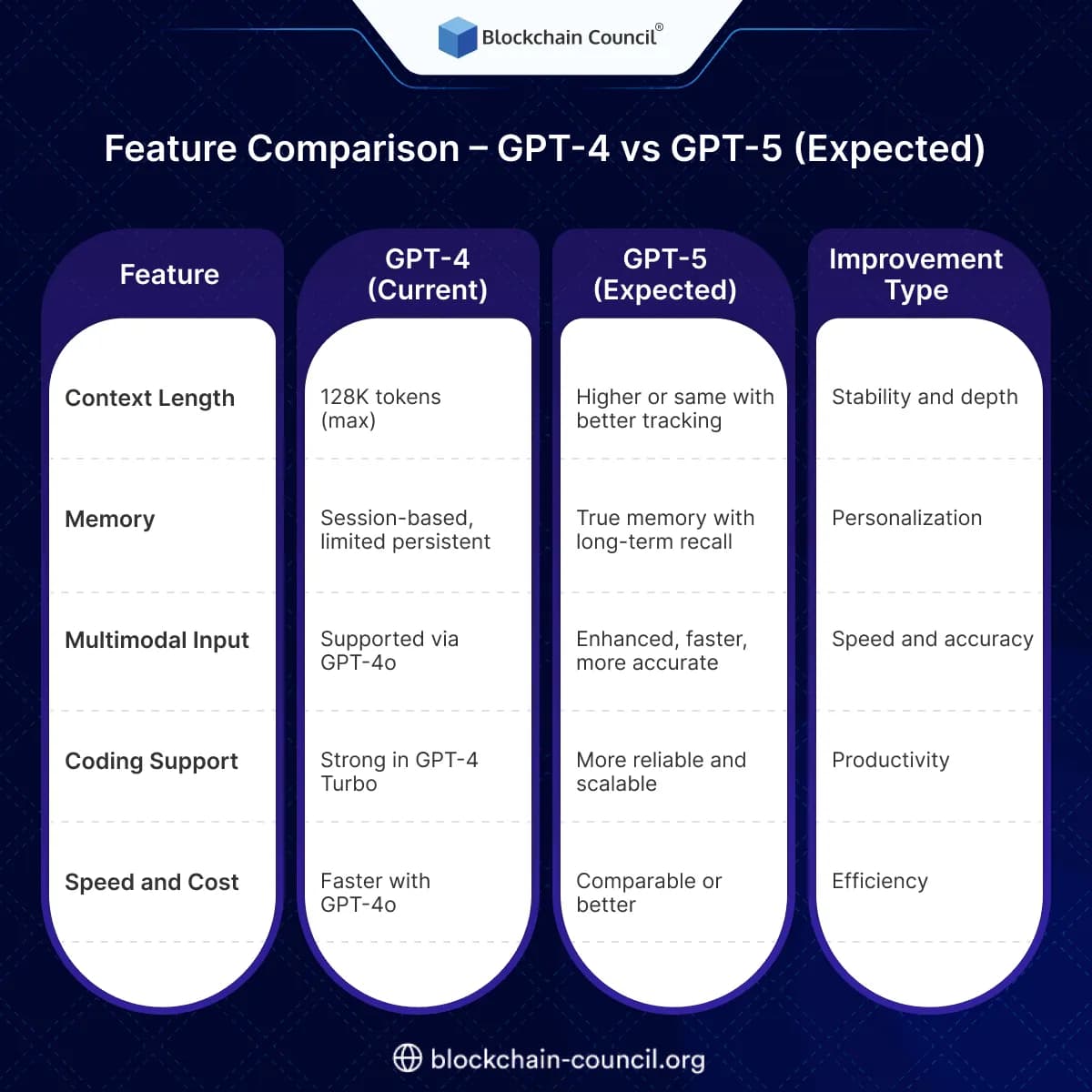
- Longer Context Window
GPT-5 is expected to handle longer conversations or documents without losing track of the topic. - Persistent Memory
Unlike GPT-4, which forgets most interactions, GPT-5 may allow users to store information over time and build long-term workflows. - Improved Coding Abilities
The new model is likely to be stronger in debugging, writing functions, and maintaining large codebases. - Faster Inference Times
GPT-5 may match GPT-4o in speed while offering deeper reasoning. - Stronger Multimodal Integration
It is expected to improve how the model handles text, images, audio, and possibly video in real time.
Feature Comparison – GPT-4 vs GPT-5 (Expected)
What Will GPT-5 Be Used For?
The range of applications is broad. GPT-5 will likely power more advanced AI agents, enterprise tools, research workflows, and creative applications. If it ships with reliable memory, users could build full assistants that manage projects, follow instructions over time, and support long-term learning.
Some common use cases may include:
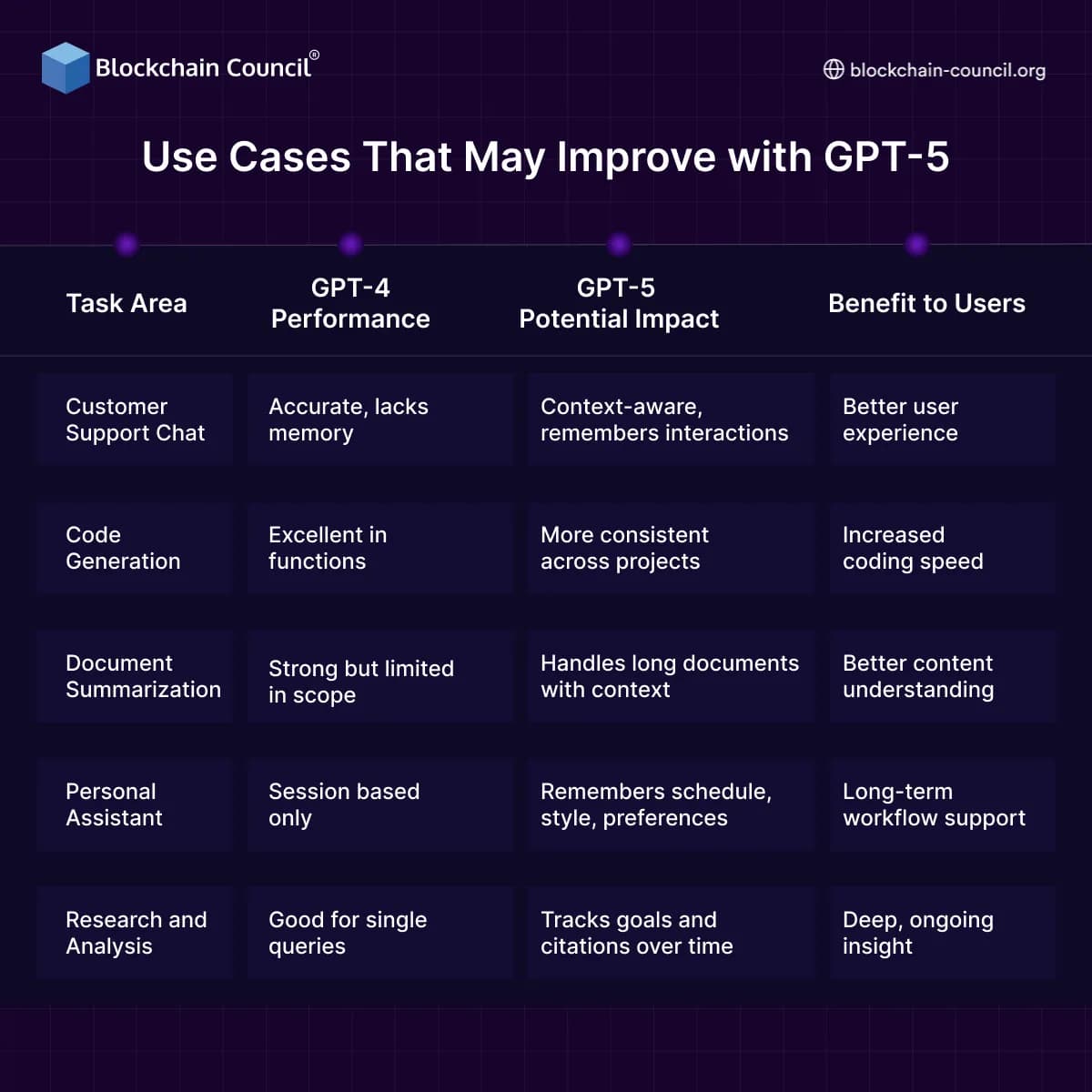
- Building long-term assistants for business or education
- More reliable AI coders
- Content generation at scale with context-awareness
- AI tutors with memory of prior lessons
- Research agents that track goals across sessions
What Developers Should Expect
If you’re a developer using OpenAI’s API, GPT-5 will likely come with new rate limits, endpoints, or pricing tiers. You may also get access to memory APIs or agents that persist across calls.
The launch of GPT-5 is also expected to inspire a wave of new tools and workflows, just like GPT-4 did in early 2023. This is a great time to get skilled in prompt engineering and model fine-tuning through programs like the AI Certification.
If you want to build full pipelines with GPT-5 and data-backed systems, the Data Science Certification is a smart next step. For those working on customer-facing tools or business automation, the Marketing and Business Certification offers cross-functional training.
Use Cases That May Improve with GPT-5
Should You Wait for GPT-5?
If you’re currently using GPT-4 or GPT-4o, there’s no need to pause your work. Those models are still highly capable. But GPT-5 will offer real advantages if you need long conversations, deeper task memory, or more accurate decision-making.
This is especially important for teams building AI agents,, managing multiple customer journeys, or automating technical workflows.
Final Takeaway
GPT-5 is shaping up to be OpenAI’s most advanced model yet. It promises not only better answers but a smarter way to work with AI long term. With memory, speed, and reasoning all improving, GPT-5 could unlock more autonomous agents, powerful business tools, and true AI assistants.
If you’re serious about staying ahead in AI, now is the time to prepare. The skills you build today will be even more valuable once GPT-5 goes live.
Related Articles
View All
AI & ML
Explainable AI for Security: Detecting Attacks, Bias, and Model Drift with Interpretability
Explainable AI for security makes threat detection auditable and trustworthy, helping teams reduce false positives, uncover bias, and detect model drift in SOC and Zero Trust workflows.

AI & ML
Security Metrics for AI: Measuring Robustness, Privacy Leakage, and Attack Surface Over Time
Learn practical security metrics for AI to track robustness, privacy leakage, and attack surface over time using OWASP, MITRE, CI/CD testing, and runtime monitoring.

AI & ML
Ethical Hacking for AI Systems: Step-by-Step Pen-Testing for ML and LLM Apps
Learn a step-by-step ethical hacking methodology for AI systems, including pen-testing ML pipelines and LLM apps for prompt injection, RAG leaks, and tool abuse.
Trending Articles

The Role of Blockchain in Ethical AI Development
How blockchain technology is being used to promote transparency and accountability in artificial intelligence systems.

AWS Career Roadmap
A step-by-step guide to building a successful career in Amazon Web Services cloud computing.

Top 5 DeFi Platforms
Explore the leading decentralized finance platforms and what makes each one unique in the evolving DeFi landscape.