

AI Threat Detection in SOCs: Using ML for Anomaly Detection Without Creating New Risks
 Suyash Raizada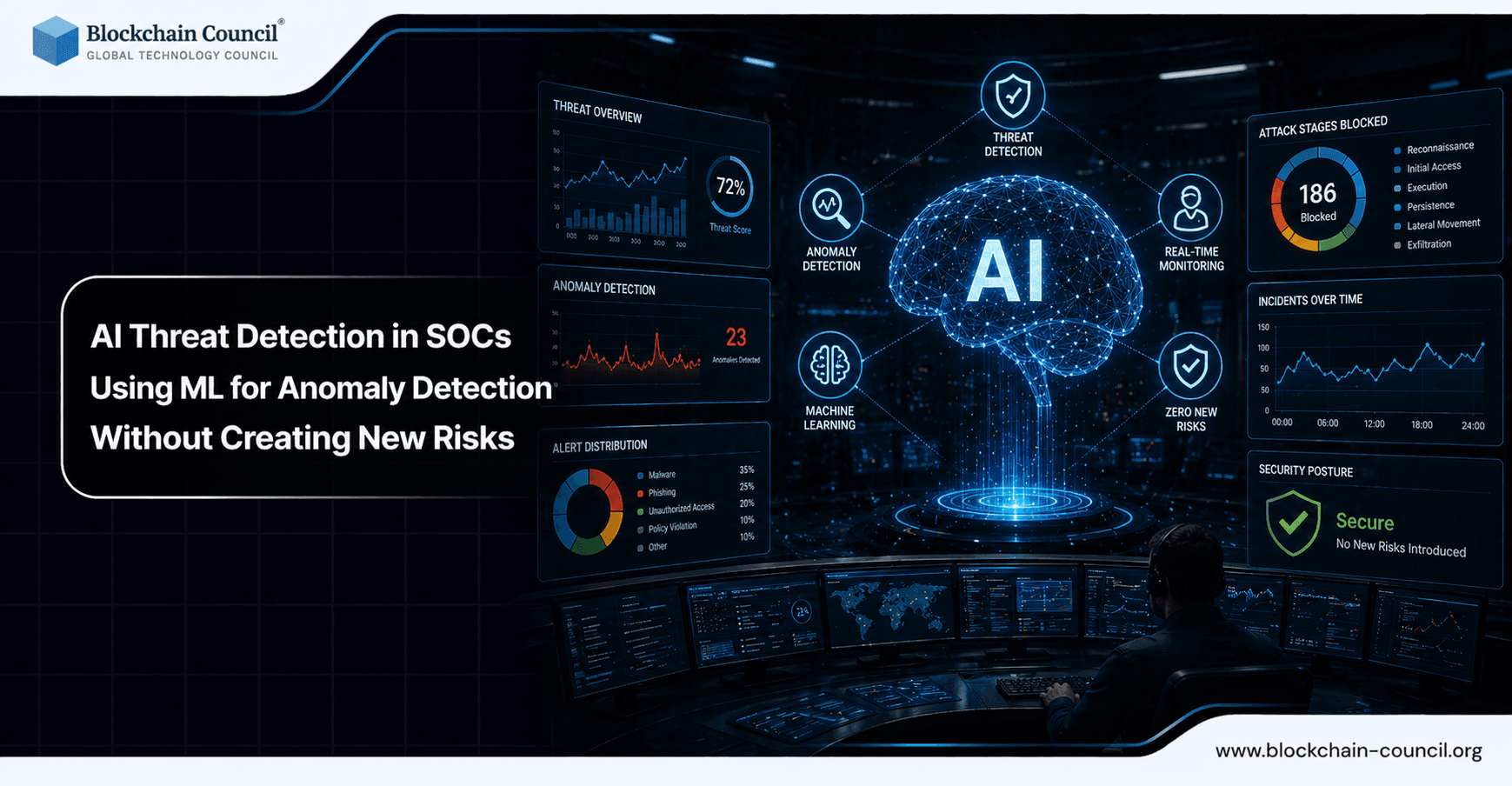
AI threat detection in SOCs is increasingly centered on machine learning (ML) based anomaly detection. Instead of relying only on predefined signatures or static rules, ML models build behavioral baselines across users, endpoints, networks, identities, and cloud workloads, then flag deviations that may indicate unknown attacks such as zero-day exploits or living-off-the-land activity. This shift can improve SOC speed and accuracy, but it also introduces new operational and security risks if models, thresholds, and workflows are not governed carefully.
Why AI Threat Detection in SOCs Is Moving Beyond Signatures
Traditional SOC detection stacks have been dominated by signature and rule-based logic. That approach works well for known threats, but it struggles with:

Zero-day techniques that do not match existing indicators
Fast-changing cloud and identity environments where normal behavior changes frequently
Alert overload caused by broad rules that generate high volumes of low-context events
ML-powered anomaly detection addresses these gaps by learning what normal looks like, then identifying suspicious changes in behavior. In modern SOC operations, this behavior-based approach is often paired with correlation across telemetry sources such as EDR, NDR, IAM, and cloud logs to improve confidence and reduce noise.
How ML Anomaly Detection Works in a SOC
At a high level, machine learning for anomaly detection follows a baseline-to-deviation pipeline:
Data ingestion and normalization across endpoint, network, identity, and cloud sources
Baseline creation for typical behavior per user, device, application, subnet, role, or workload
Anomaly scoring to measure how far an event deviates from baseline
Contextual correlation to connect anomalies across domains into incidents
Analyst feedback loop to continuously tune thresholds and reduce recurring false positives
Unsupervised ML and Why It Matters for Unknown Threats
Many SOC anomaly detection systems rely on unsupervised ML, which does not require labeled attack data. This is valuable when detecting emerging tactics that lack historical signatures. Instead of matching known indicators, the model flags changes such as unusual authentication paths, unexpected data flows, or abnormal process activity.
Dynamic Baselining and Continuous Learning
Modern environments are not static. Dynamic baselining helps models adapt as organizations onboard new SaaS tools, migrate workloads, or change access patterns. Some SOC programs also incorporate generative AI capabilities to refine baselines and summarize anomaly context for faster triage, but these features should be treated as assistive rather than authoritative.
Legacy Detection vs. ML Anomaly Detection: Operational Impact
Behavior-based detection changes both detection quality and SOC workflow. Compared to legacy methods, ML-based systems are designed to be more adaptive and to automate parts of triage:
Method: rule-based signatures vs. behavior-based self-learning models
False positives: typically higher in legacy systems vs. lower through dynamic baselining and tuning
Adaptability: static rules vs. continuous learning from new data
Response speed: manual triage vs. automated prioritization and enrichment
Platforms marketed as self-learning AI engines aim to detect deviations across silos and reduce tool sprawl by correlating multiple sources into a unified view. In practice, outcomes depend heavily on telemetry quality, configuration discipline, and feedback loops.
What the Data Suggests: Measurable SOC Improvements
When implemented well, AI and ML can improve SOC performance by reducing alert volume and accelerating detection and response. Organizations using ML-driven platforms have reported outcomes including:
Faster threat detection: reported up to 90% improvement
Reduced alert volume: reported up to 80% reduction
Lower MTTR: reported up to 70% decrease in mean time to respond
Higher SOC productivity: reported up to 60% improvement
These gains are typically attributed to unified visibility, contextual correlation, and fewer false alarms, which reduces analyst fatigue and enables teams to focus on higher-risk investigations. Results will vary based on implementation quality and environment complexity.
Real-World Use Cases of AI Threat Detection in SOCs
1. Multi-Vector Attack Detection Through Cross-Domain Correlation
Self-learning analytics can connect low-signal events into a coherent incident - for example, a suspicious login followed by unusual endpoint activity and then anomalous outbound network traffic. The value is not simply detecting a single anomaly, but correlating anomalies into a narrative that supports faster, more accurate triage.
2. Zero-Day and Living-Off-the-Land Detection
Network and log-focused tools can flag unexpected spikes in traffic, anomalous data access, or unusual authentication patterns. These techniques are useful for identifying attacks that blend into legitimate tooling and do not trigger signature-based alerts.
3. OT/ICS Anomaly Detection for Operational Resilience
In operational technology and industrial control systems, ML can baseline device metrics and protocol communications to spot deviations such as unexpected command sequences, unusual east-west traffic, or abnormal device performance. OT environments benefit particularly from this approach because many industrial systems have stable, repeatable patterns. Even so, human review remains necessary for high-impact decisions given the potential consequences of false positives in these environments.
4. AI-Native SOC Operations: Triage Automation and Attack-Path Prediction
AI-native SOC designs incorporate behavioral analytics, incident enrichment, and automated triage to reduce noise. Some approaches also attempt attack-path prediction by analyzing how an intruder might move laterally based on current identity permissions, endpoint posture, and network access.
How to Use ML for Anomaly Detection Without Creating New Risks
The central challenge is that ML can fail in ways that differ from legacy systems. Risk management must be part of the SOC design from the outset, not an afterthought.
Risk 1: Alert Fatigue from Poor Sensitivity Tuning
If thresholds are too sensitive, the SOC may be flooded with anomalies that are not actionable. This defeats the purpose of AI-assisted detection and contributes to analyst burnout.
Mitigations:
Calibrate thresholds by asset criticality - domain controllers, payment systems, production OT, and privileged identities warrant tighter thresholds
Use risk scoring and prioritization so only high-confidence anomalies trigger responders
Require contextual correlation before escalation, combining identity, endpoint, and network evidence
Risk 2: False Negatives from Over-Tuning or Coverage Gaps
Aggressive tuning to reduce noise can also suppress subtle attack signals. Model performance can degrade when environment behavior shifts significantly, such as during mergers, remote work transitions, or new SaaS adoption.
Mitigations:
Continuous retraining with analyst feedback to keep baselines aligned with the current environment
Baseline profiles informed by vulnerability and exposure context so anomalies on high-risk systems receive additional weight
Coverage validation to confirm that critical telemetry sources are present and normalized
Risk 3: Over-Reliance on AI for Decision-Making
AI should support analysts rather than replace them. Automated outputs can be wrong, incomplete, or misinterpreted without adequate operational context.
Mitigations:
Human-in-the-loop governance for containment actions such as account disablement or network isolation
Clear escalation policies defining what AI can auto-close, what requires analyst review, and what triggers formal incident response
Playbooks that document rationale for why a detection is trusted and how it is verified before action is taken
Risk 4: Data Quality and Model Poisoning Concerns
Anomaly detection is only as reliable as its inputs. Incomplete logs, inconsistent timestamps, or poorly labeled assets can distort baselines. Sophisticated attackers may also attempt to gradually manipulate what the model considers normal behavior over time.
Mitigations:
Strong data hygiene with normalization, deduplication, and time synchronization across all sources
Baseline lock and drift monitoring so large or rapid baseline shifts are flagged for review
Segmentation of training data for high-risk domains to limit the impact of manipulated telemetry
Implementation Checklist for SOC Teams
Start with a clear detection scope: identity anomalies, endpoint behavior, network exfiltration, or cloud misbehavior
Define normal by role and asset criticality, not only global averages
Establish feedback operations: analyst dispositions should inform tuning and retraining
Measure outcomes: alert reduction, MTTR, detection latency, and false positive rate by category
Document model and alert governance: who can tune thresholds, what changes require approval, and how drift is handled
For professionals building competence in these areas, Blockchain Council offers training in both AI and security operations. Relevant programs include the Certified Artificial Intelligence (AI) Expert, Certified Machine Learning Expert, Certified Cybersecurity Expert, and SOC-oriented training tracks.
Future Outlook: Toward Proactive, Baseline-Driven Defense
ML anomaly detection is pushing SOCs toward proactive defense, where baseline deviation becomes an early warning signal rather than a last resort. As environments become more hybrid and identity-centric, the ability to correlate behavior across endpoints, networks, cloud infrastructure, and IAM will remain central to effective detection. Generative AI is expected to improve how baselines are refined and how analysts consume context during triage, but resilient SOCs will keep humans responsible for high-impact decisions and ensure models are continuously validated against real-world outcomes.
Conclusion
AI threat detection in SOCs using ML-based anomaly detection can materially reduce noise, improve detection speed, and help identify unknown threats that signature-based approaches miss. The same systems can also introduce new risks, including alert fatigue, false negatives, and over-reliance on automated judgments. The most effective path is a governed, hybrid approach: high-quality telemetry, dynamic baselining with drift controls, correlation-driven prioritization, and human oversight for consequential actions. Implemented with these safeguards, anomaly detection becomes a practical foundation for modern, adaptive SOC operations.
FAQs
1. What is AI threat detection in SOCs?
AI threat detection in Security Operations Centers (SOCs) uses machine learning to identify suspicious activity. It analyzes logs, network traffic, and user behavior. This helps detect threats faster than manual methods.
2. How does machine learning improve threat detection?
Machine learning identifies patterns and anomalies in large datasets. It can detect unusual behavior that traditional rules may miss. This improves detection accuracy and speed.
3. What is anomaly detection in cybersecurity?
Anomaly detection identifies deviations from normal system behavior. These deviations may indicate potential threats or attacks. AI models learn baseline behavior and flag unusual activity.
4. Why is AI used in SOC environments?
SOCs handle large volumes of security data. AI helps automate analysis and reduce manual workload. This allows faster response to potential threats.
5. What types of threats can AI detect in SOCs?
AI can detect malware, insider threats, phishing, and network intrusions. It identifies patterns associated with malicious activity. This supports comprehensive threat monitoring.
6. What are the risks of using AI in threat detection?
Risks include false positives, model bias, and vulnerability to adversarial attacks. Poorly designed models can create new security gaps. Proper controls are necessary.
7. How can AI create new risks in SOCs?
AI systems can be manipulated through data poisoning or evasion attacks. They may also misclassify threats. Over-reliance on AI can reduce human oversight.
8. How do you reduce false positives in AI detection systems?
Use high-quality data, tune models carefully, and apply feedback loops. Combining AI with rule-based systems can improve accuracy. Continuous monitoring helps refine performance.
9. What is the role of human analysts in AI-driven SOCs?
Human analysts validate AI-generated alerts and investigate incidents. They provide context and decision-making. This ensures balanced and accurate threat response.
10. How does AI handle large-scale security data?
AI processes and analyzes large datasets in real time. It identifies patterns and correlations across multiple sources. This improves efficiency and visibility.
11. What are common ML models used in SOCs?
Common models include clustering, classification, and anomaly detection algorithms. These models analyze behavior and detect threats. Selection depends on use case and data.
12. How can organizations secure AI-based SOC systems?
Implement input validation, monitoring, and access controls. Regular testing and updates are essential. Secure design reduces vulnerabilities.
13. What is model drift in AI threat detection?
Model drift occurs when system behavior changes over time. This can reduce detection accuracy. Monitoring and retraining help maintain performance.
14. How do feedback loops improve AI threat detection?
Feedback loops use analyst input to refine model predictions. This improves accuracy over time. Continuous learning enhances system effectiveness.
15. Can AI replace human analysts in SOCs?
No, AI supports but does not replace human expertise. Analysts are needed for decision-making and complex investigations. Collaboration improves outcomes.
16. What is explainable AI in SOC environments?
Explainable AI provides insights into why a model flagged a threat. It helps analysts understand and trust AI decisions. This improves investigation efficiency.
17. How does AI support incident response in SOCs?
AI prioritizes alerts and provides context for incidents. This speeds up response times. It helps teams focus on critical threats.
18. What tools are used for AI threat detection in SOCs?
Tools include SIEM platforms, XDR systems, and AI analytics tools. These tools integrate data and automate detection. Selection depends on organizational needs.
19. What are best practices for using AI in SOCs?
Use high-quality data, combine AI with human oversight, and monitor performance. Regular testing and updates are essential. Balanced implementation reduces risks.
20. What is the future of AI in SOC threat detection?
AI will become more advanced and integrated into security workflows. It will improve detection accuracy and automation. However, managing risks will remain critical.
Related Articles
View All
AI & ML
OpenAI Launches GPT-6.1 Terra: What’s New?
OpenAI has launched GPT-6.1 Terra, a faster and cheaper mid-tier model with stronger computer use, better image understanding and fewer errors. See what is new, what it costs, and who can use it.

AI & ML
Meta Launches Muse Wonder: Its New AI Model Explained
Meta has launched Muse Wonder and Muse Wonder Full, new AI models built for personal and professional agents. Learn the features, pricing, access options and how they compare with rivals.

AI & ML
Google Playground: Create AI Games Without Coding
Learn what Google Playground is, how it uses generative AI to turn text prompts into browser games, how to create your first game, what it costs, how it compares with other no-code tools, and what limits to expect.
Trending Articles
How Blockchain Secures AI Data
Understand how blockchain technology is being applied to protect the integrity and security of AI training data.

Can DeFi 2.0 Bridge the Gap Between Traditional and Decentralized Finance?
The next generation of DeFi protocols aims to connect traditional banking with decentralized finance ecosystems.
How to Install Claude Code
Learn how to install Claude Code on macOS, Linux, and Windows using the native installer, plus verification, authentication, and troubleshooting tips.