

OpenAI Partner Network: What It Means for Enterprise AI Adoption

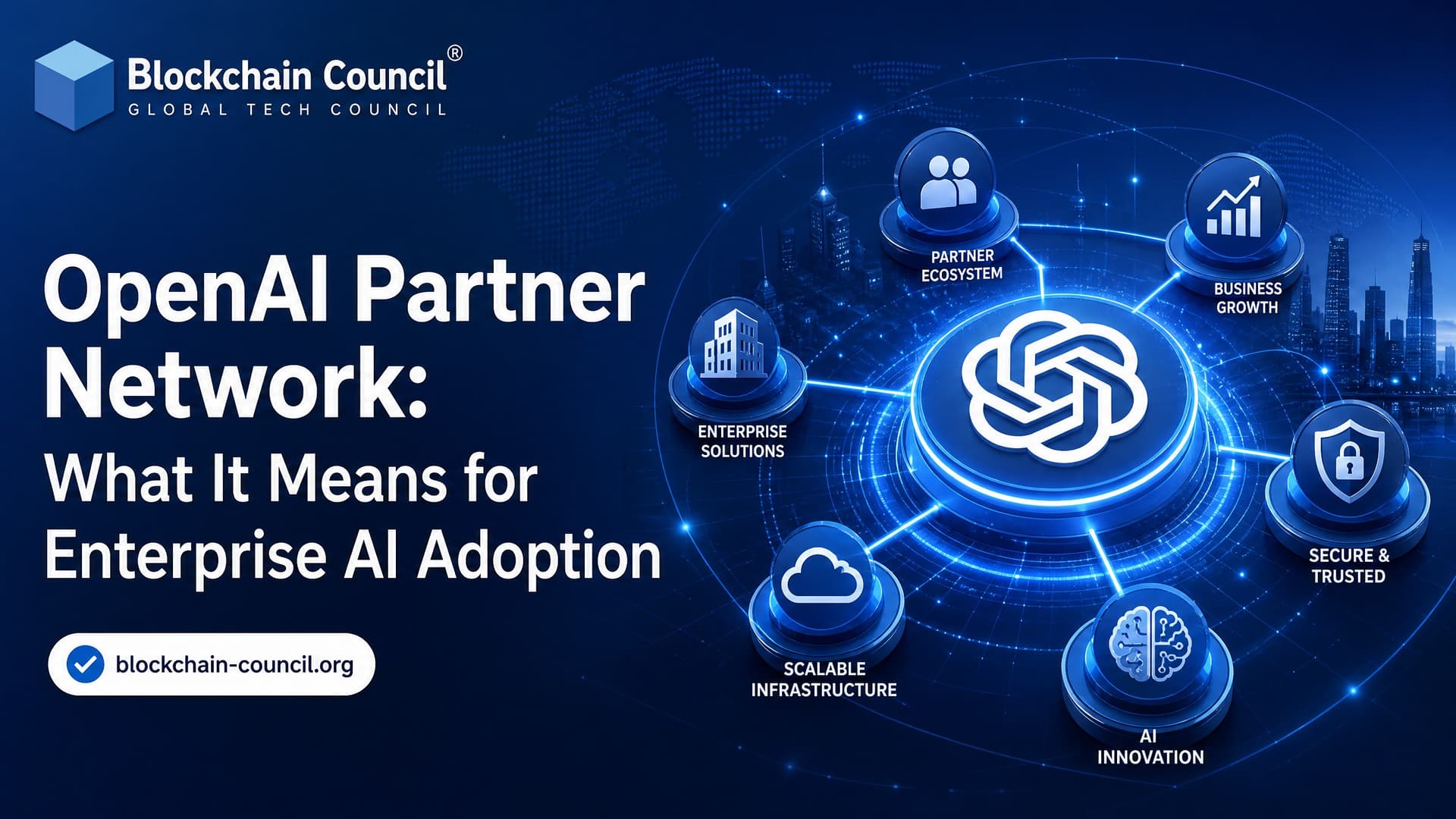
The OpenAI Partner Network is OpenAI's first formal global partner program, built to help organizations build, sell, deploy, and scale AI solutions using OpenAI technologies. It comes with a reported investment aimed at speeding up enterprise AI adoption through qualified partners.
That matters because most AI projects do not fail at the demo stage. They fail when teams try to connect models to real data, security controls, legacy systems, approval flows, and impatient business users. The OpenAI Partner Network is OpenAI's answer to that delivery gap.

What Is the OpenAI Partner Network?
The OpenAI Partner Network is a structured global program for companies that help customers adopt, deploy, and grow with OpenAI products. OpenAI's public positioning points to a broad partner base: system integrators, consulting firms, independent software vendors, managed service providers, infrastructure companies, and domain specialists.
OpenAI already had many partnerships across technology, content, data, and distribution before this. The difference now is structure. A formal partner network gives OpenAI and its partners a clearer path for co-selling, solution development, implementation support, and enterprise deployment.
In plain terms, this is not just about giving partners API access. It is about helping businesses move from "we built a chatbot in a hackathon" to "we deployed an AI assistant that works inside our service desk, follows access rules, logs decisions, and can be audited."
Why OpenAI Launched a Partner Program Now
The timing is not accidental. Enterprises have spent the last few years experimenting with generative AI, but many are stuck between pilot and production. The models are better than they were in 2023. The harder problem is absorption.
That absorption gap is the real bottleneck in AI adoption, and it matches what implementation teams see on the ground. The work is rarely just prompt writing. It is data mapping, identity management, workflow redesign, policy review, monitoring, user training, and cost control.
The reported funding behind the OpenAI Partner Network signals that OpenAI wants partners to build repeatable service practices, packaged solutions, and industry-specific offerings. That is similar to how cloud platforms matured. AWS, Microsoft Azure, and Google Cloud all became enterprise standards partly because partners made them usable inside messy organizations.
How the OpenAI Partner Network Is Expected to Work
OpenAI has not yet published every operational detail, partner tier, or regional roster. Still, the public materials and related announcements make the direction clear.
Build AI Solutions on OpenAI Models
Partners can create applications, agents, and workflow tools using OpenAI models. These may include customer support assistants, internal knowledge copilots, document analysis tools, sales enablement systems, compliance review helpers, and operational automation.
This is where independent software vendors and product companies fit naturally. A SaaS vendor might embed OpenAI-powered summarization into its CRM. A legal technology provider could build contract review workflows with human approval steps.
Sell With OpenAI
The program is expected to support co-selling. In enterprise software, co-selling is often the difference between a good product and a closed deal. Large customers want architecture guidance, procurement clarity, security answers, pricing support, and confidence that the vendor ecosystem will stay intact.
For partners, this could mean better alignment with OpenAI field teams. For customers, it should mean easier discovery of qualified firms that understand OpenAI's products and enterprise deployment requirements.
Deliver Production Deployments
This is the most important part. The OpenAI Partner Network appears focused on implementation, not theory. Partners are expected to help organizations deploy OpenAI-based systems into production environments.
A small practitioner detail: when teams move from prototype to production, the model is rarely the first thing that breaks. Rate limits, permissions, and schema validation usually show up first. Anyone who has shipped against AI APIs has seen errors like 429 rate_limit_exceeded during load testing, or watched a JSON parser fail because the model returned a helpful sentence before the object. Good partners design retries, fallbacks, logging, evals, and guardrails before executives see the demo.
OpenAI Partner Network and Frontier Alliance Partners
The OpenAI Partner Network also sits beside OpenAI's Frontier Alliance Partners initiative, which focuses on secure, scalable AI agent deployments for enterprises. That distinction is worth watching.
Partner Network looks broad. Frontier Alliance Partners appears more specialized, especially for agentic systems that perform multi-step tasks across enterprise tools. Think support agents that query a knowledge base, check order status, draft a response, and escalate edge cases. Useful, yes. Risky if done badly.
To be blunt, many so-called AI agents are overbuilt workflow scripts with a language model attached. That is not always wrong. Sometimes a deterministic workflow plus one model call is safer and cheaper than a fully autonomous agent. Skilled partners should know when not to use an agent.
Who Should Care About the OpenAI Partner Network?
Enterprises
If you lead digital transformation, data, security, customer experience, or operations, the OpenAI Partner Network may become a practical sourcing channel. Instead of evaluating hundreds of AI consultants with similar slide decks, you may be able to shortlist partners with a closer working relationship with OpenAI.
Ask hard questions anyway:
- Have you deployed OpenAI models in production, not just built prototypes?
- How do you handle data retention, access control, and audit logs?
- What eval framework do you use to test model quality before release?
- Can your solution run with human approval for high-risk actions?
- How do you estimate token cost under real traffic?
Consulting Firms and System Integrators
For consulting firms and SIs, this is a clear signal. AI implementation is becoming a formal services market. Generic AI strategy work will not be enough. You will need reference architectures, security patterns, migration playbooks, model evaluation methods, and staff who can speak to both business users and engineers.
If your team wants a structured learning route, Blockchain Council's Certified Artificial Intelligence (AI) Expert™ can support broad AI fluency, while Certified Generative AI Expert™ is a better fit for teams building with generative models. For prompt-heavy roles, consider Certified Prompt Engineer™ as an internal learning path.
Developers
Developers should view the OpenAI Partner Network as a career signal. The market is moving beyond prompt snippets. Employers will value people who can connect OpenAI models to databases, vector stores, APIs, identity providers, monitoring systems, and evaluation pipelines.
Learn the boring parts. They pay. Understand token budgeting, retrieval-augmented generation, OpenAI Structured Outputs, embeddings, latency trade-offs, and failure handling. Also learn when a smaller model is good enough. Not every task needs the largest frontier model.
Real-World Use Cases the Network Could Accelerate
OpenAI's existing ecosystem gives a good preview of where the Partner Network is headed.
- Workflow automation: OpenAI integrations with platforms such as Zapier show how models can classify tickets, summarize emails, transform data, and draft responses inside everyday SaaS workflows.
- Content and media: OpenAI has built licensing and data relationships with several media organizations, supporting higher quality training data and content-grounded AI experiences.
- Enterprise knowledge assistants: Partners can help connect OpenAI models to internal documents, permissions, and search systems so employees can query company knowledge without exposing restricted data.
- Customer support agents: AI assistants can summarize cases, suggest replies, route tickets, and escalate complex issues to human agents.
- Regulated industry workflows: Finance, healthcare, insurance, and legal teams will need partners that understand governance, review trails, and compliance constraints.
Risks and Trade-Offs
The OpenAI Partner Network should help enterprise adoption, but it will not remove the need for due diligence. A partner badge does not automatically mean a solution is secure, cost-efficient, or appropriate for your use case.
Watch for three risks:
- Over-automation: Do not let agents take irreversible actions without controls. Start with recommendations and human approval.
- Weak evaluation: If a partner cannot show test sets, scoring methods, and regression checks, the project is not production-ready.
- Data confusion: Your organization must know what data is sent to the model, where logs are stored, and who can access outputs.
The best partners will be boring in the right places. They will talk about IAM, monitoring, rollback plans, data classification, and user training before they talk about flashy demos.
Future Outlook for the OpenAI Partner Network
The OpenAI Partner Network is still early, so public data on partner tiers, regional coverage, and performance metrics remains limited. But the direction is clear. Expect more specializations by industry, function, and technical capability.
Cybersecurity, CRM, ERP, data platforms, contact centers, software development, and regulated workflows are likely areas for partner growth. Governance will also become a bigger differentiator. Enterprises want AI systems that are useful, but they also need policy controls, auditability, and predictable cost.
For professionals, the opportunity is straightforward: become the person who can turn AI capability into working systems. Start by strengthening your AI foundations, then build one production-style project with retrieval, access control, logging, and evaluation. If you need a formal path, explore Blockchain Council's Certified Generative AI Expert™ or Certified Artificial Intelligence (AI) Expert™ and use the coursework to frame a real implementation plan.
Related Articles
View All
AI & ML
GLM 5.2 for Enterprise AI: Benefits, Limits, Security, and Adoption
GLM 5.2 gives enterprises long-context reasoning, strong coding, and self-hosting control, but it demands careful security, governance, and infrastructure planning.

AI & ML
OpenAI invests $150 million in AI deployment training for 300,000 consultants: Enterprise impact
OpenAI's $150M Partner Network aims to train 300,000 consultants by 2026, signaling a new market for enterprise AI deployment skills and governance.

AI & ML
Has OpenAI Achieved Recursive Self-Improvement in Its AI Models?
OpenAI has not achieved fully autonomous recursive self-improvement, but it is using AI to improve training, evaluation, red teaming, and safety workflows.
Trending Articles
AWS Career Roadmap
A step-by-step guide to building a successful career in Amazon Web Services cloud computing.
How Blockchain Secures AI Data
Understand how blockchain technology is being applied to protect the integrity and security of AI training data.
Blockchain in Supply Chain Provenance Tracking
Supply chains are under pressure to prove not just efficiency, but also authenticity, sustainability, and fairness. Customers want to know if their coffee really is fair trade, if the diamonds are con