Multi Agent Simulations

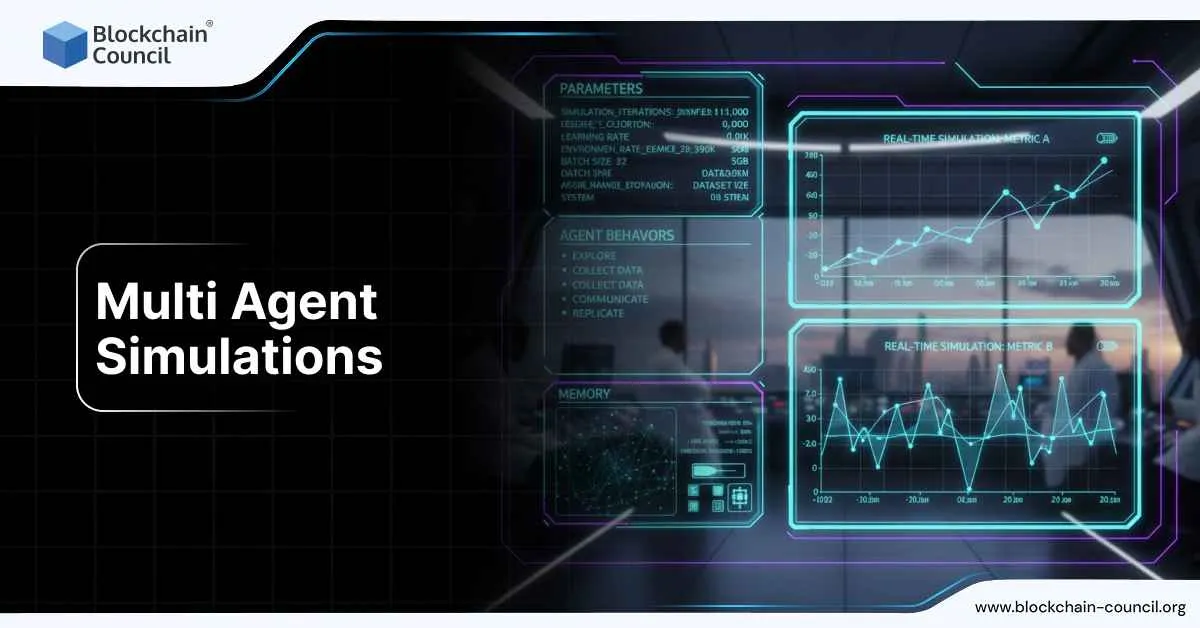
Multi agent simulations sit at the point where artificial intelligence stops being a single model answering a prompt and becomes a system of many autonomous entities interacting with each other and a shared environment. By 2024 and 2025, these simulations moved from academic curiosity into serious use across research labs, enterprise product teams, cybersecurity units, and policy analysis groups. What changed was not just model quality, but how agents were structured, coordinated, and evaluated over time.
Instead of asking one model to predict outcomes, multi agent simulations allow dozens, hundreds, or even thousands of agents to make decisions simultaneously. The value comes from what emerges from those interactions, including cooperation, competition, failure cascades, and unexpected norms.

At the center of this shift is applied artificial intelligence that can reason, plan, remember, and act in context. Understanding how such systems behave requires more than prompt engineering, which is why many professionals grounding themselves in this field start with structured learning paths such as an AI certification that explains how modern intelligent systems are designed end to end.
How Multi Agent Simulations Actually Work
A modern multi agent simulation is built around a repeating loop rather than a single inference call. Each cycle typically includes:
- A shared world state that tracks time, resources, rules, and constraints
- Individual agent states that include goals, memory, and permissions
- Perception, where each agent receives a partial view of the world
- Decision-making, where the agent selects an action
- Environment updates based on all agents’ actions
- Logging and evaluation of outcomes
This loop can run for hundreds or millions of steps depending on the purpose of the simulation. The key difference from older rule-based agent models is that LLM-powered agents can generate plans, negotiate in natural language, and adapt behavior across iterations.
The Research That Triggered the Modern Wave
One of the most cited milestones came from Stanford and Google researchers in April 2023, when they published work on “generative agents” simulating a small town of 25 autonomous characters. Each agent had memory, reflection, and planning mechanisms, leading to believable social behaviors like scheduling meetings and sharing news.
That architecture became a reference point, but it was only the beginning. By 2024, researchers started asking harder questions. Could these systems be evaluated rigorously? Could they scale beyond toy environments? Could they fail safely?
In 2025, multiple papers focused on failure modes in multi agent LLM systems, documenting coordination breakdowns, error amplification, and feedback loops where one agent’s mistake propagates across the group. These findings shifted attention from novelty to robustness.
From Talking Agents to Acting Agents
A major transition happened when agents stopped just talking and started acting through tools. Frameworks like Microsoft’s AutoGen, formalized in research released on 1 August 2024, treated multi agent conversation as a programmable system where agents could call APIs, query databases, and execute tasks collaboratively.
At the same time, companies began using agent groups internally for research synthesis, code analysis, and incident response. Anthropic described its own multi agent research setup in June 2025, explaining how multiple Claude instances explored complex questions in parallel and then reconciled findings.
This marked a shift. Multi agent simulations were no longer just social experiments. They became operational systems.
Where Multi Agent Simulations Are Used Today
By late 2025, multi agent simulations were being used in several concrete domains:
- Product testing: Simulated users interact with onboarding flows, pricing pages, and support systems to surface friction before launch
- Cybersecurity: Attacker and defender agents simulate phishing, intrusion, and response strategies in controlled environments
- Policy and social research: Agent populations simulate survey responses, opinion shifts, and behavioral reactions to policy changes
- Robotics and embodied AI: Agents interact in simulated physical environments, such as DeepMind’s SIMA project, which expanded capabilities again in November 2025
In one notable example, Stanford researchers demonstrated simulations involving over 1,000 agents, each seeded with interview data, to study how opinions might shift under different information conditions. This scale was unthinkable just a few years earlier.
The Hidden Engineering Challenges
What makes multi agent simulations difficult is not model quality alone. It is coordination.
Common failure patterns documented in 2024 and 2025 include:
- Agents duplicating work endlessly
- Over-trusting other agents’ outputs without verification
- Circular task dependencies that never resolve
- Error cascades where one flawed assumption spreads
Because of this, modern systems enforce strict boundaries. Agents have limited context, explicit roles, and permissioned tool access. Many workflows insert human approval points before high-risk actions.
Designing these systems requires deep understanding of orchestration, state management, and observability. That is why teams building multi agent platforms often rely on strong technical foundations such as those covered in a Tech Certification, especially when simulations move from research into production environments.
Evaluation and Trust
One of the hardest problems in multi agent simulations is evaluation. It is easy to generate interesting behavior. It is hard to prove that behavior maps to reality.
By 2025, best practice involved:
- Running simulations multiple times to check stability
- Comparing outputs against real-world benchmarks where possible
- Logging every decision and tool call for auditability
- Stress-testing agents with adversarial scenarios
Without this discipline, simulations risk becoming storytelling engines rather than decision tools.
Why Businesses Care Now
Multi agent simulations matter because they change how organizations explore uncertainty. Instead of guessing how users, attackers, or markets might behave, teams can simulate many possible futures and study patterns.
For businesses, this impacts:
- Product design decisions
- Risk assessment and mitigation
- Market entry strategies
- Crisis response planning
However, simulation output is only valuable if it feeds into real decisions. Translating emergent behavior into strategy requires alignment between technical teams and business leadership. That alignment is often shaped by frameworks similar to those taught in a Marketing and Business Certification, where insights are evaluated in terms of customer impact, cost, and long-term value.
Conclusion
Multi agent simulations represent a shift from static prediction to dynamic exploration. They do not tell you what will happen. They show you what could happen under different assumptions and constraints.
As of December 2025, they remain powerful but imperfect tools. Their value lies in revealing interactions, failure modes, and emergent behavior that single-model systems cannot capture. Used carefully, they offer a way to reason about complex systems that are otherwise impossible to test in the real world.