

Google UCP (Universal Commerce Protocol)

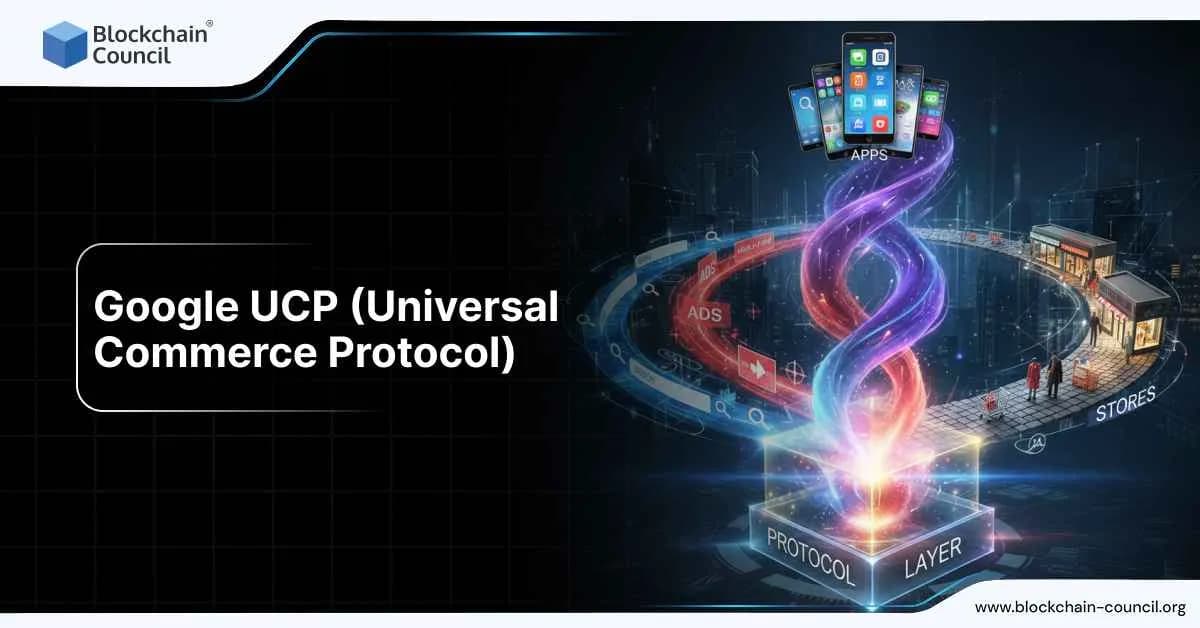
Google has introduced Universal Commerce Protocol (UCP), a new open standard designed to let AI systems and commerce platforms transact seamlessly across discovery, checkout, and post-purchase flows. The move is aimed at turning AI conversations inside Google products into instant, secure purchases without forcing merchants to build custom integrations for every AI agent or platform.
As AI systems move from answering questions to completing transactions, understanding how agent-driven commerce works is becoming a core skill. This is why many professionals first build a foundation through an AI Certification before working with AI-native commerce systems.

What Google UCP Is
Universal Commerce Protocol is an open, vendor-agnostic standard created to let AI agents and merchant systems speak a common language. According to Google, UCP enables AI experiences to move directly from product discovery to checkout and post-purchase actions inside conversational interfaces.
Google has built the first reference implementation and is using it inside its own AI products to enable direct buying.
Why Google Built UCP
Agent-based shopping breaks when every merchant needs a one-off integration for every AI interface. Google positions UCP as a way to standardize:
- Product and business information exchange
- Capability discovery between agents and merchants
- Secure checkout session creation and management
- Post-purchase handoffs like confirmations and updates
The stated goal is to reduce friction, limit cart abandonment, and make conversational commerce reliable at scale.
Where UCP Shows Up in Google Products
Google is embedding UCP directly into its conversational surfaces:
- AI Mode in Search
- The Gemini app
- Broader conversational commerce experiences
Coverage around the launch highlights buy buttons appearing inside Gemini and AI Search, with UCP acting as the underlying protocol that makes those transactions possible.
Who Is Backing UCP
Google is positioning UCP as an industry standard rather than a closed Google system. Early ecosystem support includes major commerce platforms and payment networks.
Retail and commerce platforms named in coverage include Shopify, Walmart, Target, Wayfair, and Etsy.
Payment and network support mentioned includes Visa, Mastercard, and PayPal.
Shopify has publicly stated that it co-developed UCP with Google and frames it as an open standard that allows AI agents to connect and transact with merchants without locking them into a single platform.
Where the UCP Specification Lives
UCP is published openly, with documentation and specifications available through Google’s developer properties and on GitHub via ucp.dev. Google also provides an implementation hub with guides, FAQs, and step-by-step integration material.
This combination of public specs plus a working Google implementation is central to how Google is positioning UCP as both open and practical.
What a Real Merchant Integration Involves
Google’s documentation describes UCP as a production-ready integration, not just a concept.
Merchant prerequisites include:
- A Google Merchant Center account in good standing
- Products approved for free listings
- Proper product feeds and eligibility checks
Capability negotiation:
UCP uses a server-selects model where the merchant server and Google discover overlapping capabilities. The merchant’s business profile helps negotiate protocol versions and supported features efficiently.
Checkout integration:
Merchants can implement a native checkout flow using a REST API that Google calls to create and manage checkout sessions.
Payments:
Google Pay documentation includes a UCP overview and describes it as the data exchange layer that enables agent-driven ecommerce flows across systems.
Understanding these integration patterns usually falls under modern platform architecture and standards work, which is why they often show up in Tech Certification programs focused on real-world system design.
How Google Is Positioning UCP in the Agent Commerce Race
Recent coverage frames UCP as part of a broader competition to define how AI agents buy things on behalf of users. Unlike payment-only approaches, UCP models the entire shopping journey, from discovery through fulfillment.
Early commentary highlights three recurring themes:
- UCP covers more than payment, including product data and post-purchase flows
- Merchants retain control over checkout customization
- Standardized, richer product data becomes critical for reliable AI comparison
Why This Matters for Businesses
UCP signals a shift where conversational AI becomes a direct sales channel, not just a discovery tool. For merchants and platforms, this means preparing for AI agents as real buyers.
Adapting to this shift often requires coordination across product, engineering, and go-to-market teams, which is why organizations frequently pair technical rollout with Marketing and Business Certification initiatives when moving from experimentation to revenue-driven AI commerce.
Google’s Universal Commerce Protocol is an early attempt to set the rules of that future by standardizing how AI and commerce systems interact before fragmentation sets in.
Related Articles
View All
AI & ML
Can Gemini Improve Itself? Google AI and Recursive Self-Improvement Explained
Can Gemini improve itself? Learn why Google AI does not self-rewrite its model today, but can power controlled recursive self-improvement loops.
AI & ML
Does Google AI Demonstrate Recursive Self Improvement?
Google uses AI to optimize parts of its model training stack, but public evidence does not show fully autonomous recursive self improvement.
AI & ML
OpenAI Dots vs Grok Bot vs Muse
Compare OpenAI Dots, Grok Bot, and Meta Muse to understand how these always-on AI agents differ in persistent work, computer use, connected apps, automation, and personal or business workflows.
Trending Articles

Top 5 DeFi Platforms
Explore the leading decentralized finance platforms and what makes each one unique in the evolving DeFi landscape.
How Blockchain Secures AI Data
Understand how blockchain technology is being applied to protect the integrity and security of AI training data.

Can DeFi 2.0 Bridge the Gap Between Traditional and Decentralized Finance?
The next generation of DeFi protocols aims to connect traditional banking with decentralized finance ecosystems.